Excavator
316 models
 Backhoe Loader
54 models
 Crane
68 models
 Concrete Mixer
79 models
 Wheel Loader
65 models
 Compactor / Roller
45 models
 Motor Grader
42 models

 Concrete Pump
66 models
 Skid Steer Loader
11 models



Who sets the ceiling price for a bid? In a government works tender the department does, but there is no single ceiling price in tender rules: its engineers fix the estimated cost put to tender, which is printed in the NIT, and after the bids open the tender accepting authority works out a justified rate from market prices that the bidder never sees. Under para 20.4.3.2 of the CPWD Works Manual, a quote up to 5% over the justified rate may be ignored, up to 10% can be accepted in special circumstances with reasons on record, and anything higher should not be accepted. On GeM, the buyer’s estimated bid value only guides EMD and eligibility, the GeM system sets the reverse auction start price, and GeM’s own terms use the words “ceiling price” for one thing only: the L-1 price in a Push Button Procurement notice of up to Rs 5 lakh.
A backhoe owner bidding for a Rs 2 crore drain and road job puts it as “can I quote above the estimate?” A tipper operator on GeM asks who decides the starting figure in the auction. Both are asking the same thing, and the honest answer is that the number which decides your bid is usually not the one printed on the tender.
This piece separates those numbers, says who fixes each one and whether you can see it, and works through what happens to a bid that comes in 8% above the estimate. If you are new to the sequence of envelopes, fees and approvals, start with how to bid for government construction tenders and come back here.
Who sets the ceiling price in tender documents?
For central government works, the rules sit in two documents. The CPWD Works Manual is the pattern many state PWDs and public sector buyers follow, and the latest edition CPWD posts on its website, as read on 21 November 2026, is the 2014 manual. The Department of Expenditure’s Manual for Procurement of Works, Second Edition 2025, sets the wider rules for central ministries. Between them they name the numbers below.
| Number | Who fixes it | Bidder sees it? | What it does to a high quote |
|---|---|---|---|
| Estimated cost put to tender | Department engineers, from the schedule of rates; approved with the NIT | Yes, in the NIT | Your premium or discount is measured against it |
| Justified rate | Prepared for the tender accepting authority after bids open, from market rates | No | Decides whether a premium bid is accepted |
| GeM estimated bid value | The buyer, while creating the bid | Only if the buyer displays it | None on price; it guides EMD and eligibility |
| GeM reverse auction start price | The GeM system | Yes, when the auction opens | Every auction bid must go below it |
| GeM Push Button Procurement ceiling | The system, from the L-1 marketplace price | Yes | An offer must be below it |
The estimated cost in the NIT
Para 13.2.1 of the CPWD Works Manual 2014 says the notice inviting tenders includes the name of work, the estimated cost put to tender, the completion period and the dates. That figure comes from a detailed estimate built on the department’s schedule of rates and technically sanctioned before the NIT goes out. It is the only cost figure you get before you quote.
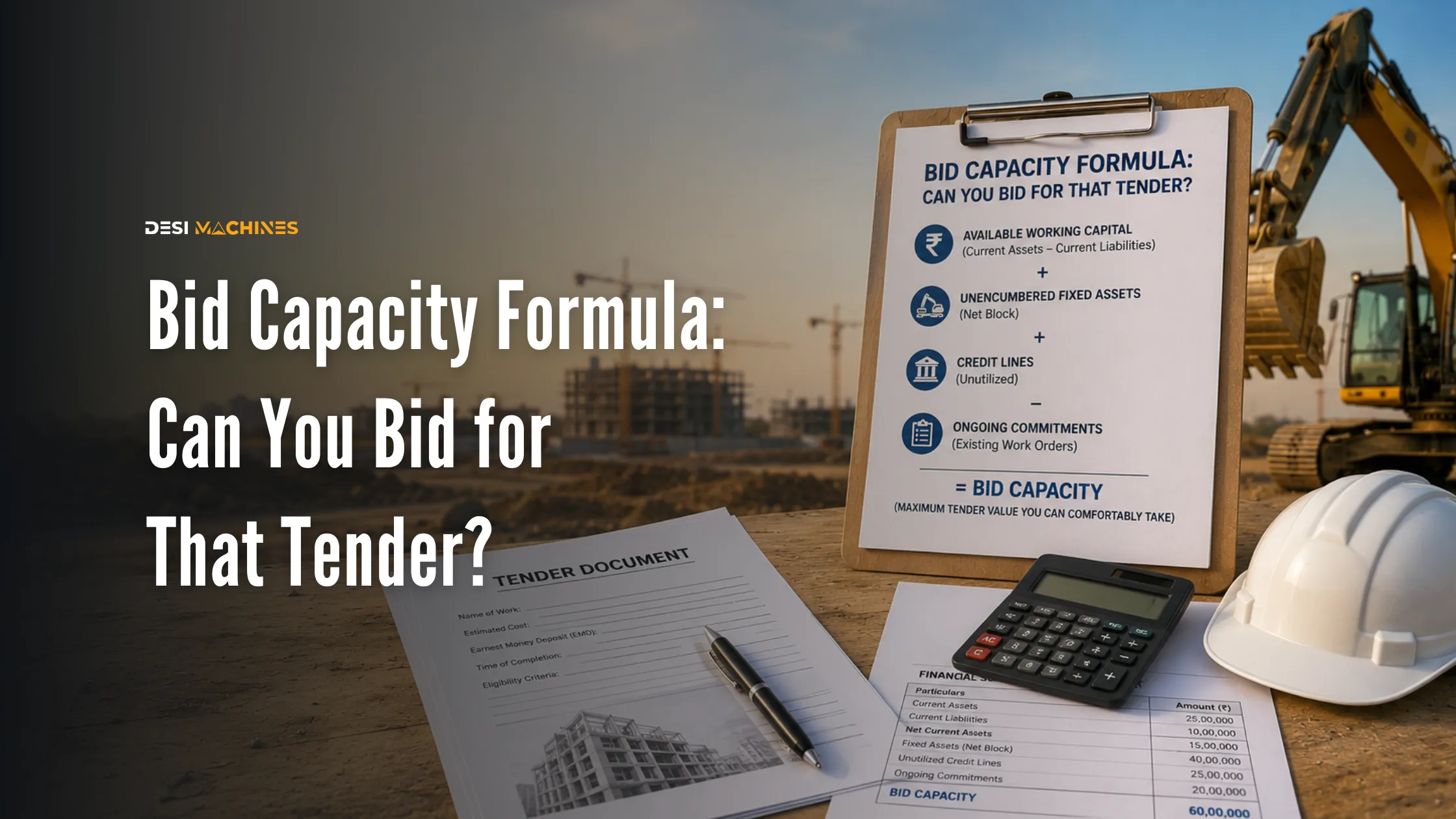
Three things hang off it. In a percentage rate tender you quote a single percentage above or below it, which the item rate versus percentage rate piece explains. Eligibility is sized from it too: the 2025 works manual measures similar-work experience as one work of 80%, two of 50% or three of 40% of the estimated cost, and your bid capacity has to clear the estimated value. And the amount above it is what contractors call the tender premium. The CPWD acceptance letter format records your accepted amount as a percentage “below/above the estimated cost”, so a bid above the estimate is a normal outcome.
A premium can slow the award, though. Para 20.4.1 of the 2014 manual says that if the tender exceeds the technically sanctioned amount by more than the sanctioning officer’s own powers, a revised technical sanction from the next higher authority is needed before acceptance. If the liability exceeds the expenditure sanction by more than 10%, a revised expenditure sanction is needed. The live tender opportunities list shows the estimated value on each card, so you can check the size before you download anything.
The justified rate decides acceptance
Para 20.4.3 of the CPWD Works Manual 2014 is the rule this whole question turns on. The tender accepting authority must satisfy itself that the rates are reasonable, “primarily” on the basis of justified rates. Para 20.4.3.1 sets out how the justified rate is worked out. Engineers prepare a detailed analysis using market rates of labour, materials and cartage, by the same method as the CPWD Analysis of Rates, for the major items that together make up at least 90% of the estimated cost. For flyovers, bridges and highways the analysis follows the MORTH standard data book.
Two details matter to a machine owner. Contractor’s profit and overheads are taken at 15% in the analysis, and the manual says the 7.5% overhead share already covers arranging tools, plant and heavy machinery not priced in the bill of quantities. So the cost of shifting your excavator to site is assumed to be inside that 15%, unless the NIT carries a special condition with a cost attached, which can be added.
Para 20.4.3.2 then gives the bands. Variation up to 5% over the justified rate may be ignored. Variation up to 10% may be allowed in peculiar situations and special circumstances, with reasons placed on record. Tenders above that “should not be accepted”.
You do not see this figure. The justification is prepared after the financial bids are opened, and para 6.2.4 of the 2025 works manual keeps evaluation information confidential until the award is notified.
What happens to a bid quoted above it
Within the bands, the tender can be accepted at your rate. Beyond them, para 20.4.7(2) of the CPWD manual says that in general there shall be no negotiation on rates with the lowest tenderer: the tender is accepted or rejected on the justification. Negotiation is allowed only with prior approval of the next higher authority for urgent work where there is no time to reject and recall, to clear up an error in an item, or when a tender rejected for high rates comes back higher again on recall.
The 2025 works manual says much the same in wider terms. Para 6.4.7 asks the tender committee to declare that the recommended rates are reasonable, and warns against blind reliance on the cost estimate in large tenders. Para 6.4.10 calls negotiation a rare exception, held only with L1, and one of the listed grounds is an L1 price that is not reasonable. Para 6.4.11 allows all bids to be rejected when prices are substantially higher than the updated cost estimate or budget. Once a work is retendered, the original offers cannot be revived, even if the new rates come in higher.
Worked example: a Rs 2 crore estimate and an L1 quote at +8%
The NIT shows an estimated cost put to tender of Rs 2,00,00,000. You are L1 at 8% above, a quote of Rs 2,16,00,000, so the tender premium is Rs 16,00,000. What happens next depends on a figure you never saw.
| Justified cost worked out after opening | L1 over justified | Band under para 20.4.3.2 | Likely outcome |
|---|---|---|---|
| Rs 2.10 crore (market above schedule) | 2.86% | Up to 5%, may be ignored | Accepted at your rate |
| Rs 1.98 crore | 9.09% | 5% to 10%, special circumstances only | Accepted only with reasons recorded |
| Rs 1.94 crore | 11.34% | Above 10% | Should not be accepted; likely recall |
The same +8% bid gets three different answers. In the first row the schedule had fallen behind diesel, labour and hire rates, and the justified cost rose above the estimate. In the third, market rates came out below the schedule, and a bid that looked modest is too high. Run your own rate analysis the way the department will run its own, item by item at market rates, and you will know which row you are probably in before you quote.
Who sets the ceiling price for a bid in GeM?
GeM’s own documents answer this more directly than most guides do. The General Terms and Conditions on GeM 4.0, version 1.29 dated 25 March 2026, use “ceiling price” only in clause 30, Push Button Procurement. For purchases up to Rs 5 lakh, the per unit L-1 price of the product the buyer picked becomes the ceiling, and a seller’s price “will have to be less than” it. Clause 30 needs at least five offers covering at least two OEMs. It applies to catalogue products, so a machine hire job rarely meets it.
In an ordinary GeM bid, the buyer enters an estimated bid value and, per GeM’s bid creation training, chooses whether to show it in the bid document. The standard bid document then says it is declared only for guidance on EMD and eligibility, has “no relevance or bearing on the price to be quoted”, and will not be used to judge reasonableness. A desilting bid, GEM/2026/B/8118134 of 9 October 2026, showed Rs 86,44,133.67 including taxes and carried exactly that note.
If the bid goes to reverse auction, clause 4(xiii)(d) of the GTC leaves the start price and the decrement to the GeM system, based on the product chosen or the result of the bid stage. Bidders see both when the auction opens. GeM’s training for service sellers sets each decrement between 0.1% and 30% of the auction reference price. Above all of this, the buyer’s duties in clause 3(B) say the buyer must satisfy itself that the selected price is reasonable.
When to quote above the estimate, and when to walk away
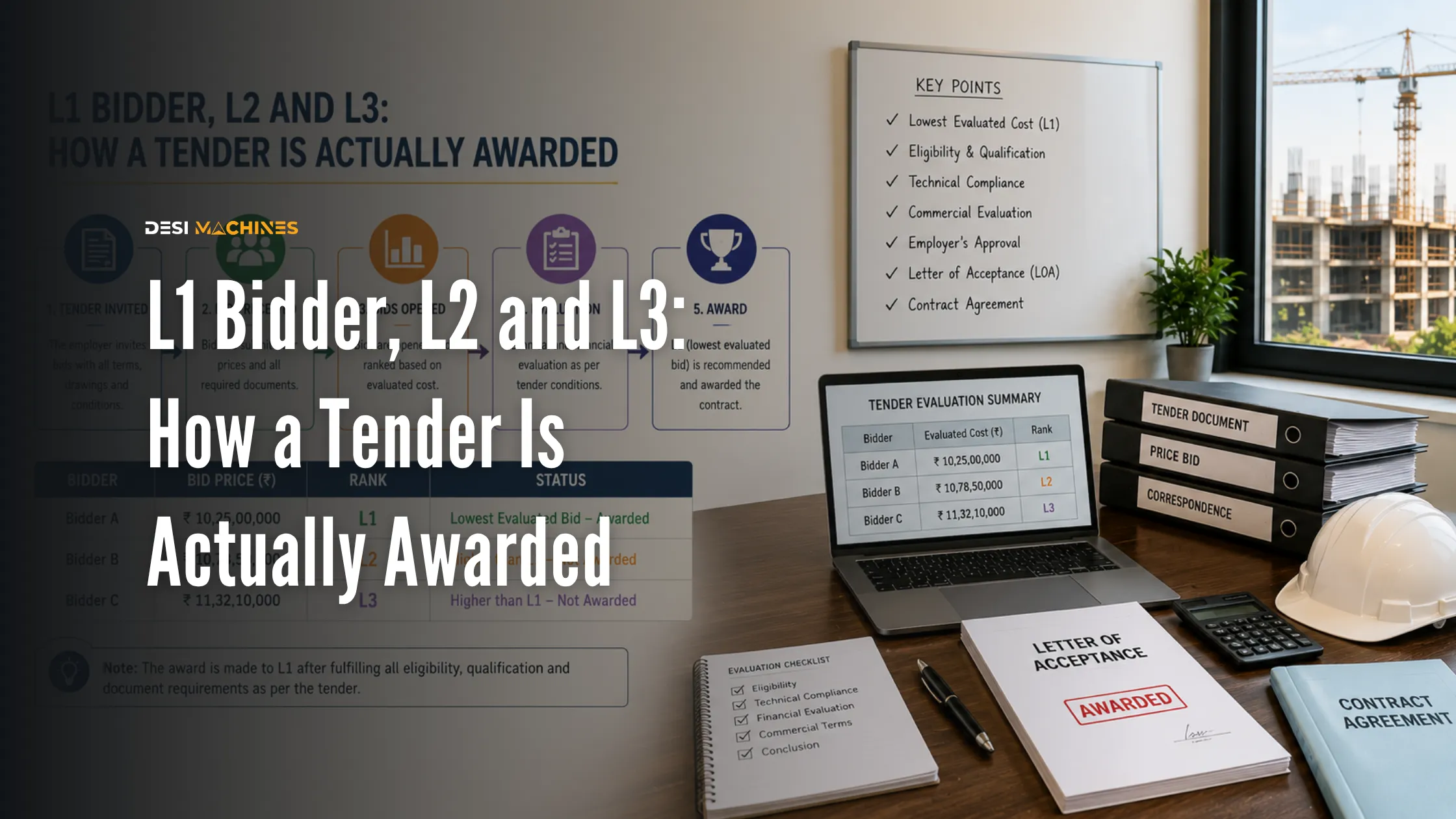
Quote above the estimated cost when your item-by-item costing at today’s diesel, operator and hire rates shows the schedule is behind, and keep the premium to what a market-rate justification could support. Keep the analysis on file. If you are called to negotiate as L1, that sheet is your case, and how an L1 bidder is actually awarded covers that stage.
Walk away when your honest cost is well over 10% above what a market-rate analysis would show. That bid is likely to be rejected and recalled, and your EMD is tied up for nothing. Quoting deep below the estimate carries its own test, explained in what makes a bid abnormally low. Pick work where the estimate and your costs are close, and scan current government tenders with their estimated values before you spend on a bid.
Tender rules, acceptance limits and portal terms change and vary between departments, states and buyers; the clauses here were read on 21 November 2026. Confirm the current position in your own NIT, the department’s manual or the GeM bid document, and with the tendering authority, before you quote. DesiMachines is not liable for decisions taken on information that may have changed after publication.