Excavator
316 models
 Backhoe Loader
54 models
 Crane
68 models
 Concrete Mixer
79 models
 Wheel Loader
65 models
 Compactor / Roller
45 models
 Motor Grader
42 models

 Concrete Pump
66 models
 Skid Steer Loader
11 models


Rs 15 lakh is the minimum sum insured IRDAI fixed on 20 September 2018 for the compulsory pa cover for owner driver, on every class of vehicle, at a premium set then at Rs 750 a year. If a tipper or road-registered backhoe loader stands in your own name and you hold a valid driving licence, the cover sits on its motor policy unless you show a stand-alone CPA policy or a 24-hour personal accident policy of at least Rs 15 lakh. Machines registered to a company or partnership firm carry no owner-driver cover at all. It pays you, the owner, and never your hired operator.
To compare motor and machine cover for your own fleet, start with construction equipment insurance. Every rule below is taken from IRDAI’s own circulars, as read on 21 November 2026.
What is the compulsory PA cover for owner driver?
It is a personal accident section inside the motor policy of any vehicle that is registered and insured as a motor vehicle. A tipper is one. So is a backhoe loader that carries a registration number and drives between sites on public roads. A tracked excavator that only moves on a trailer usually sits on a site policy and does not come into this at all; the construction equipment insurance guide explains which machine goes on which kind of policy.
The rule behind it is General Regulation 36 of the India Motor Tariff, 2002. IRDAI’s circular IRDAI/NL/CIR/MOTP/158/09/2018 dated 20 September 2018 describes it this way: the owner of the insured vehicle holding an “effective” driving licence is the owner-driver, and the cover applies “whilst driving the vehicle including mounting into/ dismounting from or traveling in the insured vehicle as a co-driver”.
Before that circular, the sum insured was Rs 2,00,000 for private cars and commercial vehicles and Rs 1,00,000 for two-wheelers. The circular raised it, after directions from the Madras High Court, to a minimum of Rs 15,00,000 for all classes of vehicles, under both liability-only and package policies, “at the premium rate of Rs. 750/- per annum for annual policy. This rate will be valid until further notice.” A higher sum insured can be bought as an optional extra.
Are these 2018 rules still live? Yes. IRDAI’s Master Circular on General Insurance Business, listed on its site on 11 June 2024, repealed a long list of older product circulars, but its Annexure A keeps the 20 September, 9 October and 11 December 2018 CPA circulars in force because they were issued under court orders.
Searches for this cover often pair it with the code “IMT 15”. The commercial vehicle package wording read for this piece (a large private insurer’s filed form for goods carrying, passenger carrying and miscellaneous and special type vehicles) does not use IMT-15 for it at all. There the owner-driver cover is Section IV of the policy itself, and it pays only if three things are true: the owner-driver is the registered owner, is the insured named in the policy, and “holds an effective driving license, in accordance with the provisions of Rule 3 of the Central Motor Vehicles Rules, 1989, at the time of the accident”. If your schedule prints a tariff code, ask the insurer which wording it points to.
Who has to carry it: five machine owners
| How the machine is owned | Compulsory owner-driver PA? | IRDAI document |
|---|---|---|
| Backhoe loader in your own name, you hold a valid licence | Yes, Rs 15 lakh minimum on the motor policy | 20 Sep 2018, para (ii) |
| Tipper in your own name, you have never held a licence | Not applicable | 9 Oct 2018, para 2 |
| Tippers registered to a private limited company | Not applicable: no owner-driver | 9 Oct 2018, para 2 |
| Machines registered to a partnership firm | Not applicable | 9 Oct 2018, para 2 |
| You hold a 24-hour PA policy of Rs 15 lakh or more for death and permanent disability | No separate CPA needed | 11 Dec 2018, para 4(viii) |
The company and firm rows come straight from circular IRDAI/NL/CIR/MOTP/170/10/2018 of 9 October 2018: “Compulsory PA cover is not applicable where a vehicle is owned by a company, a partnership firm or a similar body corporate or where the owner-driver does not hold a valid driving licence.” A sole proprietorship is not named in that list. If the registration certificate shows your personal name, you are the owner the rule is talking about, whatever your letterhead says.
If your tippers sit in a private limited company, check the RC against the policy schedule. A company-owned tipper with an owner-driver PA charge on its schedule is a line to question at the next renewal.
I never drive the machine. Do I still pay?
This is where most owners get it wrong. The test in the 9 October 2018 circular is whether the owner holds a valid driving licence. It says nothing about whether the owner actually drives the machine. An owner who keeps a licence in a wallet and leaves the backhoe to a hired operator every day still counts as an owner-driver for this purpose.
That leaves three honest routes for an owner who holds a licence:
- Keep the CPA line on the machine’s policy.
- Buy one stand-alone CPA policy (next section) and have the CPA section deleted from each machine’s policy.
- Show a 24-hour personal accident policy against death and permanent disability, total and partial, with a sum insured of at least Rs 15 lakh. The 11 December 2018 circular says that in this case “there is no need for a separate CPA cover to be taken”.
An owner with no licence at all is outside the rule. Do not declare a licence you do not hold to keep the cover: the policy wording pays only if the licence is effective at the time of the accident.
Three machines, one stand-alone CPA
Circular IRDAI/NL/CIR/MOTP/200/12/2018 of 11 December 2018 unbundled the cover. From 1 January 2019 an insurer may issue a stand-alone compulsory PA policy for the owner-driver. Its rules, quoted from paragraph 4:
- It lasts one year.
- “Coverage under the stand-alone CPA will extend to all the vehicles owned by the owner-driver under the same policy.”
- It can be taken “from any registered insurer transacting general insurance business”, not only from the insurer of your machines.
- Once you take it, the CPA cover inside the liability-only or package policy “shall be deleted”.
Take an owner with one backhoe loader and two tippers, all in the owner’s own name, all insured as motor vehicles. With the cover bundled, each policy carries its own owner-driver line. At the 2018 rate that is 3 x Rs 750 = Rs 2,250 a year, and each line protects the owner only in connection with the vehicle on that policy. A stand-alone CPA replaces all three lines with one policy that follows the owner onto whichever of the three is being driven. Its premium is set by the insurer that files the product, so compare the quote against the Rs 2,250 the bundled lines cost on your current schedules. The guide to what sets a machine’s insurance premium covers the rest of that bill.
What the Rs 15 lakh actually pays
The cover pays a fixed share of the sum insured. It does not reimburse hospital bills. The scale in the commercial vehicle wording read for this piece is the GR 36 scale:
| Injury from the accident | Share of sum insured | On Rs 15,00,000 |
|---|---|---|
| Death | 100% | Rs 15,00,000 |
| Loss of two limbs, or sight of both eyes, or one limb and one eye | 100% | Rs 15,00,000 |
| Loss of one limb or sight of one eye | 50% | Rs 7,50,000 |
| Permanent total disablement from other injuries | 100% | Rs 15,00,000 |
Three conditions in the wording matter on a site. Only one item is paid for any one accident. The total cannot exceed Rs 15 lakh in one policy period, so a second accident in the same year after a full payout gets nothing more from that policy. And nothing is paid if the owner-driver was under the influence of liquor or drugs, or for self-injury. The injury must result in death or disablement within six calendar months.
Picture an owner driving their own backhoe loader along a village road to a culvert job. The machine slips into a drain and the owner loses a leg. On a Rs 15 lakh CPA the claim is item (iii): 50% of Rs 15,00,000, which is Rs 7,50,000, paid to the owner. The repair to the backhoe is a separate own-damage claim, payable only if the machine carries a package policy.
Your operator is not covered by it
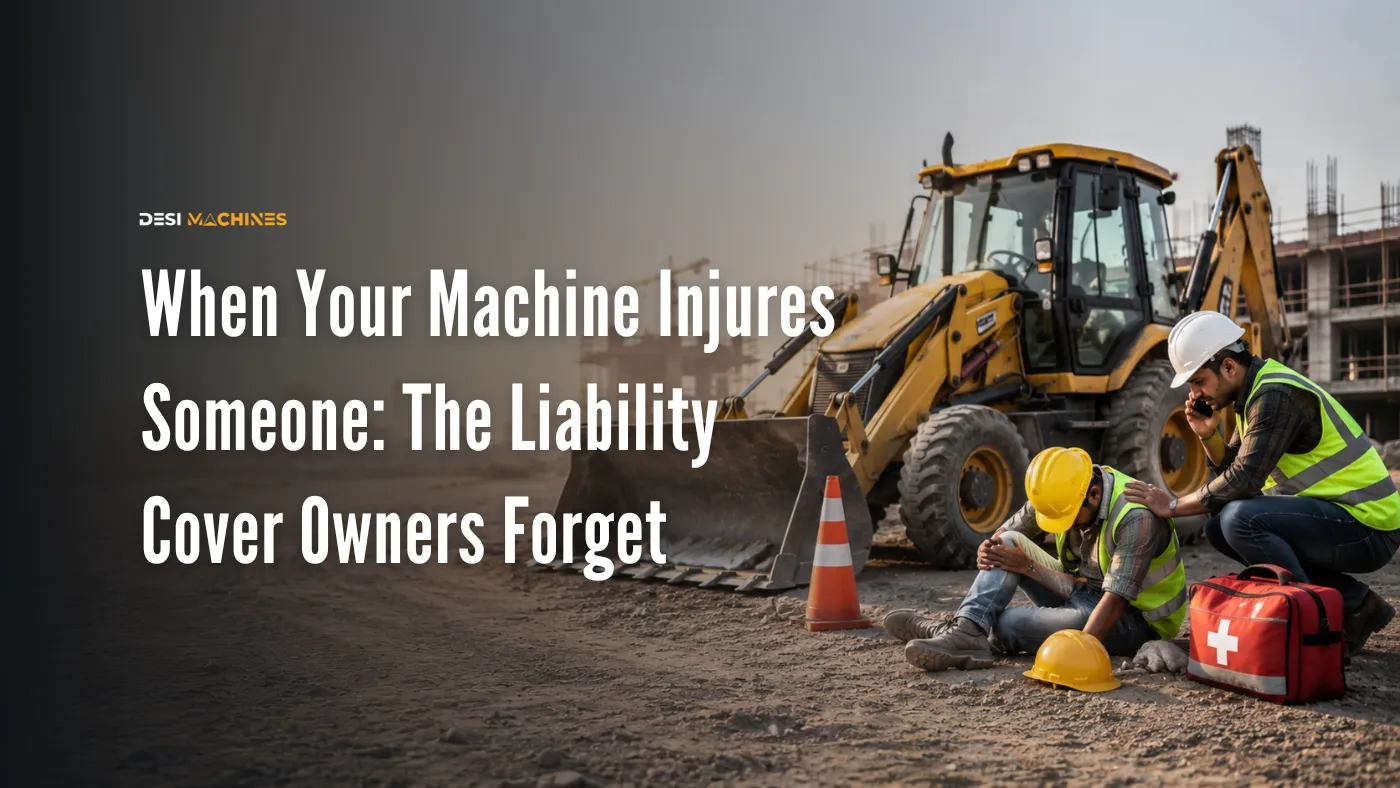
The cover is written for one person, the owner-driver. A paid operator on your tipper or backhoe is neither the registered owner nor the named insured, so Section IV never pays for the operator’s injury, however serious.
The same commercial vehicle wording offers optional endorsements for the operator, each for an additional premium shown on the schedule. IMT-17 is a personal accident cover for paid drivers, cleaners and conductors. IMT-28 covers your legal liability for injury to a paid driver employed with the insured vehicle. Neither is part of the compulsory cover, and neither is there unless you asked for it and paid.
The bigger exposure is your liability as the operator’s employer when the operator is hurt on site, which no motor endorsement fully answers. That is covered in detail in why your operator is not a third party, along with the employee’s compensation cover that carries it.
One recent change will not reach your machines. IRDAI’s circular IRDAI/NL/CIR/MISC/145/11/2026 of 2 November 2026 brings in a four-layer policy structure from 15 December 2026, with an optional PA cover for “any driver other than owner-driver”. It applies to private vehicles, meaning cars and two-wheelers, not to tippers or backhoe loaders.
Keep the CPA line, swap it, or have it removed
Pull out the motor policy schedule for each road-registered machine and decide one of three things.
Keep it if the machine is in your own name, you hold a valid licence and this is your only vehicle. Price a swap to one stand-alone CPA policy if you own two or more machines, and claim the exemption if you already carry a 24-hour PA policy of Rs 15 lakh or more; keep a copy of that policy with each machine’s papers. Have it removed if the RC shows a company or partnership firm, or if you hold no licence. Whichever you choose, the operator needs separate cover.
For quotes on the motor policies and the operator covers together, share your machine list through construction equipment insurance.
Insurance rules, wordings and premiums change, and policy wordings differ between insurers. The IRDAI circulars are summarised here in plain terms as read on 21 November 2026. Confirm your own cover, exemptions and premium with your insurer or broker before you act. DesiMachines is not liable for decisions taken on information that may have changed after publication.