
 Excavator
294 models
Excavator
294 models  Backhoe Loader
51 models
Backhoe Loader
51 models  Crane
68 models
Crane
68 models  Concrete Mixer
79 models
Concrete Mixer
79 models  Wheel Loader
54 models
Wheel Loader
54 models  Compactor / Roller
45 models
Compactor / Roller
45 models  Motor Grader
42 models
Motor Grader
42 models  Concrete Pump
66 models
Concrete Pump
66 models  Skid Steer Loader
11 models
Skid Steer Loader
11 models  Telehandler
13 models
Telehandler
13 models  Dozer
Dozer 


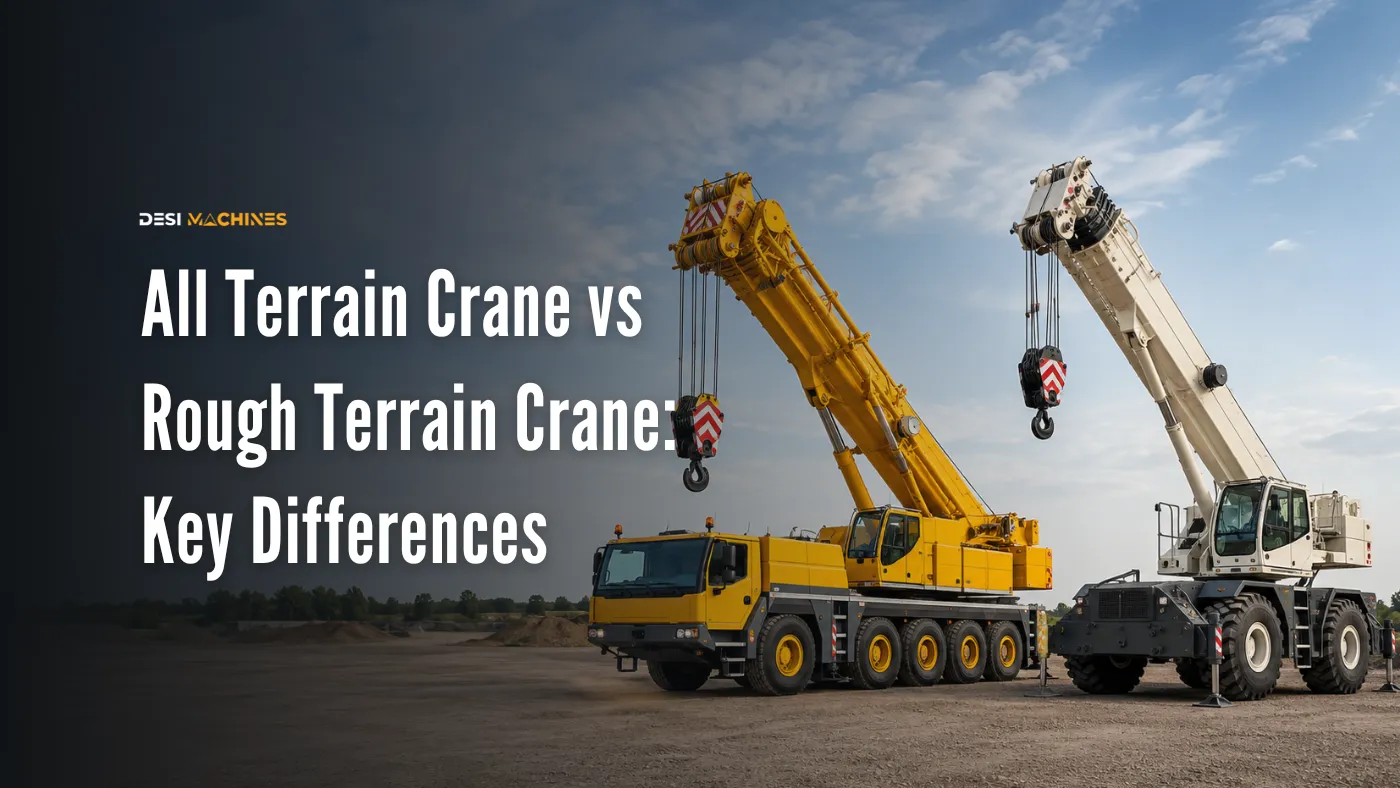
An all terrain crane and a rough terrain crane are both mobile cranes with a telescopic boom, but they are built for two different problems. A rough terrain crane is a four-wheeled machine made to work off-road inside one site, and it is carried between sites on a trailer. An all terrain crane sits on a multi-axle road carrier, drives to the site on the highway under its own power, and then works much like a rough terrain crane once it is set up on its legs.
This all terrain crane vs rough terrain crane comparison covers the wheels, road travel, lifting range, ground conditions and cost of each, and then answers the question most Indian contractors actually need settled: whether either machine is the right buy for the work you have.
What is a rough terrain crane?
A rough terrain crane is a single-engine, single-cab mobile crane that runs on four large tyres and is designed to move over broken, muddy or unmade ground inside a work site. The operator drives the machine and operates the boom from the same seat.
Three things define it. The tyres are wide, soft flotation tyres (a tyre that spreads the machine’s weight over a bigger patch of ground so it sinks less on soft soil). All four wheels drive and all four steer, including a crab mode where the machine moves diagonally without turning, which is how it squeezes along a narrow trench line or between two foundation pits. And the boom is telescopic, so it extends out of itself like the sections of a fishing rod rather than being bolted together.
Rough terrain cranes are usually rated between 8 Ton (8,000 kg) and 150 Ton (150,000 kg), with the 25 Ton (25,000 kg) to 75 Ton (75,000 kg) sizes doing most of the work in refineries, power plants, ports and dam projects. Before lifting, the operator lowers four outriggers (hydraulic legs that lift the tyres clear of the ground and give the crane a wide, stable base).
What a rough terrain crane cannot do is travel on the highway. Its road speed is low, its width is generous, and it is not built for a 300 km run between two towns. Moving one from Nashik to Nagpur means a low-bed trailer, a permit and a day of nobody lifting anything. That single fact drives most of the buying decision.
What is an all terrain crane?
An all terrain crane is a telescopic-boom mobile crane built on a multi-axle carrier that can legally travel at highway speed and still drive onto a rough site when it arrives. It is the machine that gives you both halves of the job.
The carrier normally runs on three to nine axles depending on capacity, and most of those axles both drive and steer. There are two cabs: one at the front for driving on the road, and a second on the turntable for operating the crane. Capacities in this class start around 40 Ton (40,000 kg) and run past 1,200 Ton (1,200,000 kg) on the largest wind-energy machines.
The trade-off is size. Spreading a heavy crane across many axles is what keeps each axle’s load inside road limits, but it makes the machine long. An all terrain crane needs room to swing in, room to set its outriggers, and a route with turns it can actually take. On a tight city plot hemmed in by two buildings, the shorter rough terrain machine often wins even though the all terrain crane is the more capable crane on paper.
What is the difference between an all terrain crane and a rough terrain crane?
The short answer is mobility. A rough terrain crane is a site machine that must be transported; an all terrain crane is a road machine that can also work on site. Everything else follows from that.
| Feature | Rough terrain crane | All terrain crane |
|---|---|---|
| Wheels / axles | 4 large flotation tyres on 2 axles | 6 to 18 wheels on 3 to 9 axles |
| Cabs | One (drive and lift from the same seat) | Two (road cab plus crane cab) |
| Highway travel | No, moved on a trailer | Yes, drives to site under its own power |
| Typical capacity | 8-150 Ton (8,000-150,000 kg) | 40 Ton (40,000 kg) and above |
| Soft, uneven ground | Strong, that is what it is built for | Good, but needs a firmer approach road |
| Space needed to set up | Less, it is a shorter machine | More, the carrier is long |
| Cost to move between sites | High, trailer plus permits every time | Low, it drives itself |
| Purchase cost | Lower for the same capacity | Higher for the same capacity |
General class characteristics. Exact figures vary by model and OEM specification.
Read that table with your own work in mind. If your machine will sit on one refinery shutdown for eight months, the trailer cost is a one-time entry in the books and the rough terrain crane is the cheaper way to get the same lift. If your machine will see nine sites in a year, the all terrain crane earns its higher price back in mobilisation alone.
Which crane handles Indian site conditions better?
For ground conditions on a single site, the rough terrain crane usually has the edge, and the reason is ground bearing pressure (how hard the machine presses down on each square inch of soil). Wide flotation tyres spread the load, so the machine keeps moving across a wet plot after the first monsoon shower instead of digging itself in.
That advantage disappears the moment the crane goes on its outriggers, because all the weight then passes through four small pads. On soft or filled ground, steel or timber mats under those pads are not optional, whichever crane you use. A crane that tips does not tip while lifting the heaviest load; it tips when one outrigger quietly sinks 100 mm into ground nobody tested.
The all terrain crane’s advantage is Indian geography. Work is spread across states, jobs are short, and a machine that reaches Bhubaneswar from Kolkata by evening is earning while a trailered crane is still waiting for a permit. Against that, our site access is often the limit: village approach roads, a narrow gate, an unmade last kilometre. A long multi-axle carrier can be stopped by a turn that a four-wheel machine takes easily. Machine ki taakat se pehle raasta dekho – check the approach before you fall in love with the load chart.
Both machines are lifted-load machines, not carry-load machines. Neither is meant to drive around the site with a load swinging on the hook, which is exactly what a pick and carry crane is designed to do. That difference matters more in India than anywhere else, and the next section explains why.
How much do all terrain and rough terrain cranes cost in India?
Both classes are quoted on request rather than off a price list. They are largely imported machines, and the final figure depends on capacity, boom length, counterweight package, duties and the configuration the buyer specifies, so a published number would be misleading more often than useful. Ask for a written quotation against your exact lift chart, not a phone estimate.
What does carry a listed price is the class of crane most Indian sites actually run:
| Machine | Rated capacity | Indicative price (July 2026) |
|---|---|---|
| Escorts HYDRA 1565 | 15 Ton (15,000 kg) class | ₹21–24 Lakh |
| ACE NX 360 20T | 20 Ton (20,000 kg) | ₹40–42 Lakh |
| Terex Franna FR20 | 20 Ton (20,000 kg) | ₹45–50 Lakh |
| TIL MOBILOAD 315 | 15 Ton (15,000 kg) class | Price on request |
Indicative ranges as of July 2026, taken from our listings at the time of writing. Prices vary by variant, dealer and state.
A 40 Ton (40,000 kg) rough terrain crane will not sit anywhere near these numbers, and an all terrain crane of the same rating sits higher still. If the gap between what the job needs and what the budget allows is wide, look at equipment finance and EMI options before you cut the machine size. Buying two sizes too small to fit a monthly instalment is how contractors end up hiring a second crane for every big lift.
Compare live crane models and prices and raise an enquiry to get a dealer quotation for the capacity you need.
Do you actually need an all terrain or rough terrain crane?
For a large share of Indian lifting work, the honest answer is no. Most site lifts below about 25 Ton (25,000 kg) – precast segments, structural steel, transformers, tanks, machinery unloading – are handled by pick and carry cranes, the machines everyone on site calls hydra or farana. They are cheaper, they travel on their own wheels, and they can carry a load short distances rather than only lift it in one spot.
Step up from that class when one of these is true. Your lifts are heavier than roughly 25 Ton, or they sit far out at radius where a small crane’s capacity collapses. You are working at height on a plant or a chimney. The job runs on soft, unmade ground that a pick and carry crane cannot cross safely. Or your insurer and client demand a machine with a full duty chart and outrigger stability for the lift plan.
For most contractors the sensible middle step is a truck-mounted crane, which puts a telescopic boom on a road-going truck chassis and covers a good part of what a rough terrain crane does without the trailer bill. Where the lift is very heavy or very tall, the answer usually skips past both classes to a crawler crane on tracks.
There is also a third option that is not a purchase. Rough terrain and all terrain cranes are the classic rental machines in India, hired with an operator for a single shutdown or erection job. Our crane buying and rental guide works through the arithmetic of hiring versus owning at different utilisation levels.
How do you choose between the two?
Work through five questions in this order, and the machine usually picks itself.
- What is your heaviest planned lift, and at what radius? Take the three worst lifts you expect, not the average one, and check them against a real duty chart. Our guide on how to read a crane load chart shows why a 25 Ton machine may only manage 6 Ton at 8 metres.
- How many separate sites will the machine see in a year? One or two favours a rough terrain crane. Six or more favours an all terrain crane, because every move of a trailered machine costs money and idle days.
- What is the ground like, and what is the approach like? Soft ground favours flotation tyres. A tight approach with sharp turns rules out a long multi-axle carrier regardless of its lifting chart.
- Is the work continuous or occasional? Occasional heavy lifts are cheaper to rent than to own, and rented machines come with a trained operator.
- What does the total cost look like, not just the price? Add mobilisation, operator, insurance, tyres and the duty-chart headroom you will want in two years. A machine bought exactly to today’s requirement is a machine you outgrow on the next project.
For the wider family of machines and where each one fits, start with the types of cranes guide, the mobile crane guide for the road-going classes, or the main crane guide for the whole picture from mechanism to purchase.
Ready to shortlist? Browse the full range of cranes with live prices and ask for a dealer quotation on the capacity your lifts actually need.
Prices, specifications and features are indicative, vary by variant, location and date, and should always be confirmed with the official OEM or authorised dealer before any purchase decision. DesiMachines is not liable for decisions taken on the basis of information that may have changed after publication.