
 Excavator
294 models
 Backhoe Loader
51 models
 Crane
68 models
 Concrete Mixer
79 models
 Wheel Loader
54 models
 Compactor / Roller
45 models
 Motor Grader
42 models

 Concrete Pump
66 models
 Skid Steer Loader
11 models


If you need a skid steer that can work inside a shed, a basement or a factory without filling it with fumes, an electric skid steer loader is the machine built for that job. It lifts, pushes and loads like a diesel skid steer, but a battery pack and electric motors take the place of the diesel engine, so it makes no exhaust and very little noise.
It is still a young machine. None of the 11 skid steer loaders listed on DesiMachines is electric yet; every one runs on diesel. So this guide explains how the battery version works, compares the makers’ own published figures with the diesel machines you can buy now, and lists the jobs where electric makes sense and the checks to make before you pay for one. If you are new to the machine itself, start with how skid steer loaders work.
How does an electric skid steer drive and lift?
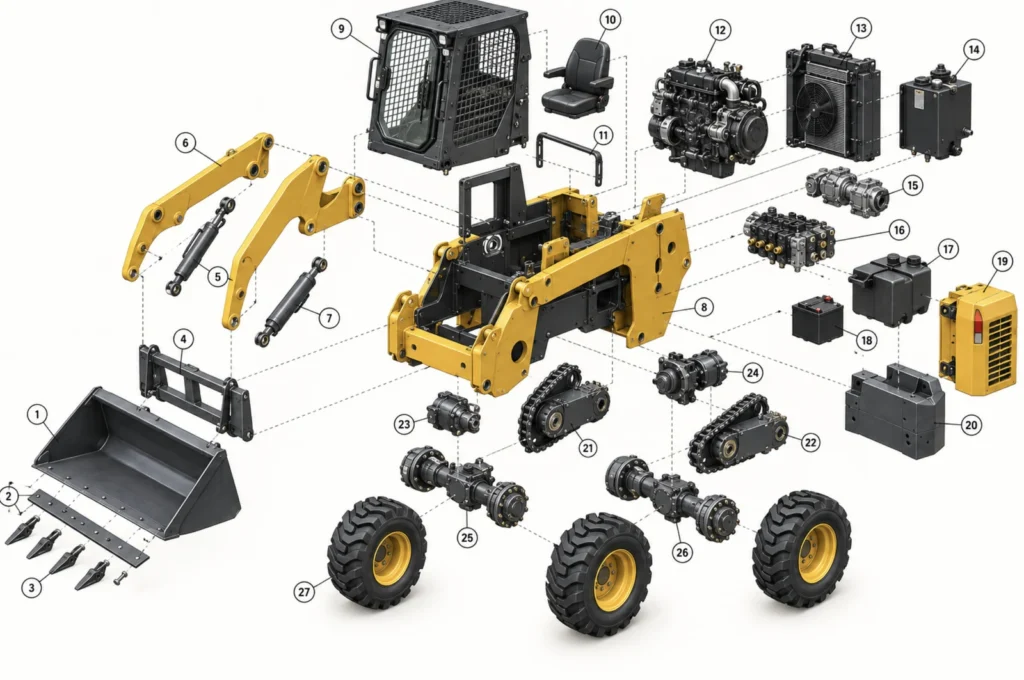
A skid steer has no steering wheel. It turns by running the wheels on one side faster than the other, so each side needs its own drive. On a diesel machine the engine turns hydraulic pumps, and those pumps run one hydraulic motor on each side. The listed Bobcat S590, for example, uses tandem hydrostatic piston pumps driving two fully reversing hydrostatic motors. The same engine also drives the pump that works the lift arms, the bucket tilt and any attachment.
An electric skid steer removes the engine and gives each side its own electric motor, fed from the battery. For the lift arms and bucket, makers have taken two different routes:
- Electro-hydraulic. A separate electric motor turns a normal hydraulic pump, and the arms and bucket still move on hydraulic cylinders. The Elise 900 from FIRSTGREEN Industries of the Czech Republic works this way: two 10 kW electric drive motors, plus one more 10 kW electric motor for the hydraulics.
- Fully electric. The cylinders go too. Bobcat says its S7X uses ball screw actuators for lift and tilt. A ball screw is a threaded rod turned by an electric motor, which pushes the arm out or pulls it back without any oil.
The difference matters on site. An electro-hydraulic machine still has hydraulic oil, hoses and a pump to look after, but it can run hydraulic attachments in the usual way. A fully electric machine has far fewer oil parts, which is the point of the design. The parts that come out are the engine, radiator, fuel tank, exhaust and drive pumps; the skid steer parts guide explains what each one does on a diesel machine.
Where the power goes: diesel, electro-hydraulic and fully electric skid steers
| Design | Power source | Wheels on each side | Lift arms and bucket |
|---|---|---|---|
| Diesel (every listed model) | Diesel engine | Engine turns hydraulic pumps, pumps run one hydraulic motor per side | Engine-driven pump feeds hydraulic cylinders |
| Electro-hydraulic (Elise 900) | 96 V battery, lead-acid or lithium | One electric motor per side, 2 x 10 kW | Separate 10 kW electric motor turns a hydraulic pump that feeds cylinders |
| Fully electric (Bobcat S7X) | 60.5 kWh lithium-ion battery | Electric drive motors | Ball screw electric actuators, no lift or tilt cylinders |
Elise 900 figures from the maker’s technical data; S7X figures from Bobcat’s announcement of 14 March 2023; diesel layout from the listed machines’ specifications.
How does an electric skid steer compare with a diesel one on paper?
Only a few makers publish a full sheet for a battery skid steer. The table puts the two clearest ones beside two diesel models you can buy today.
Electric skid steers from makers’ sheets, beside two listed diesel models
| Machine | Power | Rated operating capacity | Tipping load | Hydraulic flow and pressure | Running time and charging, as stated |
|---|---|---|---|---|---|
| Elise 900 (electric, not listed) | 2 x 10 kW drive + 10 kW hydraulic | 900 kg (0.9 tonne) | 1,800 kg | 65 L/min, 180 bar maximum | No running time on the sheet; 1- or 3-phase charging, external charger, on-board charger optional |
| Bobcat S7X (electric, not listed) | 60.5 kWh lithium-ion battery | Not stated in the announcement | Not stated | Not stated | Up to 8 hours per charge, depending on the job; full charge about 10 hours |
| Bobcat S590 (diesel) | 69 HP (51.4 kW) | 907 kg (0.9 tonne) | 1,814 kg | 64.7 L/min, 238 bar | 93.7 L fuel tank |
| JCB SSL 155 (diesel) | 56 HP (42 kW) | 703 kg (0.7 tonne) | 1,406 kg | 68.6 L/min, 230 bar | 84 L fuel tank |
Diesel figures from each listed machine’s specification, October 2026. Electric figures from the makers as named, read October 2026.
Three things stand out. First, the Elise 900 lifts almost exactly what the Bobcat S590 lifts, 900 kg against 907 kg. On every listed skid steer, and on the Elise sheet, the rated operating capacity is half the tipping load, so the two numbers are comparable.
Second, the electric machine does it on a smaller power figure: 30 kW of motors in total against the S590’s 51.4 kW engine. Electric motors give their full pulling force from a standstill, and Bobcat says the S7X’s torque is as much as three times that of traditional loaders. Power ratings for motors and engines are measured differently, so treat the kW figures as a rough guide only.
Third, the hydraulic side is lighter. The Elise moves about the same oil flow as the two diesel machines in the table, 65 L/min, but at 180 bar against 230 to 238 bar. An attachment that needs full pressure, such as a breaker or a cold planer, may not work properly on it. Check the attachment’s own pressure and flow before you plan a job around it.
Compare the live Bobcat S590 and JCB SSL 155 side by side, or see all diesel skid steer loader models and prices.
Which jobs suit an electric skid steer?
Bobcat names three settings for the S7X: environmentally sensitive sites, noise-restricted areas and indoor work. In India those translate into a short list of real jobs.
Where an electric skid steer fits, and where diesel still wins
| Site or job | Why electric helps | What to watch |
|---|---|---|
| Factory floors, warehouses and godowns | No exhaust fumes to clear from a closed building | Floor load and ramp gradient |
| Dairy, poultry and cattle sheds | No fumes around animals, and far less noise than an engine | Dung and water around the battery box; ask about its sealing |
| Cold stores and food plants | No diesel smell or soot near food | Battery output drops in the cold; ask for the operating temperature range |
| Basements and inside-building demolition | Clean air for the crew in a closed space | Breaker work needs high pressure; check the hydraulic figures |
| City night work near homes | Far quieter than an engine; Bobcat calls the S7X nearly silent | Local noise and working-hour rules still apply |
| Remote earthwork with no power supply | Little; this is diesel work | No way to recharge overnight |
Farm and shed work is where many Indian skid steers already earn their keep, as the guide to the skid steer loader for agriculture explains. A shed with a three-phase connection is one of the easiest places to run an electric machine, because it stays in one spot and comes back to the same plug every evening.
The Elise 900 can also be driven by radio or Bluetooth remote as well as from the cabin, according to its maker. That lets the operator stand clear during demolition or in a dusty bin.
How long does the battery last, and how is it charged?
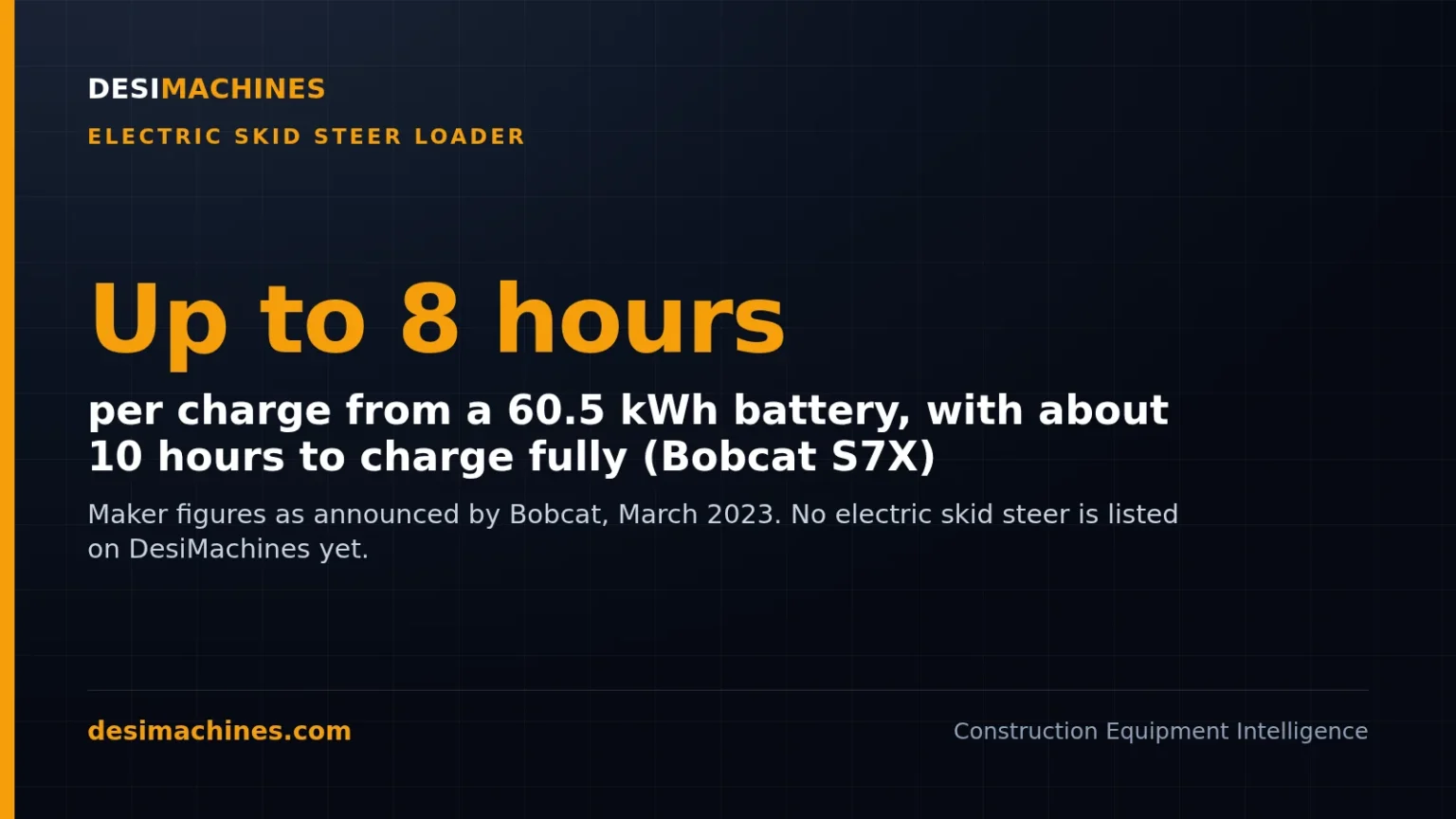
Bobcat says the S7X runs for up to 8 hours on one charge, depending on the application, and adds that this gives most operators more than a full day once breaks and waiting are counted. A full charge takes about 10 hours.
Our own arithmetic shows what that means. A 60.5 kWh battery spread over 8 hours is an average draw of about 7.6 kW. A skid steer pushing into a heap or lifting a full bucket draws far more than that, so the 8-hour figure assumes the machine spends part of the day travelling, waiting or idle. Hard, non-stop work will empty the battery sooner. Ask the dealer for the running time on a job like yours, in hours, before you buy.
Charging is the other half. A 10-hour charge fits overnight, between one day shift and the next, and nothing more. A machine that runs two shifts needs either a faster charger or a second machine. The Elise sheet lists single- and three-phase charging with an external charger, an on-board charger as an option, and fast charging as an option only with a lithium battery. Faster charging pulls more power from the supply, so check your sanctioned load with the electricity board first. The guide to charging an electric machine on site covers supply, chargers and DG sets in detail. Charging from a DG set works, but it brings back the fuel bill and the noise at the charger.
What are the pros and cons of an electric skid steer?
Electric skid steer: the two sides
| Advantages | Disadvantages |
|---|---|
| No exhaust, so it can work indoors and near people or animals | Running time is limited by the battery, and a hard day can cut it |
| Very low noise, useful at night and in towns | Needs a power supply where the machine sleeps; 10 hours for a full Bobcat S7X charge |
| No engine oil, fuel filter, radiator or exhaust to service | A replacement battery is a major later cost; ask for its price in writing |
| Full pulling force from standstill | Electro-hydraulic models may run at lower hydraulic pressure than diesel |
| No diesel to buy, store or lose to theft | No electric skid steer is sold through DesiMachines yet, so dealer support and resale value are untested |
The wider picture, across all machine types, is in the guide to electric vs diesel construction machines.
What problems come with an electric skid steer in India?
The first is price. No electric skid steer is listed here, so there is no Indian price to quote. Ask the seller for the landed price, the price of a replacement battery and the warranty terms in writing, and compare them with a diesel skid steer of the same lift.
The second is service. A diesel skid steer can be repaired by most loader mechanics. A battery machine needs someone who can test a battery pack, a motor controller and the wiring safely. Ask who will come when it stops, how far away they are, and how long a motor or controller takes to arrive.
The third is heat. Indian summers are hard on batteries. Ask what the machine does when the battery gets hot, whether it slows down to protect itself, and how the pack is cooled.
The fourth is attachments. Skid steers earn their money through what is hung on the front, from buckets and forks to augers and breakers, as the guide to skid steer attachments shows. On an electric machine, each hydraulic attachment draws on the same battery, so a high-flow tool will shorten the day. Bobcat’s announcement does not give the S7X’s hydraulic flow at all.
What should you check before buying an electric skid steer?
- Running time on your job, in hours, for the work you actually do, and not the best case.
- Battery type and size. Lithium or lead-acid, the kWh, and whether a bigger pack is offered.
- Charging. Single- or three-phase, charger power in kW, hours to full and to 80%, and whether the charger is on board or separate.
- Rated operating capacity and tipping load, so you can compare it with the diesel model you would otherwise buy.
- Hydraulic flow and pressure at the attachment coupling, checked against each tool you plan to use.
- Battery warranty in years and in hours, what counts as a failure, and the price of a new pack.
- Operating temperature range and how the battery is cooled.
- Sealing of the battery box and motors against water, dung and dust.
- Who services it near you, and where spare motors and controllers are stocked.
The same questions, for every type of electric machine, are set out in the electric machine buying checklist. If the answers do not add up for your site, a diesel skid steer is still the safe buy, and the page on construction equipment finance explains how to fund one.
Which electric machines can you buy in India today?
Electric skid steers have not reached the Indian listings, but electric excavators have. The smallest, the LiuGong 9027FE EV, weighs 2,750 kg (2.75 tonnes) with a 16.5 kW rated power, which puts it in the same weight range as the listed diesel skid steers, from 1,291 kg for the Bobcat S70 to 4,225 kg for the Bobcat S770. Larger battery machines such as the LiuGong 922FE Battery and the SANY SY215EP are listed too, and the LiuGong 922FE Battery and Cable comparison shows the two ways of feeding one. The full set is in the electric excavator range, and mains-powered concrete pumps such as the Schwing Stetter SP 1200 E run all day on a three-phase supply.
The nearest electric loader covered so far is the larger wheeled machine in the guide to electric wheel loaders, and every electric machine type is collected in the guide to electric construction machines.
For skid steer work today, compare the diesel skid steer loader models and prices, including the L&T S315R, and send an enquiry. Tell the dealer where the machine will work and ask whether a battery model can be brought in for your job. The skid steer loader guide covers sizes, uses and running the machine.
Bobcat S7X figures are quoted from Bobcat’s announcement of 14 March 2023, when the machine was shown as a prototype; Elise 900 figures from FIRSTGREEN Industries’ own technical data, read in October 2026; diesel skid steer figures from each listed machine’s specification as of October 2026. Prices, specifications and features are indicative, vary by variant, location and date, and should always be confirmed with the official OEM or authorised dealer before any purchase decision. DesiMachines is not liable for decisions taken on the basis of information that may have changed after publication.