
 Excavator
294 models
Excavator
294 models  Backhoe Loader
51 models
Backhoe Loader
51 models  Crane
68 models
Crane
68 models  Concrete Mixer
79 models
Concrete Mixer
79 models  Wheel Loader
54 models
Wheel Loader
54 models  Compactor / Roller
45 models
Compactor / Roller
45 models  Motor Grader
42 models
Motor Grader
42 models  Concrete Pump
66 models
Concrete Pump
66 models  Skid Steer Loader
11 models
Skid Steer Loader
11 models  Telehandler
13 models
Telehandler
13 models  Dozer
Dozer 


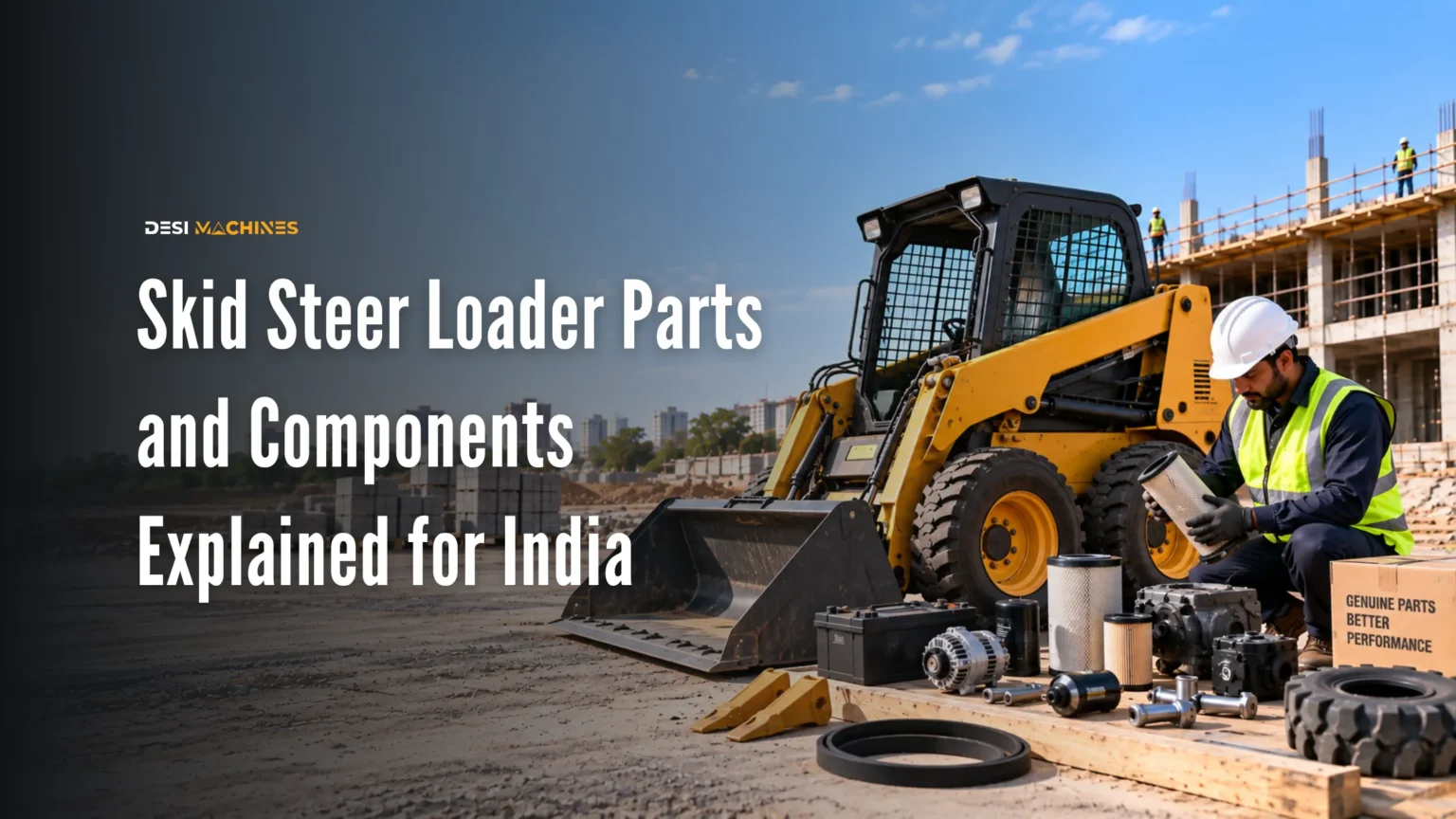
Eleven skid steer loaders are listed in India, from a 1,291 kg Bobcat S70 to a 4,225 kg Bobcat S770, and all of them are built from the same seven part groups. One of those groups sits on no other machine sold here: a sealed steel chain case on each side, carrying the chains that turn the wheels.
That is why skid steer parts confuse people who have owned a backhoe or a wheel loader. There is no axle, no differential and no gearbox in the usual sense. This guide names each part the way a parts counter names it, says which ones wear out and roughly when, and points you at the figures our own listings publish for the machines actually sold here.
What are the main parts of a skid steer loader?
A skid steer is a small machine with a lot packed into it. Split into groups it stops being confusing.
| Part group | What is in it | What it does |
|---|---|---|
| Engine and cooling | Diesel engine, radiator, fan, air cleaner, fuel and oil filters, battery, alternator | Makes the power. Every skid steer listed here is liquid cooled, so every one has a radiator, a water pump and hoses |
| Drive circuit | Twin hydrostatic pumps, two hydraulic drive motors, one per side | Drives the machine and steers it. There is no gearbox and no clutch |
| Chain cases | Left and right sealed cases, drive chains, sprockets, wheel hubs and hub seals | Carries the drive from each motor down to the two wheels on that side |
| Loader hydraulics | Loader pump, control valve, two lift cylinders, tilt cylinder, hoses | Raises the arms and rolls the bucket |
| Loader arms | Left and right arms, pins, bushes, the rear pivot, arm stops | Carries the load from the coupler back into the frame |
| Front plate | Quick coupler plate, locking pins or levers, auxiliary hydraulic couplings | Holds the bucket or the attachment and feeds oil to it |
| Wheels and frame | Four tyres, rims, the one-piece frame, the operator cab and its guarding | Takes the weight and the side loads from skidding |
The word skid in the name is doing real work. The two wheels on one side always turn together, at the same speed, because the same chain drives both of them. To turn, the machine runs one side faster than the other and lets the tyres scrub sideways across the ground. That single design choice is what decides which parts wear out, and it is the defining feature of the machine type. If you want the layout explained slowly, the guide to how skid steer loaders work covers it.
Where the power goes
Read that diagram from the right. The diesel engine turns two sets of pumps and nothing else. One set feeds the drive motors, which feed the chain cases, which turn the wheels. The other set feeds the lift and tilt cylinders and the couplings on the front plate. Nothing on a skid steer is driven mechanically from the engine except the pumps themselves, which is why an engine fault and a drive fault feel completely different from the seat.
Why does a skid steer have two separate hydraulic circuits?
Because the two jobs need opposite things. Driving needs a circuit that can run flat out in both directions all day without stopping. Lifting needs a circuit that sits still most of the time and then delivers a hard push.
The drive circuit is called hydrostatic. The Bobcat S450, S590 and S770 are each specified as tandem hydrostatic piston pumps driving two fully reversing hydrostatic motors, and the L&T S315R carries almost the same wording. Tandem means two pumps on one shaft, one per side. Fully reversing means each motor will turn either way at any speed, which is how the machine spins on the spot. Ten of the eleven machines listed publish a transmission description, and every one of them is hydrostatic.
The loader circuit is usually a plain gear pump. The ACE SS75 and the Bull AV490 both name a gear pump; the two JCB machines name hydrostatic drive pumps instead. Only four of the eleven publish a pump type at all, so ask the dealer which pump your quoted model carries before you order a seal kit or a replacement.
Where the two circuits meet the buyer is the auxiliary line, the pair of couplings on the front plate that feed a breaker or a brush cutter. Five machines publish how it is switched on, and all five put the switch on the joystick or the steering lever rather than on the dash. System pressure, where it is published, runs from 190 bar on the MANITOU 1340R to 238 bar on the Bobcat S590 and S770, with most of the class sitting at 224 to 230 bar. Nine of the eleven publish that figure. Flow matters as much as pressure when you are matching a tool, and the skid steer loader guide sets out the flow figures machine by machine. For oil grades, filtration and cooling, the hydraulic system maintenance guide goes into detail.
One more thing the spec sheets show. The Bobcat S590 and S770 publish two travel speed bands rather than one, 11.2 to 18.4 km/h and 11.4 to 19.8 km/h. That is a two-speed drive motor, which is extra hardware inside the motor and a different part number. The other nine machines publish a single speed between 9.8 and 14 km/h.
Who actually makes the engine in your skid steer?
Usually not the company whose name is on the side. Seven of the eleven skid steers listed here run an engine bought in from a specialist engine maker, and that decides where you buy engine parts.
| Machine | Engine listed | Power |
|---|---|---|
| Bobcat S70 | Kubota D1005-E | 23.5 HP (17.5 kW) |
| Bobcat S450 | Kubota V2203 | 49 HP (36.4 kW) |
| Bull AV490 | Kubota | 50 HP (36.8 kW) |
| MANITOU 1340R | Yanmar 4TNV88 | 49 HP (36 kW) |
| JCB SSL 135 | Kohler KDI 1903 TCR | 56 HP (42 kW) |
| JCB SSL 155 | Kohler KDI 1903 TCR | 56 HP (42 kW) |
| L&T S315R | Mahindra NE 460 3A | 60 HP (44.7 kW) |
| ACE SS75 | ACE A50 | 50 HP (37.3 kW) |
| CAT 216B Series 3 | Cat C2.2 | 51 HP (38 kW) |
| Bobcat S590 | Bobcat DM02-LEL02 | 69 HP (51.4 kW) |
| Bobcat S770 | Bobcat D34P | 93.3 HP (69.7 kW) |
Engine makes and models as listed on the machines sold here, current as of the September 2026 spec.
JCB is the surprise on that list. JCB builds its own engines for its backhoe loaders, but both of its skid steers here carry a Kohler. The practical effect is the same in every case: filters, injectors, a water pump or a head gasket are ordered against the engine model, not against the machine model. Write the engine number down off the block before you phone anyone. The wider picture of which engine goes in which machine is set out in the guide to engine brands in India.
What is a chain case, and what is inside it?
A chain case is a sealed steel box bolted to each side of the machine. Inside it, a chain runs from the drive motor down to the front wheel hub and a second chain carries on to the rear wheel hub, so both wheels on that side turn together. The chains run in an oil bath. There are two cases and they are filled separately.
Four things inside that box are wear parts, and they are ordered per side:
- The chains. They stretch with hours, the same way a cycle chain does. A stretched chain jumps on the sprocket teeth and makes a rattle you hear under load.
- The sprockets. Worn chains chew sprocket teeth into a hooked shape, and a new chain on hooked sprockets fails quickly.
- The wheel hub seals. These are the usual reason a case goes low on oil. The leak runs out past the wheel and is easy to miss.
- The hub bearings. These give warning with a low growl that changes when you turn.
Six of the eleven machines publish their chain case capacity, and each side holds between 6 and 19 litres. The figures machine by machine, and the trap that the number is per side rather than for the pair, are covered in skid steer fuel tank and oil capacities.
Nothing on the dashboard watches a chain case. No gauge, no warning light. Pull the level plug on both sides whenever the machine is greased, and look at the ground under the wheels after it has stood overnight. If the machine has started pulling to one side or lost drive on one side, that is a fault with a short list of causes and the guide to skid steer drive problems works through them.
What wears out on the loader arms?
The arms themselves almost never fail. What fails is the joints, and on a skid steer there are more of them than the machine’s size suggests: the rear pivot on each arm, the pins at the coupler plate, and a pin at each end of the lift and tilt cylinders.
Each joint is a hardened steel pin turning inside a bush, which is a replaceable sleeve pressed into the arm. The bush is meant to wear out and the arm is not. Grease is what keeps that true. Miss the greasing and the pin wears into the arm itself, and then you are paying for welding and line boring instead of for a bush.
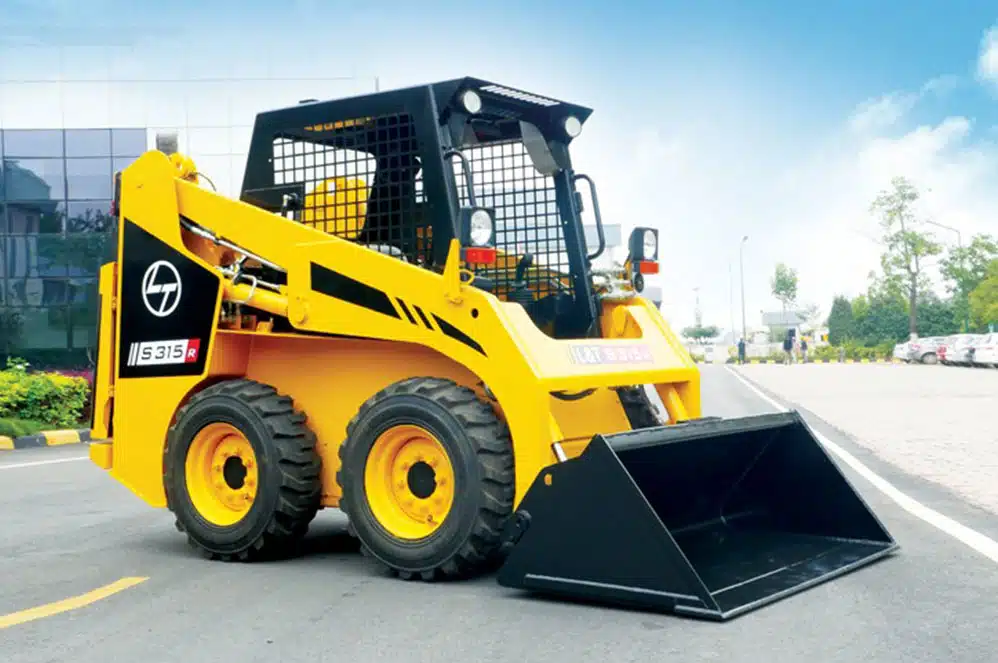
Skid steer arms take a particular kind of punishment. Because the machine turns by scrubbing, every tight turn with a loaded bucket twists the arms sideways. Watch for a bucket that sits crooked when you look down the arms, a knocking sound as the load changes direction, or a shiny ring of metal dust around a pin. Any of those means a bush has gone. The greasing guide lists the points and the intervals.
The coupler plate deserves its own look. Its locking pins carry the whole load through two small contact faces, and a coupler that has been run loose wallows out. Lift the arms, drop the attachment and look at the plate every few hundred hours. How couplers lock on is explained in the skid steer attachments guide.
Which skid steer parts wear out first in India?
Roughly in the order you will meet them:
- Tyres. Far and away the fastest. Skid steering scrubs rubber off sideways on every turn, and on broken concrete or rubble a set can go in well under a thousand hours. Most of the class runs a short, stiff, high ply rating tyre; the Bobcat S770 goes up to a twelve ply. Ply rating is a measure of how many layers of fabric are built into the casing, and a higher number means a stiffer, tougher, harder riding tyre.
- Bucket cutting edge and the bucket lip. Cheap, bolt on, and worth replacing before the bucket shell itself starts to go.
- Filters and oils. Routine, but a skid steer works its hydraulic oil harder than most machines its size because the same oil runs the attachment.
- Pins and bushes. One to three thousand hours if greased, far less if not.
- Hub seals and chain case oil. Usually the first sign of neglect rather than of age.
- Drive chains and sprockets. These are the expensive ones, and on a well kept machine they last several thousand hours.
If you are looking at a second hand machine rather than running your own, the wear checks are a different exercise and the guide to buying a used skid steer loader covers what to measure and what it should cost.
What goes into a skid steer service kit?
A service kit is simply the set of filters and fluids one scheduled service needs, sold together so nothing is forgotten. On a skid steer a routine kit is an engine oil filter, an air cleaner element, a fuel filter, a hydraulic filter, and the oils to go with them. Dealers usually build the kit around the service interval rather than the part numbers, so ask for the five hundred hour kit for your model and year.
Three items sit outside the kit and are the ones people forget. Chain case oil, because it is filled separately on each side. Coolant, because every machine in this class is liquid cooled and the coolant guide explains which type and how much. And grease, because the pins and bushes above are the cheapest failure on the machine to prevent.
To order any of it you need three things written down: the machine model, the machine serial number off the frame plate, and the engine model off the block. A parts counter that has all three can quote in one call. The kit idea is the same across machine types, and the backhoe loader filter kit guide shows what a filled out kit looks like. For when each service falls due, use the construction equipment service schedule.
What do skid steer parts cost in India?
We do not list spare parts, so we will not put a figure on a filter or a chain that we cannot stand behind. Parts are quoted by the dealer against your serial number, and the honest answer for any individual part is price on request.
What we can tell you is what the machines themselves cost, because that sets the scale of everything on them. The eleven skid steers listed run from about ₹13 Lakh to ₹32 Lakh (indicative, as of Sep 2026), the Bobcat S70 at the bottom and the Bobcat S770 at the top. Current prices sit on the skid steer loader listings.
Two rules of thumb hold when you go to buy parts. First, ask for the price of the pair, not the piece, on anything that exists on both sides: chains, sprockets, hub seals, drive motors and tyres. A quote for one is half a job. Second, decide genuine against aftermarket part by part rather than as a policy, because the answer is different for a filter than it is for a drive chain. The guide to genuine, OEM and aftermarket spare parts works through where each one makes sense.
Skid steer parts, in short
Seven part groups, and the one that makes this machine different is the pair of chain cases. There is no gearbox and no axle to worry about, and in exchange you have two oil filled boxes that nothing on the dashboard is watching. Grease the pins, check both chain case levels, and budget for tyres sooner than you would on any other machine of this size.
When you order, quote the machine serial and the engine model, and ask for the price of the pair on anything that exists twice. Ready to compare machines? Browse the skid steer loader range and prices, or start from the skid steer loader guide if you are still deciding on a size. Other machine types are covered in the parts and running costs guides, including wheel loader parts and backhoe loader parts.
Prices, specifications and features are indicative, vary by variant, location and date, and should always be confirmed with the official OEM or authorised dealer before any purchase decision. DesiMachines is not liable for decisions taken on the basis of information that may have changed after publication.