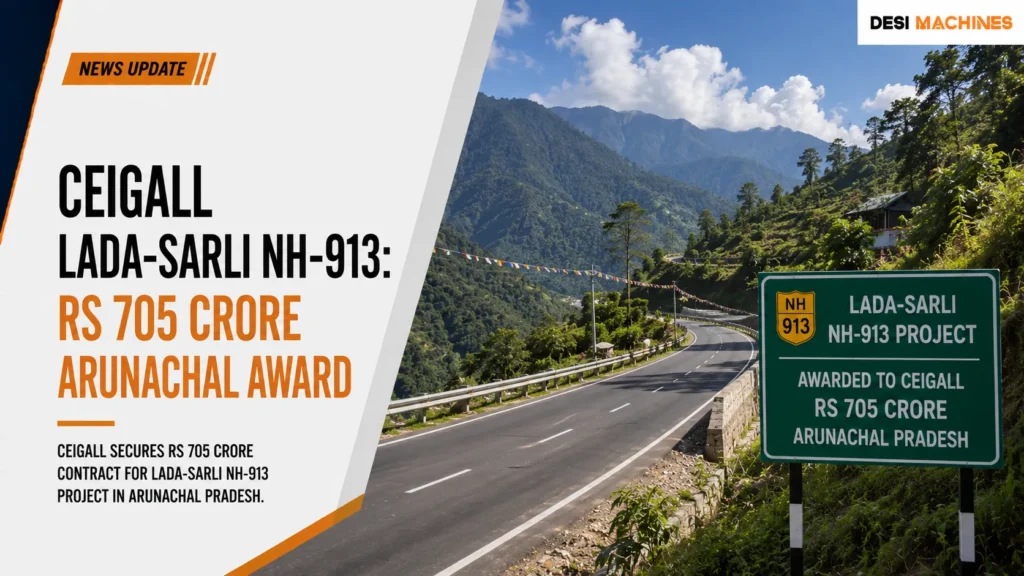
Ceigall India and Sushee Infra & Mining have taken a Rs 704.70 crore letter of acceptance from the road ministry for the Lada-Sarli section of NH-913, the Frontier Highway in Arunachal Pradesh. At 82.4 km it is the longest single Frontier Highway package this desk has tracked, and it closes out a package we flagged as still unawarded a week ago. It also arrives wrapped in a cumulative order figure that does not add up.
The quick facts
- Rs 704.70 crore, excluding GST, awarded by the Ministry of Road Transport and Highways.
- Ceigall India holds 74 per cent of the joint venture, Sushee Infra & Mining the remaining 26 per cent.
- Lada-Sarli section of NH-913, km 85.60 to km 168.00, roughly 82.4 km, built to intermediate-lane standard on EPC terms.
- Company-stated 48-month construction period, followed by a five-year maintenance obligation.
What Ceigall disclosed
The award reached the market through Ceigall’s exchange disclosure on 24 August. The Free Press Journal, ThePrint, the Economic Times and Business Standard’s capital-market desk carried the same value, the same 74:26 split and the same chainage band. The joint venture had already been named lowest bidder on this package on 8 July, so 24 August is the stage at which a bid result becomes a contractual obligation. This is a new stage, not a second telling of the July story.
Why does the order-book figure not add up?
Several carriers attached a cumulative NH-913 total of Rs 2,423.70 crore to this award and described it as Ceigall’s fifth letter on the corridor. That total is precisely the Rs 2,149.62 crore of four packages dated 17 August plus the Rs 274.08 crore Bile-Migging package dated 18 August, both of which this desk covered when they landed. It describes the position before this award, not after it. We are not publishing a corridor total, because the carriers do not agree on one.
What it means for buyers
Rs 704.70 crore across 82.4 km works out near Rs 8.55 crore a kilometre. Set that beside the two Frontier Highway rates we have already computed, roughly Rs 9 crore a kilometre on the 17 August packages and about Rs 7.3 crore on Bile-Migging Package-2, and against the Rs 1.26 crore a kilometre on nine Uttarakhand roads sanctioned this month. Three anchors, one conclusion: this is fresh formation being cut into a hill face, not widening of something that already exists.
The intermediate-lane specification sharpens the point. A narrower carriageway means less pavement per kilometre, so a rate this high is going into hill cutting, retaining and breast walls, drainage and cross structures. Pavement is the small end of this bill, which is also why a motor grader earns fewer hours here than it would on a plains alignment.
Eastern Himalaya geometry caps machine size whatever the budget allows. Expect 13 to 21 tonne excavators with rock breakers and short-shuttle tippers rather than the large crawlers a plains greenfield would pull. Formation is built up in thin lifts against a cut face, which favours smaller soil compactors and plate compactors over big single drums. Cross drainage and bridge work bring in cranes.
Our take: 82.4 km is long enough to change the calculation. The Frontier Highway awards so far have been spread across different partner combinations, but this is one continuous 82 km front under a single joint venture, and it is the first package on this corridor big enough to argue for owning iron rather than hiring it. Machines that go into Arunachal stay there, so mobilisation, spares, operator housing and diesel haulage all sit inside the quoted rate. Remember too that 48 months of contract is not 48 months of earthwork once the Arunachal monsoon is taken out of the calendar.
What to watch
- The appointed date. A letter of acceptance is not a signed contract, and mobilisation money moves only once the contract is executed.
- Whether Ceigall discloses a revised NH-913 order-book total, which would settle the figure carriers currently disagree on.
- The post-monsoon window from October, when hill earthwork fronts on this alignment can realistically open.
Planning for hill-road work? Compare excavator and compactor classes suited to constrained hill formation on DesiMachines, and check current project opportunities before you commit to a machine purchase.
FAQ
Is this the same Ceigall NH-913 award reported earlier in August?
No. The 17 August letters covered four packages worth Rs 2,149.62 crore, and 18 August brought Package-2 of the Bile-Migging section at Rs 274.08 crore. The Lada-Sarli package runs from km 85.60 to km 168.00 and is a separate award at Rs 704.70 crore.
When is machine work likely to start?
The 48-month period runs from an appointed date that has not been announced. Hill earthwork in Arunachal Pradesh realistically opens after the monsoon, so October onwards is the window to track.
What machine classes does an intermediate-lane hill road pull?
Mostly 13 to 21 tonne excavators with rock breakers, short-shuttle tippers, smaller soil and plate compactors for thin-lift work, and cranes for cross drainage and bridge structures. Hill geometry caps machine size more than the contract value does.
Related on DesiMachines: Ceigall NH-913 Package 2: Rs 274 crore Bile-Migging award
Source: Free Press Journal

 Excavator
294 models
Excavator
294 models  Backhoe Loader
51 models
Backhoe Loader
51 models  Crane
68 models
Crane
68 models  Concrete Mixer
79 models
Concrete Mixer
79 models  Wheel Loader
54 models
Wheel Loader
54 models  Compactor / Roller
45 models
Compactor / Roller
45 models  Motor Grader
42 models
Motor Grader
42 models  Dozer
41 models
Dozer
41 models  Concrete Pump
66 models
Concrete Pump
66 models  Skid Steer Loader
11 models
Skid Steer Loader
11 models  Telehandler
13 models
Telehandler
13 models