
 Excavator
294 models
Excavator
294 models  Backhoe Loader
51 models
Backhoe Loader
51 models  Crane
68 models
Crane
68 models  Concrete Mixer
79 models
Concrete Mixer
79 models  Wheel Loader
54 models
Wheel Loader
54 models  Compactor / Roller
45 models
Compactor / Roller
45 models  Motor Grader
42 models
Motor Grader
42 models  Concrete Pump
66 models
Concrete Pump
66 models  Skid Steer Loader
11 models
Skid Steer Loader
11 models  Telehandler
13 models
Telehandler
13 models  Dozer
Dozer 


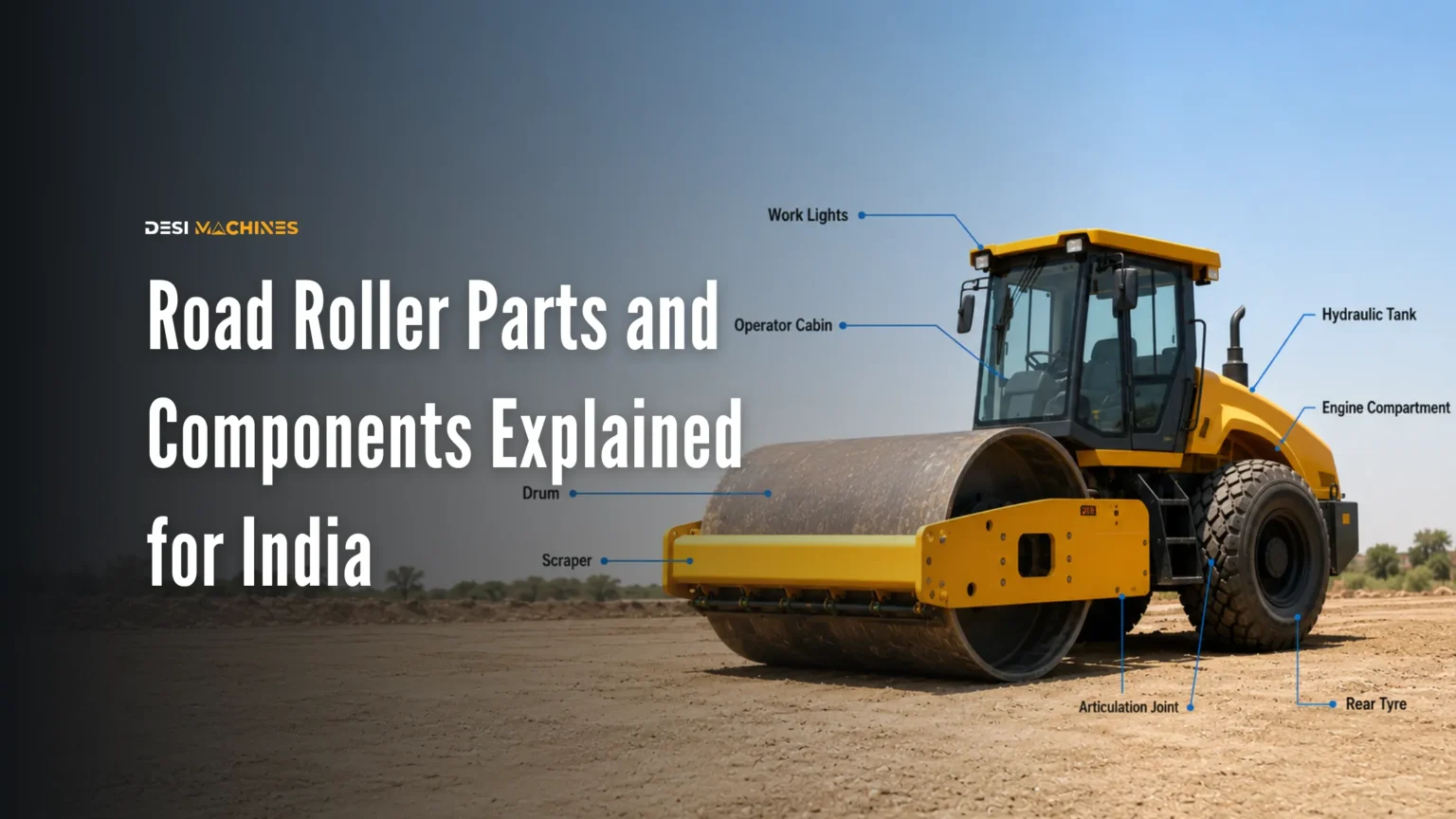
A road roller is a compaction machine that presses soil, gravel or asphalt down with a heavy steel drum so the layer underneath becomes dense and stops settling. Its parts fall into five groups: the drum, the vibration unit hidden inside that drum, the engine and hydraulic drive, the water spray system, and the frame that carries the operator. Learn those five and you can follow almost any roller on an Indian site, from a 1.5 tonne baby roller to a 22 tonne soil compactor.
This guide names each part, says what it does in plain words, and gives the real figures published for the 45 compactors listed on DesiMachines — 21 single drum soil compactors, 20 tandem rollers and 4 pneumatic tyre rollers. If you are still deciding which machine you need, the types of road rollers guide covers that first question.
What are the main parts of a road roller?
The main parts of a road roller are the drum, the eccentric vibration unit inside it, the diesel engine, the hydrostatic pumps and motors that drive the machine, the articulation joint that steers it, the water tank and spray bars, the rear tyres, and the operator’s platform. A single drum soil compactor has one steel drum in front and rubber tyres at the back. A tandem roller has a steel drum at each end. A pneumatic tyre roller, which everyone on site calls a PTR, has no drum at all. It runs on two rows of smooth rubber tyres.
| Part | What it does | Where it sits |
|---|---|---|
| Drum (roll) | The heavy steel cylinder that does the compaction | Front on a soil compactor; front and rear on a tandem |
| Drum shell | The outer steel skin of the drum, the surface that touches the ground | Wrapped around the drum |
| Eccentric shaft and weights | An off-centre weight that spins fast and makes the drum shake | Sealed inside the drum |
| Vibration motor | A hydraulic motor that spins the eccentric shaft | At one end of the drum |
| Diesel engine | Turns the pumps. It never drives the wheels directly | Rear frame, under the bonnet |
| Hydrostatic pump and drive motors | Push oil to motors in the drum and rear axle to move the machine | Engine bay, drum, rear axle |
| Articulation joint | The hinge in the middle that lets the machine bend to turn | Between front and rear frames |
| Water tank, pump and spray bars | Wet the drum or tyres so hot asphalt does not stick | Tandem rollers and PTRs |
| Scraper bars | Blades that scrape mud and tar off the drum as it turns | Front and back of each drum |
| Rear tyres | Give grip (traction) and carry the back half of the weight | Rear axle of a soil compactor |
| Operator platform, seat and canopy | Where the operator sits, steers and sets the vibration | Rear frame |
| Fuel and hydraulic oil tanks | Hold the diesel and the hydraulic oil the whole machine runs on | Rear frame |
Two of these confuse first-time buyers. Traction simply means grip: how well the machine pulls itself up a slope without slipping. And hydrostatic means the engine turns a pump, the pump sends oil to a motor, and the motor turns the wheel or drum. There is no gearbox and no clutch in between.
What is the drum of a road roller made of, and how thick is it?
The drum is a hollow steel cylinder, and the thickness of that steel is published as the drum shell thickness. On the 21 single drum soil compactors listed on DesiMachines it runs from 20 mm to 40 mm; on the 20 tandem rollers it is thinner, 12 mm to 19 mm. That difference is not a shortcut by the maker. A soil compactor beats rock and hard-packed earth all day, so its shell has to survive more abuse than a tandem drum rolling warm asphalt.
Drum width tells you how much ground you cover in one pass. Soil compactors are all built around one width band, while tandems vary hugely because the class runs from baby rollers to 10 tonne machines.
| Machine type | Drum width | Drum diameter | Shell thickness | Operating weight |
|---|---|---|---|---|
| Single drum soil compactor (21 models) | 2,100–2,150 mm (about 2.1 m) | 1,500–1,600 mm | 20–40 mm | 9,700–22,000 kg (9.7–22 tonne) |
| Tandem roller (20 models) | 800–1,750 mm | 588–1,250 mm | 12–19 mm | 1,575–10,060 kg (1.6–10 tonne) |
| Pneumatic tyre roller (4 models) | No drum. 8 or 9 rubber tyres | Not applicable | Not applicable | 10,500–18,000 kg (10.5–18 tonne) |
Figures above are taken from the specification tabs of the machines listed at the time of writing. A soil compactor drum is also either smooth or fitted with steel feet, called a padfoot drum, and that choice depends entirely on your soil, and the soil compactor guide walks through it.
What is inside the drum of a vibratory roller?
Inside the drum sits an eccentric shaft: a shaft with a heavy weight bolted off-centre. A hydraulic motor spins that shaft a few thousand times a minute, and because the weight is off-centre the whole drum shivers up and down. That shiver is what turns a heavy machine into a compaction machine. The dead weight alone would press the top layer; the shaking pushes energy deep and shuffles the soil grains together. The physics is explained in more detail in our vibratory roller guide.
Four numbers on a spec sheet describe what that eccentric does, and they are the numbers a buyer should actually read.
| Spec sheet figure | Single drum soil compactor | Tandem roller | What it means in plain words |
|---|---|---|---|
| Vibration frequency | 29–42 Hz | 30–70 Hz | How many times the drum hits the ground each second |
| Nominal amplitude (high / low) | 1.2–2.08 mm high; usually 0.6–1.0 mm low | 0.35–1.3 mm | How far the drum lifts off the ground on each hit |
| Centrifugal force | 204–390 kN | 17–130 kN | The extra hammering force the shaking adds |
| Static linear load | 23.7–69 kg/cm | 9.3–30.9 kg/cm (front / rear) | Dead weight pressing down on each centimetre of drum width |
Notice the pattern. Soil compactors shake slowly and hard (low frequency, big amplitude, up to 390 kN of force) because they are pushing energy a foot or more into raw earth. Tandem rollers shake fast and gently, up to 70 Hz but with amplitude as small as 0.35 mm, because asphalt only needs the top layer worked and a hard blow would tear the mat.
Almost every machine gives the operator two settings, listed as high and low amplitude; all 18 tandem rollers that publish a vibration stage figure list two stages. Six of the 21 soil compactors publish exactly 1.8 mm / 0.9 mm, which is close to the Indian standard for this class. One machine is different in a useful way: the Volvo SD110 lists a variable 0–30 Hz frequency instead of two fixed steps.
Use the high setting on thick, loose fill. Use the low setting on the last passes, on thin layers, and anywhere near a building or a canal lining. Heavy amplitude next to a structure cracks it.
How does a road roller move itself?
A road roller moves on a hydrostatic drive, not on gears. The diesel engine turns a pump, the pump sends high-pressure oil to motors sitting in the drum and in the rear axle, and those motors turn. 19 of the 21 soil compactors listed name their transmission simply as hydrostatic. This is why a roller creeps forward smoothly, stops the moment you centre the lever, and never needs a clutch.
| Item | Single drum soil compactor | Tandem roller | Pneumatic tyre roller |
|---|---|---|---|
| Engine power | 74–197 HP (55–147 kW) | 24–99 HP (18–74 kW) | 99–131 HP (74–98 kW) |
| Fuel tank | 196–315 litres | 23–220 litres | 180–320 litres |
| Hydraulic oil tank | 52–150 litres | 40–90 litres | 60–105 litres |
| Steering angle | ±33° to ±40° | ±27° to ±40° | ±32° (published on one model) |
| Frame oscillation | ±9° to ±17° | ±6° to ±13° | ±4° (published on one model) |
Engines come from the usual Indian suppliers — KOEL, Ashok Leyland, Mahindra MTorque, Weichai, Cummins, John Deere, Kubota and VECV appear across these listings, most of them built to CEV Stage IV or Stage V emission norms. The BS-CEV emission norms guide explains what those stages change for an owner.
Two more parts belong here. Oscillation is the small twist allowed at the joint between the front and rear halves, so that when one rear tyre climbs a stone the drum stays flat on the ground. And the parking brake on most of these machines is SAHR — spring applied, hydraulically released. A spring clamps the brake shut, and oil pressure from the running engine holds it open. Kill the engine and the brake locks itself. That is the behaviour you want on a slope.
Looking for a machine rather than a lesson? Compare the road rollers and compactors available in India and talk to a dealer directly.
Why does a road roller have a water tank?
The water tank feeds spray bars that keep the drum or the tyres wet, so hot asphalt does not stick to them and tear the fresh mat behind the machine. It is an asphalt part, not an earthwork part, and the published specifications show exactly that split. How many litres each type actually carries, and how that compares with the diesel tank, is set out in the road roller fuel tank and water tank capacity guide.
| Machine type | Water tank | Spray arrangement |
|---|---|---|
| Single drum soil compactor | None published on any of the 21 models | Not fitted. These machines work on soil, not asphalt |
| Tandem roller | 110–1,000 litres (18 of 20 models publish it) | Pressure or sprinkler spray, pump-fed, with non-clogging nozzles |
| Pneumatic tyre roller | 530–700 litres | Nozzles per tyre, plus mats that wipe each tyre |
The detail worth knowing before you buy: tank size decides how long you can keep rolling before someone has to fetch water. A JCB VMT330 carries 210 litres, while an Ammann ARX 90.2 carries 1,000 litres. On a highway job far from a water source, that gap decides your day.
The spray system also has the parts that fail most often on a rented machine: the water pump, the filters in the fill neck, and the nozzles. Nozzles block with silt when the tank is filled from a pond. The Volvo PT220 handles the problem differently, using coco mats that wipe each tyre instead of relying on spray alone.
What are the parts of a pneumatic tyre roller?
A pneumatic tyre roller compacts with rubber instead of steel, so its key parts are the tyres, the ballast box and the water spray system. The tyres are smooth, arranged in two rows, and set so the rear row runs over the gaps left by the front row, and that overlap is published as a spec. Because rubber flexes, a PTR kneads the surface and closes it up, which is why it usually follows a tandem roller on a bituminous layer. The full picture is in our pneumatic tyre roller guide.
| Model | Tyres | Tyre size | Working weight | Ballasted weight |
|---|---|---|---|---|
| SANY SPR260C-10 PRO | 9 | 12-20 | 18,000 kg | 26,000 kg |
| L&T 2490 HD | 8 | 11.00-20 18 PR | 12,800 kg | 24,000 kg |
| Dynapac CP275 | Not specified | Not specified | 14,000 kg | 30,000 kg |
| Volvo PT220 | Not specified | Not specified | 10,500 kg | 24,000 kg |
The ballast box is the part that makes a PTR unusual. It is a compartment you fill with water, sand or steel plates to add weight, and the difference is large: the L&T 2490 HD goes from 12,800 kg empty to 24,000 kg ballasted, and the Dynapac CP275 from 14,000 kg to 30,000 kg. You are effectively changing the weight class of the machine on the job itself.
Tyre pressure is the second control. Both machines that publish it allow 2 to 8 bar. Low pressure gives a soft, wide footprint for the early passes; high pressure gives a hard, narrow one for the finish. And because each tyre carries around 2,900–3,300 kg, a worn or under-inflated tyre wears out early and leaves a visible line in the finished surface.
Which road roller parts wear out first?
The parts that go first are the ones in contact with the ground, the water or the operator’s hands: drum scraper bars, spray nozzles and their filters, the water pump, rear tyres, hydraulic hoses at the articulation joint, and the drum bearings and vibration-unit seals. None of that is a surprise, and all of it is cheap compared with what it protects.
Three checks are worth doing yourself before an operator or your mistri reports anything:
- Drum bearings and eccentric seals. Oil weeping from the ends of the drum, or a rumble that changes when vibration is switched on, means the sealed unit inside is in trouble. This is the most expensive repair on the machine, and the one people ignore longest.
- Hoses at the articulation joint. They flex every time the machine turns, so they crack there first. Look for shine, cracking or damp patches where a hose bends.
- Scrapers and nozzles. A worn scraper leaves tar building up on the drum, and blocked nozzles leave dry patches that pull the mat. Both take minutes to sort and both ruin a surface if left.
Fit these into the machine’s own hour-based routine rather than checking when something sounds wrong. Our construction equipment service schedule sets out the 250, 500 and 1,000-hour intervals, and the hydraulic system maintenance guide covers oil and filter care for the drive circuit that runs everything on a roller.
When something does need replacing, fit a part that meets the maker’s specification. What to check before you fit it is covered in the construction equipment spare parts guide.
Read next
If you now want to pick a machine rather than understand one, start with the compactor buying guide, then browse the single drum soil compactors, tandem rollers and pneumatic tyre rollers listed in India. For a small job, the mini roller or baby roller may be all you need, and if the work is a one-off, hiring a road roller is often the cheaper answer. If you are buying second-hand, the used road roller buying guide explains which of these parts decide what the machine is worth.
The same anatomy treatment for the other common machine on an Indian site is in backhoe loader parts and components, and the rest of this pillar sits in the parts and running costs guides.
Ready to buy? See every road roller and compactor listed in India and get a quote from the dealer nearest you.
For what that articulation joint is rated to do on each machine, see the published steering angle, oscillation and turning radius figures in road roller steering and turning radius.
If that rumble turns out to be the vibration failing altogether, the checks that separate a real fault from a wrongly set machine are laid out in our guide to a road roller vibration problem.
Scrapers and nozzles are also the parts that fail most often in service, and the fault-finding order for a dead spray is set out in the guide to the road roller water spray system.
Specifications quoted here are taken from the machines listed on DesiMachines at the time of writing (Aug 2026). Prices, specifications and features are indicative, vary by variant, location and date, and should always be confirmed with the official OEM or authorised dealer before any purchase decision. DesiMachines is not liable for decisions taken on the basis of information that may have changed after publication.