
 Excavator
294 models
 Backhoe Loader
51 models
 Crane
68 models
 Concrete Mixer
79 models
 Wheel Loader
54 models
 Compactor / Roller
45 models
 Motor Grader
42 models

 Concrete Pump
66 models
 Skid Steer Loader
11 models



When a bitumen road ruts at the same junctions every summer, and each new coat of tar wears out sooner than the last, many Indian cities turn to whitetopping: a cement concrete slab laid straight on top of the old bitumen road, without digging it out. The Indian Roads Congress guideline for it, IRC:SP:76-2015, sorts whitetopping by thickness into conventional (200 mm or more), thin (more than 100 mm but less than 200 mm) and ultra-thin (100 mm or less), and that thickness decides how the slab is bonded, jointed and laid.
What is whitetopping in road construction?
IRC:SP:76 defines whitetopping as a Portland cement concrete (PCC) overlay built on top of an existing bituminous pavement, to rehabilitate it or make it stronger. An overlay is simply a new layer placed over an old road. The old bitumen is not thrown away. It stays in place and becomes the base the new slab rests on, in much the same way a dry lean concrete (DLC) layer sits under a new concrete highway.
The name comes from the colour. A bitumen road is black, a concrete surface is pale grey, and covering one with the other is called whitetopping.
The code gives the Indian reason plainly. Rutting, the grooves wheels press into bitumen, is a real problem in a hot climate with heavy trucks that keep stopping and starting. Concrete does not soften in the afternoon sun, so it does not rut.
A concrete layer on an old concrete road is not whitetopping, and IRC:SP:76 leaves that job out of its scope.
What are the types of whitetopping?
The code names three types. Thickness is the headline difference, but the real difference is whether the new concrete is meant to stick to the old bitumen and work with it.
| Type | Concrete thickness (IRC:SP:76 cl 1.4) | Bond with the old bitumen | Joint spacing | Where the code places it |
|---|---|---|---|---|
| Conventional whitetopping | 200 mm (8 inches) or more | Not counted on. Designed like a new concrete road, with the bitumen treated as a sub-base | 4 to 4.5 m, with dowel bars at the joints | Medium to heavily trafficked arterial roads |
| Thin whitetopping (TWT) | More than 100 mm, less than 200 mm | Wanted, and usually achieved in part, though the design may ignore it | 1.0 to 1.5 m, square panels preferred | Rural roads, MDR, SH and low-traffic NH, junctions, toll plazas, bus bays |
| Ultra-thin whitetopping (UTWT) | 100 mm (4 inches) or less | Essential. The old surface is milled about 25 mm deep to make it grip | 0.6 to 1.25 m | Generally not recommended in India, except closely controlled colony roads |
Ultra-thin overlays of 50 to 75 mm are generally not recommended for India, the code says, because small towns may lack the skill to lay such thin, high-grade concrete and an overloaded truck can always turn up. Most Indian whitetopping is therefore thin whitetopping, the type the rest of this guide describes.
Wikipedia’s article on whitetopping draws the same lines: 20 cm or more for unbonded overlays, 10 to 15 cm for thin bonded ones, and at least 7.5 cm of asphalt underneath.
Figure 1: What sits under a thin whitetopping slab
The dashed line is the bond the method depends on: milled, cleaned bitumen gives the concrete a rough face to grip, so the two layers bend together. Figures from IRC:SP:76 clauses 4.1.1, 6.2, 8.1 and 9.1.
When can an old bitumen road be whitetopped?
Not every tired road qualifies. IRC:SP:76 says whitetopping should not be done where the continuity of support underneath is in doubt, and that the existing surface should be sound, free from wide cracks, material defects and isolated subgrade failures. A concrete slab bridges small weaknesses well. It cannot float over a soft patch that keeps sinking.
For thin whitetopping the code adds a hard number: at least 75 mm of hot-mix bitumen must remain after milling, and 100 mm or more is preferred. Where the bitumen is thinner, a profile correction course of bituminous macadam can be laid, after a tack coat, to bring the total up to 75 mm. Isolated spots with heavy rutting or subgrade failure are cut out and rebuilt with M10 lean concrete before the overlay goes on.
Before deciding, the engineer takes cores or trial pits to find each layer’s thickness, maps the defects, measures how much the road bends under a wheel with a Benkelman beam, and checks drainage, black cotton soil, traffic and any limit on the finished road level.
For conventional whitetopping, which does not rely on the bond, the code reproduces a simple repair guide from the American Concrete Pavement Association. The defect names are explained in the guide to types of pavement failure.
| Condition of the old bitumen road | Repair before conventional whitetopping (IRC:SP:76 Table 1) |
|---|---|
| Rutting under 50 mm | None, or milling |
| Rutting of 50 mm or more | Milling or a levelling course |
| Shoving (the surface pushed into waves) | Milling |
| Potholes | Fill with a crushed stone cold or hot mix |
| Subgrade failure | Remove and replace, or repair |
| Alligator, block, transverse or longitudinal cracking, ravelling, bleeding | None needed for conventional whitetopping |
If the base itself has failed over long stretches, an overlay of any kind will crack along with it. That road needs its base rebuilt first, by patch repair or by a full-depth method such as full depth reclamation.
How is whitetopping done, step by step?
The order below follows IRC:SP:76 clauses 9 and 10 for thin whitetopping.
- Mill the old surface. A cold milling machine cuts 25 to 50 mm off the bitumen. That removes the ruts, leaves a rough face for the concrete to grip and keeps the finished level down at kerbs and under bridges (see cold milling of bituminous pavement). Without a milling machine, the code allows a bituminous macadam profile correction course of at least 50 mm, laid after a tack coat.
- Repair what milling exposes. Cracks are sealed with hot bitumen; where the subgrade has clearly failed, the patch is dug out and rebuilt.
- Clean the surface. Air blasting, power brooming or water blasting, then a water flush, so no dust is left to spoil the bond.
- Fix the formwork. Steel channels go along the edges; the code does not favour kerb stones. A cement slurry may be brushed on just before the concrete.
- Place and compact the concrete. Small jobs are done semi-mechanised, with a screed vibrator and needle vibrators. Bigger ones use a fixed-form paver or a slip form paver, chosen by project size and the space on site.
- Texture the surface. Just after the water sheen disappears and before the concrete stiffens. A burlap drag or coarse broom suits low-speed city streets; tining, a rake that cuts fine grooves, suits fast roads.
- Cure at double rate. A thin slab dries fast, so the code asks for curing compound or water at twice the normal rate, starting within about an hour of laying.
- Cut the joints, then seal them. Saw cuts go in 6 to 18 hours after laying, as soon as the slab can carry the saw and its crew. Because there are so many joints, the code suggests skip sawing: cut every other joint first, then the ones in between.
For conventional whitetopping in summer, the black surface is first whitewashed with lime slurry or white curing compound to keep it cool, and the code says no overlay should be paved above 35°C.
What grade of concrete is used for whitetopping?
The minimum is M40, meaning a characteristic compressive strength of 40 MPa at 28 days, and IRC:SP:76 says M50 high-performance concrete is normally preferred. A road slab fails by bending, though, so the figure that really matters is flexural strength, the stress at which a beam of the concrete cracks under a bending load. The code sets 4.5 MPa as the minimum and prefers 5.0 to 6.0 MPa.
That is a step above a plain village concrete road, where the CC road construction code asks for M30 and a flexural strength of 3.8 MPa. Whitetopping needs the extra strength because its slab is thinner.
The rest of the mix, as the code describes it:
- a water cement ratio below 0.40, preferably 0.30 to 0.38;
- a stiff mix with a slump of 25 to 50 mm, made workable with a superplasticiser instead of extra water;
- cement content not above 450 kg per cubic metre, because the strength comes from cutting the water, and extra cement only adds heat and shrinkage;
- coarse aggregate no bigger than 31.5 mm;
- fibres to control early cracking: macro polymeric fibres 30 to 60 mm long at 0.5 to 1.5 per cent of the concrete volume, which the code converts to 4.5 to 14 kg per cubic metre.
The Pune job the code describes used M40 with polypropylene fibres, 420 kg of cement per cubic metre and a water cement ratio of 0.37, mixed at a ready-mix plant.
Why does whitetopping use such small panels?
A whitetopped street is a grid of squares roughly a metre across, and the short panels are the design.
When the concrete is bonded to the bitumen, the two layers bend as one thicker unit, and much of the concrete ends up in compression, where it is strong. That is why a thin slab can carry the load. Short panels then cut the two other stresses a slab faces: curling, when the top and bottom of the slab are at different temperatures, and warping, the same thing caused by moisture. Under IRC:SP:76, the main failure seen on thin whitetopping is the corner break, often after a panel corner has curled upward on a cool night and lost its bond.
Very short panels on a thin base deflect too much, though, so the code recommends 1.0 to 1.5 m for Indian conditions, with the long side of a panel no more than 1.2 times the short side. One more effect of short panels: below about 1.30 m, the two axles of a tandem-axle truck never stand on one panel at the same time.
| Joint detail | IRC:SP:76 requirement (thin whitetopping) |
|---|---|
| When to cut | 6 to 18 hours after laying, depending on the concrete grade and admixtures |
| Cut depth and width | One third of the slab depth, 3 to 5 mm wide (10 mm at a transverse construction butt joint) |
| Panel shape | Long side no more than 1.2 times the short side |
| Tie bars at a longitudinal construction joint | Deformed steel, 10 mm diameter, 500 mm long, at 750 mm spacing, dipped in cement slurry, with about 50 mm of concrete cover |
| Dowel bars, slab under 150 mm | May be left out |
| Dowel bars, slab 150 to 200 mm | At bridges, where the slab meets another pavement and at transverse construction joints: plain mild steel with plastic sheathing, 25 mm diameter, 500 mm long, at 300 mm centre to centre |
| Sealing | An approved high-quality joint sealant, as detailed in IRC:15 and IRC:57 |
A tie bar is a ribbed bar that holds two lanes together. A dowel bar is a smooth bar that lets two panels open and close with the weather while keeping their edges level. In short panels most of the load crosses each joint through the interlocking stones on its cracked face, helped by the old road underneath, so dowels can often be left out.
How long before a whitetopped road opens to traffic?
The code’s default is 28 days, or whatever age the concrete reaches a compressive strength of at least 28.0 MPa.
Fast-track concrete shortens that. IRC:SP:76 describes mixes that reach two thirds of their strength within 48 hours and can open within 72 hours, often to light vehicles first, with wet curing continuing under traffic. The code suggests this for busy junctions and underpasses where traffic cannot be diverted.
The other common answer is to build one half at a time. On the Pune road described in the code, a 4 m strip was cast first and the second 4 m strip followed only after the first had been cured and its joints sealed, about 21 days later. Traffic used the other half meanwhile.
What are the advantages and disadvantages of whitetopping?
The benefits IRC:SP:76 lists are long life and low maintenance, so fewer lane closures; ruts filled and kept from coming back; far less cracking in hot weather; a pale surface that reflects headlights and absorbs less heat; and lower fuel use than on bitumen. Conventional and thin whitetopping carry a design life of 15 to 20 years.
The drawbacks are mostly practical, and they matter most in towns:
- The road comes up. Drains, inlets and manhole covers all have to be raised. House and shop entrances may need small ramps so rain does not run in.
- Utilities need planning first. The code’s urban appendix lays cross pipes of 300 and 450 mm diameter every 50 m and paver-block strips over service lines, so they can be reached without breaking the slab.
- The road is closed or half-closed while it cures, normally for weeks.
- Bond is everything. Panels that lose their bond tend to crack at the corners, and the usual repair is replacing the whole panel.
Which machines does a whitetopping job need?
Road machines and concrete machines share the stretch. Roughly in the order they arrive:
- a cold milling machine for the 25 to 50 mm cut, followed by tippers to carry away the millings;
- an air compressor, power broom and water tanker for cleaning;
- a backhoe loader such as the JCB 3DX for cutting out failed patches, raising drains and laying cross pipes;
- a ready-mix plant and transit mixers for the M40 concrete;
- a screed vibrator and needle vibrators, or a fixed-form or slip form paver on bigger jobs, plus a power trowel or float;
- a concrete joint-cutting saw, a texturing broom or tining rake, and curing equipment.
Transit mixers are the machines that set the pace. A single 3.5 m lane, 1 km long, with a 150 mm slab holds 3,500 m² × 0.15 m = 525 m³ of concrete. That is about 88 loads in a 6 m³ mixer, 75 in a 7 m³ mixer or 53 in a 10 m³ mixer. For example, the Schwing Stetter AM 6 (C2) has a nominal filling capacity of 6.0 m³, the AJAX AF 7XE 7.0 m³ and the Putzmeister P10 PTO 10.0 m³, as per their current (Oct 2026) specifications.
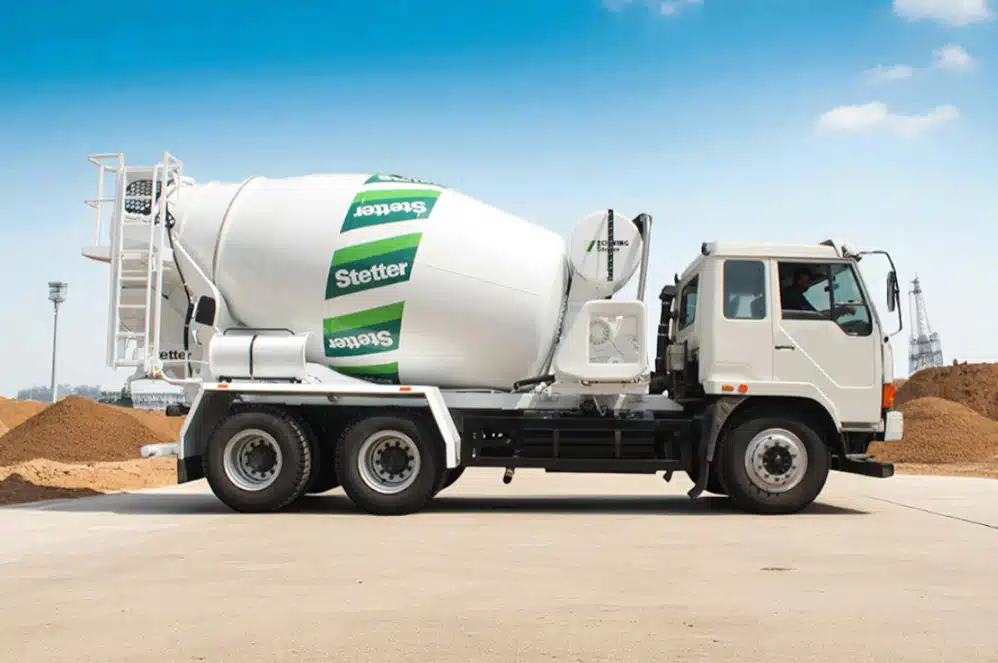
Compare transit mixer models and drum sizes with a dealer, and see machinery required for road construction for a whole road package.
Where has whitetopping been used in India?
IRC:SP:76 records successful projects in Pune, Mumbai, Delhi, Nagpur, Jaipur and Bangalore. Its worked example is Pune, which began thin whitetopping in 2008 and by the 2015 revision had built 75 to 80 km of roads, about 9 lakh square metres (900,000 m²). The 125 mm overlays of 2008 were still in excellent condition, and heavier roads had since received 175 mm.
The road the code describes runs past the Shivajinagar State Transport depot and carries more than 5,000 buses a day. It got 175 mm of M40 after 50 to 60 mm of milling, cut into 1 m × 1 m panels within 24 hours, with dowels only at construction joints and tie bars only along the centre line.
Can a village road be whitetopped?
Yes, and the code suggests it directly. Damaged metalled village roads are usually revived with a WBM or WMM layer topped with a carpet and seal coat. IRC:SP:76 clause 13.2 offers a concrete overlay of 75 to 100 mm with 1 m × 1 m panels as an alternative that would meet the need and prove economical.
Thin concrete needs good quality control and protection from overloaded trucks, which is easier on a village road than on a town bypass. A village road built new is a CC road job instead.
Whitetopping or another bitumen layer: which suits your road?
Whitetopping fits where a stretch keeps rutting under heavy, stop-start traffic, the base is sound, at least 75 mm of bitumen will remain after milling, and the road can be closed in halves for a few weeks. Junctions, bus depots and toll plazas are the classic cases.
Another bitumen layer is still the quicker fix where the road cannot close for long, levels cannot rise, or the base is failing. More on both kinds of road is in the road construction guides.
Where the figures in this guide come from. Code figures, the Pune project and the village-road clause are from IRC:SP:76-2015, Guidelines for Conventional and Thin Whitetopping (first revision), read in full; thickness classes are corroborated by Wikipedia. Mixer capacities are each model’s nominal filling capacity as listed at the time of writing. The 525 m³ lane volume and load counts are our own arithmetic.
Prices, specifications and features are indicative, vary by variant, location and date, and should always be confirmed with the official OEM or authorised dealer before any purchase decision. DesiMachines is not liable for decisions taken on the basis of information that may have changed after publication.
Machines, tenders and news for this industry: Road Construction