
 Excavator
294 models
Excavator
294 models  Backhoe Loader
51 models
Backhoe Loader
51 models  Crane
68 models
Crane
68 models  Concrete Mixer
79 models
Concrete Mixer
79 models  Wheel Loader
54 models
Wheel Loader
54 models  Compactor / Roller
45 models
Compactor / Roller
45 models  Motor Grader
42 models
Motor Grader
42 models  Dozer
41 models
Dozer
41 models  Concrete Pump
66 models
Concrete Pump
66 models  Skid Steer Loader
11 models
Skid Steer Loader
11 models  Telehandler
13 models
Telehandler
13 models 


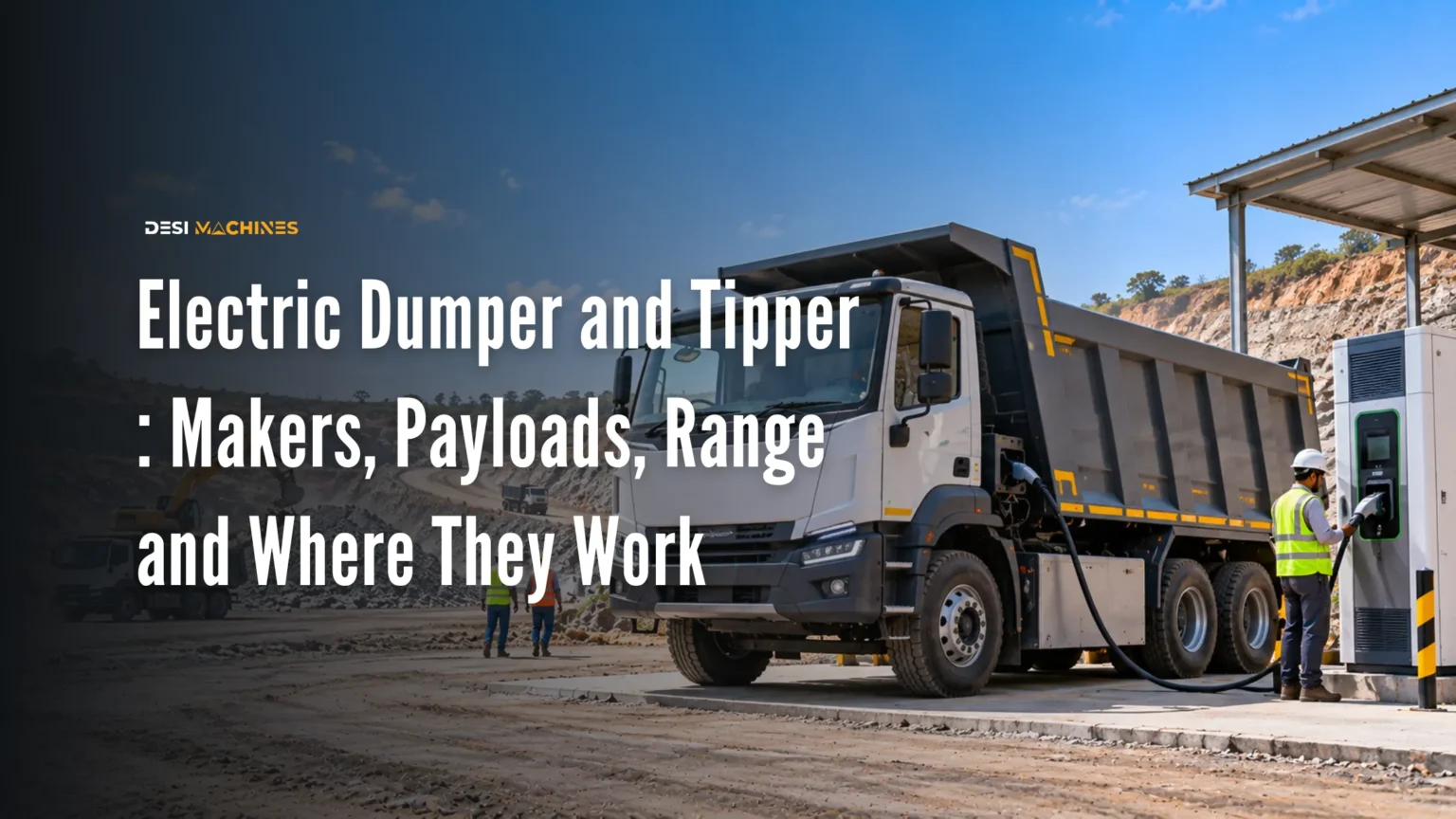
An electric dumper is a tipping-body haulage machine driven by a battery and an electric motor instead of a diesel engine. In India the word covers three machines that sit a long way apart: a road-going electric tipper registered with the RTO, an off-highway electric dump truck that works inside a mine lease, and an electric tractor-trailer on a fixed plant-to-plant run. All three move material. What separates them is where they are allowed to go, and how they get their energy back.
Two words first, because Indian site language mixes them freely. A dumper or tipper is a truck whose body tips to empty the load. A dump truck in mining usually means a much larger rigid off-highway machine that never goes on a public road. Both are called dumpers on site, and that is why one question about an electric dumper can have three unrelated answers.
What does an electric dumper mean in India?
It means one of three machine families, and the job decides which one you are actually asking about.
The road tipper. A registrable truck with a tipping body, usually a 6×4, rated by gross vehicle weight and registered with the RTO like any other truck. Gross vehicle weight, or GVW, is the loaded weight of the vehicle including its own body and the material on it.
The off-highway dump truck. A rigid mine truck rated by payload rather than GVW, because it never leaves the lease and never needs a registration. These are the machines mine operators call dumpers, and they are far bigger than road rules would allow.
The closed-loop tractor-trailer. Not a tipper at all, but it does the same haulage work on a fixed route between a plant and a grinding unit or a port. Cement and steel plants are the natural users, because they already run fixed routes between their own units.
A fourth family is worth naming so you can rule it out. The cable-electric mining excavator and shovel runs on a trailing power cable from the site supply rather than a battery, so it never charges and never runs flat. The BEML BE1800E works that way. It digs, though, it does not haul, so it answers a different question.
How does the battery and drive system work?
Strip away the badge and an electric dumper is four things: a battery pack, a motor, a reduction drive to the axle, and the electronics that manage all three.
The pack is measured in kilowatt-hours, written kWh. That is a quantity of stored energy, the electrical equivalent of the size of a diesel tank. Haulage packs are large, because moving tonnes up a ramp takes a lot of energy, and the pack is the single most expensive part of the machine.
The motor is rated in kilowatts, written kW. That is power, the electrical equivalent of horsepower, and one kilowatt is about 1.34 HP. Heavy electric drivelines commonly use a permanent magnet motor, which holds its pulling effort from a standstill. This is why an electric machine feels strong off the line on a ramp: there is no need to build revs or slip a clutch to get moving with a full body.
Two features follow from the design rather than from any one model. Regenerative braking turns the motor into a generator on a loaded downhill run and pushes energy back into the pack, which is worth real money on a pit ramp where the loaded leg runs downhill. And there is far less to wear out in the driveline, because an electric machine has no engine oil to change, no fuel filters, and no exhaust after-treatment to clog.
The one thing the design cannot escape is weight. A pack big enough for a shift is heavy, and every kilogram of battery is a kilogram you are carrying instead of material. That trade sits behind every payload and range figure you will be quoted.
How is an electric dumper charged, and what does the site need?
Charging is where most electric haulage plans either work or quietly fall apart, so treat it as the first question rather than the last.
A charger is rated in kW, the same unit as the motor. The arithmetic you need is simple: the pack size in kWh divided by the charger power in kW gives you roughly the hours to fill it from empty. A large haulage pack on a modest charger is an overnight job. The same pack on a high-power DC charger can fit a meal break. Nothing about the machine tells you which of those you will get, because the answer depends on the connection at your site, not on the truck.
That connection is the part buyers underestimate. A pack measured in hundreds of kilowatt-hours cannot be filled from an ordinary site board. You are looking at a sanctioned load from your distribution company, a dedicated transformer, a feeder cable run and a slab for the charger to stand on. On a mine lease with an existing high-tension supply that is routine work. On a road project that moves every few months it is close to impossible.
So the charging point is a construction project with a budget and an approval of its own, and it has to be sanctioned before the machine is ordered, not after it arrives. Ask for the sanctioned-load figure in writing and a quotation for the transformer and feeder at the same time as you ask for the machine price.
How do payload and range work on an electric dumper?
Payload and range are the two figures buyers compare, and both need reading carefully.
On a road tipper the headline number is usually GVW, the whole loaded weight. The payload, which is what you actually sell trips on, is whatever is left after the chassis, the body and the pack. Because the pack is heavy, an electric tipper’s payload can sit below a diesel truck of the same GVW class. Ask for the payload figure specifically, and ask with the body you intend to fit, because a rock body and a sand body are not the same tare weight.
On a mine truck the rating is payload directly, with body volume in cubic metres beside it, and there is no GVW question because the machine never goes on a public road.
Range is published as an “up to” figure, and that is the laboratory end of it. A fully loaded machine climbing a ramp in May heat, with the cab air conditioning running and a few minutes of idling at every load, will not see the headline. This is not an electric failing. A diesel tipper’s mileage drops on exactly the same work. The difference is that a diesel driver can top up in ten minutes and an electric one cannot.
For a mine truck a range figure in kilometres is not even the right measure. A mine truck is judged in tonnes moved per shift, so the number that matters is how many loaded trips it completes between charges. When a maker gives you a pack size and no range, that is honest rather than evasive, and the pack size is the more useful number anyway: it tells you the size of the electrical connection you will have to build.
The only test worth trusting is your own. Measure your real round trip in kilometres, count the trips in a shift, add the climb, and compare the total against a usable range, not against the headline.
Which jobs suit an electric dumper, and which do not?
An electric dumper earns its keep when the machine comes home. What matters is that the round trip has a known length and the vehicle parks in the same place, under power, at the end of every shift.
| What the job looks like | Electric fit | Why |
|---|---|---|
| Captive mine with the crusher at a fixed point | Suits well | Every trip ends in the same place, so one charging point serves the fleet |
| Port or plant yard on a fixed internal route | Suits well | Short repeatable loop, and the machine stands under power all night |
| Haul between two of your own gates, plant to grinding unit | Suits well | Known distance both ways, and you can charge at both ends |
| Batching plant feeding one site for a season | Usually suits | Fixed base, but check the round trip against usable range before you commit |
| District road work across several sites in a week | Does not suit | No fixed parking point and no sanctioned supply at any of them |
| Sand or aggregate lifting from a riverbed or a remote pit | Does not suit | Nothing to charge from, and no affordable way to move a charger with the machine |
| Hire fleet sent wherever the next job appears | Does not suit | The machine’s earning depends on a charger somebody else controls |
Two site questions settle it before any spreadsheet does. Is there a power connection where the vehicle stops, with enough sanctioned capacity for the pack? And does the vehicle return to that point every shift? If either answer is no, a diesel tipper is still the right machine, and there is no shame in saying so.
The pattern holds across the pit, which is why a captive mining operation is the fit people reach for first: fixed loading face, fixed crusher, fixed workshop, and a supply already on site for the plant.
What do you gain, and what do you give up?
| What you gain | What you give up |
|---|---|
| No diesel on the haul. Energy comes off your own sanctioned connection at an industrial tariff instead of a pump. | A charging connection you have to build: sanctioned load, transformer, feeder and slab, approved before the machine is ordered. |
| Far fewer wearing parts in the driveline. No engine oil changes, no fuel filters, no exhaust after-treatment. | Thin service reach. A diesel tipper can be fixed in most towns; a high-voltage driveline needs the maker’s own trained hands. |
| Regenerative braking recovers energy on a loaded downhill run, which is the normal direction on a pit ramp. | Range and payload pull against each other, because a bigger pack is more weight you haul instead of material. |
| Quiet, fumeless operation, which matters in a tunnel, an indoor yard, or night work beside housing. | Charging time has to fit your break and shift pattern, where a diesel machine refuels in minutes. |
| Energy you can meter and report per trip, because it arrives through your own meter. | Residual value is harder to establish than for a diesel truck, so check what a lender or a buyer will actually assume it is worth. |
| Fewer moving parts in the driveline also means fewer roadside breakdowns of the ordinary kind. | A pack is a wear item with a life of its own, warranted separately from the vehicle. |
One line is worth repeating, because it is the one that catches buyers out. The charging connection is a civil and electrical job with its own cost, and it belongs in the purchase decision rather than in the handover.
What makes an electric dumper hard to run in India?
Site power is the first wall, and it is a wall of paperwork as much as of cable. A sanctioned load takes an application, a deposit and a waiting period with the distribution company, and none of that moves faster because a machine is on order.
Runtime per shift is the second. A diesel tipper refuels in ten minutes and goes back to work, so the shift drives the fuelling. An electric one is tied to however long its charger needs, so the charge drives the shift. On a two-shift operation that reshapes the roster, and the honest version of the plan says which trips get dropped on the day the charger is slow.
Service is the third. Battery packs and high-voltage drivelines are not roadside repairs, so the question is where the nearest trained technician actually sits, in kilometres, and what the response commitment says in writing.
The fourth is the money, and it needs an honest word. Where resale evidence for a machine class is thin, the full cost of ownership is a forecast rather than a calculation. The method still works, and working through electric versus diesel running cost on an excavator shows how to lay it out: energy against diesel, service against service, and a residual value you have to argue for rather than look up. Where a lender is involved, ask early how an electric machine is valued for security, and look at equipment finance options before you commit.
What should you check before you order one?
Work through these in order, and get each answer on paper before the order goes in.
- The loop. Measure your actual round trip in kilometres, count the trips in a shift, and include the climb. Compare the total against a usable range, not against the “up to” figure.
- The connection. Get a written sanctioned-load figure from your distribution company for the point where the vehicle will park, plus a quotation for the transformer, the feeder and the slab.
- The rating that matters. On a road tipper, ask for GVW and the payload that is left after the body and the pack. On a mine truck, ask for payload and body volume. They are different questions.
- Charging time at your charger. Pack size in kWh divided by the charger power your connection can really deliver, confirmed by the maker in writing rather than estimated from a brochure.
- Registration and movement. A road tipper is registered through the RTO like any other goods vehicle, on the Ministry of Road Transport and Highways’ Parivahan portal, and needs a permit to carry goods for hire. An off-highway dump truck does not go on a public road at all, so confirm how it will be moved to site and who pays for that.
- The sheet, in writing. Pack size, motor rating, charging time, gradeability with a full load, and the tare weight of the body you are fitting. If a figure is not on paper, treat it as not promised.
- Battery warranty, separately. Packs and vehicles are often warranted on different terms, and what counts as a covered loss of capacity is the clause to read twice.
- Service distance. Nearest trained technician, nearest spare pack, and the response time you are being promised when the machine stops.
If you are weighing a purchase against hiring, putting a rented diesel tipper on the same route for a season is a cheap way to measure the loop properly before you electrify it.
Where can you already see electric machines working in India?
Electric machines arrive first where the work sits close to a power supply: digging on a fixed face, and materials handling inside a yard or a shed. That is the practical place to see the technology on a real site rather than in a brochure.
Among the electric excavators we list, the battery route includes the LiuGong 926FE EV, the SANY SY215EP and the Volvo EC500 Electric, each with the same pack-and-charger questions this guide sets out. The cable route, where the machine draws mains power through a trailing cable, sidesteps charging altogether on a fixed working face. Where the job is materials handling rather than earthmoving, electric forklifts have run on batteries for decades, so the pack and charging questions there are long settled.
For the rupee side of electric haulage, what an electric truck costs in India is the right page to take a budget question to. For the pit itself, mining equipment in India covers the machines that load these trucks, and batteries on construction machines explains how packs are looked after and what shortens their life. The wider pillar sits at electric construction machines and vehicles in India.
For the current picture of which makers and models are actually on sale, see electric tippers and dumpers on sale in India, which is dated and updated as machines are announced.
The engineering answer to “should I buy an electric dumper” does not change much from year to year. The machine suits a fixed loop with power at the end of it, the payload is whatever survives the pack, and the site connection decides everything. Where your work looks like that, the case is worth building. Where it does not, no battery will fix the route.
Prices, specifications and features are indicative, vary by variant, location and date, and should always be confirmed with the official OEM or authorised dealer before any purchase decision. DesiMachines is not liable for decisions taken on the basis of information that may have changed after publication.