
 Excavator
294 models
Excavator
294 models  Backhoe Loader
51 models
Backhoe Loader
51 models  Crane
68 models
Crane
68 models  Concrete Mixer
79 models
Concrete Mixer
79 models  Wheel Loader
54 models
Wheel Loader
54 models  Compactor / Roller
45 models
Compactor / Roller
45 models  Motor Grader
42 models
Motor Grader
42 models  Concrete Pump
66 models
Concrete Pump
66 models  Skid Steer Loader
11 models
Skid Steer Loader
11 models  Telehandler
13 models
Telehandler
13 models  Dozer
Dozer 


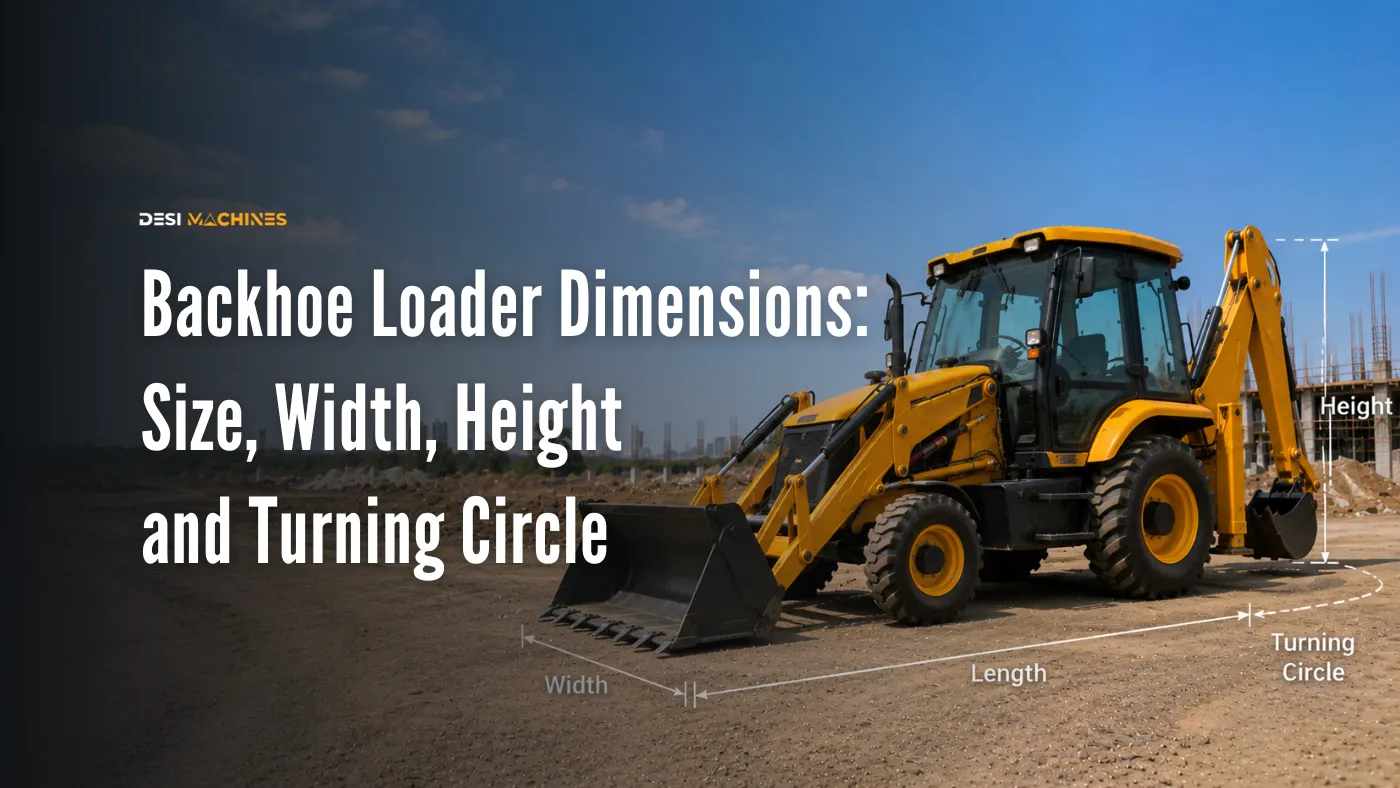
A backhoe loader’s dimensions are the machine’s overall length, width, height, wheelbase and ground clearance. Together they decide whether it can reach your site at all. Across the 51 backhoe loaders listed on DesiMachines, overall length runs about 5,500 mm to 7,800 mm (18 ft to 25 ft 7 in), width over the front bucket about 1,912 mm to 2,800 mm (6 ft 3 in to 9 ft 2 in), and transport height about 3,490 mm to 4,210 mm (11 ft 5 in to 13 ft 10 in). Machine weight sits between 5,220 kg and 9,700 kg (5.2 to 9.7 tonne).
Most first-time buyers study digging depth and engine power for weeks, then discover on delivery day that the machine cannot turn inside the plot. This guide covers the other half of the decision: the size of the machine, and how to check your gate, lane and working area before you sign anything.
Every figure below is taken from the specification sheets published on our own machine listings, current as of August 2026.
How wide is a backhoe loader?
A backhoe loader is usually 2,280 mm to 2,500 mm (7 ft 6 in to 8 ft 2 in) wide, measured across the front loader bucket, the widest part of the machine. Of the 51 machines listed, 46 publish this figure, and it spans 1,912 mm (6 ft 3 in) on the compact JCB 2DX up to 2,800 mm (9 ft 2 in) on the CASE 770 EX Plus.
Width over bucket is the number that matters for your gate. The wheels sit narrower than the bucket. Front track width across the same machines runs 1,620 mm to 2,240 mm, so a gap the tyres clear may still catch the bucket edge. Measure the bucket, not the wheels.
A practical rule from contractors: leave at least 300 mm (1 ft) of clearance on each side of the bucket. A 2,350 mm machine, the most common width in this class, wants a gate opening of roughly 2,950 mm (9 ft 8 in) to drive through without an operator inching along and scraping the gate post.
If your site is reached through a narrow galli or a village lane with pucca walls on both sides, the compact machines are the realistic option. Below about 2,000 mm the choice narrows sharply. Only the smallest machine in the class gets under that.
How tall is a backhoe loader?
A backhoe loader stands about 3,490 mm to 4,210 mm (11 ft 5 in to 13 ft 10 in) tall with the rear digging boom folded down in transport position. That is the height to check against low cables, tree branches, shed openings and the underside of a flyover on the approach road.
Cabin height is a separate and lower figure: 2,700 mm to 3,034 mm (8 ft 10 in to 9 ft 11 in) across 47 machines. The cabin is what limits you inside a covered shed or godown; the transport height is what limits you on the road, because the stowed boom rises above the cab roof on most machines.
The tallest machine listed is the JCB 4DX at 4,210 mm, worth noting if your route passes under an 11 ft or 12 ft height barrier, which many municipal roads and colony gates now carry.
One caution on overhead electricity lines: the working height of the rear boom is far greater than the transport height, so a machine that passes safely under a line while driving can still reach it while digging. Working reach is covered in our guide to backhoe loader bucket capacity, dig depth and dump height.
How long is a backhoe loader?
Overall length runs 5,500 mm to 7,800 mm (18 ft to 25 ft 7 in) across the 45 machines that publish it. That is a wide spread for one class of machine, and the reason is that makers do not all measure the same way. Some quote the machine with the backhoe arm folded tight in transport position, others with the arm carried further back.
Because of that, length is the least reliable number to plan a tight turn around. Use it for parking space and trailer planning, where a half-metre either way does not matter, and use the turning circle for anything tighter.
Wheelbase, the distance between front and rear axle centres, is a steadier figure at 2,080 mm to 2,340 mm (6 ft 10 in to 7 ft 8 in). A shorter wheelbase turns tighter, which is why the compact machines suit congested sites even though their digging reach is smaller.
Backhoe loader dimensions by model
Ten machines from across the range, as published in their specification sheets in August 2026. Width is measured over the front loader bucket, height with the rear boom stowed.
| Model | Length | Width over bucket | Height | Weight |
|---|---|---|---|---|
| JCB 2DX | 5,500 mm (18 ft) | 1,912 mm (6 ft 3 in) | Not specified | 5,220 kg |
| CAT 424 | 5,708 mm (18 ft 9 in) | 2,346 mm (7 ft 8 in) | 3,732 mm (12 ft 3 in) | 8,760 kg |
| CASE 770 NX | 5,800 mm (19 ft) | 2,280 mm (7 ft 6 in) | 3,850 mm (12 ft 8 in) | 7,600 kg |
| JCB 3DX | 6,000 mm (19 ft 8 in) | 2,350 mm (7 ft 8 in) | 3,610 mm (11 ft 10 in) | 7,200 kg |
| Tata Hitachi Shinrai Prime | 6,040 mm (19 ft 10 in) | 2,354 mm (7 ft 9 in) | 3,530 mm (11 ft 7 in) | 8,120 kg |
| Bull HD76 2WD | 6,040 mm (19 ft 10 in) | 2,350 mm (7 ft 8 in) | 3,710 mm (12 ft 2 in) | 7,850 kg |
| E-Kubota BLX75 | 6,090 mm (20 ft) | 2,380 mm (7 ft 10 in) | 3,550 mm (11 ft 8 in) | 7,850 kg (2WD) |
| ACE AX 124 | 6,200 mm (20 ft 4 in) | 2,500 mm (8 ft 2 in) | 3,600 mm (11 ft 10 in) | 8,040 kg (2WD) |
| JCB 3DX Super | 6,250 mm (20 ft 6 in) | 2,230 mm (7 ft 4 in) | 3,900 mm (12 ft 10 in) | 7,880 kg |
| JCB 4DX | 6,350 mm (20 ft 10 in) | 2,440 mm (8 ft) | 4,210 mm (13 ft 10 in) | 8,450 kg |
Read the pattern rather than the individual rows. The machines cluster tightly between 5.7 m and 6.4 m long and 2.2 m to 2.5 m wide, so if your site can take one standard backhoe loader it can usually take most of them. The real decisions get made at the two ends of the range: the compact machine for a tight urban plot, the larger 4DX-class machine where reach and lift matter more than access.
Compare live backhoe loader models and specifications and speak to a dealer about the machine you have in mind.
What is the turning circle of a backhoe loader?
The turning circle is the width of the circle a backhoe loader sweeps when the steering is at full lock. It answers the question every buyer with a small compound asks: will it turn around inside my plot, or will I have to reverse out?
Backhoe loaders publish two versions of it, and the difference between them is large:
- Inner wheels not braked — a normal turn. On the JCB 3DX this is 11,600 mm (38 ft), measured outside the loader bucket.
- Inner wheels braked — the operator locks the inside rear wheel with the independent brake pedal and the machine pivots around it. The same JCB 3DX comes down to 8,640 mm (28 ft 4 in).
Braking the inner wheel is a normal operating technique, not an emergency one, and it is how experienced operators get a backhoe loader around inside a compound that looks too small for it. The Bull HD76 shows the same pattern: 11,600 mm free, 8,800 mm with the inner wheel braked.
One important caution before you compare these figures across brands. Makers do not all quote the turning circle the same way. Some publish the full width of the circle swept, others publish it measured from the centre of the turn, which produces a number roughly half the size. A 4.6 m figure and an 11.2 m figure can describe machines that turn almost identically. Before you rule a machine in or out on this number, ask the dealer which way it was measured. It is the single most misread specification in this class.
Four-wheel drive also changes the answer. A 4WD machine steers its front axle through a slightly wider arc than the 2WD version of the same model, so the turning circle grows a little, one of several trade-offs covered in 2WD vs 4WD backhoe loader.
The steering system that swings that front axle, and the 16 degree oscillation that lets the axle rock while the machine stays level, are set out in the guide to backhoe loader steering and the front axle.
How much ground clearance does a backhoe loader have?
Minimum ground clearance, the gap between the lowest point under the machine and the ground, runs 260 mm to 480 mm (10 in to 19 in) across the 45 machines that publish it. Most sit between 310 mm and 380 mm.
Ground clearance decides how the machine copes with a kaccha approach road, a raised field bund, a drain crossing or a half-built site with loose spoil lying around. On a rutted village track a machine with 480 mm underneath will walk over what grounds a 260 mm machine.
There is a second figure worth knowing: slew ground clearance, the gap under the rear digging assembly when it swings. That runs 330 mm to 660 mm on the 31 machines that publish it, and it is what catches on a kerb or a bund when the operator slews the boom across.
Clearance trades against stability. A machine that sits higher has a higher centre of gravity. This is why the taller-clearance machines in the class are generally also the heavier ones.
How to check your site before the machine arrives
Take a measuring tape and walk the whole route from the main road to where the machine will actually work. Write down five numbers:
- The narrowest gate or gap on the route, measured at its tightest point. Compare against width over bucket plus 600 mm.
- The lowest overhead obstruction — cable, branch, height barrier, shed opening. Compare against transport height, not cabin height.
- The tightest turn, measured corner to corner across the space the machine has to swing through. Compare against the unbraked turning circle first; if it only fits on the braked figure, your operator will be working hard on every turn.
- The worst point on the approach road — the deepest rut, the highest bund, the steepest drain crossing. Compare against ground clearance.
- The unloading spot, if the machine arrives by trailer. A trailer needs considerably more room to manoeuvre than the backhoe loader does, and this is where most delivery-day problems actually happen.
If the machine will move between sites on a trailer, ask the transporter to confirm the permitted width and height on your specific route before the first move rather than after it. Route restrictions vary by state and by road.
One more habit worth building: measure the gate again after any boundary wall work or gate replacement. A new gate frame that narrows an opening by 150 mm is enough to stop a machine that used to pass through comfortably.
Where dimensions fit in the buying decision
Size is a filter, not a ranking. It removes the machines that cannot physically work at your site, and among the ones that remain you decide on digging performance, fuel burn, dealer support and resale.
Once the access question is settled, the useful next reads are bucket capacity, dig depth and dump height for what the machine can actually move, backhoe loader mileage and fuel consumption for what it costs to run, and the maintenance schedule for what it asks of you every 250 and 500 hours. If you are still deciding between machine types, what a TLB is and the backhoe loader guide cover the ground before specifications. Attachments change the width figure too. A wider bucket or a different front tool shifts the number you measured against, as set out in backhoe loader attachments.
Weight matters alongside size for trailer hire and for working on soft ground; excavator and backhoe weight by class sets it out in kg and tonnes. The same access questions come up with other wheeled machines: hydra crane boom height, turning radius and size covers them for pick-and-carry cranes.
Ready to shortlist? Browse the full range of backhoe loaders with specifications and connect with a dealer near you.
Reach and clearance decide where the machine fits; what it can pick up once it is there is covered in backhoe loader lifting capacity.
Prices, specifications and features are indicative, vary by variant, location and date, and should always be confirmed with the official OEM or authorised dealer before any purchase decision. DesiMachines is not liable for decisions taken on the basis of information that may have changed after publication. Buyers cross-shopping a tracked machine can run the same check with the excavator dimensions and tail swing guide, where swing clearance replaces turning circle as the tight measurement.
