
 Excavator
294 models
Excavator
294 models  Backhoe Loader
51 models
Backhoe Loader
51 models  Crane
68 models
Crane
68 models  Concrete Mixer
79 models
Concrete Mixer
79 models  Wheel Loader
54 models
Wheel Loader
54 models  Compactor / Roller
45 models
Compactor / Roller
45 models  Motor Grader
42 models
Motor Grader
42 models  Dozer
41 models
Dozer
41 models  Concrete Pump
66 models
Concrete Pump
66 models  Skid Steer Loader
11 models
Skid Steer Loader
11 models  Telehandler
13 models
Telehandler
13 models 


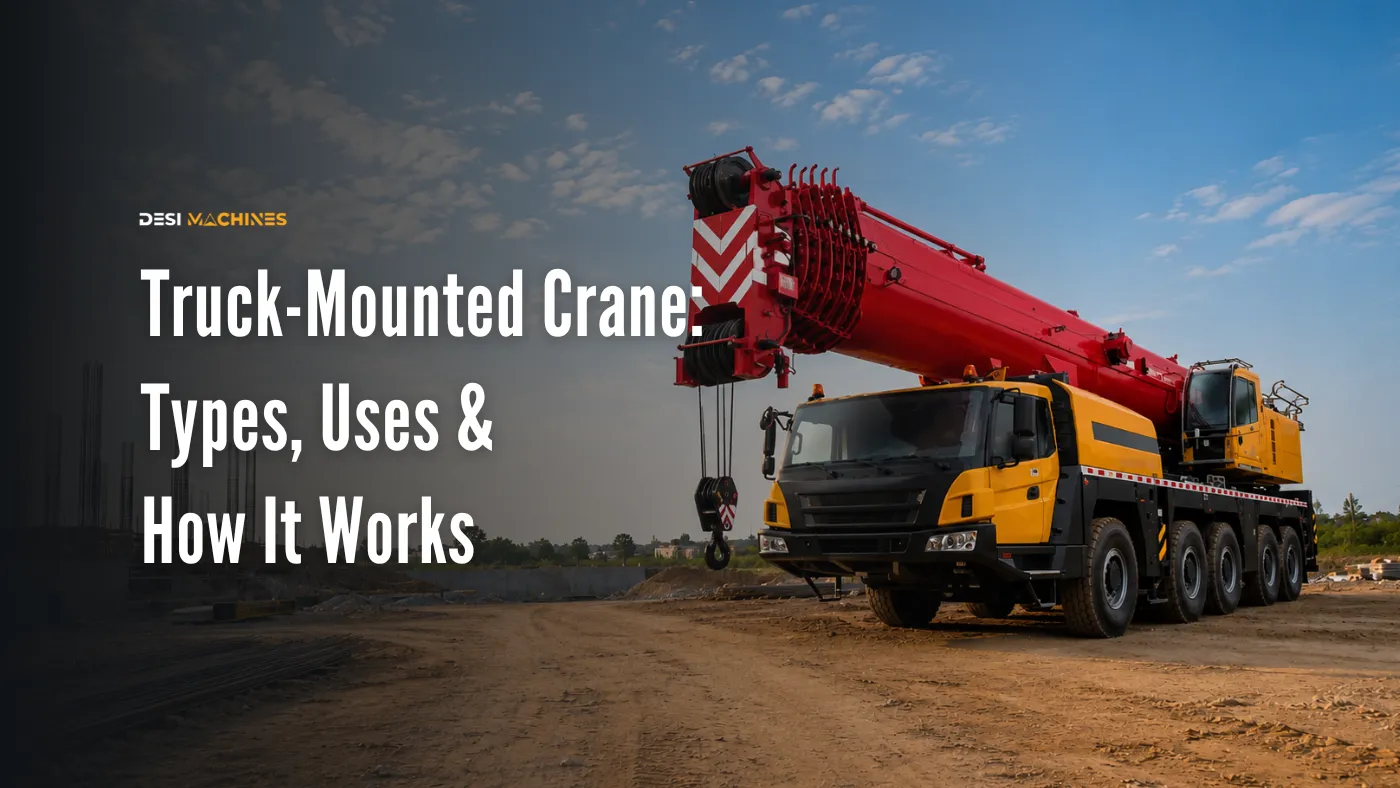
A truck-mounted crane is a lifting crane built onto a road-going truck chassis, so one machine drives on the highway like a truck and lifts at the site like a crane. You have seen them on Indian roads without thinking about it: the folding arm behind a truck cab that loads its own cargo bed, the long telescopic boom placing a mobile-tower section, the crane truck setting a transformer into a substation.
The whole point of the machine is travel. A crane that moves between towns at truck speed reaches jobs that a slow site crane never could, and that single fact decides where it is used, what it costs to run and who buys one. This guide explains how a truck-mounted crane works, the types sold in India, where they earn their money, and how they differ from the Hydra and Farana cranes most Indian contractors actually own. If you want the full family tree first, start with the types of cranes guide.
How does a truck-mounted crane work?
A truck-mounted crane works by borrowing the truck’s own engine to power the crane: a PTO (power take-off, a gearbox tap that sends engine power to a hydraulic pump) drives the oil pressure, and that oil moves the boom, the winch and the legs. There is no second engine on most machines; the same diesel that drives the wheels does the lifting once the truck is parked.
The lift, step by step
Every lift follows the same order. Park the truck on firm, level ground. Lower the outriggers (the steel legs that push the truck up off its tyres). Raise the boom, telescope it out to the reach you need, swing it over the load, and lift on the winch rope or hook. Reverse the whole thing before you drive away. An operator who respects that order goes home every evening; one who rushes it makes the accident reports.
Why outriggers decide everything
A truck chassis stands on rubber tyres and springs, and neither was made to take a swinging load. The outriggers plant the machine on rigid steel instead, which is what stops it tipping when the boom swings sideways with weight on the hook. On soft Indian ground, mats or steel plates go under the outrigger pads first so the leg does not punch into the soil mid-lift. Plant the feet before you raise the hand.
What are the types of truck-mounted cranes?
India sees three broad types of truck-mounted crane, split by how the crane sits on the truck and how much it lifts.
Telescopic truck crane (crane truck)
A full crane cabin and telescopic boom mounted on a truck chassis. The boom extends in sections like a spyglass, swings a full circle on most models, and handles the serious erection work: steel structures, precast pieces, heavy plant. Steel and cement works run mobile cranes like this too, alongside the machines for steel and cement plants listed for them.
Lorry loader (knuckle-boom crane)
A folding, jointed arm fitted behind the truck cab, made to load and unload the truck’s own bed. It folds flat for driving and unfolds like a knuckle at the site. For goods yards, pipe deliveries and machine shifting, it removes the need for a second crane at either end of the trip.
Heavy road cranes
At the top end sit high-tonnage truck cranes used for wind, refinery and metro erection jobs. These are specialist, project-hired machines with multi-axle carriers, and in India they live almost entirely in the rental fleets of large lifting contractors.
| Type | What it is | Best for | The trade-off |
|---|---|---|---|
| Telescopic truck crane | Slewing crane with telescopic boom on a truck | Erection work, transformers, towers | Needs outrigger space and setup time |
| Lorry loader (knuckle-boom) | Folding arm behind the cab | Loading its own truck bed, deliveries | Short reach, modest capacity |
| Heavy road crane | High-tonnage crane on a multi-axle carrier | Refinery, wind and metro projects | Specialist, rental-market machine |
Truck-mounted crane vs Hydra: what is the difference?
The difference is simple: a truck-mounted crane lifts standing still on its outriggers, while a pick-and-carry crane, the machine every Indian site calls a Hydra or a Farana, picks the load up and drives with it across the site. The Hydra lifts and drives with the load; the truck crane stands still and lifts.
That one difference splits their worlds. The pick-and-carry lives inside the site boundary, shifting loads all day between stores, trucks and workfronts. The truck-mounted crane lives on the road network, driving between scattered jobs and doing one planned lift at each. A mobile crane family tree puts both in context, and our Hydra vs Farana comparison settles the naming confusion once and for all.
| Question | Truck-mounted crane | Pick-and-carry (Hydra / Farana) |
|---|---|---|
| Can it travel with the load? | No, it lifts parked on outriggers | Yes, lifting and carrying is its whole job |
| Where it works | Road network, town to town | Inside one site, all day |
| Setup before a lift | Outriggers, pads, level check | Almost none, drive in and lift |
| Typical Indian owner | Lifting contractor, rental fleet | Contractor, builder, factory |
How much weight can a truck-mounted crane lift?
A truck-mounted crane lifts what its load chart allows, and the load chart is the only honest answer to this question. The load chart is the table pasted in every crane cabin that says how much the machine lifts at each boom length and each distance from the crane’s centre. The rated capacity you hear in the market is the best case: the heaviest lift, close in, boom short, outriggers fully spread.
Stretch the boom out and the number falls fast. A machine that lifts its full rated load at close radius may safely handle only a small fraction of it at full reach. As a working sense of the classes: lorry loaders sit at the light end for self-loading duty, telescopic truck cranes cover the broad middle of erection work, and the multi-axle heavy road cranes at the top are project machines rated in the hundreds of tonnes. Class figures are indicative; the chart of the exact machine, at the exact radius, is the number that matters.
Two habits keep that number honest on site. First, weigh or confirm the load before the lift instead of guessing from its size. Second, never bypass the machine’s load-moment warning to squeeze one more lift; the chart does not negotiate. Operators put it plainly: the chart is written in ink, excuses are written in accident reports.
What should you check before hiring a truck-mounted crane in India?
Since most Indian contractors hire rather than buy these machines, the money questions arrive at hiring time. Five checks cover most of the risk:
- The load chart matches your lift. Give the rental company the load weight, the lift height and the radius (the flat distance from crane centre to where the load lands), and ask them to show the chart line that covers it with margin.
- Ground and access. Confirm the truck can reach the spot, stand level, and spread its outriggers fully; a lift planned on paper fails on a blocked approach lane.
- Papers. The crane is a registered road vehicle, so RC, permit, fitness and insurance should be current, and the operator licensed for it.
- Rigging comes with it. Slings, shackles and taglines in test-passed condition, not whatever rope is lying on the truck bed.
- Rate clarity. Fix the hourly or shift rate, mobilisation charge, and who pays for idle time if the site is not ready. Most disputes are born here, not at the hook.
One planned lift with a hired truck crane, done with these checks, is cheap. The same lift attempted with an overloaded pick-and-carry machine is how sites lose a season to an accident inquiry.
Where are truck-mounted cranes used in India?
Truck-mounted cranes earn wherever the lifting jobs are scattered and the roads connect them. The common Indian work looks like this:
- Steel and PEB erection: columns and roof trusses for factory sheds and warehouses, one planned lift after another.
- Power and telecom: placing transformers in substations and raising mobile-tower sections, often in towns far apart.
- Goods handling: lorry loaders delivering pipes, tiles, machines and site cabins, loading and unloading themselves.
- Urban lifts: glass, AC units and water tanks onto mid-rise buildings where a big site crane makes no sense for a day’s work.
- Project support: heavy road cranes hired in for metro girders, refinery vessels and wind turbine sections.
Notice what is missing: the everyday, all-day site shifting. That work belongs to the pick-and-carry crane, which is exactly why India buys so many of them.
Which crane should you buy for Indian site work?
Buy for the work you have every day, not the lift you might do twice a year. Truck-mounted cranes in India are specialist machines, built to order on a chosen chassis and priced by configuration, so the honest answer on their cost is price on request, against your specification; most contractors simply hire one for the odd planned lift. The crane buying and rental guide walks through that buy-or-hire decision.
For daily site lifting, the money goes to a pick-and-carry machine. The listed range runs from the 9 Tonne (9,000 kg) ACE Rhino 90C at ₹12–14 Lakh to the 35 Tonne (35,000 kg) ACE F350 at ₹62–66 Lakh. In between sit the workhorses: the 14 Tonne (14,000 kg) Indo Power 14T at ₹18–22 Lakh, the Escorts HYDRA 1565 from ₹22.6 Lakh onwards, which its product page quotes as a starting price rather than a band, and the articulated 17 Tonne (17,000 kg) Terex Franna FR17 at ₹47–49 Lakh. All figures indicative, as of September 2026. A machine that runs every day also deserves a hard look at the EMI, so check equipment finance options before you sign.
Ready to shortlist? Compare live pick-and-carry crane models and prices and talk to our team with your tonnage and site in mind.
Truck-mounted crane in short
A truck-mounted crane is road speed plus lifting muscle in one machine: PTO power, outrigger feet and a telescopic or knuckle boom. It owns the scattered, planned lifts of Indian erection and delivery work, while the everyday shifting inside a site stays with the Hydra and Farana. Know which of those two worlds your work lives in, and the buying decision makes itself.
Read next: the crawler crane, the heavy erection machine that trades road speed for raw lifting capacity. And when the shortlist is ready, compare crane models and current prices and get the best current offer.
If you are unsure which shackle goes between the hook and the sling, the D shackle and bow shackle guide explains the difference and how to read the WLL stamp.
Prices, specifications and features are indicative, vary by variant, location and date, and should always be confirmed with the official OEM or authorised dealer before any purchase decision. DesiMachines is not liable for decisions taken on the basis of information that may have changed after publication.
To work out what those duty ratings mean for a real lift, see our guide on reading crane load charts.