Excavator
294 models
Excavator
294 models  Backhoe Loader
51 models
Backhoe Loader
51 models  Crane
68 models
Crane
68 models  Concrete Mixer
79 models
Concrete Mixer
79 models  Wheel Loader
54 models
Wheel Loader
54 models  Compactor / Roller
45 models
Compactor / Roller
45 models  Motor Grader
42 models
Motor Grader
42 models  Dozer
41 models
Dozer
41 models  Concrete Pump
66 models
Concrete Pump
66 models  Skid Steer Loader
11 models
Skid Steer Loader
11 models  Telehandler
13 models
Telehandler
13 models 


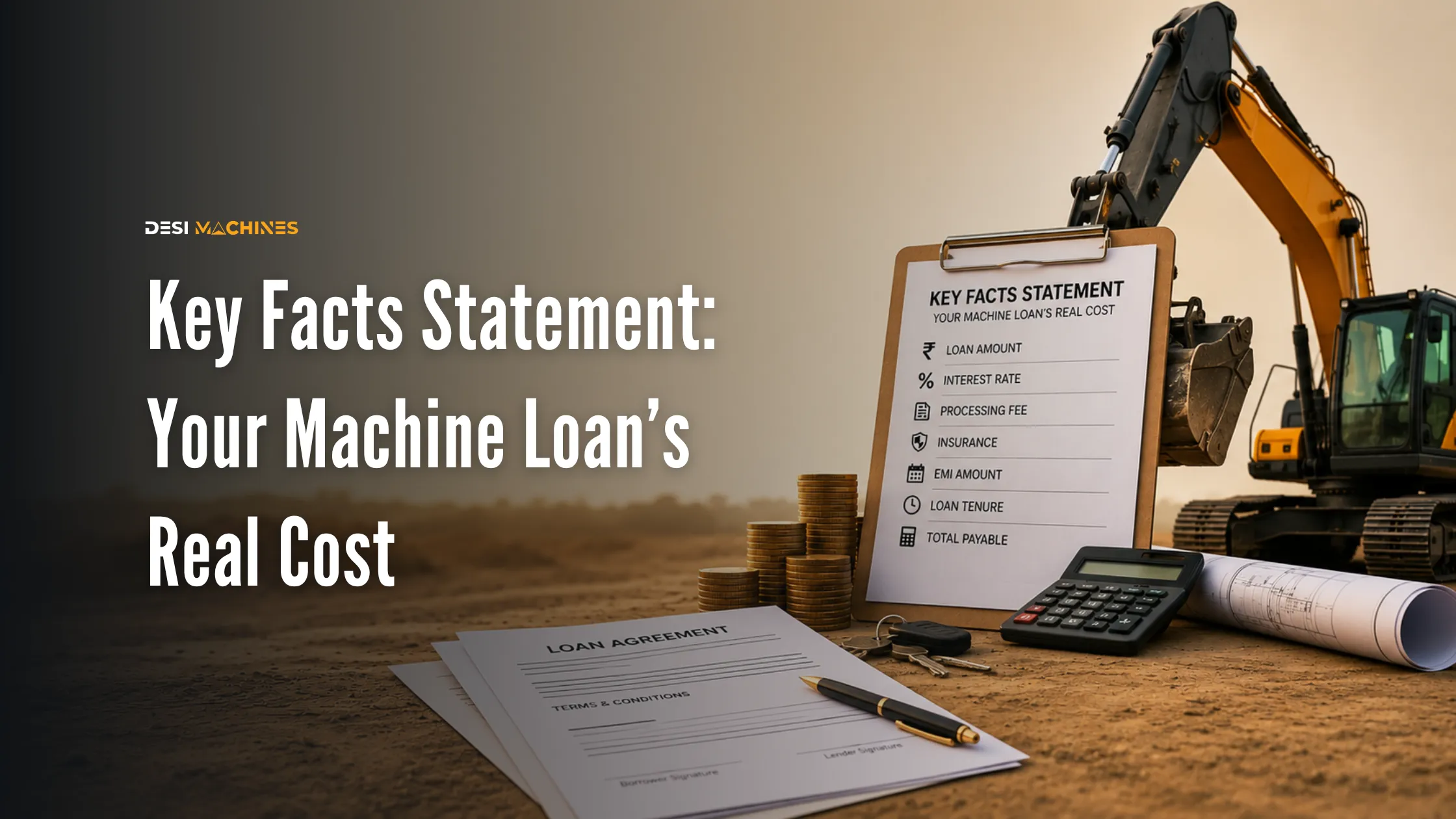
Before you sign a machine loan, your lender must give you a key facts statement — one standard page carrying every charge, the repayment schedule and the annual percentage rate, which is the true all-in cost. It stays valid for at least three working days and the lender is bound by it if you accept inside that window. Anything not written on it cannot be charged to you later without your explicit consent.
The gap between the quoted rate and the real one
Ask three lenders what a machine will cost to finance and you will get three interest rates. None of those numbers is what you actually pay.
Processing fee, documentation charges, valuation, stamping, the insurance premium collected along with the loan — all of it comes out of the same pocket, and most of it is deducted before the money reaches the dealer. You borrow one number and receive a smaller one, while repaying against the larger one.
The annual percentage rate is the figure that closes that gap, and the regulator has made the lender compute it for you.
What a key facts statement has to contain
The document follows a standard format, carries a unique proposal number, and has to be written in a language you understand. The lender is required to explain its contents and take your acknowledgement that you have understood them.
On the page you should find the sanctioned amount, the tenor, the number and size of instalments, when repayment starts, the rate and whether it is fixed or floating, every fee split between what goes to the lender and what goes to third parties, the net amount actually disbursed, the total you will repay, a computation sheet for the APR, and a full amortisation schedule for the whole tenor.
That last item is the one owners skip and then need two years later. It tells you, instalment by instalment, how much of each payment is principal and how much is interest — which is precisely what decides whether prepaying early is worth anything.
How much the charges actually move the number
The RBI illustrates the calculation with a deliberately small loan, and the arithmetic travels well:
| Line | Amount |
|---|---|
| Sanctioned amount | ₹ 20,000 |
| Rate of interest (fixed) | 15% |
| Instalments | 24 monthly × ₹ 970 |
| Total interest over the tenor | ₹ 3,274 |
| Fees — to the lender | ₹ 240 |
| Fees — to third parties | ₹ 160 |
| Net amount disbursed | ₹ 19,600 |
| Annual percentage rate | 17.07% |
A headline rate of 15% is an APR of 17.07%. The whole of that difference is ₹400 of fees on a ₹20,000 loan, because the APR is computed on the net amount disbursed, not the amount sanctioned, using the IRR approach on a reducing balance.
Scale that thinking to a machine. On equipment finance the fee block is rarely ₹400, and the insurance premium is often folded in. The proportion moves, the mechanism does not. This is why two lenders quoting the same rate can be materially different deals, and why the comparison worth making is the one in bank versus NBFC equipment loan rates.
The three-day window most borrowers give away
The statement carries a validity period: at least three working days where the loan tenor is seven days or more. Inside that window, if you agree to the terms, the lender is bound by the terms shown.
Read that as what it is. It is a priced, time-limited, binding quote. It exists so you can take it away, put it next to another lender’s, and decide without someone standing over the desk.
Owners routinely sign on the spot because the dealer is waiting and the machine is loaded. Three working days is usually available and almost never used.
The clause that works for you all tenor long
The single most useful line in the rulebook is short: any fees or charges not mentioned in the statement cannot be charged at any stage during the term of the loan without your explicit consent.
That converts the document from a signing formality into a reference you keep. When a charge you do not recognise appears in year three, the question is no longer whether it seems fair. It is whether it was disclosed on that page. If it was not, and you did not separately consent, it should not be there.
Third-party charges recovered on an actual basis — insurance and legal costs among them — must be included in the APR and disclosed separately, and you are entitled to receipts and related documents for each payment. If your equipment insurance was financed through the lender, that premium belongs in the APR, and its paperwork belongs to you. Whether it should be bundled at all is a separate decision, covered in our equipment insurance section.
The statement also has to appear as a summary box inside the loan agreement, so the two documents cannot quietly disagree.
How to use it in a real negotiation
Ask for the statement before you commit, not after sanction. Ask each lender you are talking to for one, on the same machine and the same tenor.
Then compare a single number across them: the APR. Not the rate, not the EMI, not the processing fee in isolation. The APR is the only line that has all of it inside, which is why it is the honest basis for a decision and the reason it exists. Run the instalment against your own cash cycle with our equipment loan EMI calculator before you agree to a tenor.
Check two more things while you have the page in hand. Look at what leaving early costs, because foreclosure and prepayment charges vary sharply between lenders. And look at what a missed instalment costs, since penal charges are capped and cannot be compounded.
Read the APR before you accept a loan offer
A key facts statement turns a sales conversation into a comparable, binding, written offer, and it is yours by right rather than by request. The lender has already done the hard arithmetic. Asking for the page costs nothing, and reading the APR on it is the fastest way to find out which quote is actually the cheapest.
When you are ready to compare offers on a specific machine, start with our construction equipment finance options and ask every lender for the statement before you sign anything.
Rates, schemes, specifications and prices change — confirm current terms with the OEM, dealer, bank or insurer before deciding. Source: Reserve Bank of India (Non-Banking Financial Companies – Responsible Business Conduct) Directions, 2025, as updated to 1 July 2026. Nothing here is legal or financial advice on your specific account.