Excavator
294 models
Excavator
294 models  Backhoe Loader
51 models
Backhoe Loader
51 models  Crane
68 models
Crane
68 models  Concrete Mixer
79 models
Concrete Mixer
79 models  Wheel Loader
54 models
Wheel Loader
54 models  Compactor / Roller
45 models
Compactor / Roller
45 models  Motor Grader
42 models
Motor Grader
42 models  Dozer
41 models
Dozer
41 models  Concrete Pump
66 models
Concrete Pump
66 models  Skid Steer Loader
11 models
Skid Steer Loader
11 models  Telehandler
13 models
Telehandler
13 models 


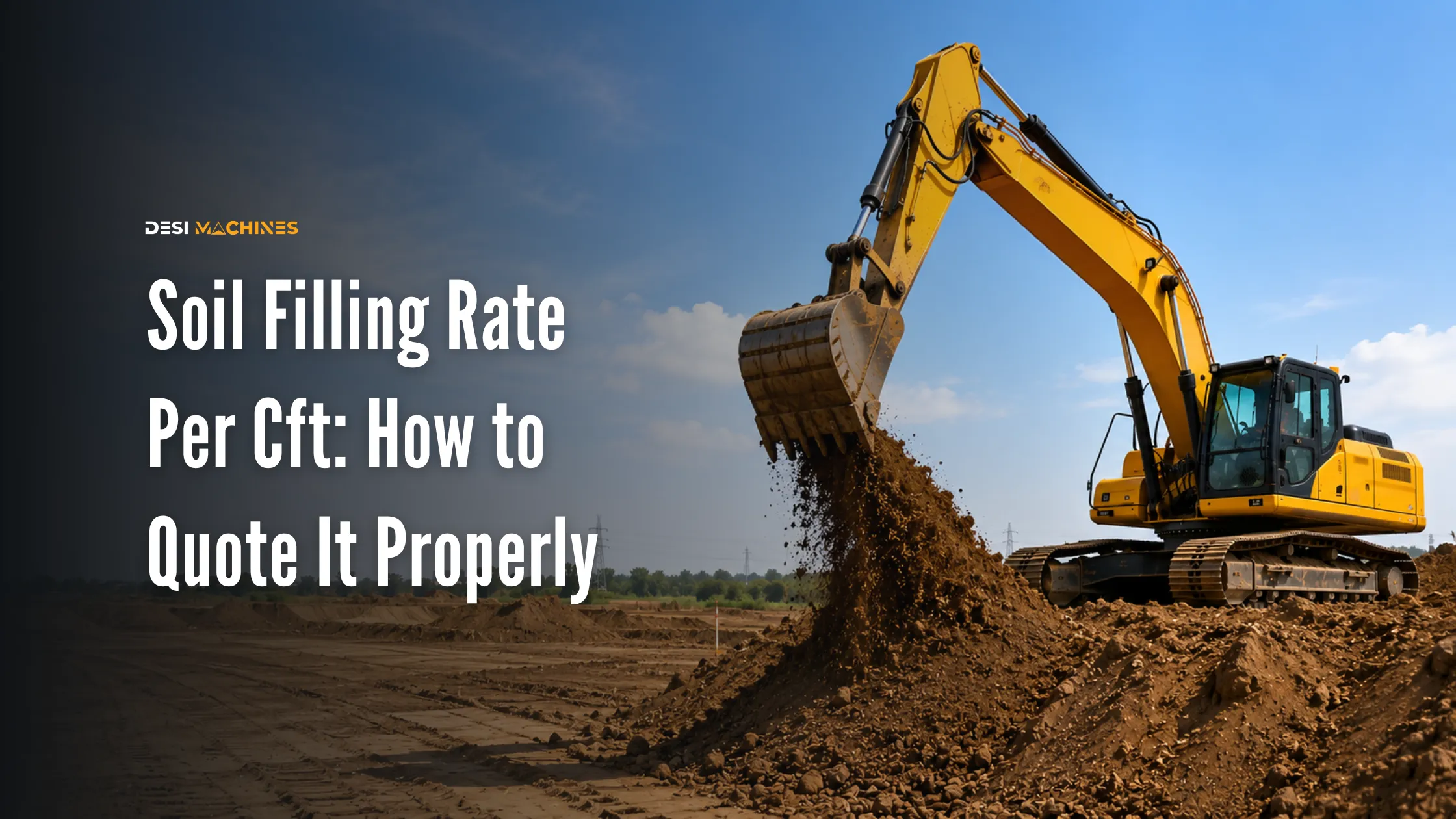
A soil filling rate per cft is a built number, not a market number. Add up the earth and its royalty, loading, cartage over the actual lead, spreading, watering and compaction, then divide by the compacted volume the client will measure — not the loose volume you carted. Cartage usually dominates. One cubic metre is 35.31 cft (indicative rates below), and mixing those two units is the most expensive arithmetic mistake on filling work.
Filling is not excavation in reverse
Owners who quote excavation confidently often under-quote filling, because it looks like the easier half. The machine time per unit is genuinely lower. Everything around the machine is higher.
On excavation, the material is already there and you are paid to remove it. On filling, you have to source the earth, move it to site, place it in layers, wet it, roll it, and then be measured on what remains after all of that. Four of those six steps are not machine work at all, and they are where the money goes.
If you are pricing the digging side of the same job, the companion method is in excavation rate per cubic meter.
Building a soil filling rate per cft, head by head
Work in cubic metres while you build, then convert once at the end. It keeps the machine outputs and the earth volumes in the same unit and stops rounding errors compounding.
| Cost head | What actually drives it |
|---|---|
| Earth at source | Borrow pit rate or purchased soil; free earth from a nearby excavation changes the job completely |
| Royalty and permissions | State rate on the material taken; confirm in writing who bears it |
| Loading | Excavator or loader hours against actual trips loaded per hour |
| Cartage | Lead distance, tipper capacity, trips per day, diesel, driver — usually the biggest line |
| Spreading | Dozer, grader or loader hours to place in layers of the specified thickness |
| Watering | Tanker trips and water source; ignored in most quotes and never free |
| Compaction | Roller hours, number of passes, any density testing |
| Shrinkage allowance | The gap between loose volume carted and compacted volume measured |
| Overheads and margin | Supervision, site running cost, breakdown risk, and your profit |
Machine-side numbers should come from your own records rather than a thumb rule. If you do not have them, our breakdowns of excavator cost per hour and current equipment hire rates give you a defensible starting point to adjust.
A worked example, with every input flagged as an assumption
Published market rates for filling are close to meaningless, because the lead alone can double them. So build your own. Assume a job of 1,000 cft of compacted filling, which is 28.3 cum, and substitute your real figures for the ones below (all indicative):
| Line | Assumption (indicative) | Cost for the job |
|---|---|---|
| Earth + royalty at source | ₹ 60 per cum | ₹ 1,700 |
| Loading | ₹ 40 per cum | ₹ 1,130 |
| Cartage over the lead | ₹ 180 per cum | ₹ 5,100 |
| Spreading | ₹ 35 per cum | ₹ 990 |
| Watering | ₹ 15 per cum | ₹ 425 |
| Compaction | ₹ 45 per cum | ₹ 1,275 |
| Direct cost | ₹ 375 per cum | ₹ 10,620 |
| Overheads + margin at 20% | — | ₹ 2,125 |
| Quoted total | ₹ 450 per cum | ₹ 12,745 |
| Soil filling rate per cft | ₹ 450 ÷ 35.31 | ₹ 12.75 per cft |
Notice what the table shows without being told. Cartage is nearly half the direct cost, and the earth itself is the smallest line but one. Change the lead and the whole quote moves; change the soil price and almost nothing does.
The shrinkage gap that quietly eats the margin
Here is the trap that catches owners once and is remembered forever.
You buy loose earth. You cart loose earth. You are paid on compacted volume measured in place. Loose soil takes up more room than the same soil after spreading, watering and rolling, so the volume that leaves the borrow pit is always larger than the volume you eventually get paid for.
Price against the loose volume you carted and you will be short on every single job, by the same proportion, invisibly. The fix is not a formula from a book, because the gap depends on your soil and your compaction standard. Run a trial stretch, measure what went in against what was accepted, and carry that factor into your rate. Do it once and it serves you for years on that soil type.
Fix the measurement basis before the rate
Two parties can agree a rate and still fall out, because they never agreed what they were counting.
Measured in place means the filled area is levelled and the compacted volume computed from levels. It is the fairer basis and the one most clients want. By vehicle load means you are paid on trips at an assumed body volume. It bills faster and invites arguments about whether the body was full and whether it holds what it claims.
Pick one, write it into the work order, and write in the layer thickness and the compaction expectation alongside it. A filling rate with no stated layer thickness is an invitation to be asked for more passes at the same price. The same discipline that keeps land leveling quotes honest applies here.
What comes off the bill afterwards
The rate you agree is not the money that reaches you. Royalty on the borrow earth, retention, and the usual statutory deductions all sit between the two, and on government work the timing sits there as well.
Settle who is paying royalty on the earth before you quote rather than after the first bill — royalty on earthwork explains how it is computed and where it gets deducted from the wrong quantity. If the client is a department rather than a builder, price the wait as well, using what we set out in contractor payment delays on government work.
Allow for shrinkage and lead when quoting soil filling
A soil filling rate per cft is only as good as the lead you priced it against and the shrinkage you allowed for. Build it from your own machine costs, measure the compacted volume you will actually be paid on, name the layer thickness in the work order, and convert between cft and cum exactly once, at the end.
Getting more of these jobs comes down to owning the right machine for the placing and rolling, not just the digging. Look at the wheel loaders and excavators that suit filling work, and price the next quote from your own numbers rather than the going rate.
Rates, schemes, specifications and prices change — confirm current terms with the OEM, dealer, bank or contractor before deciding. All figures above are indicative assumptions for illustration and must be replaced with your own site costs.