
 Excavator
294 models
Excavator
294 models  Backhoe Loader
51 models
Backhoe Loader
51 models  Crane
68 models
Crane
68 models  Concrete Mixer
79 models
Concrete Mixer
79 models  Wheel Loader
54 models
Wheel Loader
54 models  Compactor / Roller
45 models
Compactor / Roller
45 models  Motor Grader
42 models
Motor Grader
42 models  Dozer
41 models
Dozer
41 models  Concrete Pump
66 models
Concrete Pump
66 models  Skid Steer Loader
11 models
Skid Steer Loader
11 models  Telehandler
13 models
Telehandler
13 models 


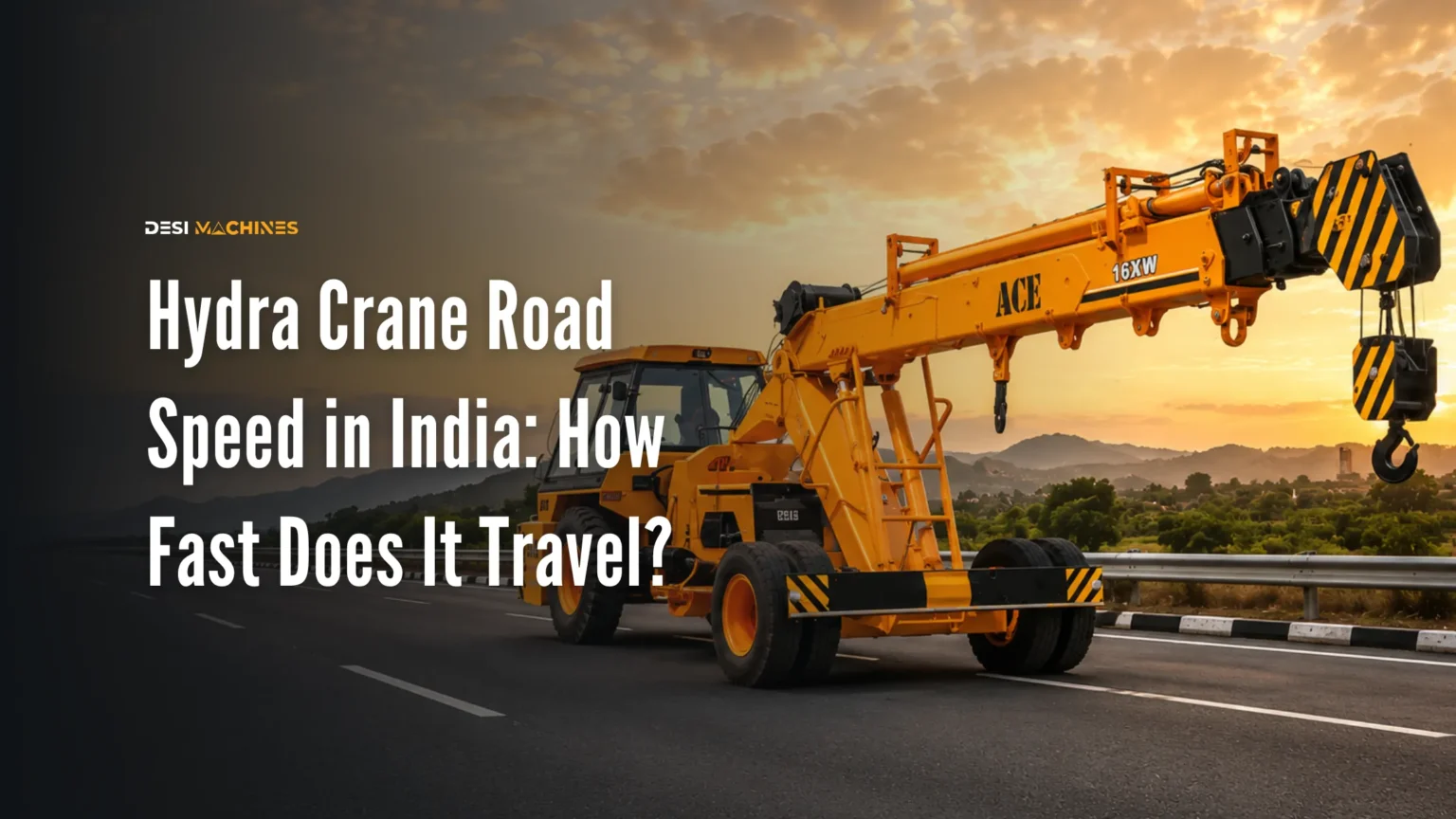
How fast does a hydra crane travel on the road?
Hydra crane speed on the road runs from 28 km/h to 50 km/h. A hydra is a pick and carry crane: it lifts a load, carries it, and drives to the next job on its own wheels instead of being loaded onto a trailer. All 67 pick and carry cranes listed on DesiMachines publish a top speed, so that 28 to 50 km/h band is the full spread of the class as it stands in August 2026.
Two things about that number matter before you plan anything around it. It is the maximum speed without a load, which is exactly what the specification sheet says. And it is a top speed on a good surface, not a speed you will hold on a village road. A hydra moving between sites in real traffic averages well below its rated figure.
The spread is not evenly filled either. Six machines in ten sit between 28 and 35 km/h, and only six machines out of 67 are rated at 48 km/h or above. If you picture a hydra as a machine that keeps up with traffic, the listings say otherwise for most of them.
Why are two-wheel-drive hydras slower than four-wheel-drive ones?
Drive type is the single biggest divider in this class, and it separates the listings far more cleanly than anything else. Drive means how many of the machine’s wheels receive engine power: on a 2WD crane only one axle is driven, on a 4WD crane both are.
Grouping all 67 machines by what they publish for drive gives this:
| Drive | Machines listed | Speed range | Typical (median) |
|---|---|---|---|
| 2WD | 39 | 28 – 41 km/h | 29 km/h |
| 4WD | 25 | 30 – 50 km/h | 40 km/h |
| Selectable or not stated | 3 | 35 – 42 km/h | 35 km/h |
The typical 4WD machine travels about 11 km/h faster than the typical 2WD one. That is not a small difference over a 40 km move between sites.
The reason is that these are two different machines built for two different jobs. A 4WD hydra is built to work on loose, broken and sloping ground, so it is geared and driven for that, and the same package lets it run faster on a road. A 2WD machine is built to be cheaper and to work on prepared, level yards where all-wheel traction is not needed. Speed follows from that choice rather than being designed in on its own.
One thing the table does not settle: a 2WD machine can still be quick, and the fastest 2WD in the listings is rated 41 km/h. Drive tells you where a machine is likely to sit, not exactly what it will do. Read the spec for the model you are buying.
Does a bigger hydra crane travel faster?
No, and this catches a lot of first-time buyers. Lifting capacity and road speed barely move together across the listings.
| Lifting capacity | Machines | Speed range | Average speed |
|---|---|---|---|
| Up to 12 Tonne | 5 | 28 – 30 km/h | 29.0 km/h |
| 13 – 16 Tonne | 28 | 28 – 50 km/h | 33.7 km/h |
| 17 – 20 Tonne | 16 | 28 – 50 km/h | 37.6 km/h |
| Above 20 Tonne | 14 | 28 – 48 km/h | 36.9 km/h |
Look at what the table actually does. The average climbs a little from the smallest band upward, then falls back above 20 Tonne. And every band from 13 Tonne up starts at the same 28 km/h floor, which means you can buy a 25 Tonne crane that travels no faster than a 13 Tonne one. Measured across the whole class, the link between capacity and speed is weak.
So a bigger crane is not a faster crane. If travel speed matters to you, check the drive type and the machine’s own rated figure, not the tonnage on the badge. For how the rest of the specifications move with tonnage, where the relationships are much stronger, see hydra crane operating weight by tonnage class and hydra crane engine power by tonnage.
How long does it take to move a hydra crane between sites?
Work it out from a realistic road speed, not the rated one. On Indian roads a hydra rarely holds its top figure: traffic, junctions, speed breakers and rough patches all pull the average down, and the machine has no suspension comfort to speak of.
A workable rule is to plan on roughly 60 to 70 percent of the rated top speed as a door-to-door average on ordinary roads, and less through a town. On that basis a 29 km/h 2WD machine covers about 18 to 20 km in an hour, and a 40 km/h 4WD machine about 24 to 28 km.
That arithmetic decides something practical: how far you can profitably send a machine. A crane that spends four hours travelling to a two-hour lift has earned very little that day. Contractors who run hydras well tend to work a tight radius around a base and refuse jobs outside it, or charge the travelling time openly.
For longer moves, a trailer is usually cheaper than driving the crane, because you save the hours and the wear on tyres and driveline. Tyres are the item that suffers most from long road runs, and they are not cheap to replace on this class of machine, as the breakdown of hydra crane tyre sizes front and rear shows.
Can a hydra crane travel with a load on the hook?
It can, and that is the whole point of a pick and carry crane, but the published speed does not apply. The rated figure in every listing is maximum speed without load. With a load on the hook the safe travelling speed is far lower, and it is set by the machine’s load chart and the ground, not by the engine.
The reason is stability rather than power. As the crane moves, the load swings, and any swing shifts weight away from the machine’s centre. On a slope or a rut that shift is what tips a crane over. This is why pick and carry travel is done slowly, with the boom low and short, and the load kept close to the ground.
Treat the load chart as the authority here. It tells you what the crane can carry at a given radius, and carrying while moving is the most demanding thing you will ask of it. If you have not read one before, the walk-through of how to read a crane load chart covers it step by step, and the crane safety rules and operator training guide sets out the site practice around it.
Comparing machines? Browse the current range of pick and carry cranes and check each model’s rated speed and drive against the job you actually run.
What road speed should you look for when buying?
Start from how the machine will be used, because the right answer is genuinely different for different contractors.
If the crane works one yard or one plant, road speed hardly matters. A 28 to 30 km/h 2WD machine is the cheaper buy and it will do everything asked of it. Spend the saving on capacity or on a better boom instead.
If the crane moves between sites most weeks, speed becomes real money. A 4WD machine in the 40 km/h band turns a two-hour move into an hour and a quarter, and over a year that is a large number of billable hours recovered.
If the sites are rough, muddy or sloping, buy 4WD for the traction and take the speed as a bonus. A 2WD crane that cannot get to the lifting position is worth nothing that day, whatever its rated speed.
Two checks are worth making before you sign. Ask for the rated speed in writing on the quotation for the exact variant, because the figure moves between variants of the same model. And ask what tyres are fitted, since tyre size and rating are part of what makes a published speed safe to use.
It is also worth reading the same specification across the machines you are comparing rather than trusting a brochure headline. The overview of pick and carry cranes, hydra and farana explained sets out how this class differs from the rest, and the crane buying and rental guide covers whether owning is the right call at all.
How does this compare with other machines on the road?
A hydra is quick compared with a tracked machine and slow compared with a wheeled loader. That ordering is worth knowing when you plan how a mixed fleet moves.
| Machine | Typical road speed | Moves itself between sites? |
|---|---|---|
| Pick and carry crane (hydra) | 28 – 50 km/h | Yes, on its own wheels |
| Backhoe loader | See the speed and gears guide | Yes, commonly driven |
| Wheel loader | 20 – 50 km/h (median 36) | Short moves only |
| Crawler excavator | Not road legal | No, needs a trailer |
All 54 wheel loaders listed publish a top forward speed, spanning 20 to 50 km/h. The two machines most often compared with a hydra on this point are the backhoe and the wheel loader, and both have their own figures worth checking: backhoe loader top speed and gears and wheel loader top speed. A crawler machine is a different case altogether, since it travels on tracks and has to be trailered.
Hydra crane road speed: the short version
Pick and carry cranes listed in India are rated between 28 km/h and 50 km/h without a load, and all 67 machines publish the figure. Drive type is what divides them: 2WD machines run a median of 29 km/h and 4WD machines a median of 40 km/h. Lifting capacity is a poor guide, because every tonnage band from 13 Tonne upward starts at the same 28 km/h floor.
Plan real journeys at about two-thirds of the rated speed, never travel at the rated speed with a load on the hook, and buy 4WD when the machine genuinely moves between sites or works rough ground.
Ready to shortlist? Compare the current pick and carry crane range and the wider selection of cranes, and ask the dealer to confirm the rated speed and drive for the exact variant you are quoted.
Prices, specifications and features are indicative, vary by variant, location and date, and should always be confirmed with the official OEM or authorised dealer before any purchase decision. DesiMachines is not liable for decisions taken on the basis of information that may have changed after publication.