
 Excavator
294 models
Excavator
294 models  Backhoe Loader
51 models
Backhoe Loader
51 models  Crane
68 models
Crane
68 models  Concrete Mixer
79 models
Concrete Mixer
79 models  Wheel Loader
54 models
Wheel Loader
54 models  Compactor / Roller
45 models
Compactor / Roller
45 models  Motor Grader
42 models
Motor Grader
42 models  Dozer
41 models
Dozer
41 models  Concrete Pump
66 models
Concrete Pump
66 models  Skid Steer Loader
11 models
Skid Steer Loader
11 models  Telehandler
13 models
Telehandler
13 models 


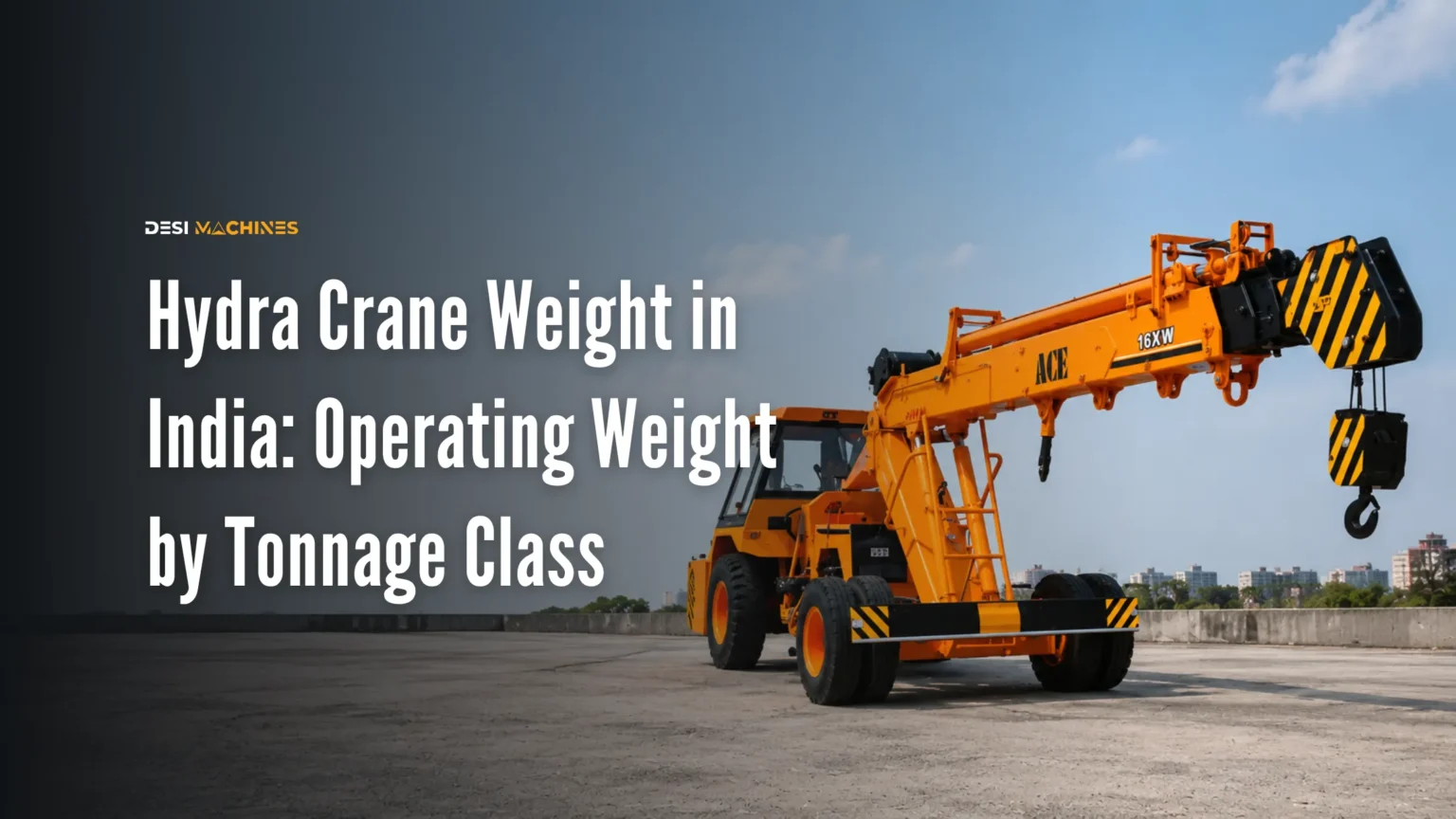
Hydra crane weight is what the machine itself weighs, ready to work, with fuel and the operator – the figure a spec sheet calls operating weight. Across the 67 pick and carry cranes listed on DesiMachines, published operating weight runs from 7,750 kg (7.75 tonnes) on a 9 tonne machine to 27,450 kg (27.45 tonnes) on a 35 tonne machine, as per the current August 2026 spec sheets.
The number that confuses most first-time buyers is on the badge. A “14 tonne hydra” does not weigh 14 tonnes – that is what it is rated to lift. This guide gives the real weights class by class, explains why two cranes with the same badge can differ by nearly seven tonnes, and shows what the figure changes for your trailer, your road permit and the ground you park on.
How much does a Hydra crane weigh?
A pick and carry crane in India weighs between about 7.8 and 27.5 tonnes, and most of the machines contractors actually buy – the 12 to 20 tonne badges – sit between 9 and 20 tonnes. Every one of the 67 listed machines publishes an operating weight, so this is a complete picture of the market rather than a sample.
Operating weight means the machine as it stands and drives: chassis, boom, engine, hydraulics, tyres, full fuel tank and the operator. It does not include the load on the hook, any lifting tackle you hang below the hook, or a second man riding along.
The lightest machine listed is the ACE Rhino 90C at 7,750 kg, and the heaviest is the ACE F350 at 27,450 kg. Between those two sit every machine you are likely to see on an Indian site.
Hydra crane weight by tonnage class
The table below groups all 63 listed machines that publish both a rated capacity and an operating weight. Read the ranges as what the market offers at that badge, not as one fixed figure.
| Rated capacity (badge) | Machines listed | Operating weight |
|---|---|---|
| 9 – 11 tonne | 2 | 7,750 – 8,150 kg (7.8 – 8.2 tonne) |
| 12 – 13 tonne | 6 | 8,950 – 12,960 kg (9 – 13 tonne) |
| 14 tonne | 6 | 10,430 – 16,020 kg (10.4 – 16 tonne) |
| 15 tonne | 17 | 11,600 – 18,300 kg (11.6 – 18.3 tonne) |
| 16 – 18 tonne | 8 | 11,970 – 17,820 kg (12 – 17.8 tonne) |
| 20 tonne | 10 | 13,750 – 20,400 kg (13.8 – 20.4 tonne) |
| 23 – 25 tonne | 10 | 14,400 – 21,950 kg (14.4 – 22 tonne) |
| 27 – 35 tonne | 4 | 20,060 – 27,450 kg (20 – 27.5 tonne) |
Figures as per the current August 2026 spec sheets on DesiMachines. The 15 tonne badge is the most crowded class in the market with 17 machines, and it is also the widest: the lightest publishes 11,600 kg and the heaviest 18,300 kg, a difference of 6.7 tonnes on the same badge.
If you also need reach rather than only weight, the Hydra crane boom height guide gives boom and turning-circle figures for the same machines.
Why do two 15 tonne cranes weigh so differently?
Because the badge describes the load at the shortest working radius, not the machine. Two builders can reach the same rated lift with very different machines, and the listed cranes fall into two clear families once you look at the steering.
| Family | Machines listed | Operating weight | Steering articulation |
|---|---|---|---|
| Short-radius yard machines (XW, Rhino, HXP series) | 26 | 7,750 – 17,420 kg | 45 degrees and above (up to 55) |
| Road-going machines (F, FX, TRX, NX, FN series) | 37 | 12,630 – 27,450 kg | Below 45 degrees (mostly 35 – 40) |
The first family bends sharply in the middle, turns inside a narrow yard, and is built lighter because it spends its life on short moves. The second family articulates less, carries a heavier chassis and stronger axles, and travels faster between sites. The ACE 15XWE at 11,600 kg and the ACE NX 360 15T at 18,300 kg are both 15 tonne cranes, and that is the whole difference.
Neither is better in general. A crane that works inside a factory shed or a housing site wants the lighter, sharper-turning machine. A crane that moves between three sites in a week wants the heavier road-going one. The naming and family differences are set out in the guide to Hydra and Farana cranes.
Does a Hydra crane weigh more than it can lift?
Often it weighs less. Of the 63 listed machines that publish both figures, 48 have an operating weight below their rated capacity. The Escorts HYDRA 14, rated at 14 tonnes, weighs 11,750 kg. The Indo Power 20T, rated at 20 tonnes, weighs 13,750 kg.
That sounds impossible until you remember what the rating means. Rated capacity is measured at the shortest boom and the smallest radius, with the load tucked in close to the machine. In that position the load sits almost over the front axle and the rear of the machine acts as the counterweight. Stretch the boom out, and capacity falls away fast.
This is exactly why a crane’s load chart matters more than its badge. A 20 tonne machine may be rated for two or three tonnes at full radius. Judging a lift from the badge is one of the most common causes of a crane tipping on an Indian site, and the safety rules that follow from it are covered in the guide to crane safety and operator training.
What does the weight change for moving the crane?
A pick and carry crane is a wheeled machine, so unlike a tracked excavator it drives itself to the job. That is its main advantage, and machine weight is what decides whether that stays true.
- Road permits and bridges. A 27 tonne machine on a village road with a weak culvert is a real problem, while a 9 tonne machine is not. Check the route, not only the distance.
- Registration. Wheeled cranes are registrable vehicles and are driven on public roads under the usual rules, which are explained in the guide to equipment registration at the RTO.
- Soft ground. Weight concentrated on six tyres presses far harder into wet ground than a tracked machine of the same weight. On monsoon sites, the heavier machine is the one that sinks and needs pulling out.
- Trailer hire. For long moves, machine weight decides the trailer class and therefore the cost. The heavier road-going families are also the ones built to travel at 35 to 50 km/h, so they usually drive rather than ride; the full hydra crane road speed spread runs 28 to 50 km/h and splits on drive type rather than tonnage.
Weight also sets tyre load. Most listed machines carry four tyres in front and two at the rear, with the front pair taking the load during a lift, which is why front tyre condition and inflation are checked before every serious lift. The sizes those tyres come in, and why the rear pair is almost always a bigger tyre than the four in front, are set out in the guide to hydra crane tyre sizes by tonnage class. The wear items on these machines are listed in the guide to Hydra crane parts.
How does crane weight compare with other machines?
A pick and carry crane is light for its size compared with earthmoving machines. A 20 tonne class excavator weighs about 20 to 22 tonnes and cannot leave the site without a trailer. A 20 tonne badge crane weighs 13.8 to 20.4 tonnes and drives itself there.
That difference explains why a hydra is the default lifting machine on small and medium Indian sites: it is cheap to move, it needs no assembly, and one operator does the whole job. Machine weights for the earthmoving side are in the guide to excavator and backhoe operating weight.
Engine size follows the same pattern – these machines carry far less power than their tonnage suggests, which is covered in the guide to Hydra crane engine power, and the tank sizes that go with it are in the guide to crane fuel and oil capacities.
How do you check a crane’s weight before you buy or hire?
Ask for the operating weight of the exact variant, in writing. Within one model family, a top-jack version, a longer boom or a different axle package changes the figure, and the sales brochure may quote whichever variant reads best.
Then check three things against your own work:
- The heaviest route on your regular circuit. If one bridge or one lane cannot take the machine, the crane is the wrong size no matter what it lifts.
- The ground you park and lift on. Softer ground needs mats or a firm pad under the tyres, and a heavier machine needs them sooner.
- What you actually lift, at what radius. Take the load chart, not the badge, and decide the class from there.
Compare live crane models and prices across brands, or read the guide to buying against hiring a crane if the machine will not work every day.
Hydra crane weight, in short
Pick and carry cranes in India weigh 7.75 to 27.45 tonnes, and the badge on the machine is its rated lift at the shortest radius, not its weight. Same-badge machines vary widely – the 15 tonne class alone runs from 11,600 kg to 18,300 kg – because lighter, sharply articulated yard machines and heavier road-going machines both reach the same rating. Check the weight against your route and your ground, and the load chart against your lift.
Prices, specifications and features are indicative, vary by variant, location and date, and should always be confirmed with the official OEM or authorised dealer before any purchase decision. DesiMachines is not liable for decisions taken on the basis of information that may have changed after publication.