
 Excavator
294 models
Excavator
294 models  Backhoe Loader
51 models
Backhoe Loader
51 models  Crane
68 models
Crane
68 models  Concrete Mixer
79 models
Concrete Mixer
79 models  Wheel Loader
54 models
Wheel Loader
54 models  Compactor / Roller
45 models
Compactor / Roller
45 models  Motor Grader
42 models
Motor Grader
42 models  Dozer
41 models
Dozer
41 models  Concrete Pump
66 models
Concrete Pump
66 models  Skid Steer Loader
11 models
Skid Steer Loader
11 models  Telehandler
13 models
Telehandler
13 models 


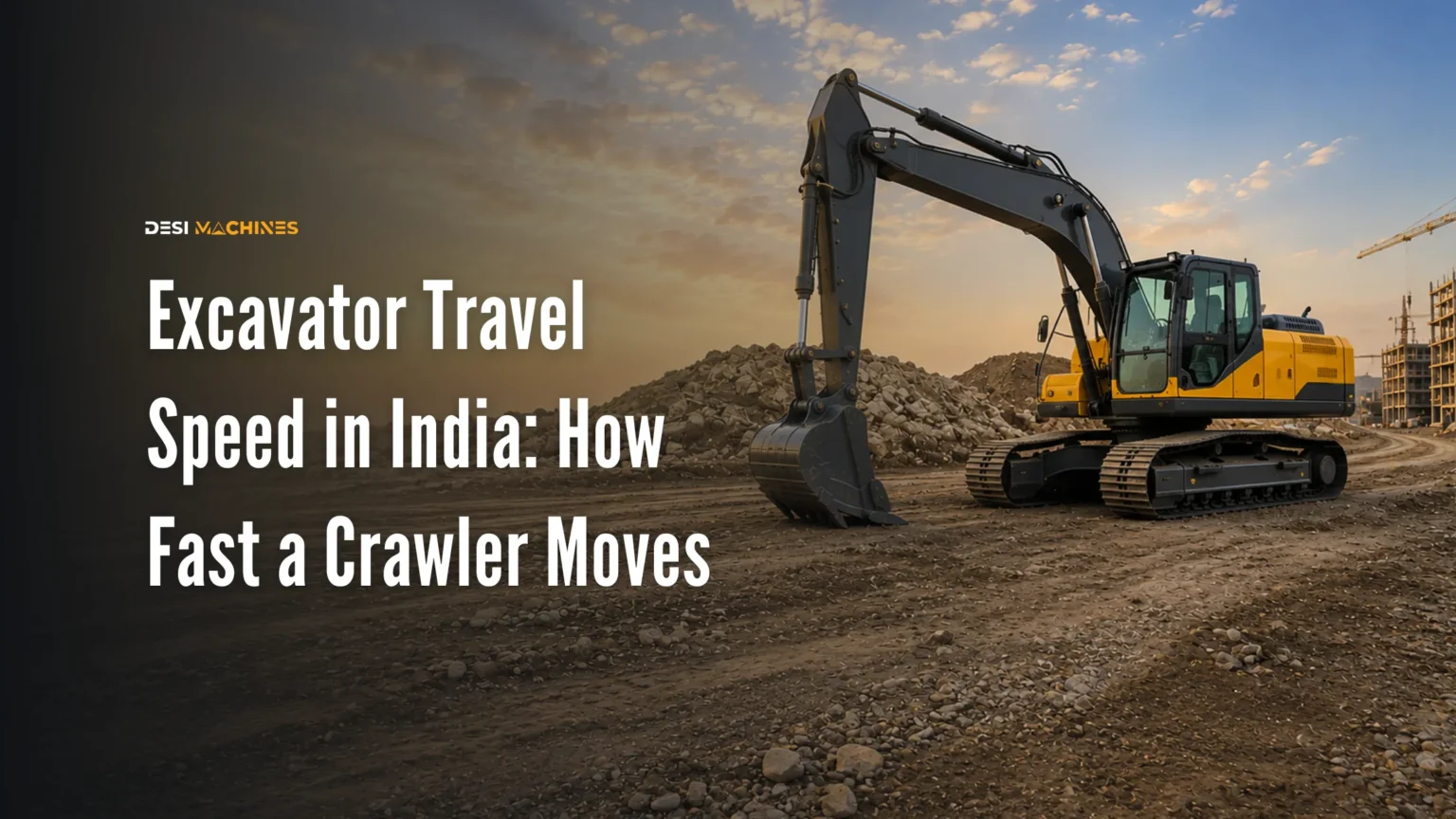
Excavator travel speed is how fast a crawler excavator moves on its own tracks, measured in kilometres per hour on flat, firm ground with an empty bucket. Almost every machine publishes two figures, not one: a low range for working and manoeuvring, and a high range for crossing the site.
Across the 294 excavators listed on DesiMachines, high range runs from 2.0 km/h to 6.1 km/h, as per the current August 2026 spec sheets. A 20 Ton (20,000 kg) machine tops out around 5.4 km/h, which is about the speed you walk at. That single fact decides something every first-time buyer needs to know early: an excavator is not driven to site. It is carried there.
What is excavator travel speed?
Travel speed is the speed of the tracks, not of the digging. It tells you how quickly the machine can reposition itself between one dig and the next, and how long it takes to cross from one end of a plot to the other.
Two hydraulic travel motors, one per track, do this work. They take oil from the same pump that feeds the boom and arm, which is why an excavator slows down noticeably if you try to travel and swing at the same time. How those motors work is covered in our guide to excavator swing and travel motors.
The figure is measured with an empty bucket on level, firm ground. Treat it as a ceiling. On soft soil, on a slope, or with the bucket loaded, you will not see it.
Why does an excavator have two travel speeds?
Because the two jobs need different things. Low range gives more pulling force at the track and finer control, which is what you want when you are inching into position beside a trench or climbing onto a trailer. High range trades that force for speed, and is used on flat, firm ground when the machine simply has to get somewhere.
The operator changes range with a switch or a foot control in the cab, usually marked with a rabbit and a tortoise. Many machines drop back into low range on their own when the load rises, so the tracks do not stall on a climb.
This is the number most spec sheets hide in plain sight. A sheet listing a single “travel speed” figure is usually quoting the low range, and reading it as top speed will make the machine look far slower than it is. Our guide on how to read an excavator spec sheet covers the rest of the sheet the same way.
How fast does an excavator go?
An excavator goes about 5 km/h in high range. The table below sets both published ranges against the size class each machine is listed under, with the count of machines in that class that publish the figure.
| Size class | Machines publishing it | Low range | High range | Median high range |
|---|---|---|---|---|
| Mini (0–6 Ton / 0–6,000 kg) | 47 of 49 | 1.6 – 3.0 km/h | 3.0 – 5.3 km/h | 4.4 km/h |
| Small (6–15 Ton / 6,000–15,000 kg) | 41 of 46 | 2.3 – 4.3 km/h | 3.5 – 5.7 km/h | 5.2 km/h |
| Medium (15–25 Ton / 15,000–25,000 kg) | 66 of 77 | 2.3 – 4.2 km/h | 3.0 – 6.0 km/h | 5.4 km/h |
| Large (25–50 Ton / 25,000–50,000 kg) | 42 of 46 | 2.1 – 3.9 km/h | 3.2 – 6.1 km/h | 5.4 km/h |
| Extra-Large (over 50 Ton / 50,000 kg) | 47 of 50 | 1.3 – 3.6 km/h | 2.0 – 5.5 km/h | 3.5 km/h |
Figures taken from the published specifications of machines listed on DesiMachines, August 2026. Size classes follow the same classes the machines are listed under, explained in our guide to excavator size classes.
Does a bigger excavator travel faster?
No, and this is the part that surprises people. Top speed climbs only slightly from mini to large, then falls away on the biggest machines.
The median high range goes 4.4 km/h for a mini, 5.2 for a small machine, 5.4 for a 20 tonner, 5.4 again for a 25 to 50 Ton machine, and then drops to 3.5 km/h for the mining class above 50 Ton (50,000 kg). The slowest machine on the list travels at 2.0 km/h.
The reason is weight on the undercarriage. A track frame carrying 80 tonnes cannot be geared for speed without wearing out rollers, links and idlers far too quickly, so the makers gear it for pulling instead. On a mining bench that is the right trade: the machine is meant to sit and load trucks, not to travel. The same wear story is covered in our guide to the excavator undercarriage.
For a buyer this means travel speed is not a reason to choose a bigger machine. Choose on operating weight and reach, and treat travel speed as something to plan around rather than shop for.
How fast can a mini excavator go?
A mini excavator travels at 3.0 to 5.3 km/h in high range, with a median of 4.4 km/h, and 1.6 to 3.0 km/h in low range. Of the 49 mini machines listed, 47 publish the figure.
Minis are not the fastest class, which catches people out. A small machine has small tracks and a small travel motor, so it gains little from being light. What it does gain is the ability to work in tight ground and to be moved on a small trailer or even a tractor trolley, which matters far more on a village or narrow-plot job than a kilometre per hour either way.
Worth naming honestly: the Tata Hitachi TMX 20 Neo publishes its low range as a 0 to 1.64 km/h band rather than a single figure, so it is not directly comparable with the rest of the class. Where a sheet publishes a band, read it as a band.
How fast does an excavator swing?
Swing speed is how fast the upper body rotates on the slew ring, published in revolutions per minute (rpm). It matters more to daily output than travel speed does, because a machine loading a tipper swings hundreds of times a day and travels only a few.
| Size class | Machines publishing it | Swing speed | Median |
|---|---|---|---|
| Mini (0–6 Ton) | 46 of 49 | 8.3 – 11.0 rpm | 9.1 rpm |
| Small (6–15 Ton) | 45 of 46 | 10.0 – 13.8 rpm | 12.0 rpm |
| Medium (15–25 Ton) | 75 of 77 | 9.2 – 13.7 rpm | 11.9 rpm |
| Large (25–50 Ton) | 45 of 46 | 7.6 – 12.0 rpm | 9.5 rpm |
| Extra-Large (over 50 Ton) | 48 of 50 | 3.1 – 10.2 rpm | 5.9 rpm |
At 12 rpm a machine takes about five seconds for a full turn, so a 90 degree swing to a waiting tipper and back takes roughly two and a half seconds each way. Swing speed follows the same shape as travel speed: it peaks in the small and medium classes and falls away on the mining machines.
Can you drive an excavator on the road in India?
In practice, no. A crawler excavator is not a registrable road vehicle, it carries no number plate, and steel tracks damage a bitumen surface. At 5 km/h it would also take over three hours to cover 16 km, with the undercarriage wearing the whole way.
Excavators move between sites on a trailer. That is why the ex-factory price of a tracked machine is quoted as a landed cost rather than an on-road price: there is no RTO registration or road tax in the number, but there is trailer transport. Our guide to the right trailer for excavator transport covers which type suits which weight class.
Wheeled machines are the exception to all of this. A backhoe loader is road legal and drives itself between jobs at backhoe loader top speed, and a payloader does the same at wheel loader top speed. Both travel roughly six to eight times faster than a crawler excavator. If your work is spread across many small sites, that difference is a real argument for a wheeled machine.
What slows an excavator down on site?
The published figure assumes conditions you rarely get. Four things take it away.
Soft or wet ground. Tracks sink, and the machine spends its power pushing soil instead of moving. Low ground pressure helps here, and it is the spec to check if you work on black cotton soil or paddy fields.
Slopes. Climbing a ramp or a bund drops the machine into low range, whether the operator selects it or the machine does it automatically.
Worn undercarriage. Stretched track chains and worn sprockets lose drive, and a track that is too loose or too tight costs speed and wears faster.
Using the boom while travelling. The travel motors share oil with the boom, arm and swing. Ask for all of it at once and each gets less.
What travel speed means when you buy
Read both figures on the sheet, not one. If a dealer quotes a single number, ask whether it is high or low range, because the two differ by roughly two kilometres an hour on most machines.
Plan transport before you buy. A tracked machine needs a trailer for every move, and on a job spread over several small sites those trailer trips add up faster than most first-time buyers expect. If that describes your work, price a backhoe loader against the excavator before deciding.
And do not pay for speed you cannot use. Within a size class the spread is under two kilometres an hour, which over a working day is worth far less than bucket size, reach or fuel burn.
Compare live excavator models and prices, or narrow it to mini excavators and 15 to 25 Ton machines, and speak to a dealer about what actually suits your ground.
Two machines were left out of the figures above because their published sheets contradict themselves: the SANY SY80C-9 SALT and the SANY SY220C-9XL Sparc+ each list a high range below their own low range, and the Tata Hitachi EX 215LC Prime lists a low range of zero. These have been flagged for correction.
Prices, specifications and features are indicative, vary by variant, location and date, and should always be confirmed with the official OEM or authorised dealer before any purchase decision. DesiMachines is not liable for decisions taken on the basis of information that may have changed after publication.