
 Excavator
294 models
Excavator
294 models  Backhoe Loader
51 models
Backhoe Loader
51 models  Crane
68 models
Crane
68 models  Concrete Mixer
79 models
Concrete Mixer
79 models  Wheel Loader
54 models
Wheel Loader
54 models  Compactor / Roller
45 models
Compactor / Roller
45 models  Motor Grader
42 models
Motor Grader
42 models  Dozer
41 models
Dozer
41 models  Concrete Pump
66 models
Concrete Pump
66 models  Skid Steer Loader
11 models
Skid Steer Loader
11 models  Telehandler
13 models
Telehandler
13 models 


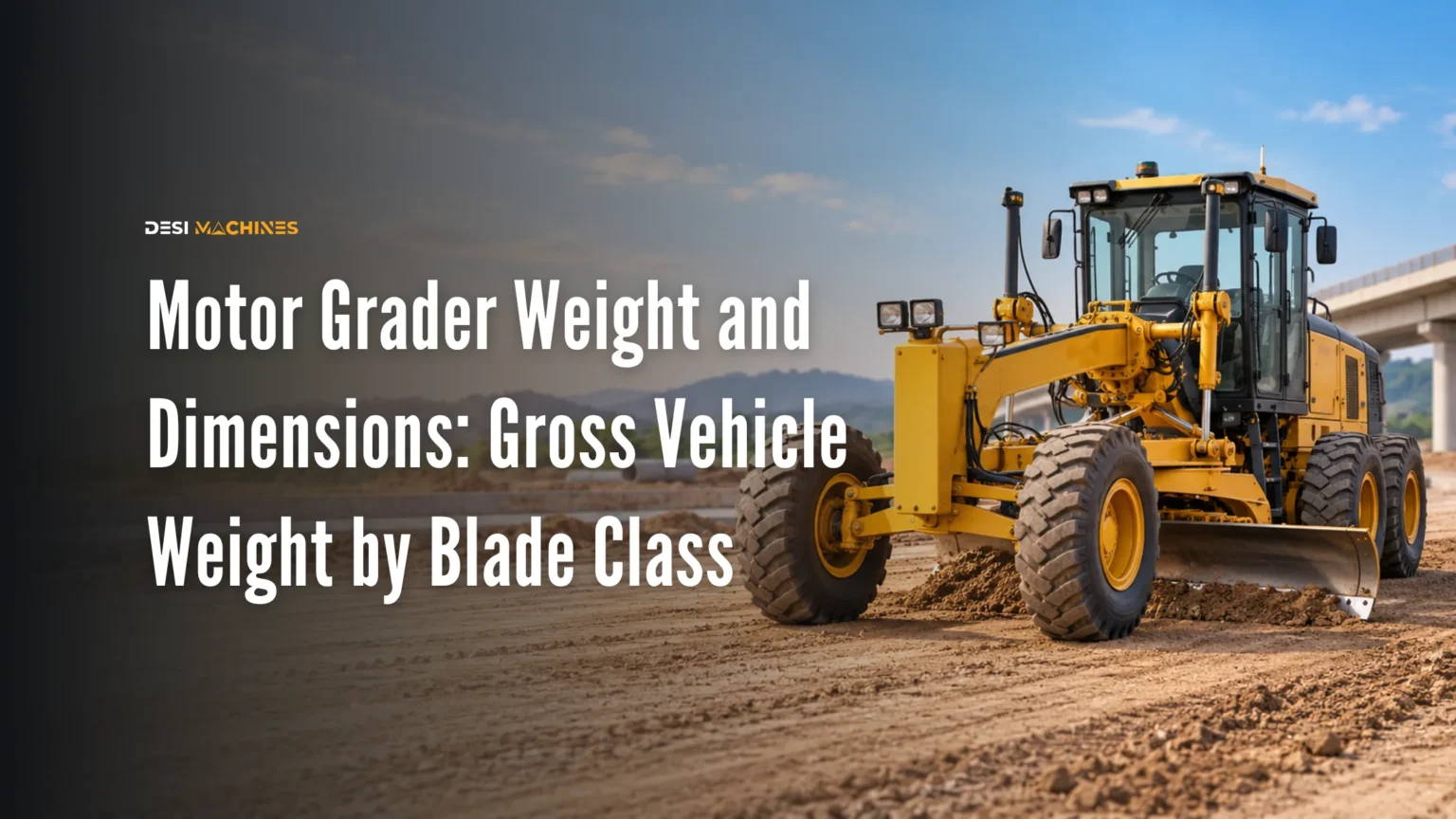
A motor grader’s weight is published as gross vehicle weight (GVW) — the figure the manufacturer prints for the complete machine as it stands, with its blade, cab and tyres fitted. Tyre size feeds straight into that height, and motor grader tyre sizes run from 11.00-20 on the smallest machines up to 26.5-25 on the largest. Across the 42 motor graders listed on DesiMachines, gross vehicle weight runs from 7,160 kg (7.2 tonnes) to 65,840 kg (65.8 tonnes), and blade width runs from 2,600 mm (8.5 ft) to 7,300 mm (24 ft), as per the current September 2026 spec sheets.
That is a nine-fold spread in weight, which is wider than any other machine family on an Indian road job. A buyer looking at a grader for village road work and a buyer looking at one for a mining haul road are reading the same spec sheet and need completely different numbers from it.
This guide gives the weight and the main dimensions by blade class, explains the difference between gross vehicle weight and the “operating weight” people ask for, and shows why the heaviest machine in a class is often not the one with the widest blade.
How much does a motor grader weigh in India?
Between 7,160 kg and 65,840 kg for the machines listed here, but almost every grader sold for Indian road work sits in the narrow band from 9,000 kg to 18,000 kg (9 to 18 tonnes).
The very light and very heavy ends of that range exist for specific jobs. The lightest machine on the books is the Mahindra Roadmaster G75 Smart at 7,160 kg, built for narrow village roads and small contract work. The heaviest is the Cat 24M at 65,840 kg, a mining grader that maintains haul roads wide enough for dump trucks. Between those two sit 40 machines, and 29 of them fall between 9,000 kg and 18,000 kg.
Weight matters to a grader more than it does to most machines, and for a reason that is easy to miss. A grader does not dig with hydraulic force the way an excavator does. It drags a steel blade through soil, and the thing that stops the blade from lifting and skating over hard ground is the weight of the machine pressing down on it. A light grader on hard murram will ride up; a heavy one will hold its cut. Weight is the grader’s working tool, not just a transport number.
Is gross vehicle weight the same as operating weight?
Not exactly, and this is worth understanding before you compare two brands.
Every motor grader listed here publishes one weight field, and it is labelled gross vehicle weight. Other machine families publish operating weight instead, which normally means the machine with full fuel, all fluids and an operator of standard weight aboard. Gross vehicle weight is usually the heavier of the two, because it is the total the machine is rated to put on the ground.
The practical effect for a buyer is small but real. If you compare a grader’s gross vehicle weight against an excavator’s operating weight, you are not comparing like with like, and the grader will look slightly heavier than it works out to be. The gap is normally a few hundred kilograms, not tonnes.
Two rules keep you safe. Compare graders against graders, since every machine here publishes the same field, so the comparison is fair. And when a transporter, a bank or an insurer asks you for a weight, ask them which figure they want, then get that exact figure confirmed by the dealer in writing. The difference between the two definitions is explained in more detail in our guide to operating weight, gross weight and payload.
Motor grader weight and blade width by class
Graders are grouped by blade width, not by weight, because the blade is what decides how much ground the machine covers in one pass. The table below groups all 42 listed graders by blade width and gives the weight range inside each group.
| Class | Blade width | Gross vehicle weight | Engine power | Machines listed |
|---|---|---|---|---|
| Light / compact | 2,600–3,050 mm (8.5–10 ft) | 7,160–11,500 kg | 74–150 HP | 9 |
| Mainstream road | 3,360–3,710 mm (11–12 ft) | 9,100–17,900 kg | 130–225 HP | 20 |
| Heavy | 3,962–4,320 mm (13–14 ft) | 14,373–25,968 kg | 150–290 HP | 8 |
| Large | 4,878–5,489 mm (16–18 ft) | 25,750–47,320 kg | 280–426 HP | 4 |
| Mining | 7,300 mm (24 ft) | 65,840 kg | 533 HP | 1 |
Blade width figures are the published blade length for each machine, September 2026 spec sheets. Power is the standard rating; a few machines publish a second, higher rating at a different engine speed.
Read the overlap in that table carefully, because it is the most useful thing on this page. The light class tops out at 11,500 kg and the mainstream class starts at 9,100 kg. Those two ranges cross over by more than two tonnes. A wide blade does not automatically mean a heavy machine, and a heavy machine does not automatically carry a wide blade.
The mainstream road class is where the Indian market actually sits. Twenty of the 42 graders listed are in it, and they cover almost every state highway, PMGSY village road and site levelling job in the country.
How wide is a motor grader blade?
Most commonly 3,660 mm, which is exactly 12 feet. Of the 42 graders listed, 18 carry a blade between 3,650 mm and 3,710 mm, so a 12 ft blade is close to the default size in India.
Blade widths cluster on whole foot sizes because that is how blades and their cutting edges are manufactured and stocked. Reading down the listed machines, the sizes that repeat are 10 ft (3,000 mm), 12 ft (3,658–3,660 mm), 13 ft (3,962 mm), 14 ft (4,268–4,270 mm), 16 ft (4,878–4,928 mm) and 24 ft (7,300 mm). If a dealer quotes you a blade in feet, that is not loose talk — it is the size the part is actually made in, and it matters when you buy a replacement cutting edge later.
What the blade width buys you is coverage per pass. A 12 ft blade set at an angle covers less ground than 12 ft, because angling the blade is what makes the soil roll sideways off the mouldboard instead of piling up in front of it. A wider blade means fewer passes on the same road, which is why highway contractors move up to 13 or 14 ft while a village road contractor stays at 10 or 12 ft.
A small warning on the numbers. A few spec sheets publish two slightly different blade width figures for the same machine, differing by 30 mm to 300 mm. Where that happens, ask the dealer which figure applies to the machine you are being quoted, and get it in writing before you order spare cutting edges against it.
Comparing sizes? Browse the full range of motor graders with live specifications and connect with a dealer.
How long, tall and wide is a motor grader?
A motor grader is a long machine for its weight. It has three axles spread over a long frame, and that length is deliberate — it is what lets the blade sit midway between the front and rear wheels and smooth out bumps instead of following them.
| Class | Overall length | Overall height | Wheelbase | Track width (tread gauge) |
|---|---|---|---|---|
| Light / compact | 7,360–9,270 mm | 3,290–3,550 mm | 5,050–5,300 mm | 1,674–1,800 mm |
| Mainstream road | 8,241–11,100 mm | 2,940–3,798 mm | 5,400–6,570 mm | 1,660–2,280 mm |
| Heavy | 8,534–11,554 mm | 3,200–3,535 mm | 6,219–6,800 mm | 2,074–2,300 mm |
| Large | 11,470–13,200 mm | 3,719–3,990 mm | 7,100–8,330 mm | 2,460–3,005 mm |
Ranges cover the listed machines in each class that publish the figure; not every machine publishes every dimension. The Cat 24M does not publish these dimensions and is not included.
Three of those numbers change how you work. Overall length decides whether the machine can turn around at the end of a narrow road or has to reverse the whole stretch. Overall height decides whether it clears a low tree line, a cable or a gate. Wheelbase, the distance between the front axle and the rear tandem, is the one that decides smoothing quality: a longer wheelbase bridges over dips rather than dropping into them, which is why the large machines run wheelbases past 7 m.
Height is the figure that catches people out. A grader in the mainstream class stands roughly 3 m to 3.8 m tall, and that is measured to the top of the cab. Tyre size and cab options change it, so confirm the height for your exact machine before planning a route under a low structure.
Does a heavier motor grader always do more work?
No, and the listed machines show it clearly.
The heaviest machine in the light blade class is the BEML BG605I at 11,500 kg, with a blade close to 3,000 mm and a 150 HP rating. Compare that with the Mahindra Roadmaster G80 at 7,738 kg, which carries a 3,000 mm blade on a 74 HP engine. The BEML is nearly four tonnes heavier on a similar blade width. The extra weight is not buying coverage; it is buying downforce on the blade and stability on slopes.
That is the trade-off in one line. Weight buys cutting force and stability. Blade width buys coverage per pass. A contractor cutting hard, stony ground on a small site wants the heavy short-blade machine. A contractor finishing long stretches of soft formation wants the wider blade even if it weighs less.
Engine power follows weight rather than blade width for the same reason: a heavier machine needs more power to drag itself and its loaded blade forward, so the 150 HP on that 11,500 kg BEML is doing the same job as 150 HP on a lighter machine with a wider blade. Our guide to cutting depth and blade reach covers what the blade can do once the weight is there to hold it down.
Why weight decides how you move the machine
A motor grader drives itself between jobs on rubber tyres, and it is quick — quick enough that short moves rarely need a trailer at all. Our guide to motor grader travel speed covers those figures.
For long moves, weight decides the trailer. A 7 to 9 tonne grader from the light class sits comfortably on the same kind of trailer a small contractor already hires for a backhoe loader. A 15 to 18 tonne mainstream machine needs a proper low-bed trailer. Once you go past 25 tonnes into the large class — the BEML BG825 at 25,750 kg or the Komatsu GD955-7 at 47,320 kg — you are into specialist multi-axle transport, and the move needs planning rather than a phone call.
Two things follow from that, and both cost money people forget to budget. Transport for a heavy grader is priced by the trip and the route, not by the hour. And the permissions required to move an over-dimension or overweight load on a public road are decided by your state authority and arranged through the transporter, so ask them for the current requirement and cost before you commit to a machine at the top of a class. Do not assume the rules that applied to your last machine still apply to a heavier one.
Length matters here too. At 11.5 m to 13.2 m, a large grader is longer than most low-beds are rated for, which is a separate problem from the weight.
Which weight and size figures should you check before buying?
Five figures, in this order.
Gross vehicle weight tells you what you are moving and what the blade can push down with. Blade width tells you your coverage per pass, and therefore how many passes a stretch of road takes. Wheelbase tells you how smooth a finish the machine will hold. Overall height tells you what it fits under. Track width tells you how stable it is across a camber and how wide a formation it needs to stand on.
Match them to the job rather than to a budget. For PMGSY village roads and small site work, a light-class machine of 8 to 11 tonnes with a 10 or 12 ft blade does the work and is cheap to move. For state highway and larger site contracts, the mainstream class of 13 to 18 tonnes with a 12 ft blade is the standard answer, which is why 20 of the 42 listed graders are built for it. For long highway packages where passes per kilometre decide your margin, the heavy class of 14 to 26 tonnes with a 13 or 14 ft blade earns its cost. The large and mining classes are for haul roads and earthworks at a scale most road contractors never touch.
Buying a grader for the first time? Our motor grader buying guide walks through the full decision, and how motor graders work explains the frame, circle and mouldboard the weight is carried on.
How do you confirm the figures for your own machine?
Ask the dealer for the spec sheet of the exact variant and read four things off it: the weight field and what it is labelled, the blade width, the overall height, and the tyre size the figures assume.
The last one is why two quotes for “the same machine” can differ. Tyre size changes overall height and ground clearance, and on some machines it changes the published weight as well. Cab options, front counterweights, a front blade or a rear ripper all add weight that may or may not be in the headline figure.
Get the answer in writing. A grader is normally bought once and kept for years, and the weight figure follows it into every transport booking, insurance policy and resale conversation it will ever have.
The same weight-and-dimensions figures for the other machines on a road job are in our guides to road roller dimensions and transport, backhoe loader dimensions and site access and hydra crane weight by tonnage class. If you are still deciding between machine types, motor grader vs bulldozer is the comparison most first-time buyers need.
Motor grader weight and dimensions, in short
Gross vehicle weight across the 42 listed motor graders runs from 7,160 kg to 65,840 kg, and blade width from 2,600 mm to 7,300 mm. The Indian mainstream is a 9,000 to 18,000 kg machine on a 12 ft blade, and 20 of the 42 machines listed are built for exactly that. Weight gives the blade its cutting force; blade width gives you coverage per pass. The two do not rise together, so read both before you choose.
Ready to compare machines? See live specifications across the full range of motor graders, or start with the complete motor grader guide.
What that blade width means for passes per road and area covered per hour is set out in our guide to motor grader productivity and output per hour.
Blade width is only half the story, because how far the blade is swung and pitched changes what that width actually cuts. The settings are set out in the guide to motor grader blade angles.
Weight decides the quality of the cut, but the engine decides how fast you can make it, and the two do not rise at the same rate across the classes. The figures are set out in the guide to motor grader engine power and torque by class.
Specifications quoted here are taken from our listings at the time of writing (September 2026). Prices, specifications and features are indicative, vary by variant, location and date, and should always be confirmed with the official OEM or authorised dealer before any purchase decision. DesiMachines is not liable for decisions taken on the basis of information that may have changed after publication.