
 Excavator
294 models
Excavator
294 models  Backhoe Loader
51 models
Backhoe Loader
51 models  Crane
68 models
Crane
68 models  Concrete Mixer
79 models
Concrete Mixer
79 models  Wheel Loader
54 models
Wheel Loader
54 models  Compactor / Roller
45 models
Compactor / Roller
45 models  Motor Grader
42 models
Motor Grader
42 models  Dozer
41 models
Dozer
41 models  Concrete Pump
66 models
Concrete Pump
66 models  Skid Steer Loader
11 models
Skid Steer Loader
11 models  Telehandler
13 models
Telehandler
13 models 


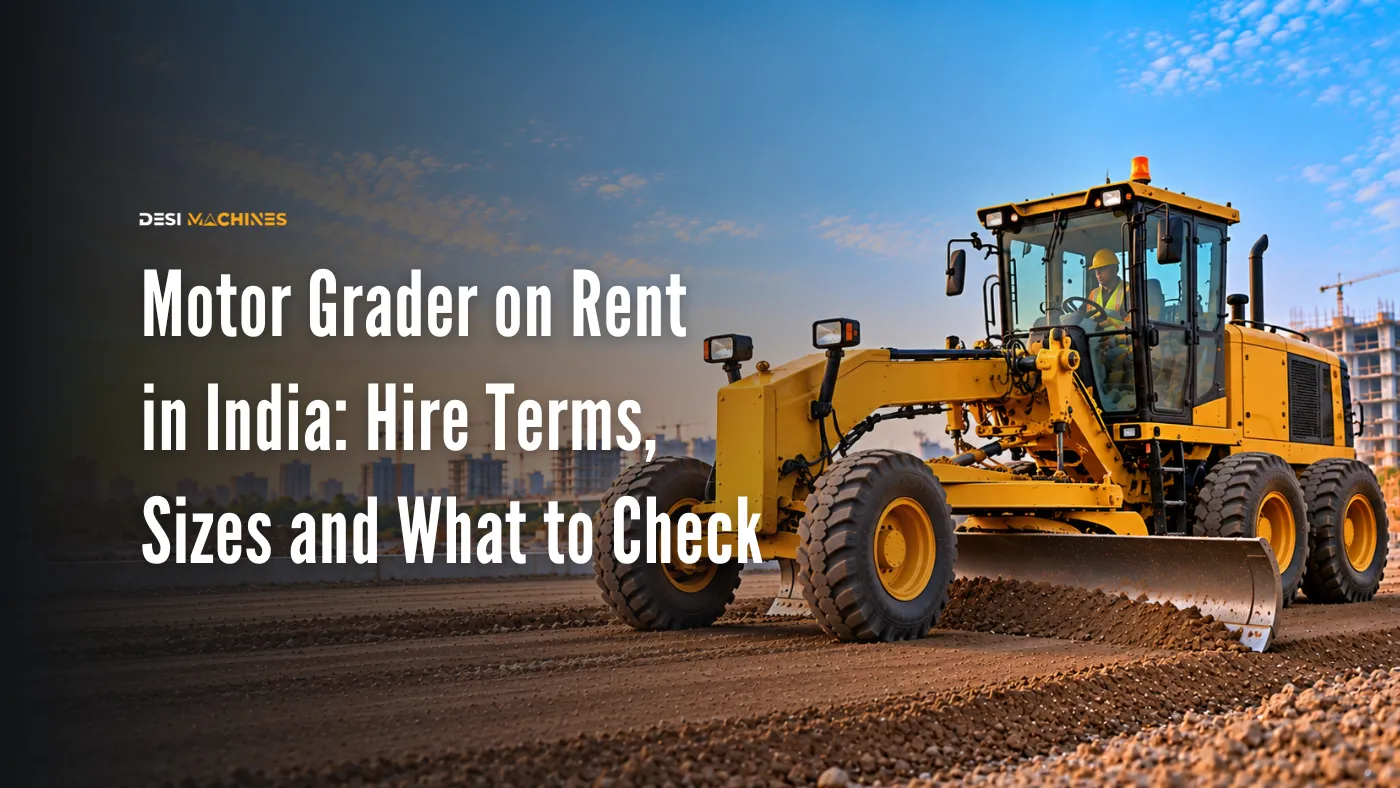
A motor grader on rent is a road-finishing machine hired by the day, the week or the job instead of being bought. It is the machine with the long steel blade slung between its front and rear axles, and its job is to give a road its final level and its camber, the gentle slope that pushes rainwater off to the sides. On most small road contracts in India the grader is hired rather than owned, because a machine that starts around ₹29.5 Lakh and runs past a crore is only wanted on site for a few days of a job that lasts months.
This guide covers what a grader hire includes, which blade width to ask for, how many days a stretch of road really needs, and what to look at before you sign. One thing it does not do is quote a rate, and the reason is explained below.
What does it mean to take a motor grader on rent?
It means a yard or another contractor gives you the machine for an agreed period and you pay for the time. Everything else in the deal is negotiable, and that is where first-time hirers lose money.
Two arrangements are common in India. Dry hire means you get the machine alone and you arrange the operator and the diesel yourself. Wet hire means the owner sends his own operator, and usually the diesel too, and bills you a higher rate that has the wage and the fuel baked into it.
On a grader that choice matters more than on most machines. A backhoe with an average operator still digs a trench. A grader with an average operator leaves a surface that will not drain, and you find out after the first rain. Blade angle, tilt, cutting depth and the speed held are all judged by eye by the person in the seat. Unless you already have a grader operator you trust, take the wet hire and take the yard’s man.
The basics of hiring in India — the documents a yard will ask for, the security deposit, and how billing periods are counted — are the same for a grader as for anything else, and are set out in our guide on how to rent construction equipment in India.
If you are weighing hire against ownership, our used motor grader buying guide covers what to check on a second-hand machine and how to price one against the new band for its class.
Should you rent a motor grader or buy one?
For most contractors, rent. A grader is the clearest hire-rather-than-buy machine in Indian construction, and the reason is utilisation.
New motor graders on our books run from ₹29.5 Lakh for the smallest, the Mahindra Roadmaster G80, which is listed as an onwards price rather than a band, up to ₹1.5–1.9 Crore for the largest machine carrying a published figure, the Komatsu GD705-5 (indicative, as of September 2026; the biggest machines in the range are listed as price on request). That is backhoe-loader money at the bottom and excavator-fleet money at the top.
Against that, count the days. On a road package the grader trims the subgrade, comes back to shape the granular sub-base, then again for the wet mix layer, and stands between those visits. The earthwork machines and the roller are busy for weeks; the grader is busy for days.
The arithmetic fits on paper. Count the days a blade was actually needed on your last three jobs, multiply by what a yard quotes for those days, and compare it against a monthly instalment that does not pause between jobs, plus an operator on your payroll, plus insurance and parking. Our equipment finance options give you the instalment side of the sum. If the two are close, buy; if hiring is clearly cheaper, the machine is not yours to own yet. For the full ownership case see the motor grader buying guide.
How much does a motor grader cost to rent in India?
We do not publish a grader hire rate, and we would rather say so than print a number we cannot stand behind. Our equipment rental rate card carries indicative hire bands for backhoe loaders, excavators, wheel loaders, road rollers, hydra cranes and self-loading mixers, because those machines hire at rates a yard will repeat to any caller. Graders are quoted job by job against the length and width of your stretch, so the quote in Bihar in December is not the quote in Kerala in June.
What you can control is what the quote is made of. Five things move a grader number: the blade width, whether the operator comes with it, how far the machine travels from the yard, how many days you book, and how busy the season is. October to May is the road season across most of India, and a grader is scarce and dear in it.
Fix these in writing before the machine moves:
- The billing unit. Per day, per shift, per month, or per kilometre of road finished. The last is the fairest for you if the yard will agree to it.
- The minimum period. Most yards will not send a grader for one day. Ask what the minimum is before you plan the sequence.
- The idle-day rate. Your grader will wait for material. Agree what a standing day costs, because the default answer is a full day.
- Diesel. Who fills it, and at whose rate.
- Mobilisation both ways. Getting the machine back is a separate charge, and the one people forget.
- The breakdown clause. Who repairs, who pays, and whether billing stops while the machine is down.
Never work off a verbal per-hour figure. Get the day rate or the per-kilometre rate on paper, with the inclusions listed under it.
Which motor grader size should you ask for?
Ask for a blade width, not a horsepower. The moldboard, which is the blade itself, decides how many passes your road takes, and it is the number every yard understands. Across the 42 motor graders listed on DesiMachines blades run from 2,600 mm to 7,300 mm, and the mainstream is a 12 ft blade of about 3,660 mm.
| Blade width | In feet | Engine power on our books | What it suits | Example machine |
|---|---|---|---|---|
| 2,600 mm | 8.5 ft | 74–95 HP (55–70 kW) | Village lanes, narrow link roads, yard and plot work | Mahindra G9075 |
| 3,000 mm | 10 ft | 74–102 HP (55–76 kW) | PMGSY through roads, site levelling, municipal work | Mahindra Roadmaster G80 |
| 3,658–3,660 mm | 12 ft | 150–225 HP (112–168 kW) | Two-lane state highways, the common hire in India | Sany STG140C-10 |
| 3,962–4,270 mm | 13–14 ft | 150–290 HP (112–216 kW) | Wider highway packages, long continuous stretches | CASE 865B, Sany SMG200C-8 |
| 4,878–7,300 mm | 16–24 ft | 280–533 HP (209–397 kW) | Large NHAI packages and mine haul roads | BEML BG825, Cat 24M |
Blade widths and engine ratings are taken from the specifications published for each machine, current as of September 2026.
A bigger blade is not always faster on a narrow road: a wide machine cannot turn where a small one can, and time lost at the ends of a short stretch eats the coverage gained. Weight, not blade width, decides how the machine reaches you, and the class weights are set out in our guide to motor grader weight and dimensions in India, which records the Indian mainstream as a 9,000 to 18,000 kg machine on a 12 ft blade.
How many days of hire do you actually need?
Fewer than you think, and working it out before you call the yard is the most useful thing on this page. The method comes from our own published output figures for motor grader productivity in India, turned around to answer hire duration instead of purchase output.
Start with passes: how many runs the machine needs to cover the width of your road once. Indian road widths are standardised, so this is a table rather than a guess. The time for one cover of a kilometre is then the passes divided by the speed you actually grade at, allowing for the fact that nobody grades sixty minutes in an hour.
| Road being graded | Width | Passes with a 12 ft blade | Time per km, one cover | Time per km, three covers | Km in an 8-hour day |
|---|---|---|---|---|---|
| PMGSY link road | 3.00 m | 2 | 0.5 hr | 1.6 hr | 5.0 km |
| Single lane / PMGSY through road | 3.75 m | 2 | 0.5 hr | 1.6 hr | 5.0 km |
| Intermediate lane | 5.50 m | 2 | 0.5 hr | 1.6 hr | 5.0 km |
| Two lane, no kerbs | 7.00 m | 3 | 0.8 hr | 2.4 hr | 3.3 km |
| Two lane with paved shoulders | 10.00 m | 4 | 1.1 hr | 3.2 hr | 2.5 km |
Worked at a measured grading speed of 5 km/h and 45 working minutes in the hour, using the pass counts published in our productivity guide. No manufacturer publishes a grading speed, so 5 km/h is a working assumption: measure your own on the first day and redo the sum.
Three points fall out of that table. A 12 ft blade covers a 3 m village road and a 5.5 m intermediate lane in the same two passes, so a narrow road does not hire cheaper, it finishes sooner. “Three covers” is an example rather than a rule: count the layers your own specification asks the blade to shape, which on a rural road means the subgrade, the granular sub-base and the wet mix layer. And a 5 km two-lane stretch is roughly two days of blade time, so you book a week to allow for material and weather, not a month.
Real sites run slower than a table: turning at the ends, waiting for the tipper, shifting between disconnected reaches. Book in that slack, because an extra day of hire is cheaper than a second mobilisation.
What does the hire rate include, and what is extra?
Assume nothing is included until it is written down. Normally included: the machine, its routine servicing, and the owner’s insurance on the machine itself. Normally extra: diesel, the operator if you took dry hire, transport to site and back, and any damage beyond fair wear.
Diesel swings a grader bill the most, and nobody can quote it honestly in advance. No manufacturer publishes a litres-per-hour figure for a grader, because consumption depends on how hard the blade is loaded and how much of the day is spent reversing. What is published is tank size, and our motor grader fuel tank and oil capacities reference lists it machine by machine. If you are paying for fuel: fill the tank on arrival, record the hour meter, and fill it again at the end of the first day. That gives you your own number for the rest of the hire, and it beats any figure a yard or a brochure offers.
How does the motor grader reach your site?
Either it drives itself or it comes on a trailer, and that depends on distance and paperwork rather than on the machine. A grader is wheeled and road-registrable, so unlike a tracked excavator it can drive to site, as our guide to motor grader travel speed in India explains. A road move needs the machine registered and the operator licensed, and those rules are set state by state, so confirm the position with the owner and your RTO first. Size is the other constraint: the blade can sit wider than the wheels, the largest moldboards run past 4.9 m, and the machine is often 9 m long.
Longer moves go on a trailer, and who arranges it and who pays is covered in our guide to equipment rental mobilisation in India. Settle the return leg when you settle the delivery.
What should you check before you accept the grader?
Spend twenty minutes on the machine before you sign. A grader hides its wear in places a general check misses.
- The cutting edge and end bits. The replaceable steel strip along the bottom of the blade. Worn thin it will not hold a line, and you will be arguing later about who wore it out. Photograph it.
- Circle and drawbar play. The circle is the large toothed ring that swings the blade. Ask the operator to rotate it fully both ways and watch for jerk or a dead spot, because a worn circle makes fine grading impossible and is an expensive repair.
- Blade drift. Set the blade, shut the machine down, and look again after ten minutes. If it has sunk, the hydraulic cylinders are leaking internally and the operator will fight it all day.
- The articulation joint. On an articulated machine, the pivot in the middle. Play here shows up as a wandering finish.
- Tyres. Six of them, and they are not cheap. Note the tread and any cuts in writing.
- All-wheel drive and the hour meter. Ask whether the machine drives all six wheels, because on wet subgrade it is the difference between working and waiting. Photograph the hour meter on arrival and on return.
Our explainer on how motor graders work covers the blade, the circle and the drive systems if you want to know what you are looking at. Then write a short condition note, get the owner’s man to sign it, and keep the photographs. Almost every rental dispute in India is about damage neither side recorded on day one.
Do you pay GST on motor grader hire?
Yes. Hiring out equipment is a supply of service, so a grader hire bill carries GST, and a registered contractor can normally take that tax as input credit. The applicable rate and the coding your invoice should carry are set out in our guide to GST on construction equipment in India. Insist on a proper tax invoice carrying the owner’s GSTIN: a hand-written slip is not a bill you can claim against. Confirm the treatment of your own contract with your accountant.
Renting a motor grader: the short version
- A grader is a hire machine for most contractors. It works in short visits on a long job, so ownership only pays if your days add up.
- Ask for a blade width, not a horsepower. A 12 ft blade of about 3,660 mm covers everything up to a two-lane road.
- Work out your days before you call. One cover of a two-lane kilometre is roughly 0.8 hours of blade time.
- Take wet hire unless you have a grader operator you trust. The finish is the operator’s, not the machine’s.
- Get the billing unit, the minimum period, the idle-day rate, diesel, mobilisation both ways and the breakdown clause in writing, and check the cutting edge, the circle, the blade for drift and the tyres before you sign.
When the sums point the other way, compare motor grader models and prices and talk to a dealer. Our equipment rental guide covers the same ground for every other class, including the road roller on rent that follows the grader onto your stretch and the excavator on rent that comes before it.
If the job is pushing and stripping material rather than finishing a surface, the same hire questions for a dozer on rent are set out separately, including the blade and the ground bearing pressure to ask for.
Prices, specifications and features are indicative, vary by variant, location and date, and should always be confirmed with the official OEM or authorised dealer before any purchase decision. DesiMachines is not liable for decisions taken on the basis of information that may have changed after publication.