
 Excavator
294 models
Excavator
294 models  Backhoe Loader
51 models
Backhoe Loader
51 models  Crane
68 models
Crane
68 models  Concrete Mixer
79 models
Concrete Mixer
79 models  Wheel Loader
54 models
Wheel Loader
54 models  Compactor / Roller
45 models
Compactor / Roller
45 models  Motor Grader
42 models
Motor Grader
42 models  Concrete Pump
66 models
Concrete Pump
66 models  Skid Steer Loader
11 models
Skid Steer Loader
11 models  Telehandler
13 models
Telehandler
13 models 


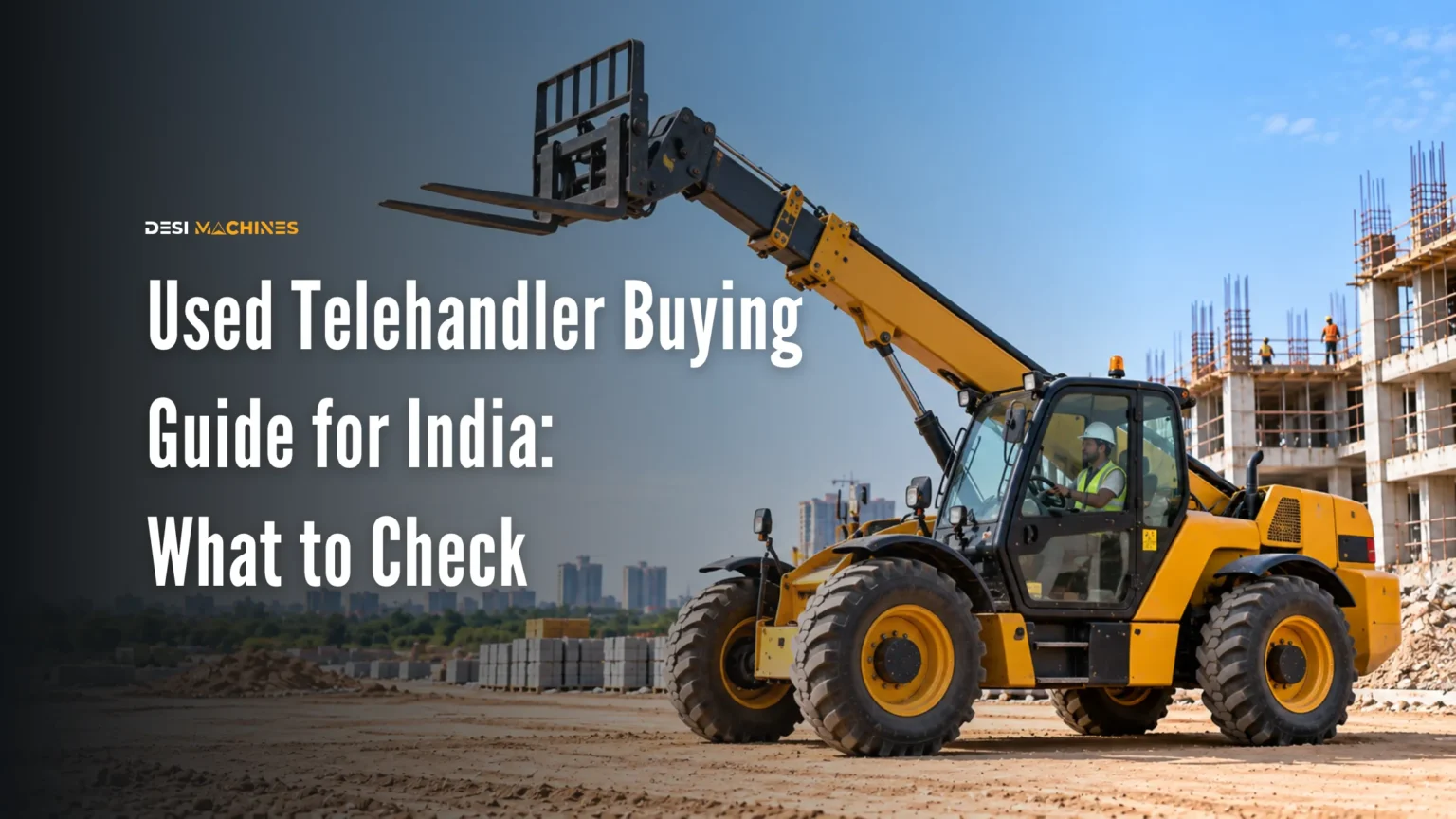
On a used telehandler the boom decides the price, not the engine. Check the boom sections for play and the wear pads for thickness first, then the load chart plate, the forks and the carriage, and leave the engine and tyres until after that.
This guide covers the boom checks, why the load chart plate has to match the forks on the machine in front of you, what the hour meter is really telling you, how a used rotating machine differs from a used fixed one, and which papers must change hands. The class figures come from the thirteen telehandler models and prices listed on DesiMachines, and each range says how many machines it is built from.
What should you check on a used telehandler?
Work from the boom tip backwards. A telehandler earns its money by putting a load somewhere a forklift cannot reach, so everything between the fork tip and the boom pivot is the machine you are buying. The engine is a known cost. A tired boom is not.
- Boom sections and wear pads. Extend the boom fully with nothing on the forks and look for sideways rattle and for the tip settling. Thin pads show up as play long before anything breaks.
- The load chart plate. It must be present, readable, and the right chart for the carriage and forks fitted to this machine. A missing or wrong plate is not a cosmetic fault.
- Forks and carriage. Measure the fork blade thickness near the heel, check both fork tips sit at the same height, and work the latches and the quick hitch.
- Frame levelling and stabilisers. If the machine has a levelling function or stabiliser legs, run them through full travel both ways and watch for a leg that drifts back down.
- Hydraulic drift. Lift the boom, hold a load on the forks, shut the engine off and mark the position. Anything that keeps sinking is a cylinder or valve problem and it is a workshop job.
- Tyres and driveline. All thirteen machines listed here are four-wheel drive, and six of them run a larger tyre at the front than at the rear, so you cannot rotate the tyres to even out wear. Check the size stamped on every tyre before you agree a price.
Do the general checks as well: cold starting, oil condition, smoke, cracked welds and a tampered hour meter are all in the used equipment inspection checklist. The list above is what that checklist does not cover, because it belongs to this machine and no other.
How do you check the boom and its wear pads?
The boom is made of steel sections that slide inside one another, and they do not slide on steel. They slide on wear pads, which are blocks of hard plastic bolted between the sections. Pads are meant to wear out, and the telehandler parts and components guide explains how the boom is built. What follows is how you test it in a yard, in ten minutes, without tools. Park the machine on level ground with the forks empty and low, then do four things in this order.
- Extend fully and watch the tip. Run the boom out to full extension and stop. Stand to one side and look along the boom. A tip that droops visibly, or that rattles when the operator blips the controls, is telling you the pads are thin.
- Push the tip sideways. With the boom out and low, get two people to push the fork carriage left and right by hand. A small amount of movement is normal. Movement you can see from ten metres away is not.
- Retract slowly and listen. A healthy boom comes back in one smooth movement. A knock or a jerk as each section passes the next means the pads have worn unevenly or the boom has been run dry of grease.
- Look for shiny steel. Open the boom covers if it has them and look at the section faces. Bright polished lines or score marks mean the pads have worn through and steel has been running on steel. That is a boom rebuild, not a pad change, and it is the most expensive thing on this list.
No manufacturer in these listings publishes a pad thickness or a pad life in hours, so there is no figure to measure against. What you are judging is whether the previous owner changed pads on time or ran them out. If the boom will not extend at all, or it extends and then creeps down when parked, the causes are worked through in the guide to telehandler boom problems, and a seller who cannot explain the fault is a seller who has not fixed it.
Is the load chart plate still on the machine, and does it match the forks?
A telehandler’s safe lifting capacity falls as the boom goes out, because the load moves further from the machine. The chart in the cab gives the operator the safe weight at each height and reach, and how to read a telehandler load chart works through one line by line. Second-hand, there are two separate questions about it.
First, is the plate there and readable? Charts get painted over, scraped off, or lost when a cab is repaired. Nobody who does not already know the numbers can work the machine safely without it, and a replacement means going back to the manufacturer with the serial number.
Second, is it the right chart for what is bolted on the front? A load chart is issued for the machine with a specific carriage and attachment. Used machines change hands with whatever the last owner happened to own, and a jib, a bucket or a longer fork set changes the numbers completely. If the forks on the machine are not the forks on the chart, the chart is decoration. Ask for the manual and the original paperwork for any telehandler attachment included in the deal.
While you are at the front of the machine, inspect the forks themselves. The international standard for fork arms in service, ISO 5057, sets the wear limit at ten percent: a fork comes out of service once the blade has worn to ninety percent of its original thickness, measured just in front of the heel where the blade meets the upright. Losing a tenth of the thickness costs roughly a fifth of the fork’s rated capacity, which is why it is a limit and not a guideline. Check for cracks at the heel radius, check that both tips sit level with each other, and check that the pins and latches hold the forks square on the carriage.
How many hours is too many on a used telehandler?
There is no single number, and a seller who offers one is guessing. The meter counts engine hours, and a telehandler spends much of its day standing still with the engine running: waiting for the mason, waiting for the truck, holding a load at height while someone fixes it in place. So engine hours and boom cycles come apart on this machine more than on most. A telehandler that spent three years feeding block and mortar to a building site has cycled its boom many thousands of times; one that moved pallets around a warehouse floor has barely worked the pads at all, and both can read 4,000 hours.
So use the hours to ask better questions. What was the machine doing, and where? Crusher dust, cement dust and steel swarf kill wear pads, seals and hoses, and a machine that worked in any of them has aged faster than the meter says. Then match the answer against what you measured on the boom. A tight boom at 6,000 hours means someone spent money recently, and that is worth paying for. A loose boom at 2,000 hours means either the hours are not the real hours or the machine has had a hard life. Ask for the last three service bills and the date the wear pads were last changed, in writing.
Should you buy a used fixed boom or a used rotating telehandler?
Ten of the thirteen telehandlers listed here have a fixed boom and three rotate. A fixed boom telehandler points its boom straight ahead, so placing a load to the side means driving the whole machine round. A rotating telehandler turns its upper structure on a slew ring, which is a large toothed bearing, so it can set down anywhere in a circle from one parked position.
Table 1: Telehandler classes on DesiMachines listings, as of September 2026
| Figure | Fixed boom (10 machines) | Rotating (3 machines) |
|---|---|---|
| Maximum lifting height | 7,000 to 17,400 mm (7.0 to 17.4 m) | 15,800 to 34,700 mm (15.8 to 34.7 m) |
| Maximum outreach | 3,800 to 13,480 mm (3.8 to 13.5 m) | 13,500 to 28,000 mm (13.5 to 28.0 m) |
| Maximum lifting capacity | 2,721 to 4,540 kg (2.72 to 4.54 tonnes) | 4,500 to 7,000 kg (4.5 to 7.0 tonnes) |
| Operating weight | 6,972 to 15,530 kg (6.97 to 15.53 tonnes) | 13,305 to 23,800 kg (13.31 to 23.8 tonnes) |
| Engine power | 74 to 120 HP | 116 to 211 HP |
For a first machine the fixed boom is the easier buy: less to inspect, less to go wrong, and far more of them on the market. A used rotating machine adds the slew ring and four stabiliser legs to your inspection list, and both are expensive to put right. Ask for the slew ring to be turned a full circle in both directions while you listen, and extend every leg under load. The extra reach is worth paying for when the work genuinely needs it, such as feeding two faces of a building from one set-up. It is not worth paying for on a site where the machine can simply be driven round.
What does a telehandler cost, new and used?
Start from the new price for the same class and work down. The fixed boom machines run from the ACE AT 30 at ₹30 – ₹38 Lakh to the SANY STH1056A at ₹95 Lakh – ₹1.20 Crore (both indicative, as of September 2026, quoted as published rather than rounded). The three rotating Manitou machines are price on request. All ten published ranges are listed in the telehandler parts and costs guide, and the live telehandler range and prices carries today’s figure.
Those listed figures are ex-factory and include GST. A telehandler is a wheeled machine that registers for the road, so the on-road figure adds transport, RTO registration, TCS, warranty and insurance on top.
We do not publish used prices, because a used price is set by one machine’s history and not by its model. Four things move the number, roughly in this order.
- Boom condition. Pads are a service item and belong in the price. Scored boom sections are an open-ended cost and belong in the decision.
- The forks, carriage and chart. A machine that comes with its correct chart, its manual and forks inside the wear limit is a machine you can put to work on day one.
- Tyres. Four large tyres, often two different sizes, replaced together. Price a set before you negotiate.
- Papers and finance status. A clean registration in the seller’s name with the loan cleared is a different proposition from one where the finance is still running.
Money works differently on a second-hand machine: lenders shorten the tenure and ask for a larger down payment as the machine gets older. Our equipment finance options and equipment insurance partners cover what each of them will want to see.
Which papers must come with a used telehandler?
A telehandler drives on wheels at 23 to 40 km/h, so it is registered rather than treated as a tracked site machine, and the paperwork is heavier as a result. This is where second-hand deals most often come apart. Ask for all of it before any money moves.
- Registration certificate (RC) in the seller’s name, with the chassis and engine numbers matching the ones stamped on the machine. Go and read the stampings yourself.
- Form 29 and Form 30, the ownership transfer forms, signed by the seller.
- Hypothecation removal if the machine has ever been financed. A loan still showing on the RC means the lender has a claim on the machine you just paid for.
- Insurance, and confirmation that the policy can be transferred to you.
- Original purchase invoice, which is what establishes the machine’s real age.
- Operator manual and the load chart for the attachment fitted. On this machine those are safety documents, not accessories.
- Service records and job cards, the only evidence of what the hour meter means.
The transfer itself, including getting a financed machine released, is set out step by step in the owner’s guide to RC transfer and hypothecation removal. Do not pay the balance until the transfer has been filed. If the machine is moving to you on a trailer, the weights and widths that decide which trailer you need are in telehandler weight and dimensions.
Is a used telehandler worth buying in India?
Often, yes, with one condition attached. Telehandlers arrived on Indian sites much later than backhoe loaders or excavators, so the second-hand pool is small and much of it is ex-rental. An ex-rental machine has usually been worked hard and serviced on a schedule, which is a better combination than it sounds, provided the job cards exist to prove the second half.
The condition is the boom. A used telehandler with a tight boom, a correct chart and forks inside the wear limit is good value, because the expensive part of the machine is intact and everything else on it is ordinary maintenance. A used telehandler with a loose or scored boom is a rebuild wearing a low price, and there is no discount large enough to make that a good buy for a first-time owner.
If you are still deciding whether this is the right machine at all, the complete telehandler guide for India covers what the machine does and where it beats a crane or a backhoe. When you are ready to compare real machines, browse the current telehandler models and prices and talk to a dealer about what a comparable used machine should cost.
Buying a used telehandler, in short
Inspect the boom before the engine, because that is where the money is. Extend it fully, watch for droop and rattle, push the carriage sideways, listen on the way back in, and look for polished steel inside the sections. Check that the load chart plate is present and matches the forks actually fitted, and measure the fork blades against the ten percent wear limit. Treat the hours as a question and the service records as the answer. Then work the price down from the new band for the same class, and settle the RC, Form 29 and 30 and the hypothecation removal before the final payment.
Other machines in this series: used motor grader and the rest of the used equipment guides. If you are buying second-hand for the first time, start with how to buy used construction equipment in India.
Prices, specifications and features are indicative, vary by variant, location and date, and should always be confirmed with the official OEM or authorised dealer before any purchase decision. DesiMachines is not liable for decisions taken on the basis of information that may have changed after publication.