
 Excavator
316 models
 Backhoe Loader
54 models
 Crane
68 models
 Concrete Mixer
79 models
 Wheel Loader
54 models
 Compactor / Roller
45 models
 Motor Grader
42 models

 Concrete Pump
66 models
 Skid Steer Loader
11 models


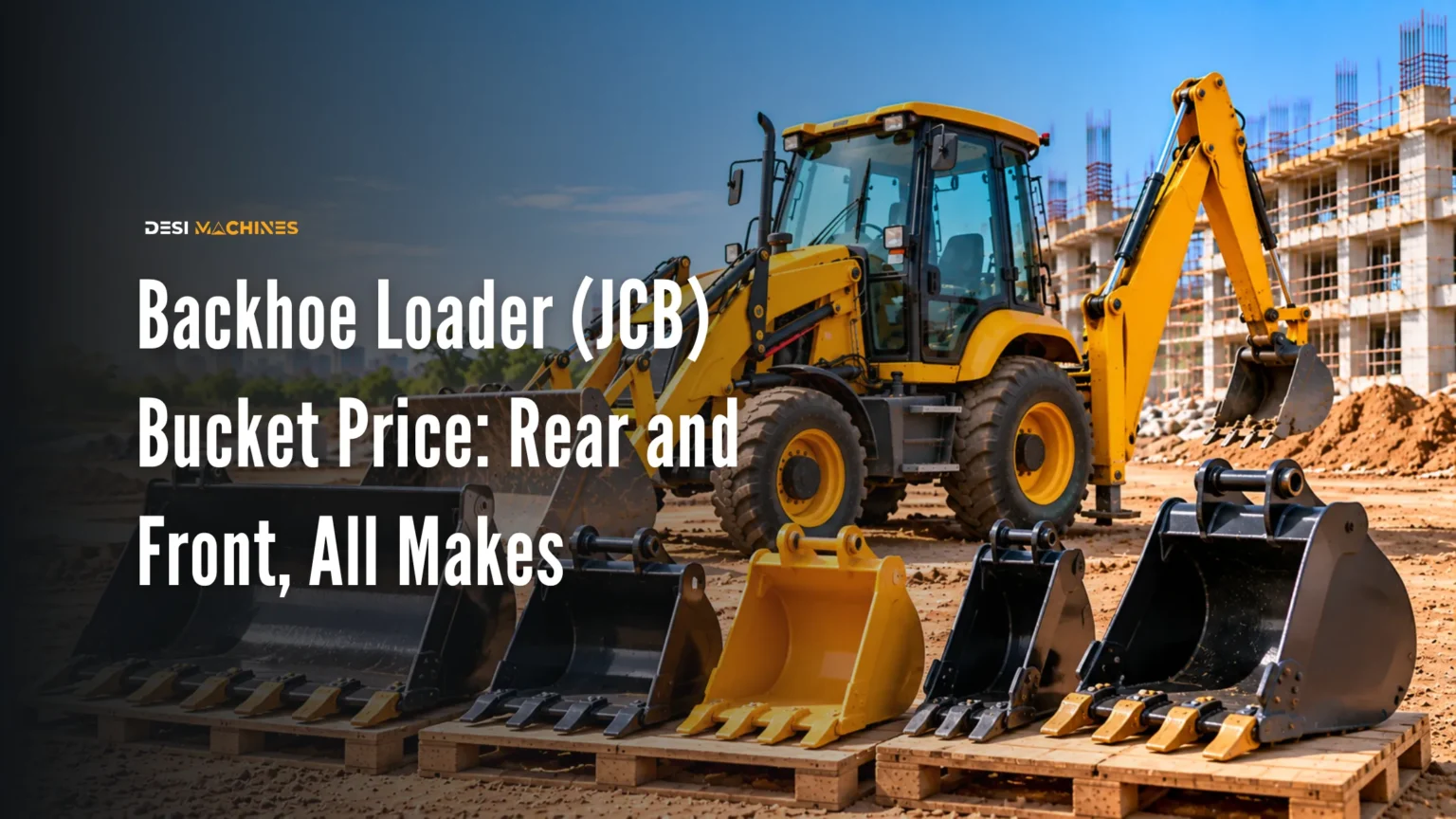
The type of bucket sets a backhoe loader bucket price in India before anything else: the standard rear digging bucket is the cheapest, special rear buckets for trenching, rock or ditching cost more, and the big front loader bucket costs several times a standard rear one. After that, the steel, the build, what comes with the bucket and who made it move the price. The make of the machine matters least, because the same sizes are built for every make.
Most people in India call a backhoe loader a JCB, and sellers label their buckets the same way, but the same bucket sizes are built for CASE, Mahindra EarthMaster, Tata Hitachi Shinrai, ACE, Bull, Escorts Kubota, Caterpillar, Manitou, BEML and Bobcat machines too. This page is about the price of the bucket itself. If you are looking for the price of the machine, which many people search as “bucket JCB”, see the backhoe loader price list instead.
What decides the price of a backhoe loader bucket?
A backhoe loader carries a large loader bucket at the front and a smaller digging bucket at the rear. Owners change the rear one most often, swapping widths for different jobs.
| Bucket | Size | Used for |
|---|---|---|
| Rear digging bucket, standard | 0.24 – 0.30 m³, the factory size on most backhoe loaders | General digging and loading |
| Rear digging bucket, narrow | 12 inch | Trenches for cables and small pipes |
| Rear trenching (pipeline) bucket | 9 inch | Narrow, deep pipeline trenches |
| Rear rock bucket | 18 inch | Hard and rocky ground |
| Heavy-duty rear bucket | Various widths | Abrasive ground and daily hard use |
| Rear ditching / grading bucket | 42 inch | Cleaning drains and shaping slopes |
| Front loader bucket | 1.0 – 1.3 m³ | Loading, levelling, backfilling |
| Teeth | Single tooth point | Replaced as they wear |
| Teeth set | Teeth plus side cutters, rear bucket | A full change on a standard rear bucket |
In the seller listings we checked in late September 2026, the narrow 12-inch and rock buckets sat close to a standard rear bucket, while the 9-inch pipeline bucket, the heavy-duty buckets and the wide 42-inch ditching bucket cost clearly more. Front buckets are rarely listed with a price at all, and the few that were cost several times a standard rear bucket.
To get a price, give the dealer your machine make, model and year, the pin diameter, and the width or capacity you want. Ask what steel the bucket is made from, and whether teeth, side cutters, pins and GST are included, because two quotes for the “same” bucket often differ on exactly that. The dealer price form on this page sends your request straight to sellers.
This is a general guide based on machine size class. Always confirm the fit with your machine’s operator manual or the manufacturer before buying or fitting.
What size bucket does each backhoe loader make use?
Almost every full-size backhoe loader sold in India comes from the factory with a rear bucket between 0.24 and 0.30 m³ and a front bucket between 1.0 and 1.26 m³. All 51 models in our catalogue publish both figures. The table groups them by make.
| Make | Models | Rear (digging) bucket | Front (loader) bucket |
|---|---|---|---|
| JCB | 3DX, 3DX Plus, 3DX Xtra, 3DX Super, 4DX | 0.26 – 0.32 m³ | 1.0 – 1.2 m³ |
| JCB (compact) | 2DX | 0.18 m³ | 0.60 m³ |
| CASE | 770 NX, 770 NXe, 770 EX, 770 EX Plus, 770 NX Magnum, 851 NX | 0.26 – 0.30 m³ (851 NX: 0.36 / 0.40 m³) | 1.1 m³ |
| Mahindra EarthMaster | SX, VX, SXE, SX IV, VX IV, SX Smart 50 | 0.27 m³ | 1.1 m³ |
| Tata Hitachi Shinrai | Pro, Prime, Power, Power 4 | 0.26 – 0.30 m³ | 1.1 m³ |
| ACE | AX 124, AX 124 Eco Master, AX 130, Phantom 2WD, Phantom 4WD, Phantom 4WD N | 0.24 – 0.30 m³ | 1.0 – 1.1 m³ |
| Bull | HD76, HD96, HD100, SD76, CH76 Challenger, Grandia | 0.22 – 0.27 m³ | 1.1 – 1.26 m³ |
| Escorts Kubota | Digmax II, Digmax II XP, Digmax Super, Jungli HT, BLX75 | 0.26 m³ | 1.1 – 1.2 m³ |
| Caterpillar | 424 | 0.27 m³ | 1.05 m³ |
| Manitou | MBL 745 series (five versions) | 0.27 m³ | 1.0 m³ |
| BEML | BL9H 4×2, BL9H 4×4 | 0.24 m³ | 1.20 m³ |
| Bobcat | B900 | 0.27 m³ | 1.1 m³ |
Only 14 of the 51 models publish the rear bucket width. They sit between 752 mm and 940 mm, which is about 30 to 37 inches: the Tata Hitachi Shinrai range at 752 to 798 mm, the JCB 3DX family at 790 to 820 mm, the Manitou MBL 745 at 889 mm and the JCB 4DX at 940 mm. So when a seller quotes a “standard” bucket, it usually means one about 30 to 32 inches wide. The backhoe loader bucket capacity guide sets these sizes beside dig depth and dump height.
This is a general guide based on machine size class. Always confirm the fit with your machine’s operator manual or the manufacturer before buying or fitting.
Will a bucket made for one make fit another backhoe loader?
Sometimes, but never assume it. A bucket has to match three things: the pin diameter, the distance between the two pins on the dipper and the linkage, and the width of the mounting ears. Backhoe loaders of different makes are close in size, since all but one model in our catalogue weigh between 7.2 and 9.7 tonnes, yet their pins and pin centres differ. A bucket built for a JCB 3DX will not always sit on a Mahindra EarthMaster or a CASE 770 without new bushes or re-bored ears.
Give the seller your make, model, year and pin size. A bucket bigger than the factory size slows every cycle and strains the arm.
This is a general guide based on machine size class. Always confirm the fit with your machine’s operator manual or the manufacturer before buying or fitting.
Why do buckets of the same size have different prices?
- Steel. Buckets made from wear-resistant steel cost more than mild-steel buckets but last much longer in sand, murram and rock. The bucket wear plate guide explains the 400, 450 and 500 HB grades.
- Build. Extra wear strips, a thicker cutting edge and reinforced sides add weight and cost.
- What comes with it. Teeth, adapters, side cutters and pins may or may not be included.
- Maker. Buckets from the machine’s dealer cost more than buckets from local fabricators. A well-built local bucket can do the job; a poorly welded one cracks at the corners.
What decides the price of an excavator bucket?
Excavator buckets are priced by the size of the machine, because a 20-tonne excavator carries a bucket about four times the size of a backhoe’s rear bucket. Our catalogue lists excavators from Tata Hitachi, Komatsu, Hyundai, Caterpillar, SANY, Volvo, Kobelco, JCB, LiuGong, XCMG and others, and the factory bucket size follows the machine weight.
| Excavator size | Usual factory bucket |
|---|---|
| Mini, under 6 tonnes | 0.04 – 0.22 m³ |
| 6 – 10 tonnes | 0.30 – 0.35 m³ |
| 10 – 17 tonnes | 0.6 – 0.72 m³ |
| 17 – 26 tonnes, general purpose | 0.9 – 1.2 m³ |
| 17 – 26 tonnes, rock or heavy duty | 0.9 – 1.2 m³ |
| 26 – 40 tonnes | 1.4 – 2.3 m³ |
Within one size, a rock or heavy-duty bucket costs clearly more than a general-purpose one, because it carries thicker plate, wear strips and a heavier edge. Seller listings on IndiaMART and TradeIndia for 20-tonne buckets name machines such as the Tata Hitachi EX200, Komatsu PC210, Hyundai R215, Volvo EC220, SANY SY210 and CAT 320, and several sellers build the same bucket for all of them. To get a price, give the dealer your machine model, its operating weight, the bucket type and the capacity you want; bucket types are also listed on our excavator bucket page. For the machines themselves, see the excavator price list. The excavator bucket guide explains general-purpose, rock, trenching and ditch-cleaning buckets.
This is a general guide based on machine size class. Always confirm the fit with your machine’s operator manual or the manufacturer before buying or fitting.
Standard front bucket or multipurpose bucket?
A standard front bucket loads and carries. A multipurpose bucket, often called a 4-in-1 or 6-in-1, has a clamshell that opens, so the same bucket can also grab, level, doze and spread. It costs more and weighs more, and it earns its keep on jobs that change through the day, such as road work and site clearing. Several models in India offer it as an option.
For the other tools a backhoe can run, from rock breakers to augers, see the backhoe loader attachments guide.
When should you replace teeth, the cutting edge or the bucket?
- Replace a tooth point when it has worn round and blunt, or when the adapter behind it starts to show. A blunt tooth makes the machine work harder for every bucket.
- Replace the cutting edge before the wear reaches the bucket floor. The edge is cheap; the floor is the bucket.
- Check the corners and the pin bosses for cracks. Welding a small crack early costs far less than a new bucket.
- Replace the bucket when the floor has worn thin or holes appear, or when the pin bosses have worn oval.
Buckets sit alongside tyres, batteries and engine oil as the parts backhoe owners buy most often. The parts and running costs guides cover the rest of the machine.
What moves the price of teeth, adapters and side cutters for every machine size, from a backhoe loader to a 50-tonne excavator, is covered in the bucket teeth price guide.
Bucket sizes are the makers’ published specifications. Prices, specifications and features are indicative, vary by variant, location and date, and should always be confirmed with the official OEM or authorised dealer before any purchase decision. DesiMachines is not liable for decisions taken on the basis of information that may have changed after publication.
Get a bucket price from a dealer near you
Tell us your machine and what you need, and we will ask the nearest dealer to reach out to you with a price.