
 Excavator
294 models
Excavator
294 models  Backhoe Loader
51 models
Backhoe Loader
51 models  Crane
68 models
Crane
68 models  Concrete Mixer
79 models
Concrete Mixer
79 models  Wheel Loader
54 models
Wheel Loader
54 models  Compactor / Roller
45 models
Compactor / Roller
45 models  Motor Grader
42 models
Motor Grader
42 models  Concrete Pump
66 models
Concrete Pump
66 models  Skid Steer Loader
11 models
Skid Steer Loader
11 models  Telehandler
13 models
Telehandler
13 models  Dozer
Dozer 


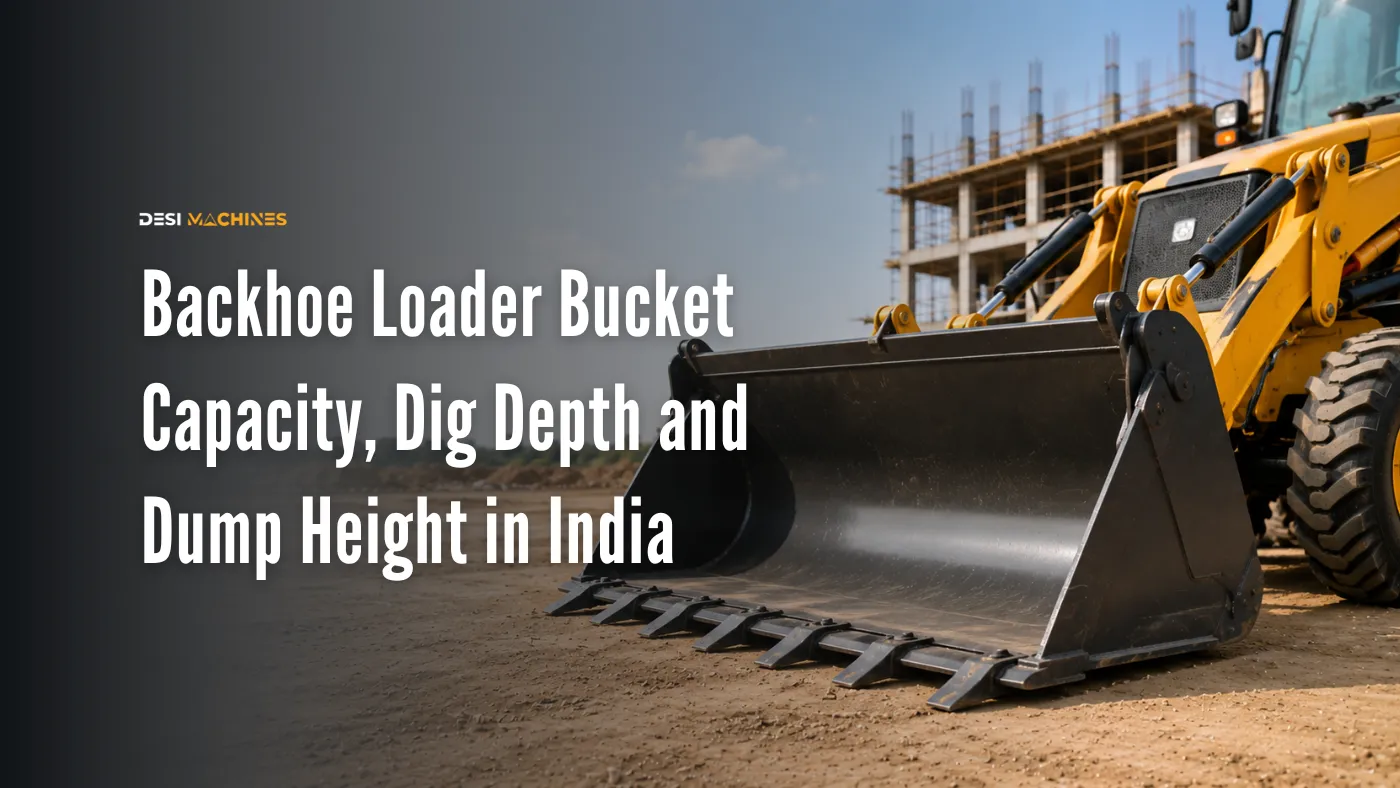
Bucket capacity on a backhoe loader is how much material one scoop holds, measured in cubic metres (m³). A backhoe loader carries two buckets, not one: a wide front shovel that loads, and a narrower rear bucket on the digging arm that digs. Across the 42 backhoe loaders on DesiMachines that publish these figures, front shovels hold 0.60 to 1.26 m³ (600 to 1,260 litres) and rear buckets hold 0.22 to 0.40 m³ (220 to 400 litres), as per the current August 2026 spec sheets.
Those two numbers, plus how deep the machine digs and how high it tips, decide whether a backhoe loader suits your work. This guide explains each figure in plain language and shows what the machines sold in India actually deliver.
What does bucket capacity mean on a backhoe loader?
Bucket capacity is a volume, not a weight. It tells you the space inside the bucket in cubic metres. One cubic metre is 1,000 litres, so a 1.1 m³ front shovel holds about 1,100 litres of loose soil in a single pass.
Weight is a separate matter, and it is where first-time buyers get caught. A cubic metre of dry sand and a cubic metre of wet clay occupy the same space but do not weigh the same. That is why the spec sheet also lists a payload figure in kilograms: the load the front shovel is rated to lift. Fill a bucket with something heavy and you will hit the payload limit long before the bucket is full.
One more thing worth asking your dealer: whether the published figure is struck (level with the bucket rim) or heaped (piled above it). The two are measured differently and the gap between them is real. The figures below are the standard capacities as published on each machine’s spec sheet.
How much does a backhoe loader bucket hold?
Most full-size backhoe loaders sold in India carry a front shovel of 1.0 to 1.2 m³ and a rear bucket of 0.24 to 0.30 m³. The table below sets out both ends of the machine for a spread of models across brands, along with dig depth and dump height, all taken from the published specifications as of August 2026.
| Model | Engine | Front shovel | Rear bucket | Dig depth | Dump height | Payload |
|---|---|---|---|---|---|---|
| JCB 2DX | 49 HP | 0.60 m³ (600 L) | — | 3,020 mm (9.9 ft) | 2,300 mm (7.5 ft) | 800 kg |
| JCB 3DX | 49 HP | 1.0 m³ (1,000 L) | 0.26 m³ (260 L) | 4,770 mm (15.6 ft) | 2,740 mm (9.0 ft) | 1,650 kg |
| JCB 4DX | 74 HP | 1.2 m³ (1,200 L) | 0.40 m³ (400 L) | 5,360 mm (17.6 ft) | 2,930 mm (9.6 ft) | 1,800 kg |
| CASE 770 NXe | 49.5 HP | 1.1 m³ (1,100 L) | 0.26 m³ (260 L) | 4,400 mm (14.4 ft) | 2,720 mm (8.9 ft) | 1,925 kg |
| Bull HD76 2WD | 76 HP | 1.1 m³ (1,100 L) | 0.27 m³ (270 L) | 4,600 mm (15.1 ft) | 2,960 mm (9.7 ft) | 2,400 kg |
| Escorts Digmax II | 75 HP | 1.2 m³ (1,200 L) | 0.26 m³ (260 L) | 4,800 mm (15.7 ft) | 3,000 mm (9.8 ft) | 1,980 kg |
| Tata Hitachi Shinrai Prime | 74.3 HP | 1.1 m³ (1,100 L) | 0.26 m³ (260 L) | 4,700 mm (15.4 ft) | 2,690 mm (8.8 ft) | 1,920 kg |
| Mahindra EarthMaster SX IV | 74 HP | 1.1 m³ (1,100 L) | 0.27 m³ (270 L) | 4,959 mm (16.3 ft) | 2,708 mm (8.9 ft) | Not specified |
| ACE AX 124 | 74 HP | 1.1 m³ (1,100 L) | 0.24 m³ (240 L) | 4,250 mm (13.9 ft) | 2,760 mm (9.1 ft) | 1,900 kg |
| Bobcat B900 | 74 HP | 1.1 m³ (1,100 L) | 0.27 m³ (270 L) | 4,996 mm (16.4 ft) | 2,737 mm (9.0 ft) | 2,000 kg |
| CAT 424 | 74 HP | 1.05 m³ (1,050 L) | 0.27 m³ (270 L) | 4,138 mm (13.6 ft) | 2,794 mm (9.2 ft) | Not specified |
Figures as published on each machine’s specification sheet, August 2026. The JCB 2DX rear-bucket figure is under review, so it has been left blank here rather than printed unverified.
Two patterns stand out. First, the front shovel is roughly four times the rear bucket on every machine. The front end is built to move loose material in bulk; the rear end is built to cut into ground. Second, the compact JCB 2DX sits well below the rest on every measure. It is a smaller class of machine, and its 0.60 m³ shovel and 3,020 mm dig depth suit narrow lanes and small plots rather than highway work.
How deep can a backhoe loader dig?
A backhoe loader digs between 3,020 mm and 5,360 mm (9.9 ft to 17.6 ft) across the machines listed on DesiMachines, measured from ground level straight down. Leave out the compact 2DX and the full-size machines fall in a tighter band of about 4.1 m to 5.4 m (13.6 ft to 17.6 ft). The deepest is the JCB 4DX at 5,360 mm.
Dig depth is the figure most buyers ask about first, and for good reason. It decides which jobs you can quote for:
- Water and drainage pipe trenches in a village or small town usually sit within 2 to 3 metres. Every full-size backhoe loader clears this comfortably.
- Foundation trenches for a two- or three-storey building generally fall inside 3 metres, again well within range.
- Septic tank and soak pit excavation runs deeper, often 3 to 4.5 metres, and here the difference between a 4.1 m machine and a 5.3 m machine starts to matter.
- Anything past 5.4 m needs a different machine. That is excavator work, not backhoe work.
Depth is not the whole story. Reach matters as much: how far back the arm extends from the machine. A deeper-digging machine usually reaches further too, which lets the operator sit in one spot and cut a longer stretch of trench before repositioning. Fewer repositions means less diesel and a faster job.
If you are weighing a backhoe loader against a tracked machine for deep work, our guide on how deep a mini excavator can dig sets out what the smaller excavator classes manage.
How high can a backhoe loader lift and dump?
Dump height is how high the front shovel rises before it tips, and on the machines listed here it runs from 2,300 mm to 3,000 mm (7.5 ft to 9.8 ft). Most full-size backhoe loaders land between 2.7 m and 3.0 m. The Escorts Digmax II tops the list at 3,000 mm.
This is the number that decides whether you can load a tipper without a struggle. The shovel has to clear the side wall of the truck body and still have room to roll forward and empty. A machine that only just clears it will spill material down the outside of the truck and slow every cycle. Before you buy, measure the side height of the tippers you actually load and compare it against the dump height on the spec sheet.
Two related figures sit alongside it. Maximum working height is how high the shovel reaches at full lift, and it ranges from 3,880 mm to 6,526 mm (12.7 ft to 21.4 ft) across these machines. Maximum payload is what the shovel is rated to carry, from 800 kg on the compact 2DX up to 2,400 kg on the Bull SD76 and HD76.
Payload is the figure to check if you handle dense material. Loading loose sand, you will fill the bucket before you reach the weight limit. Loading wet earth, aggregate or demolition rubble, you will hit the weight limit first and the bucket will run part-full all day. In that case a bigger bucket buys you nothing, and a higher payload rating is what you want.
Ready to compare machines side by side? Browse backhoe loader models and prices and talk to a dealer about the ones that fit your work.
What is breakout force on a backhoe loader?
Breakout force is the pushing power at the bucket edge: how hard the machine can force the bucket into packed ground before the hydraulics give up. It is published in kilogram-force (kgf), which you can read as “the machine pushes with the weight of this many kilograms”.
Backhoe loaders publish two of these figures, one for each end:
- Shovel breakout force (front end) runs from about 3,370 to 8,793 kgf across these machines. This is what lets the front shovel bite into a heap of packed material rather than skidding off it.
- Bucket digging force (rear end) runs from about 3,120 to 6,716 kgf. This is what gets the rear bucket through hard, dry or stony ground.
Capacity and breakout force work together, and buyers often look at only the first. A large bucket on a machine with modest breakout force will not fill properly in hard soil. It will scrape the surface and come up half empty, so your real output per cycle drops below what the bucket size promised. In soft alluvial soil the bucket size dominates; in murram, laterite or dry black cotton soil, breakout force does.
Where the machines actually differ on that force, and by how much inside a single weight class, is set out in backhoe loader breakout force.
The parts and components of a backhoe loader guide explains the hydraulic side of this in more detail.
Which numbers should actually decide your purchase?
The honest answer is that most full-size backhoe loaders in India are closely matched. Nearly every machine in the table runs a 1.0 to 1.2 m³ shovel, a 0.24 to 0.30 m³ rear bucket and digs 4.1 to 5.4 m. Choosing on bucket size alone will not separate them.
What genuinely differs, and what to weigh instead:
- Dig depth, if your work is trenching. The spread here is real, from 4,138 mm on the CAT 424 to 5,360 mm on the JCB 4DX, and it decides which jobs you can take.
- Dump height, if you load tippers all day. A 300 mm difference between machines is the difference between a clean tip and a daily struggle.
- Payload, if your material is heavy. The gap between 1,650 kg and 2,400 kg is the gap between a bucket that fills and one that does not.
- Breakout force, if your ground is hard. Numbers on a spec sheet mean little if the bucket cannot enter the soil.
- Engine power, which ranges from 47 HP to 100 HP here and drives how quickly the machine completes each cycle.
Beyond the spec sheet, weigh dealer support and parts availability in your district, and check whether you need 2WD or 4WD for the ground you work on. A machine with slightly smaller numbers and a service centre 20 km away will earn more than a bigger machine with the nearest mechanic three districts over. For running costs, our guides on backhoe loader fuel consumption and the backhoe loader maintenance schedule cover what the machine costs once it is yours.
If a new machine is beyond your budget right now, the used backhoe loader buying guide sets out the checks worth making, and backhoe loader rental explains what hiring costs instead.
Backhoe loader bucket capacity and reach: the short version
- Front shovel: 0.60 to 1.26 m³ (600 to 1,260 litres). Most full-size machines: 1.0 to 1.2 m³.
- Rear bucket: 0.22 to 0.40 m³ (220 to 400 litres). Most full-size machines: 0.24 to 0.30 m³.
- Dig depth: 3,020 to 5,360 mm (9.9 to 17.6 ft).
- Dump height: 2,300 to 3,000 mm (7.5 to 9.8 ft).
- Maximum payload: 800 to 2,400 kg.
- Machine weight: 5,220 to 9,700 kg (5.2 to 9.7 tonnes).
- Engine power: 47 to 100 HP.
Learn how the machine is put together in our backhoe loader guide, see what the attachments add to it, or read what a TLB is if you have heard the machine called that. For weights across classes, see excavator and backhoe weight in India, and for reading a spec sheet line by line, what each number on a spec sheet means.
When you are ready, compare backhoe loader models, specifications and prices and connect with a dealer near you.
Capacity tells you what the machine can move; backhoe loader dimensions and site access covers whether it can physically reach the spot, from gate width to turning circle.
Bucket size is only half the output story. Backhoe loader productivity in cubic metres per hour shows how bucket capacity and cycle time combine into a day of real work.
Where a backhoe is simply too wide to reach the work, the compact alternative is weighed up in skid steer vs backhoe loader, which compares both classes on width, digging depth and price.
Capacity is a volume limit; what the arms are rated to carry is a separate figure, set out in backhoe loader lifting capacity.
For what a replacement bucket or teeth set costs, see the JCB bucket price guide.
Specifications quoted here are the standard published figures taken from our listings at the time of writing and can change by variant and model year. Prices, specifications and features are indicative, vary by variant, location and date, and should always be confirmed with the official OEM or authorised dealer before any purchase decision. DesiMachines is not liable for decisions taken on the basis of information that may have changed after publication.
