
 Excavator
294 models
Excavator
294 models  Backhoe Loader
51 models
Backhoe Loader
51 models  Crane
68 models
Crane
68 models  Concrete Mixer
79 models
Concrete Mixer
79 models  Wheel Loader
54 models
Wheel Loader
54 models  Compactor / Roller
45 models
Compactor / Roller
45 models  Motor Grader
42 models
Motor Grader
42 models  Dozer
41 models
Dozer
41 models  Concrete Pump
66 models
Concrete Pump
66 models  Skid Steer Loader
11 models
Skid Steer Loader
11 models  Telehandler
13 models
Telehandler
13 models 


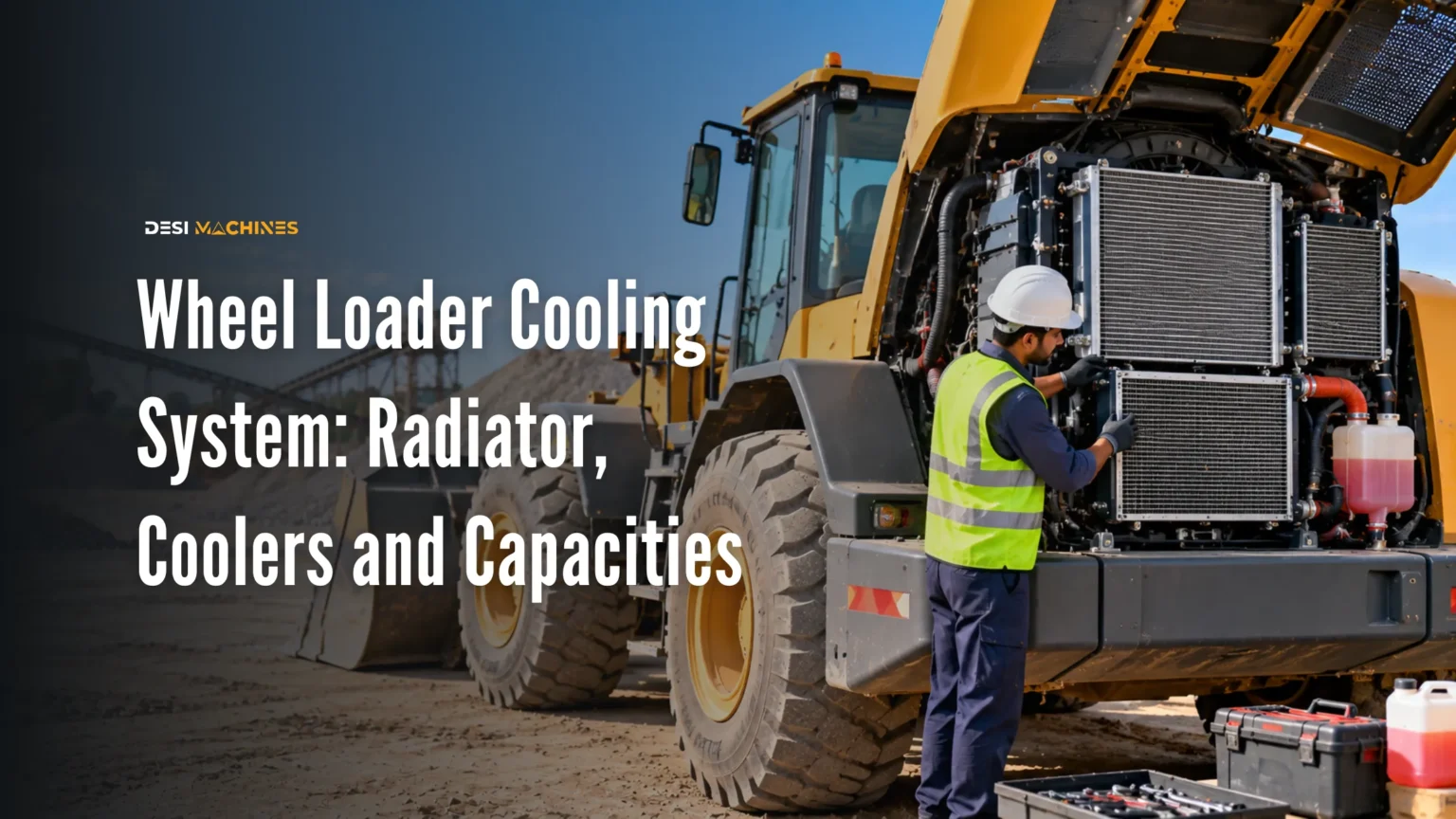
A wheel loader that climbs into the red on a hot afternoon in a stockyard, then cools down the moment the operator idles it, is almost never short of coolant. It is short of airflow. A wheel loader cooling system is not one radiator but a stack of coolers sitting in the same stream of air: the engine radiator, a charge-air cooler for the turbo, an oil cooler for the hydraulics, and on most machines another for the transmission. Block the front of that stack with quarry dust and all of them stop working.
That stack is why a payloader behaves differently from an excavator when it gets hot. It is also why the figure most buyers want, which is how much coolant the machine actually holds, is worth looking up rather than guessing. Of the 54 wheel loaders listed on DesiMachines, 46 publish a cooling-system refill capacity, and those figures run from 23 litres on a small 10-tonne machine to 520 litres on the largest mining loader on the books.
This guide sets out what is in the cooling pack, what each class holds, why engine power is a poor guide to the answer, what blocks a radiator on an Indian site, and what to check on a used machine. Every figure comes from the specification sheets on the machine listings themselves, current as of October 2026.
What is in a wheel loader’s cooling system?
The cooling system on a wheel loader is a set of heat exchangers stacked behind one fan, plus the water pump, thermostat, hoses and coolant that carry engine heat to them. The engine radiator is only the first of them. Air is pulled through the whole stack, so each cooler depends on the ones in front of it staying clean.
Four jobs are being done in that one airflow:
- The engine radiator takes heat out of the coolant circulating through the engine block and cylinder head. This is the circuit the capacity figure measures.
- The charge-air cooler cools the air leaving the turbocharger before it enters the engine. Compressing air heats it, and hot air carries less oxygen, so cooling it back down is what makes the turbo worth fitting. Makers also call this an intercooler or an aftercooler, and the general principle is set out in the reference on charge-air cooling. Of the 54 machines listed, 51 are turbocharged and 21 of those name a charge-air cooling stage outright. Only the Liugong 818N is naturally aspirated, so it has no charge air to cool.
- The hydraulic oil cooler keeps the lift and tilt circuit in range. Hydraulic oil that runs too hot thins out, and thin oil leaks past seals instead of doing work, which is the chain of symptoms covered in the guide to wheel loader hydraulic problems.
- The transmission or converter oil cooler handles heat from the torque converter. 52 of the 54 machines publish a transmission oil capacity, which is a separate fluid from the coolant and is changed on its own schedule.
Legend. 1 Charge-air cooler: cools turbocharged intake air. 2 Engine radiator: the circuit the published coolant capacity measures. 3 Hydraulic oil cooler: keeps lift and tilt oil in range. 4 Transmission or converter oil cooler: takes heat from the torque converter. The order varies by machine; the dependency does not.
The coolant itself is a mixture of water, glycol and an additive package, and the type matters as much as the quantity. Which grade a machine takes, whether two coolants can be mixed, and why plain borewell water is the worst thing to put in are covered in the guide to coolant for construction machines.
How much coolant does a wheel loader hold?
Between 23 and 520 litres, and for the machines Indian contractors actually buy the working answer is 23 to 50 litres. Of the 54 machines listed, 46 publish the figure. The spread by size class is below, using the catalogue’s own size classes.
| Size class | Machines listed | Publish a capacity | Range | Middle of the class |
|---|---|---|---|---|
| Compact, 1 to 8 ton | 2 | 1 | 28 L | 28 L |
| Small, 8 to 15 ton | 12 | 9 | 23 to 30 L | 25 L |
| Medium, 15 to 30 ton | 24 | 20 | 28 to 71.6 L | 50 L |
| Large, above 30 ton | 16 | 16 | 55 to 520 L | 120 L |
The small class is the tight one. Every 8 to 15 tonne machine that publishes a figure sits between 23 and 30 litres, a band narrow enough that a 20-litre pack of concentrate plus the same again in water will fill almost any of them at a 50:50 mix. Above 15 tonnes the band opens up and one pack size stops being a safe assumption.
For the machines built to Indian emission norms, here are the figures as published. These 12 are the CEV and Bharat Stage machines that state a cooling capacity.
| Model | Engine power | Operating weight | Cooling system |
|---|---|---|---|
| Hindustan 2021E | 133 HP (98 kW) | 11,637 kg | 23 L |
| L&T 9020 | 133 HP (98 kW) | 11,500 kg | 25 L |
| L&T 9020 SX | 140 HP (104 kW) | 11,400 kg | 25 L |
| Liugong 818N | 74.5 HP (55 kW) | 5,610 kg | 28 L |
| Tata Hitachi ZW225 CEV 5 | 225 HP (168 kW) | 17,690 to 18,210 kg | 28 L |
| XCMG ZL33FV | 133 HP (99 kW) | 10,600 kg | 30 L |
| Liugong 836N | 160 HP (118 kW) | 11,660 kg | 30 L |
| Liugong 838H MAX | 160 HP (118 kW) | 12,210 kg | 30 L |
| Liebherr L550 | 228 HP (168 kW) | 17,750 kg | 34 L |
| XCMG ZL55GV | 230 HP (170 kW) | 17,300 kg | 45 L |
| Liugong 848H | 220 HP (162 kW) | 16,870 kg | 50 L |
| Liugong 856H MAX | 225 HP (168 kW) | 18,350 kg | 50 L |
Capacities for the other fluids on the same machines (diesel, engine oil, hydraulic oil and axle oil) sit in the wheel loader fuel and oil capacities reference.
Does a bigger engine mean more coolant?
No, and the gap is wide enough to catch people out. Across the 46 machines that publish both figures, the amount of coolant per horsepower runs from 0.11 to 0.39 litres, a spread of more than three times, with no clean pattern by brand or by size.
Two machines on the list make the point on their own. The Tata Hitachi ZW225 CEV 5 and the Liugong 856H MAX are both 225 HP machines of almost the same weight, around 18 tonnes. One holds 28 litres of coolant. The other holds 50. That is not a small difference when you are buying concentrate.
It happens within one brand too. The Cat 950L is a 252 HP machine with a 59-litre system. The Cat 966H has more engine, at 281 HP, and a smaller system at 39 litres. A bigger radiator core running cooler can shift the same heat as a small one running hot, and designs differ in how much coolant sits in the block rather than in the radiator. Either way the conclusion is the same: read the figure for the machine in front of you.
Why does a wheel loader’s cooling system work harder than an excavator’s?
Because a wheel loader turns engine power into heat in a place an excavator does not have: the torque converter. 48 of the 54 machines listed publish a torque converter specification, and a converter is a fluid coupling that works by churning oil. Every time the operator pushes the bucket into a stockpile and the wheels slow against the load, the converter slips, and slipping is heat. That heat goes into the transmission oil, and the transmission oil cooler sits in the same airflow as the engine radiator.
The duty cycle makes it worse. A load-and-carry cycle is full throttle into the pile, full throttle to lift, then a short run to the tipper and back, over and over, with very little of the coasting that lets a travelling machine catch its breath. A tracked excavator doing the same work spends more of its cycle swinging, which draws less power.
The machines that use hydrostatic drive rather than a powershift gearbox are the exception that proves the point, because a hydrostatic transmission has no torque converter to churn. The three Liebherr machines, including the Liebherr L550, correctly publish no converter at all. How the two drive types differ in daily use is set out in the guide to wheel loader transmission types, and the way the whole driveline fits together is in how a wheel loader works.
Two things follow for an owner. A wheel loader’s temperature gauge is reporting on more than the engine, so a creeping needle after an hour in a pile may be the converter rather than the coolant. And transmission oil and coolant are separate services on separate intervals, both set out in the construction equipment service schedule.
What makes a wheel loader radiator block, and how do you clean it?
A radiator blocks from the outside in, and on Indian sites the material doing the blocking is usually local. A loader works in the dust it creates, standing in the cloud it raises off a stockpile, which is a harder life for a cooling pack than moving through clean air.
The usual culprits, in the order they turn up:
- Stone and quarry dust. Fine, dry and abrasive. It packs into the first cooler face and sets hard once a little moisture reaches it.
- Crop trash. Paddy husk, cotton fluff, sugarcane fibre and chaff on a machine working near a mandi or a mill. It mats across the core instead of sitting in it, which cuts airflow over a large area at once.
- Oily film plus dust. A weeping hose or a seeping seal puts a thin oil film on the core, and dust then sticks to it permanently. Compressed air will not shift this; it needs a wash.
- Bent fins. Usually from a pressure lance held too close, or from stones thrown up by the tyres.
Cleaning it is straightforward if it is done in the right direction:
- Blow from the engine side outwards. Air or water pushed the way the fan draws it only packs the dirt deeper into the core. Reverse the direction and the dirt comes back out the way it went in.
- Keep the pressure low and the lance back. A hand-held washer at arm’s length is enough. A high-pressure jet held close flattens the fins, and a flattened fin never cools again.
- If the machine has a reversing fan, use it. Several machines in the large class run a temperature-controlled, hydraulically driven fan that can reverse and self-clean. That stretches the interval between washes rather than replacing them.
- Clean each face, not just the front one. A clean front cooler in front of a blocked second one still runs hot.
- Check the shroud and the seals. If air can go round the stack instead of through it, the fan does less work than the gauge suggests. A missing rubber seal between core and frame is a common, cheap fault.
One warning sign is worth knowing. If the machine runs cool while travelling and only heats up in the pile, the cooling pack is probably dirty rather than faulty, because low airflow shows up first when engine load is high and road speed is zero. A temperature lamp coming on is covered in the guide to wheel loader warning lights and dashboard symbols, and the same fault pattern on a tracked machine is in excavator overheating.
Looking at machines to buy? Compare live wheel loader models, specifications and prices and talk to a dealer about the service history of the one you are considering.
What should you check on the cooling system of a used wheel loader?
The cooling pack is one of the cheapest places to read how a used wheel loader has been treated, because neglect leaves marks that cannot be cleaned off the morning of the inspection. Six checks, in order of what they tell you:
- Look at the core faces in daylight, from both sides. Hold a torch behind the stack. If you cannot see light through most of it, the machine has been run blocked, and running blocked for long enough warps cylinder heads.
- Open the cap on a cold engine and look at the coolant. Clean coolant has a colour. Brown water means years of topping up from a drum, and that means rust inside the block. Oil floating on top is a far more serious conversation.
- Squeeze every hose you can reach. A good hose is firm and springs back. One that feels soft, or crunches, is near the end.
- Look for a dried coolant trail. A white or coloured crust around a joint, the water pump or the bottom tank is a leak that has been left. Follow the trail to its highest point to find the source.
- Check the fan and its drive. Blade tips should not be chipped. A belt-driven fan should have a belt without glazing. A hydraulically driven fan should spin up as the machine warms, and a dealer can read its control fault history.
- Watch the gauge through a real load, not an idle. Ask for the machine to push into a pile for ten minutes. A needle that climbs and stays up under load, then drops at idle, is the airflow signature described above.
The rest of a used inspection, meaning hours, tyres, pins, bushes and the hydraulics, is covered in the used wheel loader buying guide. The engine figures that tell you what class of machine you are looking at are in wheel loader engine power and torque.
Which machines do not publish a cooling capacity, and what do you do then?
Eight of the 54 wheel loaders listed do not state a cooling-system capacity on their specification sheet, and the gap is not spread evenly. All four Hyundai machines on the list leave it blank: the Hyundai HL930I, HL950I, HL630I-V and HL650I-V. So do the ACE ALN 100 and ACE ALN 500, the Tata Hitachi TL340H Prime and the XCMG ZL48GV.
If the machine you want is one of those, there are three honest routes and none of them involves guessing:
- Ask the dealer for the operator’s manual page. The refill capacities table is in every manual, and a dealer can send a photograph of it in minutes.
- Drain and measure once. At the next coolant change, catch the old coolant in a marked drum. That gives you the real number for your own machine, better than any published figure, and you only do it once.
- Use the class band as a buying estimate only. A 10-tonne machine is very likely in the 23 to 30 litre band. That is enough to size a purchase of concentrate, and never the figure to fill to.
That last point holds for every machine, published figure or not. A refill capacity is what the system takes when it is completely empty. After a partial drain you will put in less, so fill to the sight glass or the cold mark. Overfilling pushes coolant out of the overflow the first time the machine gets hot.
A note on the figures in this guide
The capacities, powers and weights above are read from the specification sheets of the 54 wheel loaders taken from our listings at the time of writing, in October 2026. Forty-six of them publish a cooling-system refill capacity; the class ranges and the middle figures are built from those 46 only, and the machine counts per class come from the catalogue’s own size classes.
Two entries are excluded rather than worked around. The Tata Hitachi TL340H Prime publishes a hydrostatic transmission and a torque converter on the same sheet, which cannot both be right, so it is counted in neither group and has been flagged for correction rather than resolved here. The three ACE machines leave the converter field blank although they run geared transmissions, so 48 is a count of published entries, not a claim that six machines lack a converter.
Prices, specifications and features are indicative, vary by variant, location and date, and should always be confirmed with the official OEM or authorised dealer before any purchase decision. DesiMachines is not liable for decisions taken on the basis of information that may have changed after publication.

