
 Excavator
294 models
Excavator
294 models  Backhoe Loader
51 models
Backhoe Loader
51 models  Crane
68 models
Crane
68 models  Concrete Mixer
79 models
Concrete Mixer
79 models  Wheel Loader
54 models
Wheel Loader
54 models  Compactor / Roller
45 models
Compactor / Roller
45 models  Motor Grader
42 models
Motor Grader
42 models  Dozer
41 models
Dozer
41 models  Concrete Pump
66 models
Concrete Pump
66 models  Skid Steer Loader
11 models
Skid Steer Loader
11 models  Telehandler
13 models
Telehandler
13 models 


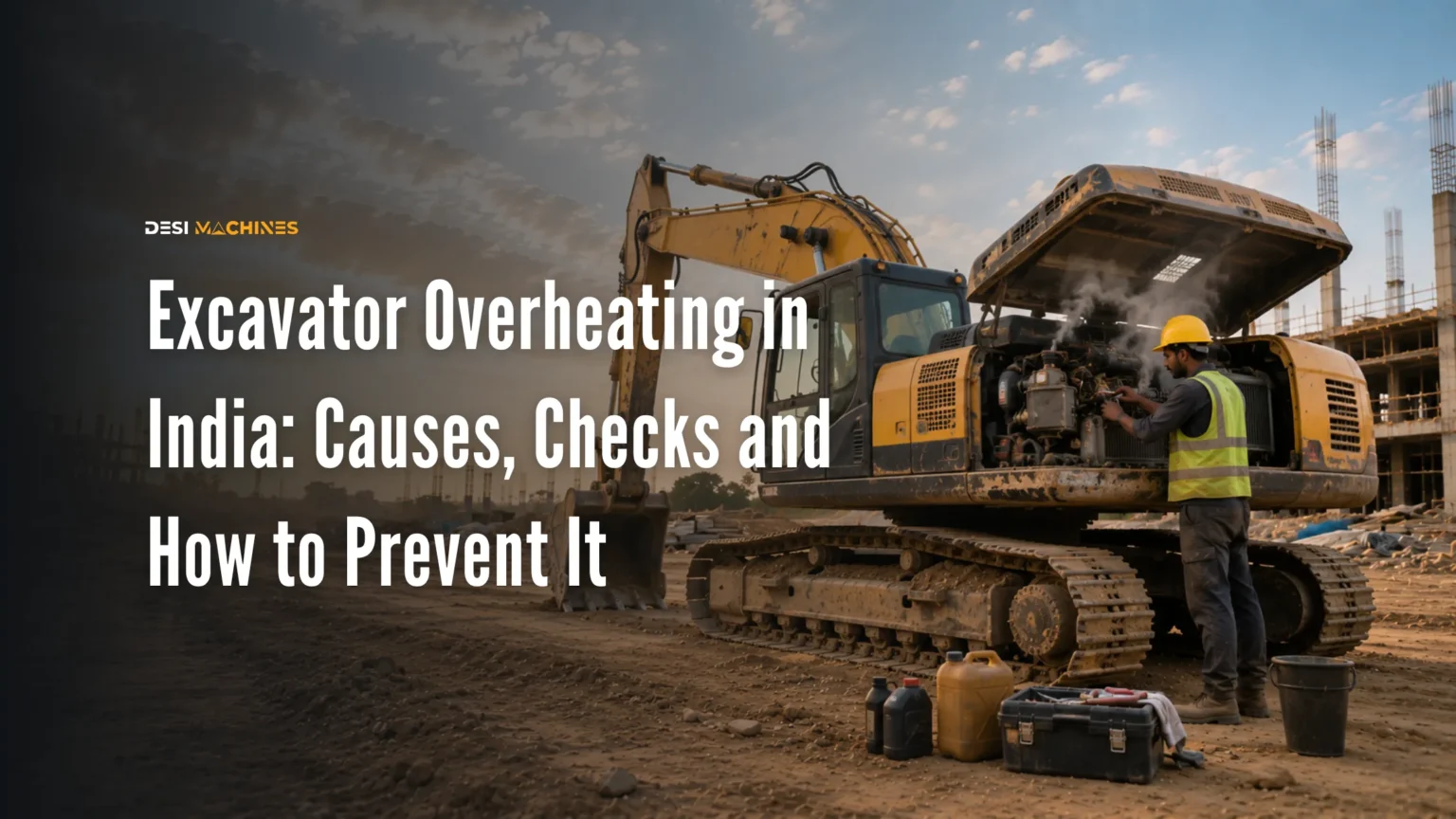
Why does an excavator overheat?
Excavator overheating is when the engine or the hydraulic oil rises above its safe working temperature and the gauge climbs into the red. On Indian sites the cause is almost always the same one: the cooling pack at the back of the machine is choked with dust, mud or crop waste, so air cannot pass through it and the heat has nowhere to go.
The rest of the causes are a short list, and most of them a machine owner can check without a mechanic: low coolant, a slack fan belt, a thermostat stuck shut, a tired water pump, or simply working a machine flat out at 45°C with a radiator nobody has cleaned since the monsoon.
This page covers what makes an excavator run hot, what to check in what order, what to do the moment the gauge climbs, and how much coolant these machines actually hold. If your machine is blowing black smoke as well as running hot, read that alongside this: the two often share a cause, and we cover it in excavator black smoke from the exhaust.
What are the common causes of excavator overheating?
Work down this list in order. It is arranged cheapest and most likely first, which is also the order a good mechanic will follow.
| Cause | What you will see | What to do |
|---|---|---|
| Blocked radiator or oil cooler | Temperature climbs slowly through the day, worst in the afternoon; fins packed with dust and mud | Clean the cooling pack with low-pressure air, blowing from the fan side outward |
| Low coolant | Level below the mark in the overflow bottle; sometimes a white crust around a hose joint | Top up when cold, then find the leak — coolant does not disappear on its own |
| Loose or worn fan belt | Squeal on start-up, glazed or cracked belt, belt gives more than a thumb’s press | Tension or replace the belt |
| Thermostat stuck closed | Temperature rises fast, within minutes of starting, even in cool weather | Replace the thermostat — it is a small part and a common failure |
| Failing water pump | Overheats under load, coolant weeping from the pump housing, sometimes a bearing whine | Dealer or workshop job; do not keep working on it |
| Plain water instead of coolant | Scale and rust inside the radiator, repeat overheating after a flush | Flush and refill with the coolant mix the manual specifies |
| Hydraulic oil running hot | Hydraulic temperature gauge climbs, machine feels slow and soft on the levers | Check the hydraulic cooler and oil level; see hydraulic system maintenance |
| Bent or flattened radiator fins | Often follows a high-pressure wash held too close | Comb the fins straight; wash at low pressure in future |
The hydraulic side matters more than most first-time owners expect. On most excavators the hydraulic oil cooler sits in the same pack as the radiator, so a blocked pack cooks both systems at once. Our guide to hydraulic system maintenance covers the oil side in detail.
Hot hydraulic oil is a different fault from a hot engine, and it announces itself differently: there is no shutdown, the engine sounds completely normal, and the machine simply digs slowly and without force. Excavator hydraulic oil temperature covers why the oil heats up and what to check when it does.
How much coolant does an excavator hold?
It depends on the size of the machine, and the range is wide. Of the 294 excavators listed on DesiMachines, 237 publish an engine coolant capacity. Here is what each size class typically holds.
| Size class | Machines listed | Typical coolant capacity | Example |
|---|---|---|---|
| Mini (under 6 tonne) | 37 | About 6.5 L | SANY SY38U PRO, 3.9 t — 3.8 L |
| Small (6–13 tonne) | 23 | About 13.5 L | Tata Hitachi NX 80, 7.5 t — 12 L |
| Medium (13–25 tonne) | 99 | About 23 L | Volvo EC215, 21.2 t — 18 L |
| Large (25–50 tonne) | 42 | About 35 L | Tata Hitachi ZAXIS 370LCH Ultra, 35.7 t — 35 L |
| Mining (50 tonne and above) | 36 | About 85 L | Tata Hitachi ZAXIS 890LCH, 84.3 t — 133 L |
The figures in the “typical” column are the middle value for each class, because the spread inside a class is real: two 20 tonne machines from different makers can differ by several litres. Read the capacity for your own machine off its specification sheet rather than working from the class figure, and keep a sealed can of the right coolant on the site rather than topping up with whatever water is nearest.
To place your machine in the right class, see excavator size classes in India and excavator operating weight by class. Engine oil and hydraulic oil capacities are set out separately in our excavator oil capacity reference.
Which coolant to put back in is a separate question from how much, and it is the one that decides whether the machine overheats again in a month: the type, the mix ratio and the water you mix it with are set out in our guide to which coolant a machine needs and how much of it.
Can you keep working when the temperature gauge climbs?
No. An engine that is allowed to keep working hot is an engine that warps a cylinder head, and that repair costs many times what a thermostat or a belt costs. The gauge climbing into the red is the machine asking you to stop.
What to do, in order:
- Stop the work, but do not switch the engine off straight away.
- Let it idle at low revs for a few minutes with the boom down. The fan keeps turning and the coolant keeps circulating, which brings the temperature down evenly.
- Then shut it off and leave it. Killing a hot engine instantly traps the heat around the head with no coolant moving.
- Never open the radiator cap while it is hot. The system is under pressure and the coolant comes out as scalding steam. Wait until the machine is cold enough to hold your hand on the top hose.
- Look for the obvious once it is cool: coolant level, belt, and whether the cooling pack is packed with dirt.
If the machine overheats again within the same shift after a clean and a top-up, stop using it and get a mechanic to it. Repeat overheating with no visible cause usually means the thermostat or the water pump, and neither is a field repair. How to tell the two apart, and the signs each one gives before it fails, are in the guide to the JCB water pump and thermostat.
Why Indian site conditions make overheating worse
Three things about working here push cooling systems harder than the manual assumes.
Dust. Earthmoving in the dry months puts a constant cloud of fine dust through the cooling pack. On a canal or road job the fins can be half blocked within a week, and nobody notices until the gauge moves. This is why a daily look at the radiator matters more here than a weekly one.
Heat. A machine rated to work comfortably at moderate temperatures is being asked to shed the same heat at 43°C to 45°C in a north Indian summer. There is far less margin, so a half-blocked radiator that would be survivable in January will overheat in May.
Crop and site waste. Machines working near fields pick up straw and husk, which mats across the pack and is much harder to blow out than dust. If your machine works near harvesting, check the pack every single morning.
None of this is a reason to avoid working the machine. It is a reason to treat cooling-pack cleaning as a daily job rather than something done at service time. The full routine is in our construction equipment service schedule.
What checks stop overheating coming back?
A short daily and weekly routine prevents almost every overheating call-out.
Every morning, engine cold: check the coolant level in the overflow bottle, look through the cooling pack towards the fan and see whether light passes through it, and glance under the machine for fresh coolant drips.
Every week: blow the cooling pack out with low-pressure air from the fan side outward, so the dirt exits the way it came in. Press the fan belt with a thumb and check it does not give more than about a centimetre. The JCB fan belt guide shows how to read the belt number and how to set the tension. Look at the hoses for swelling or hardness near the clamps.
At every service: have the coolant strength checked, not just the level, and have the radiator cap tested. A cap that no longer holds pressure lowers the boiling point and causes overheating that no amount of cleaning will fix. Coolant itself has a service life and is normally changed on a fixed interval, not when it looks dirty.
For what else falls due alongside this, see excavator components and how they work and the undercarriage wear and maintenance guide, which is the other daily-attention item on a crawler machine.
Does engine size change how hot a machine runs?
Not in the way people assume. A bigger engine makes more heat, but it is matched with a bigger radiator and a bigger fan, so a well-maintained 35 tonne machine is no more likely to overheat than a well-maintained 8 tonne one. What changes is the consequence: the larger machine holds more coolant, costs more to repair, and usually earns more per day it stands idle.
What genuinely raises the risk is duty. A machine doing continuous heavy digging or rock breaking runs hotter than the same machine loading soft soil, because the hydraulics are working harder and dumping more heat into the oil. If you have fitted a breaker, expect to clean the cooling pack more often. Engine ratings by class are set out in excavator engine power by size class, and tank sizes in fuel tank capacity of excavators.
Excavator overheating: the short version
- Most likely cause: a cooling pack blocked with dust, mud or crop waste. Clean it first.
- Then check: coolant level, fan belt tension, thermostat, radiator cap, water pump — roughly in that order.
- When the gauge climbs: stop working, idle down, then switch off. Never open a hot radiator cap.
- Coolant capacity: about 6.5 L on a mini, 23 L on a medium machine and 35 L on a 25 to 50 tonne machine, but read your own specification sheet.
- Prevention: a daily look at the radiator beats any repair.
Comparing machines before you buy? See every excavator listed on DesiMachines and open the specification tab to check cooling and service capacities, or start from the excavator guide.
A boom that sinks on its own is a separate fault with its own causes, and hot hydraulic oil makes it worse: see our guide to excavator boom drift.
When cleaning no longer brings the temperature down and the core itself is finished, our guide to the radiator and cooling pack explains repair, re-core and replacement, and what drives the cost of each.
Capacity figures on this page are taken from the specification sheets published on DesiMachines product pages and were checked in September 2026. Prices, specifications and features are indicative, vary by variant, location and date, and should always be confirmed with the official OEM or authorised dealer before any purchase decision. DesiMachines is not liable for decisions taken on the basis of information that may have changed after publication.