
 Excavator
294 models
Excavator
294 models  Backhoe Loader
51 models
Backhoe Loader
51 models  Crane
68 models
Crane
68 models  Concrete Mixer
79 models
Concrete Mixer
79 models  Wheel Loader
54 models
Wheel Loader
54 models  Compactor / Roller
45 models
Compactor / Roller
45 models  Motor Grader
42 models
Motor Grader
42 models  Concrete Pump
66 models
Concrete Pump
66 models  Skid Steer Loader
11 models
Skid Steer Loader
11 models  Telehandler
13 models
Telehandler
13 models 


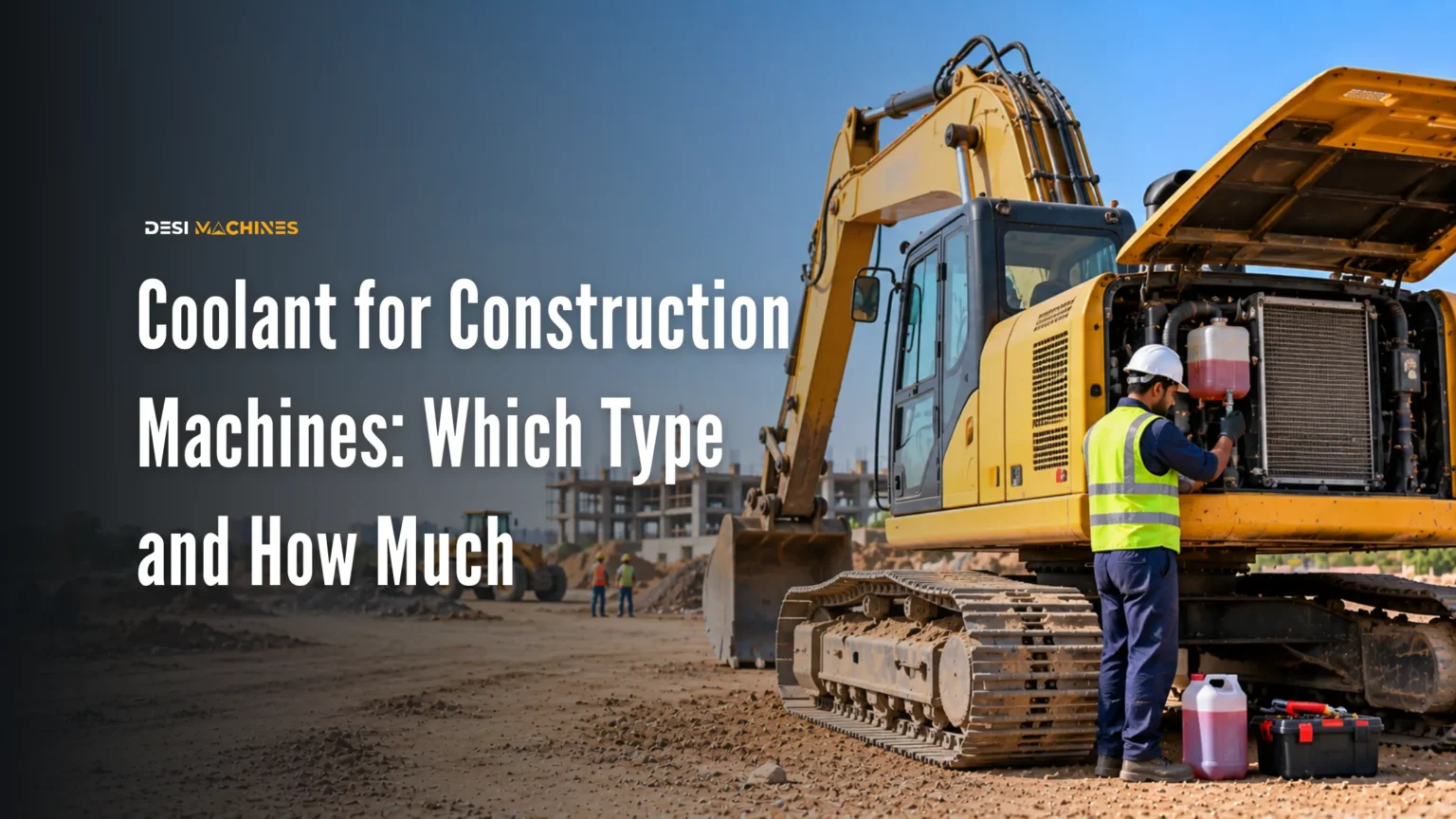
Coolant is the liquid that carries heat out of a diesel engine, and it is a mixture of three things: water, glycol and an additive package that stops the metal inside the engine corroding. On a construction machine it is not simply water with colour in it, and choosing the wrong one is one of the cheapest mistakes an owner can make and one of the most expensive to undo.
This page answers the question our own machine pages keep pointing at without answering: what does “use the coolant the manual specifies” actually mean. It covers the types, what the colour does and does not tell you, whether you can mix two coolants, why plain water is the worst choice in Indian conditions, how much a machine holds and how often it should be changed. The same rules apply whether you are buying excavator coolant, coolant for a backhoe loader or coolant for a road roller.
Why does a machine in India need coolant if it never freezes here?
This is the most common misunderstanding on Indian sites, and it comes from the word antifreeze. Freezing is the reason coolant was invented in cold countries. It is not the reason your machine needs it in Nagpur or Nashik.
Coolant does three jobs, and only one of them is about cold:
- It raises the boiling point. Plain water boils at 100°C. A glycol mixture in a pressurised system boils well above that, which is what keeps the liquid a liquid when a machine is working flat out in May. Once coolant boils, it stops carrying heat, and the temperature gauge climbs very fast.
- It stops corrosion. An engine is several metals bolted together with water running between them. Left to itself that water corrodes the block, the radiator and the water pump. The additive package is what prevents it.
- It stops liner cavitation. On a diesel engine the cylinder liners vibrate as the engine fires. That vibration forms tiny bubbles against the liner wall, and when they collapse they punch microscopic holes in the metal. Over time those holes go right through the liner. The additives in a proper heavy-duty coolant are what stop this, and no amount of water will.
Cavitation is the failure most owners have never heard of, and it is the one that quietly turns a coolant decision into an engine rebuild.
The cooling circuit, in order
The pump pushes coolant through the block, where it picks up heat. The thermostat holds it inside the engine until the engine is warm, then opens and lets it through to the radiator, where the fan takes the heat out. It then returns to the pump. The overflow bottle is the only part of that loop you should ever open on a warm machine.
What are the different types of coolant?
Every coolant is water and glycol. What separates one from another is the additive package, which is the chemistry that protects the metal. There are three families in common use, and the difference matters because it decides how long the coolant lasts.
| Type | What it means | Typical service life | Usually sold as |
|---|---|---|---|
| IAT | Inorganic Additive Technology. The conventional, older chemistry. Protects quickly but the additives deplete fastest. | Shortest of the three | Green or blue |
| OAT | Organic Acid Technology. Long-life chemistry. The additives deplete slowly, so the change interval is much longer. | Longest of the three | Red, orange or pink |
| HOAT | Hybrid Organic Acid Technology. A blend of the two, common on modern diesel engines. | Between the two | Yellow or turquoise |
Heavy diesel engines with wet cylinder liners often need one more thing on top: a nitrite or SCA (Supplemental Coolant Additive) content specifically for the liner cavitation described above. A coolant sold for a car may carry none of it. This is the single most important reason not to pour a passenger-car coolant into a construction machine, even when the colour matches.
The general chemistry behind these families is documented in the reference on antifreeze and engine coolant. Which specific product your machine takes, though, is decided by one document only, and that is the operator’s manual for your exact model.
Does the colour of the coolant tell you the type?
No, and this is where most site-level mistakes begin. Colour is a dye. It is a manufacturer’s marketing convention, not a standard, and two coolants of completely different chemistry can be sold in the same colour. A red coolant from one brand may be a long-life OAT product, and a red coolant from another may be a conventional one.
Read the label, not the liquid. The label will name the type, state whether it is concentrate or pre-mixed, and give the service life. If the drum in your store has no label left on it, the safe assumption is that you do not know what is in it.
Can you mix two different coolants?
Treat the answer as no unless the manual explicitly allows it. Mixing an OAT coolant with a conventional IAT one can cause the additive packages to react with each other. In the worst case the additives drop out of the liquid and form a gel or a sludge that blocks the narrow passages in the radiator core, which is the exact opposite of what coolant is for.
If you genuinely do not know what is in the system, the correct answer is not to top it up with a guess. Drain it, flush it with clean water until it runs clear, and refill with one known product. A flush costs a few hours. A blocked radiator core costs a radiator, and usually a day of hire on a machine that was meant to be working.
In an emergency in the field, where the machine is losing coolant and the choice is between topping up with clean water or stopping work, top up with clean water and get the system corrected properly afterwards. A diluted system for a few hours is recoverable. A seized engine is not.
Can you just use plain water in a construction machine?
You can, and the machine will run, which is exactly why this habit is so common. The damage is slow and invisible until it is expensive.
Plain water gives no boiling-point protection, no corrosion protection and no cavitation protection. Worse, in most of India the water that actually goes in is borewell or tap water, which is hard. Hard water carries dissolved minerals, and when it is heated those minerals come out of solution and deposit as scale on the hottest surfaces inside the engine. Scale behaves like insulation. A thin layer of it on a cylinder wall keeps heat in the metal instead of letting it pass into the coolant, so a machine that is full to the mark still runs hot.
This is the mechanism behind a specific and very common site complaint: a machine that overheats, gets flushed, runs fine for a few weeks, and then overheats again. Our guide to excavator overheating causes and checks lists plain water as one of the causes to work through, and this page is the other half of that answer. If the temperature gauge is climbing right now, start there rather than here.
Concentrate or pre-mixed, and what water do you mix it with?
Coolant is sold two ways. Concentrate is neat glycol and additives, and it must be diluted before it goes in. Pre-mixed (sometimes called ready-to-use) is already diluted at the factory and goes straight in. Pre-mixed costs more per litre for the obvious reason that a good part of what you are buying is water.
If you buy concentrate, two things decide whether the job is done properly:
- The ratio. A 50:50 mix of concentrate and water is the most commonly specified, and manufacturers generally work within a band of roughly 40 to 60 percent glycol. Below that band the corrosion protection weakens; above it the mixture actually carries heat worse than a correct mix. The manual gives the figure for your machine, and it is worth reading rather than assuming.
- The water. Use distilled or de-ionised water, not borewell water, not tap water and not water from the site tank. This is the step that gets skipped most often, and it quietly reintroduces the scale problem that the coolant was bought to avoid. Distilled water is cheap and sold everywhere.
Mix it in a clean container before it goes into the machine, not by pouring concentrate into the radiator and then adding water and hoping. An uneven mix protects unevenly.
How much coolant does a construction machine hold?
Enough that a single small pack is usually not enough, which is the practical reason to check before you drive to the dealer.
Of the 764 machines listed on DesiMachines, 417 publish a cooling-system capacity and 347 do not. Across those 417 the median is about 24 litres (24,000 ml), and roughly nine in ten working machines hold under 120 litres. The very large mining machines sit far above that and are a different conversation.
The backhoe loader class is the tightest and the most useful reference, because it is the machine most Indian buyers own. Every one of the 44 backhoe loaders we list that publishes the figure falls between 10 and 20.5 litres, and the full model-by-model table sits in our reference on backhoe loader oil and fluid capacities.
Now the arithmetic that decides what you buy. Take a machine with a 17-litre system, which is the middle of that backhoe range. At a 50:50 mix that needs about 8.5 litres of concentrate and the same again in distilled water. A 5-litre pack of concentrate does not cover it, so a 10-litre pack is the sensible purchase, with a little left over for top-ups. Buy the small pack and you make a second trip to the dealer in the middle of a service, which is the same trap owners fall into with engine oil.
Capacity figures for the other classes sit with each machine type: excavator engine and hydraulic oil capacities, motor grader fuel and oil capacities, skid steer loader capacities, telehandler capacities and road roller fuel and water capacities.
Excavator coolant quantities vary more than any other class, because the class itself runs from small mini machines up to mining excavators, so a figure borrowed from a neighbour’s machine is rarely close. Where a machine does not publish the figure, ask the dealer to confirm it in writing before the service rather than estimating from a machine of similar size. Cooling systems do not scale neatly with engine power, and the 347 machines with no published figure include plenty of common models.
How often should coolant be changed?
Coolant does not wear out the way engine oil does. The water and the glycol are much the same after two years. What runs out is the additive package, and once it is depleted the liquid still looks fine and still carries heat while no longer protecting anything. That is why coolant has a change interval at all.
On the service pattern we publish for construction machines, the cooling system is checked at the 500-hour service and the coolant is replaced at around 2,000 hours or two years, whichever comes first. The full hour-by-hour pattern is in our construction equipment service schedule, and the backhoe-specific version sits in the backhoe loader maintenance schedule. A long-life OAT coolant may carry a longer interval than that and a conventional one a shorter one, so where the manual and the general pattern disagree, the manual wins.
Two things shorten the interval in real Indian conditions. Dust is the first, because a radiator packed with dust makes the system work harder and run hotter, and heat is what depletes additives. Repeated top-ups with plain water are the second, because every top-up dilutes what protection is left.
Between changes, check the level in the overflow bottle when the engine is cold, and never open a hot radiator cap. That check is part of the daily walk-round on every machine, and the dashboard lamp that watches the same system is covered in our guide to excavator warning lights and what each symbol means. If you are weighing up a machine’s condition before buying it, oil floating on the coolant is one of the checks in our used equipment inspection checklist, and it points at a head gasket rather than a service item.
The short version
Buy the type the manual names, not the colour you remember. Do not mix two coolants. Do not run plain water, and if you must in an emergency, correct it the same week. Mix concentrate with distilled water at the ratio the manual gives, work out the quantity from your machine’s own system capacity before you go to the dealer, and change it at the interval rather than when it looks dirty. Coolant is among the cheapest fluids on the machine and it protects the most expensive part of it.
Genuine and aftermarket fluids are not the same purchase, and the difference is covered in our note on genuine and aftermarket spare parts. If heat is your real problem rather than the fluid, read excavator hydraulic oil temperature, because the hydraulic side runs hot for different reasons and needs a different fix.
When it is the machine rather than the fluid that needs replacing, you can compare live excavator models and prices or talk to a dealer directly. More running-cost and component guides for every machine type are collected in the parts and running costs guides.
Prices, specifications and features are indicative, vary by variant, location and date, and should always be confirmed with the official OEM or authorised dealer before any purchase decision. DesiMachines is not liable for decisions taken on the basis of information that may have changed after publication.