Excavator
294 models
Excavator
294 models  Backhoe Loader
51 models
Backhoe Loader
51 models  Crane
68 models
Crane
68 models  Concrete Mixer
79 models
Concrete Mixer
79 models  Wheel Loader
54 models
Wheel Loader
54 models  Compactor / Roller
45 models
Compactor / Roller
45 models  Motor Grader
42 models
Motor Grader
42 models  Dozer
41 models
Dozer
41 models  Concrete Pump
66 models
Concrete Pump
66 models  Skid Steer Loader
11 models
Skid Steer Loader
11 models  Telehandler
13 models
Telehandler
13 models 


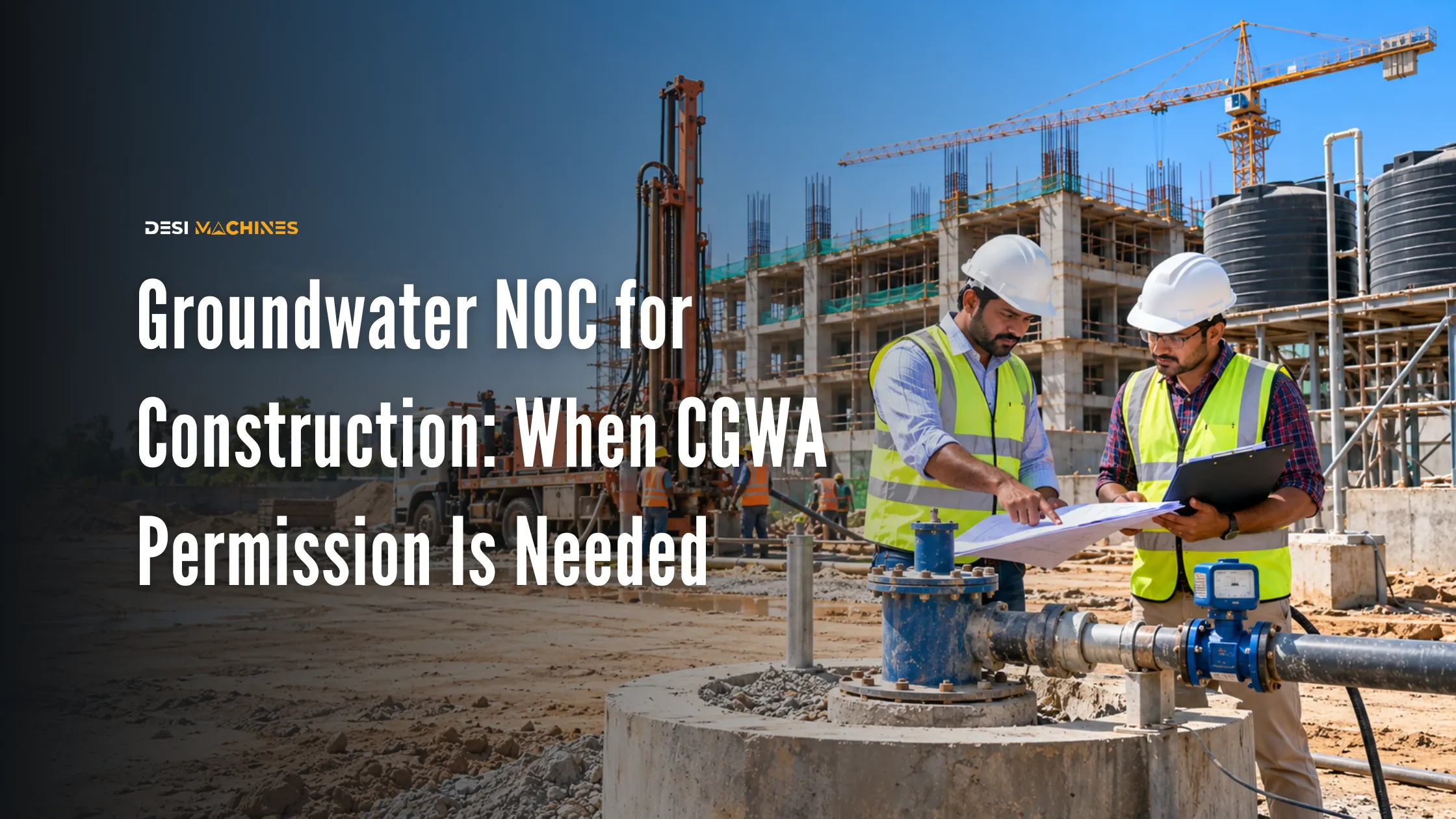
The pump in your foundation pit needs a permit before it starts. Under the Central Ground Water Authority’s Guidelines of 24 September 2020, a project that dewaters during construction or uses groundwater to build needs a groundwater NOC from CGWA before work begins, and construction use is not on the exemption list. Sixteen states and union territories, including Karnataka, Tamil Nadu, Delhi, Haryana, Uttar Pradesh and Telangana, issue the permission through their own authority instead. Pumping without it is treated as illegal extraction and draws Environmental Compensation.
Dig a basement two levels deep in most Indian cities and you hit water. The excavator stops, a diesel pump goes in, and water runs to the drain for weeks. Each of those litres is groundwater extraction, and the rules on it do not care that the water was a nuisance you were trying to get rid of.
When a construction site needs a groundwater NOC
The national rules are the Guidelines to regulate and control ground water extraction in India, notified as S.O. 3289(E) on 24 September 2020 and amended on 29 March 2023. The wording below is as quoted in National Green Tribunal orders that apply the Guidelines.
Para 4.3 covers construction. In the words the NGT quoted, “New infrastructure projects/residential buildings may require dewatering during construction activity and/or use ground water for construction. In both cases, applicants shall seek No Objection Certificate from CGWA before commencement of work.”
So two different jobs trigger it. Dewatering a pit, trench or basement is one. Drawing borewell water for curing, mixing or dust suppression is the other. Para 4.3 adds a tighter rule for areas assessed as over-exploited: groundwater may be used for construction only if no treated sewage water is available within 10 km of the site.
CGWA or your state: who issues it
CGWA is not the authority everywhere. An NGT order of 28 August 2024 records that these states and union territories regulate groundwater through their own authority, law, government orders or bye-laws:
| Regulated by the state or UT | Regulated by CGWA |
|---|---|
| Andhra Pradesh, Goa, Himachal Pradesh, Jammu and Kashmir, Karnataka, Kerala, NCT Delhi (government orders), Tamil Nadu (government orders), Telangana, West Bengal, Chandigarh (bye-laws), Puducherry, Lakshadweep, Punjab, Uttar Pradesh, Haryana | The other states and union territories, including Maharashtra, Gujarat, Rajasthan, Madhya Pradesh, Bihar, Odisha, Jharkhand, Chhattisgarh, Uttarakhand and the North-Eastern states |
In the first column, the permission comes from the state groundwater authority under its own procedure, fees and forms, and you apply there. In the second, you apply to CGWA online through its NOCAP portal.
Who is exempt, and why construction is not
CGWA’s exemption list, as it set it out before the NGT in May 2026 after the 2023 amendment, is:
| Exempt from a groundwater NOC | Limit |
|---|---|
| Rural drinking water supply schemes | None stated |
| Armed forces and central armed police establishments | None stated |
| Agricultural activities | None stated |
| Micro and small enterprises | Under 10 m³ a day |
| Industries, mining and infrastructure projects, for drinking and domestic use only | Up to 5 m³ a day |
| Residential apartments and group housing, for drinking and domestic use | Up to 20 m³ a day |
Read the infrastructure line carefully. The exemption covers water drawn for drinking and domestic use by the people on site. Water pumped out of an excavation, or drawn to mix concrete, is neither, so the 5 m³ allowance does not cover it. The guidelines as quoted in the orders give no small-quantity or short-duration exemption for dewatering.
What the NOC asks of a dewatering site
The conditions quoted in a March 2025 NGT order show what the authority expects from a site that pumps. The dewatering discharge has to be measured with a digital water flow meter and reported through the web portal, and the records kept for two years. The application needs an impact assessment report from an accredited consultant giving the plan of pumping and what will be done with the pumped water. Abstraction charges are payable, and in over-exploited areas restoration charges. A 2026 order adds that digital flow meters with telemetry are mandatory, and their installation has to be reported within 30 days of the NOC.
Renewal is applied for 90 days before the NOC expires. For a housing project, a 2026 order records a five-year validity.
For the excavation contractor, the practical point is simple. The NOC is the project proponent’s to obtain, but the pump, the meter and the hours are on your side of the site. Ask for a copy of the NOC before you quote dewatering, price the meter reading and log-keeping into the job, and write in who pays if the pump is stopped for want of permission. The cost of a rate per cubic metre of excavation rises quickly once a pit sits waterlogged, and an excavator parked beside a stopped pump earns nothing.
Extraction without a groundwater NOC
The Guidelines say extraction without a valid NOC “shall be considered illegal”, and the user becomes liable to pay Environmental Compensation. The amount is worked out from the quantity drawn a day, a rate per cubic metre that rises with how stressed the area is, the number of days, and a deterrence factor. A late applicant also faces a late fee under CGWA’s public notices.
The NGT has been firm on recovery. In Haider Ali v. Central Ground Water Board (Central Zone bench, 25 March 2025), the tribunal said that illegal extraction of groundwater is a criminal offence under the Environment (Protection) Act, 1986, and that compensation must be recovered on the formula already laid down. In a 2026 order on two townships and a group-housing project that had drawn groundwater before getting NOCs, the bench directed that the compensation deposited be spent on groundwater recharge structures and that CGWA monitor extraction. And in a 2025 case on Gurugram builders dewatering without permission from Haryana’s authority, the Principal Bench ordered an enquiry into the officers who had let it continue.
Two loose ends are worth knowing. The NGT ruled against the 2020 Guidelines in February 2022, but the Supreme Court stayed that ruling on 19 May 2022, and the tribunal continues to apply the Guidelines. And a joint committee report placed before the NGT in 2023 noted that the 2020 notification does not specify an NOC for seepage pumped out of a finished basement during the building’s operation. That point was in a committee report, not a ruling.
Where it fits with your other site permissions
The groundwater NOC runs alongside the other approvals a project needs, each from a different office. A batching plant on the same site needs pollution-board consent, covered in consent to establish and consent to operate. A tall building near an airport needs an AAI NOC for height clearance. If you drill borewells for clients, the rig itself may need registration with the state groundwater authority, set out in the borewell business breakdown.
The bottom line
If your site dewaters or uses borewell water, it needs a groundwater NOC before work starts: from CGWA in most of central, western and north-eastern India, or from the state authority in the 16 states and UTs that regulate themselves. The exemptions do not cover construction water. Get the NOC copy before you start pumping, meter the discharge, and keep the logs, because compensation is worked out by the day.
For basement and foundation jobs, compare excavators such as the Tata Hitachi EX 210 Infra and the Hyundai R210 Smart Plus, look at equipment finance if you are adding a machine for a long dewatering job, and find excavation work in the tender and project opportunities listings.
Rates, schemes, specifications and prices change — confirm current terms with the OEM, dealer, bank or insurer before deciding. Groundwater rules differ by state and by assessment unit; confirm the current requirement with CGWA or your state groundwater authority before work starts. This is not legal advice.