Excavator
294 models
Excavator
294 models  Backhoe Loader
51 models
Backhoe Loader
51 models  Crane
68 models
Crane
68 models  Concrete Mixer
79 models
Concrete Mixer
79 models  Wheel Loader
54 models
Wheel Loader
54 models  Compactor / Roller
45 models
Compactor / Roller
45 models  Motor Grader
42 models
Motor Grader
42 models  Dozer
41 models
Dozer
41 models  Concrete Pump
66 models
Concrete Pump
66 models  Skid Steer Loader
11 models
Skid Steer Loader
11 models  Telehandler
13 models
Telehandler
13 models 


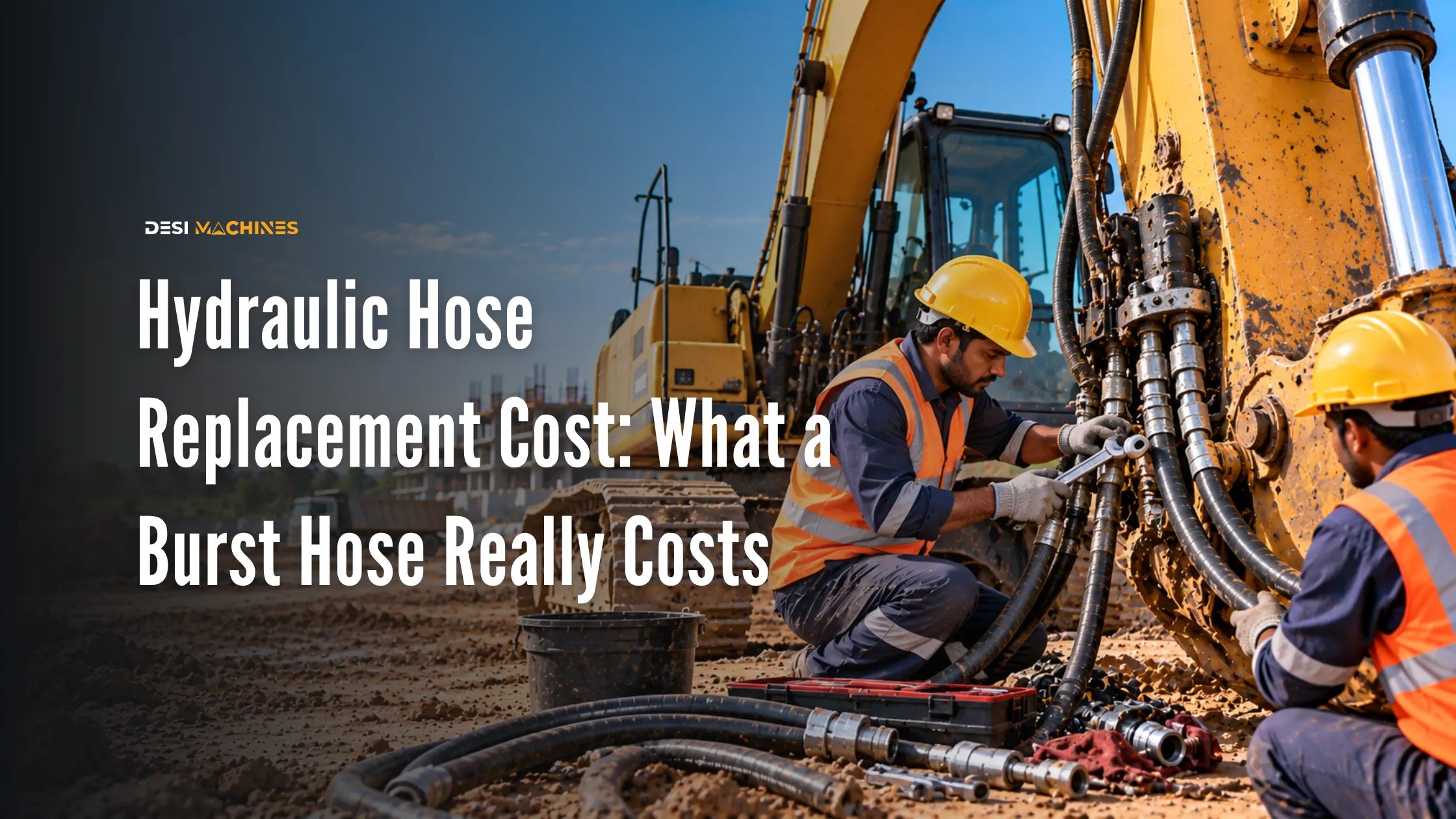
The hose is the cheapest thing about a burst hose. Hydraulic hose replacement cost on a backhoe or excavator is really five lines: the hose assembly, the fittings, the fitter’s call-out, the oil that went on the ground, and the hours the machine stood. On a mid-size excavator one idle day can cost ₹16,000 to 25,000 (indicative, as of Jul 2026) before any repair bill, so the decision that matters is how fast the machine is back at work, not the price of the hose. A local crimp is fine when the shop uses matched hose and fittings at the right pressure rating; a small spare-hose kit pays for itself on a remote site.
It usually happens at the worst moment. The bucket is loaded, the boom is coming up, and a line near the arm lets go with a bang. A sheet of oil goes over the machine and the ground, the operator kills the engine, and the site goes quiet. Somebody gets on the phone to the hose shop in the nearest town.
What the owner pays for the next few hours has very little to do with the length of rubber that failed. This piece breaks the bill into its parts so you can see which ones you control.
What the hydraulic hose replacement cost is made of
| Line on the bill | What moves it | How to keep it down |
|---|---|---|
| Hose assembly | Bore size, one or two wire braids, length, the two end fittings | Know the part number or bring the old hose |
| Fittings and adaptors | Whether the old fittings are reusable (crimped ones are not) | Ask for a matched hose-and-fitting system |
| Fitter call-out | Distance to site, night or holiday work | Carry the hoses your model loses most |
| Oil lost | How long the engine ran after the burst | Train operators to stop the engine at once |
| Idle hours | Hire rate or contract penalty, the EMI that keeps running | Spare kit, a known hose shop, a fitter’s number |
The first two lines are what most people mean when they ask for a hose price. The last two are usually larger. Our estimate of equipment downtime cost puts a mid-size crawler excavator’s all-in idle day at ₹16,000 to 25,000 (indicative, as of Jul 2026), and a backhoe lands lower. A hose that takes a whole day to source has cost you that day, whatever the invoice says.
Why we do not print a price per hose
Hoses are not one product. In India, wire-reinforced hydraulic hose is specified under IS 7651:1997, which is based on ISO 1436 and splits hose by the number of wire braids: one braid for the lower-pressure lines, two for the high-pressure ones. Bore sizes run from a finger’s width to a wrist’s, lengths vary from line to line on the same machine, and every hose carries two end fittings that have to match the ports.
Multiply those choices and a “hose price” covers a range so wide it tells you nothing. What you can do is read the numbers printed along the old hose and give them to the shop. Our guide to hydraulic hose sizes, pressure ratings and fittings explains how to read them, and the right answers there are what keep the next hose from failing in a month.
The oil you lose, and how to cost it
This is the line owners underestimate, because it depends on seconds. The pumps keep pushing oil until the engine stops. Tata Hitachi’s brochure for the 20-tonne EX200LC Super+ rates its two main pumps at up to 2 x 221 litres a minute, against a 129-litre hydraulic tank and 220 litres in the whole system. At full flow, an engine left running for a short time can send a large share of that tank onto the ground.
A backhoe holds less. The JCB 3DX leaflet gives 92 litres for the whole hydraulic system. The rule is the same on both: stop the engine first and look second.
To put a number on it, measure what it takes to bring the tank back to the mark and multiply by the per-litre price on your dealer’s quote. If oil also got into the pump through an empty tank, ask the workshop whether you are paying for a top-up or a full flush; our page on hydraulic oil price and capacities explains why a full drain uses well more than the tank figure.
Crimp it locally, or wait for a genuine hose?
Most hoses in India are replaced by a local shop that cuts the hose to length and crimps new fittings on while you wait. That is often the right call, because it puts the machine back to work the same day. It is safe when two things are true.
First, the hose is the same pressure class as the one it replaces, with the same number of braids. Second, the hose and fittings come from one maker’s matched system. Gates’ safety guide is blunt on this: mixing couplings from one manufacturer with hose from another “can lead to premature or catastrophic assembly failure.” Parker’s safety guide adds that its crimped fittings must never be reused. A shop that crimps your old fittings back onto new hose is saving itself money, not you.
For lines that run near the cab, on the boom or arm, or anywhere a failure could hit a person, many owners fit a genuine assembly even if it means a wait. A useful split is local crimp for the job that is stopped today, genuine for the line you replace on schedule.
Is a spare-hose kit worth carrying?
On a remote site, or a machine on hire with a penalty clause, almost always. The arithmetic is short: price the kit, compare it with one idle day, and you usually have your answer after the first burst it saves.
The kit should hold the hoses your model actually loses, which on most backhoes and excavators are the lines that flex every cycle at the boom, arm and bucket cylinders, not a box of every size. Ask your dealer or your hose shop which ones they replace most on your machine. Two cautions apply. Parker’s guide says made-up assemblies “shall not be stored for longer than 2 years”, so date the kit and rotate it into service. It also says stored hose belongs in a cool, dark and dry place with the ends capped, which rules out the toolbox on the machine’s deck in May.
If you would rather source assemblies and fittings in advance than in a hurry, compare construction machine spare parts from dealers before the next stoppage.
When a hose must be replaced, not patched
The most expensive hose is the one that fails a second time. Parker’s hose safety guide (Bulletin 4400-B.1, which refers readers to SAE J1273 for industry practice) lists the conditions that require shutting down and replacing a hose: a fitting that has slipped, a cover worn through so the wire shows, hose that is hard, cracked or charred, a leak at the fitting or in the hose, a kink or crush, and a blistered cover. It also says to never patch or repair a failed assembly. Tape and clamps belong nowhere on a pressure line.
Some makers add a calendar limit. Komatsu recommends replacing hydraulic hoses every two years or 4,000 hours, whichever comes first, for safety-critical lines. That is one maker’s figure for its own machines, not a rule for every machine, so follow your own manual where it gives one.
One safety point outranks all the money above. Oil from a pinhole leak can be injected through the skin; the UK Health and Safety Executive warns this can happen at pressures as low as 7 bar, and untreated injection injuries can lead to amputation. Never run a hand along a hose to find a leak. Use a piece of card, and treat any injection as a hospital case the same day, even if it looks like a small cut.
How to read a hose shop’s bill
Ask for the bill split into lines. The hose should show its size, braid type and length; the fittings should be listed as new, not “reused”; labour and travel should be separate; and the oil should show litres and price per litre. If the shop crimped the assembly, ask whose hose and fittings it used. A bill that just says “hose repair” in one line hides the answer to every question above.
Keep these bills. Six months of them tell you which hoses your machine eats, which is exactly what goes into the spare kit, and whether one line keeps failing because it rubs or is routed badly.
The bottom line
Price a burst hose by the hours, not the rubber. Stop the engine the moment a line goes, keep a dated kit of the few hoses your model loses, use a hose shop that fits a matched hose and new fittings at the right rating, and fit genuine assemblies on the lines near people. Replace on condition, and on the maker’s calendar where your manual gives one.
If hoses are failing because the machine is ageing out, it may be time to compare what a newer machine costs to run. Browse live excavator models and prices and backhoe loaders, and look at equipment finance options before you spend another season on repairs.
Repair costs, part prices, oil prices and workshop rates vary by model, region and supplier, and change over time. Confirm current figures and the correct hose specification with your OEM dealer or an authorised workshop before you commit to a repair.