Excavator
294 models
Excavator
294 models  Backhoe Loader
51 models
Backhoe Loader
51 models  Crane
68 models
Crane
68 models  Concrete Mixer
79 models
Concrete Mixer
79 models  Wheel Loader
54 models
Wheel Loader
54 models  Compactor / Roller
45 models
Compactor / Roller
45 models  Motor Grader
42 models
Motor Grader
42 models  Dozer
41 models
Dozer
41 models  Concrete Pump
66 models
Concrete Pump
66 models  Skid Steer Loader
11 models
Skid Steer Loader
11 models  Telehandler
13 models
Telehandler
13 models 


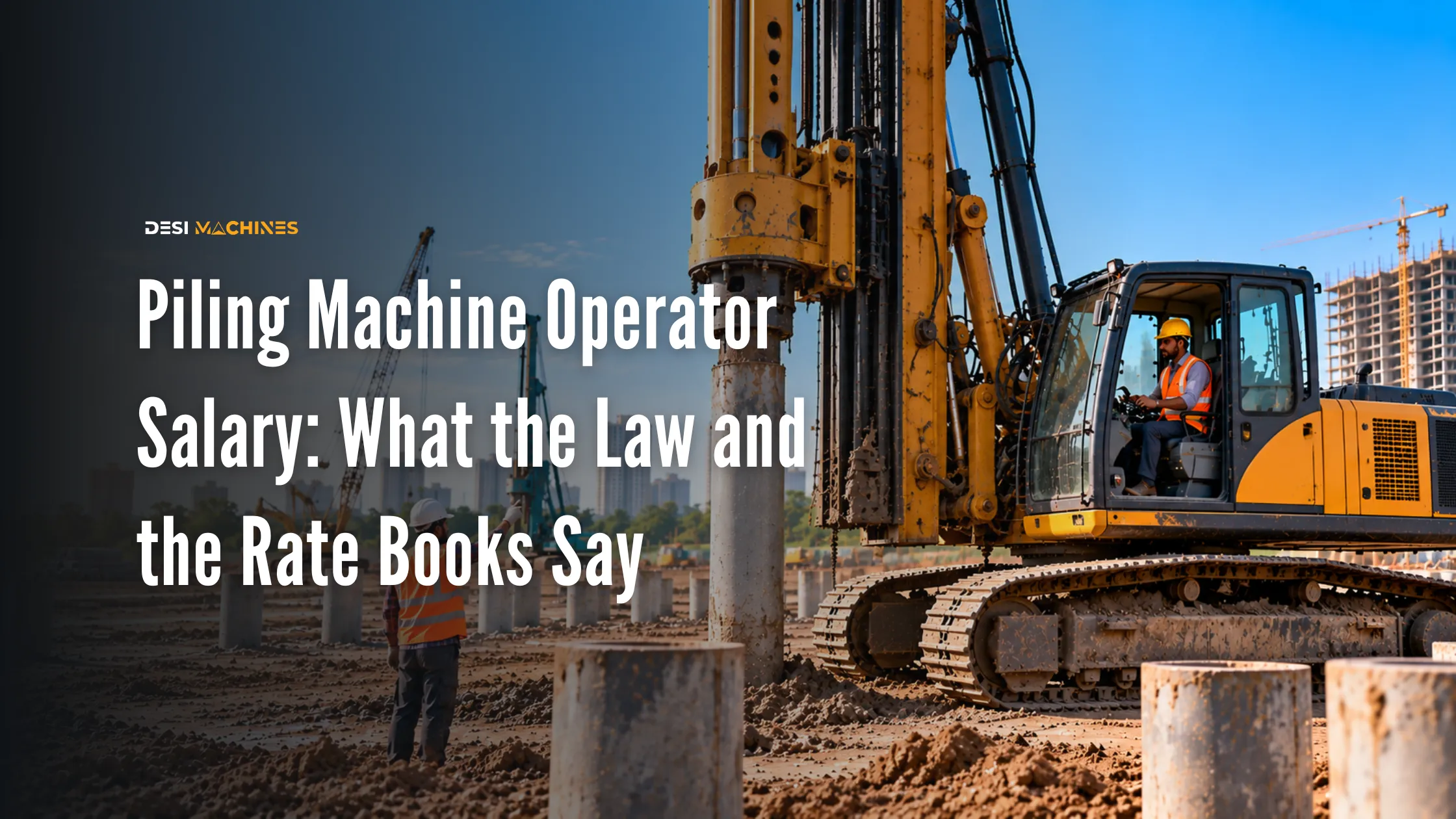
Rs 850 a day. That is what Puducherry’s 2024-25 schedule of rates pays an “Operator (Pile/Special machine)” when it prices a piling job, and Tamil Nadu’s 2025-26 schedule pays a “Pile Driver” Rs 832. No wage order or survey names the piling machine operator salary exactly, so those state figures, about Rs 21,600 to 22,100 a month at 26 working days, are the closest official benchmark. The legal floor is lower and depends on the state: Kerala lists pile driving as highly skilled at a basic Rs 940 a day plus allowance, Delhi’s skilled rate is Rs 22,411 a month. Rig experience, night shifts, metro and bridge work, and the value of the rig you keep running are what lift pay above the floor.
A rotary piling rig earns its money one metre at a time. The person in its seat decides how many metres get drilled in a shift, whether the bore stays vertical, and whether the kelly comes out clean or stuck. Yet ask what a piling rig operator earns and you get a shrug, because no official list of jobs in India puts that title next to a wage.
What does exist is a set of dated, official numbers around the job. Put together, they tell an operator what to expect and an owner what to pay.
What the state rate books pay a pile-machine operator
State public works departments publish schedules of rates so their engineers can estimate what a job should cost. Two of them list a piling operator by name in their labour rates:
| Schedule | Job as listed | Day rate | At 26 days |
|---|---|---|---|
| Puducherry PSR 2024-25 (from 14 Aug 2024) | Operator (Pile/Special machine) | Rs 850 | about Rs 22,100 |
| Puducherry PSR 2024-25 | Driller Grade-I (Pile) | Rs 900 | about Rs 23,400 |
| Puducherry PSR 2024-25 | Helper for Rig | Rs 500 | about Rs 13,000 |
| Tamil Nadu SOR 2025-26 (from 22 Jul 2025) | Pile Driver (skilled) | Rs 832 | about Rs 21,600 |
Read these carefully. They are the rates a government estimate uses for a day of that worker’s labour, not a salary any employer has promised, and Tamil Nadu’s schedule does not define whether its “Pile Driver” means the rig operator or a pile-driving hand. For comparison, the same Puducherry schedule pays a driver for a road roller, concrete mixer or truck Rs 960 a day, and Tamil Nadu pays a heavy-duty driver Rs 965. On these books, the piling operator is priced like any other skilled machine hand, not as a specialist.
The legal floor: the minimum wage for the nearest named job
Below the rate books sits the minimum wage, which no employer may pay under. Each state sets its own, and most orders list jobs by skill grade rather than by machine. The ones that come closest to piling:
| State and order | Nearest named job | Minimum wage |
|---|---|---|
| Kerala, construction (G.O. 71/2019, Aug 2019) | Pile Driving, highly skilled | Rs 940 a day basic, plus dearness allowance |
| Kerala, dams (G.O. 16/2021, Feb 2021) | Boring Machine Operator, Drilling Machine Operator | Rs 780 a day basic, plus dearness allowance |
| Himachal Pradesh, construction (from 1 Apr 2025) | Skilled operators, incl. drill operators | Rs 493 a day, Rs 14,790 a month |
| Telangana, roads and buildings (1 Apr to 30 Sep 2026) | Driver of bulldozers and earth-moving machinery | Rs 14,546 a month incl. VDA |
| Delhi, all scheduled employments (from 1 Apr 2025) | Skilled (no jobs named) | Rs 862 a day, Rs 22,411 a month |
The Kerala figures are basic wages only; the order adds a dearness allowance linked to the consumer price index, so the total is higher. Himachal’s construction list names wagon drill and boring operators but not a piling rig, so treat it as the skilled floor rather than a piling rate. If your state’s order does not name the job, the skilled rate is the minimum, and the Kerala labour commissionerate’s list of wage notifications is an example of where states publish them. The same floors, with the Himachal hydro-project uplifts, are set out in our piece on batching plant operator salary.
The legal framework has also changed. An Uttarakhand government order of April 2026 records that the Code on Wages, 2019 came into force by central notification on 21 November 2025. Your state labour department will tell you which notified rate applies to your site today.
What lifts a piling machine operator salary above the floor
The floor is where pay starts, not where a good rig operator stays. What moves it up:
- Rig experience, especially on larger rotary rigs and deep bridge or metro piles.
- Shift pattern: where piling runs at night, Tamil Nadu’s schedule allows an extra 25 per cent on labour rates for night work in corporation and municipal areas.
- Site terms: food, lodging or a site allowance on remote project sites, where the employer offers them.
- Crossover skills: operators who can also run the service crane or an excavator are easier to keep busy between piles.
Our wider guide to heavy equipment operator salary in India puts experienced machine operators at about Rs 15,000 to 40,000 a month and crane operators at Rs 20,000 to 45,000 or more (indicative). A piling rig operator with a record of clean, vertical bores on metro or bridge work belongs at the upper end of that market, not at the rate-book figure.
What an operator is worth to a rig owner
Here the arithmetic is lopsided. Puducherry’s schedule prices a hydraulic piling rig with power unit at Rs 30,000 a day for one eight-hour shift, and says the hire charge includes the operating staff, fuel and consumables. Tamil Nadu’s schedule prices hydraulic piling rigs at Rs 4,000 an hour on the same basis. Against that, the operator’s day rate in the same Puducherry book is Rs 850, under 3 per cent of the rig’s day.
A rig that drills even one extra pile a shift, or loses half a day less to a stuck kelly or a collapsed bore, pays for a much better operator many times over. The cost heads behind a piling rate, including rig time and the crew, are set out in our guide to piling rate per metre. If you are choosing a rig, our list of piling rig manufacturers in India shows who makes and supports them here; on most bored-pile sites a pick-and-carry piling crane such as the ACE FP 210 works alongside the rig, and its operator is a crane operator by trade.
The employer’s cost does not stop at the wage. Statutory contributions apply too: the Central Government has notified Rs 25,000 a month as the wage ceiling for ESI coverage under the Code on Social Security (S.O. 5109(E), 17 September 2026), so an operator paid up to that amount is covered. Our guide to PF and ESI for construction workers explains the contributions.
Getting into the seat
There is no national qualification for a hydraulic piling rig operator on the National Qualifications Register; we checked twenty-one likely titles and found none. The construction skill council’s active piling qualification is “Chargehand – Piling” (CON/Q0707, NSQF level 4), and it covers boring cast-in-situ piles with a winch-operated tripod, not a hydraulic rig. Its entry route asks for experience as a certified piling rigger or nine years in rigging work.
Without a national course, the route into the seat is training on the rig under an experienced operator, and time on excavators or cranes is useful preparation. Rig helper and driller are the jobs listed below the operator in Puducherry’s schedule. Overseas work is another route; read our guide to operator jobs abroad before paying any agent.
The bottom line
For an operator: the official benchmarks put a pile-machine operator’s day at about Rs 832 to 850 in two state rate books, and the legal floor depends on your state, from Kerala’s highly skilled pile-driving rate to Delhi’s Rs 22,411 a month for skilled work. Experience on large rigs, night shifts and project sites are what move you above it. For an owner: the operator costs a few per cent of what the rig earns in a day, so pay for the one who keeps it drilling.
Contractors bidding for foundation work can track live piling and infrastructure tenders, and owners weighing a rig or a service crane can compare crane models and prices and equipment finance options.
Wage rates, schedules of rates and labour law change, and pay varies by employer, state and project. Confirm the current minimum wage with your state labour department and the actual pay and benefits with your employer or contractor before you accept or offer a job.