
 Excavator
294 models
 Backhoe Loader
51 models
 Crane
68 models
 Concrete Mixer
79 models
 Wheel Loader
54 models
 Compactor / Roller
45 models
 Motor Grader
42 models

 Concrete Pump
66 models
 Skid Steer Loader
11 models


The types of bricks used in construction in India come in about fifteen kinds, and the Indian Standards split them two ways: by what the brick is made of, and by how strong it is. Common burnt clay bricks alone are graded into eleven strength classes, from 3.5 to 35 N/mm², and that class number tells you more about a brick than its colour does.
The red clay brick from a local kiln is the brick most people in India picture first. Fly ash bricks, concrete blocks and AAC blocks are the main alternatives, and a few special bricks do jobs an ordinary brick cannot, such as lining a sewer or a furnace. This guide lists each type, the standard that covers it, where it belongs in a building, and the simple checks that tell a good lot from a bad one.
What are the main types of bricks used in construction?
Bricks fall into three families. Fired clay bricks get their strength in a kiln. Fly ash, lime and cement bricks harden by a chemical reaction, without firing. Concrete and aerated blocks are larger units made with cement and cured, sometimes under steam pressure. Each type has its own Indian Standard, and the standard is what a seller’s test report should name.
Table 1: Types of bricks and blocks used in India, with the standard for each
| Type | Made of, and how it hardens | Indian Standard | Usual job |
|---|---|---|---|
| Common burnt clay brick (red brick) | Clay, moulded and fired in a kiln | IS 1077 | Walls, foundations, general masonry |
| Heavy duty (engineering) brick | Processed clay, pressed or extruded, fired | IS 2180 | Bridge structures, industrial foundations, tall load-bearing walls |
| Burnt clay fly ash brick | Clay mixed with fly ash, fired | IS 13757 | Same work as a red brick |
| Fly ash-lime brick (FALG) | Fly ash, lime and sand, not fired | IS 12894 | Walls, mostly plastered |
| Fly ash-cement brick | Fly ash, cement and fine aggregate, not fired | IS 16720 | Walls, mostly plastered |
| Calcium silicate (sand lime) brick | Ground sand and lime, often with some fly ash | IS 4139 | Walls |
| Perforated brick | Burnt clay with holes through the brick | IS 2222 | Lighter walls and partitions |
| Hollow brick or clay block | Burnt clay with cavities at right angles to the bed | IS 3952 | Walls and partitions where weight and heat matter |
| Facing brick | Burnt clay, made for a clean exposed face | IS 2691 | Exposed brickwork that is not plastered |
| Sewer brick | Dense burnt clay | IS 4885 | Lining of domestic sewers |
| Concrete block, hollow or solid | Cement, aggregate and water, cured | IS 2185 (Part 1) | Load-bearing and filler walls |
| AAC block | Cement, lime, fly ash or sand, aerated and autoclaved | IS 2185 (Part 3) | Filler walls in framed buildings |
| CLC (foam concrete) block | Cement slurry with preformed foam, cured | IS 2185 (Part 4) | Partitions and walls; denser grades are load bearing |
| Fire brick (fireclay refractory) | Fireclay, fired to resist high heat | Refractory standards; laid in IS 195 fireclay mortar | Kilns, furnaces, chimneys, fireplaces |
| Acid-resistant brick | Dense clay body fired to resist chemicals | IS 4860 | Floors and linings where chemicals spill |
If you are choosing between the two most common walling materials, the side-by-side tests are already done in fly ash bricks vs red bricks and AAC blocks vs red bricks. Block sizes and density grades for aerated blocks are set out in the guide to AAC blocks.
What are first, second, third and fourth class bricks?
These four names are the old field grading of red bricks, still used by masons, kiln owners and civil engineering courses. They describe how well a brick was moulded and burnt. They are not the classes in IS 1077, which grades bricks by tested strength instead. The descriptions below follow the teaching notes on bricks used at Rajiv Gandhi Proudyogiki Vishwavidyalaya.
- A first class brick has a standard shape and size, sharp edges and smooth faces, and is burnt in a kiln. It gives a clear ringing sound when two are struck together. Use it for exposed work and for walls that carry load.
- A second class brick is ground moulded and kiln burnt, but its edges are not as sharp and its surface is a little rough. It is fine for walls that will be plastered.
- A third class brick is ground moulded and burnt in a clamp, the open heap kiln. Its edges are distorted and it gives a dull sound. Keep it for temporary sheds and boundary work that carries nothing.
- A fourth class brick, called jhama, is over-burnt. It is dark and badly out of shape. It is not laid in walls. It is broken into brick ballast, the coarse aggregate under floors and roads, and IS 3068 covers broken brick aggregate for lime concrete.
An under-burnt brick, pale and soft, is the one to reject outright. It soaks up water and weakens every time it gets wet.
How are bricks classified by compressive strength as per IS 1077?
IS 1077 sorts common burnt clay bricks by their average compressive strength, the load a brick takes before it crushes, measured in newtons per square millimetre (N/mm²). The class designation is that number. A “class 10” brick must average at least 10 N/mm², which is about 100 kg pressing on every square centimetre.
Table 2: Strength classes of common burnt clay bricks (IS 1077:1992, Table 1)
| Class designation | Average compressive strength, not less than | Water absorption after 24 h, not more than | Efflorescence, not more than |
|---|---|---|---|
| 35, 30, 25, 20, 17.5, 15 | 35 to 15 N/mm² (350 to 150 kgf/cm²) | 15 percent by weight | Slight |
| 12.5, 10, 7.5, 5, 3.5 | 12.5 to 3.5 N/mm² (125 to 35 kgf/cm²) | 20 percent by weight | Moderate |
Three rules sit behind that table. No single brick in the test may fall more than 15 percent below its class figure, a condition added by Amendment 1 in 2008; if it does, the lot is checked against the next lower class. Bricks of 40 N/mm² and above fall outside IS 1077 and are covered by IS 2180, which has two heavy duty classes, 40 and 45, and allows only 10 percent water absorption. And the higher the class, the stricter the limits on water and salt.
The fly ash family uses the same idea with fewer steps. IS 13757 grades burnt clay fly ash bricks from class 3.5 to class 30, with the same water and efflorescence limits as IS 1077. IS 12894 grades fly ash-lime bricks from 3.5 to 30 on wet strength and adds a drying shrinkage limit of 0.15 percent, because a brick that is not fired can still move as it dries. IS 16720 grades fly ash-cement bricks from 5 to 15 on 28-day wet strength.
Concrete blocks are graded by density as well as strength. Under IS 2185 (Part 1), a Grade A hollow block weighs at least 1,500 kg per cubic metre and comes in strengths from 3.5 to 15 N/mm²; a solid Grade C block weighs at least 1,800 kg per cubic metre.
BIS published a sixth revision of the clay brick standard, IS 1077:2025, in November 2025, replacing the 1992 edition. Its public draft listed a change to the modular brick size and new warpage checks. The class figures above are from the 1992 edition and its 2008 amendment, so when a supplier hands you a test report, check which edition it was made to.
Which bricks should you use for which job?
Match the brick to the job, not to the cheapest stack in the yard. The limits in each standard point to where a brick is meant to go.
Table 3: Where each brick type belongs
| Job | Brick to ask for | Why |
|---|---|---|
| Load-bearing walls of a house | Well-burnt clay brick of a tested class, or fly ash brick of the same class | Strength class is printed on the test report and checked against IS 1077 or IS 13757 |
| Filler walls in an RCC frame | AAC block, CLC block, hollow clay block or concrete block | The frame carries the load, so a lighter unit cuts the dead weight on beams |
| Exposed brickwork, no plaster | Facing brick | IS 2691 asks for at least 10 N/mm², water absorption within 15 percent and nil efflorescence |
| Sewer and manhole lining | Sewer brick | IS 4885 asks for at least 17.5 N/mm² and an average absorption of 10 percent or less |
| Bridges, industrial foundations | Heavy duty brick | IS 2180 classes 40 and 45, absorption within 10 percent; the standard names bridge structures and industrial foundations as its use |
| Kiln, furnace or chimney lining | Fire brick | Ordinary bricks crack and soften under repeated high heat |
| Sub-base of floors and village roads | Brick ballast from jhama bricks | Too misshapen for walls, but hard enough to work as aggregate |
CPWD’s specifications allow fly ash-lime bricks in load-bearing structures of up to two storeys, and in non-load-bearing 23 cm walls of taller buildings. For anything bigger, your structural engineer sets the class.
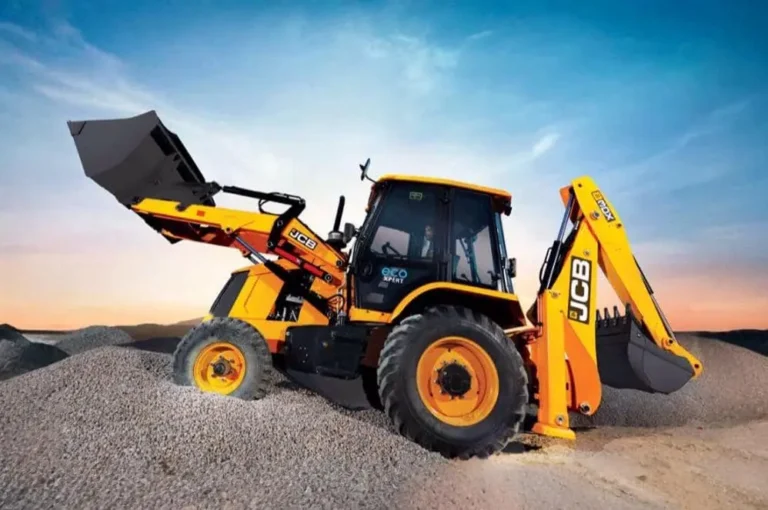
Where the bricks come from matters too. Most red bricks are still made at kilns where a backhoe loader such as the JCB 3DX digs and loads clay. The machines and the rules at those kilns are covered in brick kiln equipment, and the economics of a fly ash plant in the fly ash brick business.
What is the standard size of a brick in India?
India uses two brick sizes side by side. The modular brick, set by IS 1077:1992, is 190 × 90 × 90 mm, with a 190 × 90 × 40 mm brick tile. The traditional brick is 230 × 110 × 70 mm under the same standard, which added it because buyers kept asking for it. CPWD’s 2009 specifications give the traditional brick as 225 × 111 × 70 mm actual and 229 × 114 × 70 mm nominal.
A simple way to tell which brick a wall is built of is to measure four courses. With 10 mm joints, CPWD says four courses and three joints should measure 39 cm for modular bricks and 31 cm for traditional ones. Hand-moulded bricks of 90 mm or 70 mm height carry a frog, a dent 10 to 20 mm deep on one flat face that holds mortar and usually shows the maker’s mark.
The weight of a single brick and the number you need per cubic metre are worked out in building material calculation and the unit weight of building materials. Allow for broken bricks as well; the usual allowance is in the guide to material wastage.
How do you check the quality of bricks on site?
You do not need a laboratory to reject a bad lot. Four quick checks catch most problems before the truck is unloaded.
- Sound. Strike two bricks together. A well-burnt brick gives a clear ringing sound, which CPWD’s specification asks for. A dull thud means under-burnt.
- Scratch. Press a fingernail into the face. A good brick leaves no mark.
- Drop. Drop a brick flat from about one metre onto hard ground. A good one does not break into pieces.
- Shape and colour. Lay ten bricks in a row. They should be even in size and colour, with straight edges, no cracks and no white lime spots.
For a building that matters, ask for lab results to IS 3495. The water absorption test dries the brick in an oven at 105 to 115 °C, weighs it (M1), soaks it in water for 24 hours and weighs it again (M2). Absorption is (M2 − M1) ÷ M1 × 100. A brick that soaks up more than its class allows draws water out of fresh mortar before it can set.
The efflorescence test looks for the white salt that comes out of a brick as it dries. IS 3495 (Part 3) rates it in five steps: nil, slight (no more than 10 percent of the exposed face covered), moderate (up to 50 percent), heavy (50 percent or more) and serious, where the salt is heavy and the surface powders or flakes. A lot rated heavy or serious is the one most likely to keep showing white patches on the plaster.
The test methods on this page are from IS 3495 (Part 3):2019, Methods of Tests of Burnt Clay Building Bricks, Determination of Efflorescence and IS 3495 (Part 2):2019 on water absorption. The field classes and the drop test are from the bricks teaching notes published by Rajiv Gandhi Proudyogiki Vishwavidyalaya. Strength classes, limits and sizes are from IS 1077:1992 with Amendment 1, IS 2180:1988, IS 13757:1993, IS 12894:2002, IS 16720:2018, IS 2222:1991 with Amendment 3 (which sets the hole area of a perforated brick at 20 to 36 percent of its face), IS 3952:2013, IS 2691:2017, IS 4885:1988 and IS 2185 (Parts 1 and 4), and from CPWD Specifications 2009, Volume 1, sub-head 6. All were read in October 2026.
If your site also needs machines to dig foundations or move material, compare backhoe loader models and prices and talk to a dealer. More material topics are collected in the building materials guides.
Prices, specifications and features are indicative, vary by variant, location and date, and should always be confirmed with the official OEM or authorised dealer before any purchase decision. DesiMachines is not liable for decisions taken on the basis of information that may have changed after publication. Brick classes, sizes and test limits on this page are as published in the Indian Standards named above and read in October 2026; confirm the edition your supplier tests to, and have a structural engineer set the brick class for any load-bearing work.
Machines, tenders and news for this industry: Building Construction