Excavator
294 models
 Backhoe Loader
51 models
 Crane
68 models
 Concrete Mixer
79 models
 Wheel Loader
54 models
 Compactor / Roller
45 models
 Motor Grader
42 models

 Concrete Pump
66 models
 Skid Steer Loader
11 models


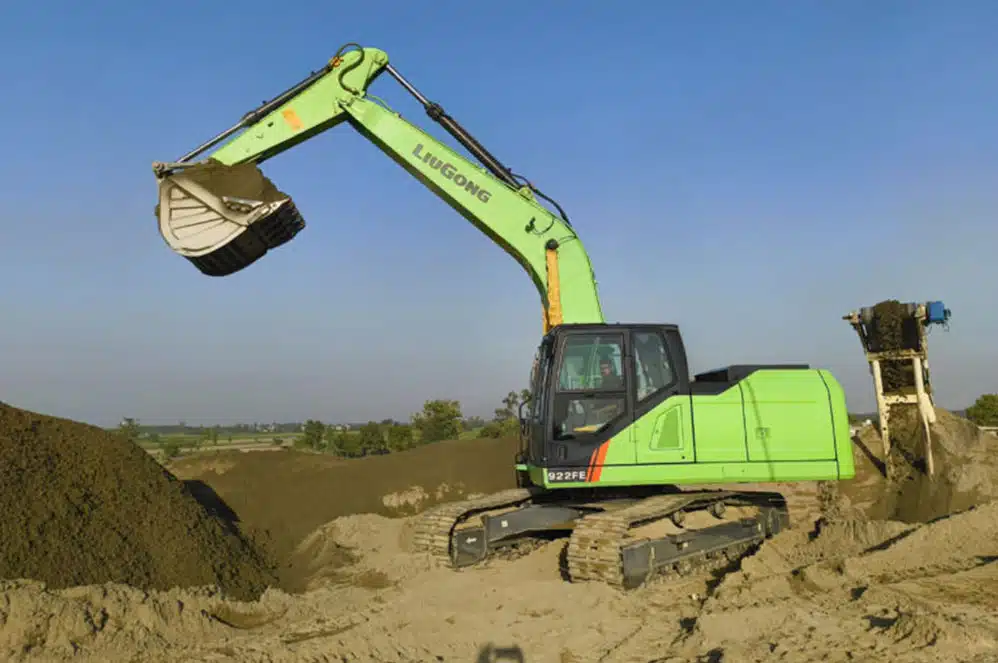
A mini excavator is a tracked digger of roughly 1 to 8 tonnes, small enough to work in a lane, a plot or a shed where a full-size machine cannot turn, and an electric one swaps the diesel engine for an electric motor fed by an on-board battery. If you are shopping for an electric mini excavator in India in October 2026, the honest answer is that the choice is still very small: two machines under 8 tonnes are listed on this site, the 2,750 kg LiuGong 9027FE EV and the 7,600 kg LiuGong 908FE EV, with indicative bands of ₹28.5–31.5 Lakh and ₹31.4–34.7 Lakh. This page sets out what each one can reach, what else is genuinely on sale from other makers, and the questions to settle before you commit.
What counts as an electric mini excavator in India, and where the 8 tonne line sits
There is no legal definition of a mini excavator in India, so the number moves depending on who is selling. In day-to-day use on site the class runs from about 1 tonne up to about 8 tonnes, and the practical test is not the weight at all. It is whether the machine fits through the gap you have to get it through, and whether it can swing in the space you have once it is inside.
That is why the two numbers worth writing down before you shop are the width over the tracks and the tailswing radius. Width decides whether the machine passes a gate, a corridor or a lane. Tailswing decides whether the back of the machine hits a wall every time the operator turns to dump. A 2.75 tonne machine with a 775 mm tailswing can work with its back close to a boundary wall. A 7.6 tonne machine with a 1,650 mm tailswing needs more than twice that clearance, which rules out a lot of urban plots even though it is still called a mini.
The electric mini excavators listed on this site
Two of the electric excavators in our catalogue fall under 8 tonnes. Both are from LiuGong, and the figures below come from each machine’s own product page, so the weight, the reach and the band in each row all come from the same record.
| Machine | Operating weight | Bucket | Max digging depth | Width over tracks | Tailswing | Motor | Band (indicative, Oct 2026) |
|---|---|---|---|---|---|---|---|
| LiuGong 9027FE EV | 2,750 kg | 0.08 m³ | 2,857 mm | 1,550 mm | 775 mm | 16.5 kW (21.1 HP) | ₹28.5–31.5 Lakh |
| LiuGong 908FE EV | 7,600 kg | 0.32 m³ | 4,110 mm | 2,200 mm | 1,650 mm | 47 kW (63 HP) | ₹31.4–34.7 Lakh |

Read across those two rows and the difference is larger than the price gap suggests. The 908FE EV weighs nearly three times as much, carries four times the bucket and digs about 1.25 m deeper, for roughly ₹3 Lakh more on our indicative bands. If your work genuinely needs the depth, the bigger machine is the better buy by a wide margin. If your work is defined by the space you have to fit into, the extra 650 mm of width and the much larger tailswing on the 908FE EV will cost you jobs the 9027FE EV could have taken. The full price picture for every electric excavator we carry, including the larger classes, is set out in our electric excavator price guide.
The gap in the middle of the Indian range
Counting our own catalogue tells you something about the market that no brochure will. We list 13 electric excavators. Eleven of them weigh 21 tonnes or more, running up to a 175 tonne mining machine. Only the two above sit under 8 tonnes, and between them there is a hole of 4,850 kg with nothing in it at all.
That hole matters because the 3 to 6 tonne band is the workhorse size for Indian contract work: big enough for a drainage trench or a footing, small enough to move on an ordinary trailer. In diesel the band is crowded. In electric it is nearly empty. The one machine we found that lands squarely in it is the Volvo EC55 Electric, a 5,800 kg compact excavator which Volvo CE India lists on its own India product site. It is not a machine we carry, so we cannot quote you a price for it, but a buyer sizing up this class should know it exists rather than assume the gap is unfillable.
What a buyer will actually find on sale right now
Electric machines attract a lot of coverage, and much of what gets written up is a prototype on an expo stand rather than something you can order. We checked each maker’s own India pages on 27 October 2026 and recorded only what those pages themselves show.
| Machine or maker | Class | What we found, 27 October 2026 | Source we opened |
|---|---|---|---|
| LiuGong 9027FE EV | 2,750 kg | Listed with a published price band | Its product page on this site |
| LiuGong 908FE EV | 7,600 kg | Listed with a published price band | Its product page on this site |
| Volvo EC55 Electric | 5,800 kg | Carried on Volvo CE India’s own electric excavator page, with full specifications; no India price published there | Volvo CE India en-in EC55 Electric product page |
| JCB India | — | No electric excavator of any size. The India product list runs to 72 machine pages, including eight diesel mini excavators from the 18Z to the 55Z, plus a separate range of electric scissor lifts | JCB India en-IN product sitemap |
The JCB row is the one that surprises people, because the 19C-1E electric mini excavator is widely written about in the Indian trade press. It is not on JCB’s India product list. JCB India does sell electric machines, but in the access range rather than the digging range. For the wider picture across every category, including loaders, tippers and concrete machines, see our list of electric construction equipment on sale in India, and for the machines leading the class worldwide, our round-up of the most advanced electric excavators.
Where a small electric digger earns its keep
The jobs that justify the higher purchase price are the ones a diesel machine does badly or cannot do at all.
Indoor and covered work. A machine with no exhaust can work inside a building, a basement or a warehouse without the ventilation a diesel machine needs. On demolition and strip-out jobs inside an occupied building this is often the only way to get a machine in.
Night and early-morning work in built-up areas. The usual block on working at those hours is noise, and an electric machine removes most of it. On urban utility work, where the lane has to be dug and closed before traffic builds, that can be the difference between a one-night job and a three-night job.
Narrow lanes and tight plots. At 1,550 mm over the tracks, the 9027FE EV passes through most compound gates, and its 775 mm tailswing lets it work alongside a wall. This is the standard problem on urban plot work, water and sewer connections, and cable trenching in old localities.
Nursery, farm and estate work. Light digging, tree planting, irrigation channels and shed foundations suit the smaller machine well, and on an estate with its own supply the charging question answers itself.
The honest counter-case is just as short. If your work is open ground in daylight, far from a power supply, with a machine that runs hard all day, a diesel mini will cost less to buy and will not leave you planning your shift around a charger.
| Where it wins | Where it does not |
|---|---|
| Indoor, covered and enclosed sites with no ventilation for exhaust | Remote sites with no reliable supply to charge from |
| Night and residential work where noise limits the hours | Long continuous digging shifts with no break to recharge in |
| Fuel theft and pilferage are removed as a running-cost problem | Higher price to buy, and a charging point to pay for on top |
| Fewer moving parts, no fuel filters, no engine oil changes | Thin service network and fewer operators who have run one |
| Resale into low-emission urban work should hold up as rules tighten | Resale values in this class are untested in India so far |
Runtime and charging, in plain words
This is where buyers get the least straight information, so it is worth being precise about what the makers do and do not say.
No maker we checked publishes a plain runtime figure for a small electric excavator. Volvo CE India states on its own EC55 Electric page that the machine carries a 67 kWh battery and can be fully charged during a lunch break using a fast off-board charger, and that a standard on-board charger will run from a wall socket or a wallbox. On operating time, Volvo’s own page says it will help a buyer calculate it for their requirements rather than quoting a number. Those are the maker’s claims, not our measurements.
That refusal to quote a number is not evasion, and you should read it as useful. An excavator’s draw depends entirely on what it is doing. The same machine trenching hard murram all morning and levelling loose soil all afternoon will show two completely different consumption figures, so a single headline runtime would mislead more often than it helped. Our own catalogue does not publish a usable battery capacity for either LiuGong machine, which is a gap we would rather state than paper over.
What this means in practice is that the charging plan, not the battery, is the thing to settle. Work out the supply you have at the site or the yard, how many hours the machine must work between charges, and whether a mid-shift top-up is possible where the machine will be standing. Settle that before you sign, because a charging point installed later, at a site you did not plan for, is where the budget usually breaks. The arithmetic of what electric actually saves against diesel is worked through in our electric versus diesel running cost comparison.
What to check before you buy one
Measure the gap, not the machine. Take the narrowest point on the jobs you actually win, and check it against width over tracks. Then check your tightest working corner against the tailswing radius. These two numbers reject more machines than price does.
Ask for a runtime measured on work like yours. Not a brochure figure. Ask the dealer to quote hours on a duty cycle you recognise, and ask what the machine was doing when that figure was recorded.
Price the charging point as part of the machine. Ask who surveys the supply, who installs it, what it costs, and whether the quoted machine price includes a charger at all or only the on-board one.
Get the battery warranty in writing, separately from the machine warranty. Ask for the term in both years and hours, what counts as a covered failure, what capacity loss is treated as normal, and what a replacement pack would cost today.
Check the service reach before you check the price. Ask where the nearest technician trained on the electric drive is based, and what the response time is. On a machine class this new in India, this is the single biggest difference between a good ownership experience and a bad one.
Ask what happens at resale. Nobody can give you a reliable number for this class in India yet, and a dealer who offers one with confidence is guessing.
The bottom line
The electric mini excavator market in India is real but narrow. Two machines under 8 tonnes are listed on this site, one genuinely small at 2,750 kg and one at the top of the class at 7,600 kg, with a wide gap between them that only an off-catalogue Volvo compact currently occupies. If your work is indoors, at night, or in lanes where a diesel machine is a nuisance, the case is strong enough to act on today. If it is not, the sensible move is to wait, because the makers that have shown machines in this class have not yet put them on sale here.
You can see every electric digger we carry, with its specifications and current availability, on our electric excavator category page, and the wider picture across electric machines of every type in our guide to electric construction machines. If the purchase price is the obstacle rather than the machine, our equipment finance options can spread it.
Prices, specifications and features are indicative, vary by variant, location and date, and should be confirmed with the dealer before you buy. Maker figures quoted on this page are the manufacturer’s own published claims, recorded on 27 October 2026.