Excavator
294 models
 Backhoe Loader
51 models
 Crane
68 models
 Concrete Mixer
79 models
 Wheel Loader
54 models
 Compactor / Roller
45 models
 Motor Grader
42 models
 Dozer
41 models
 Concrete Pump
66 models
 Skid Steer Loader
11 models
 Telehandler
13 models


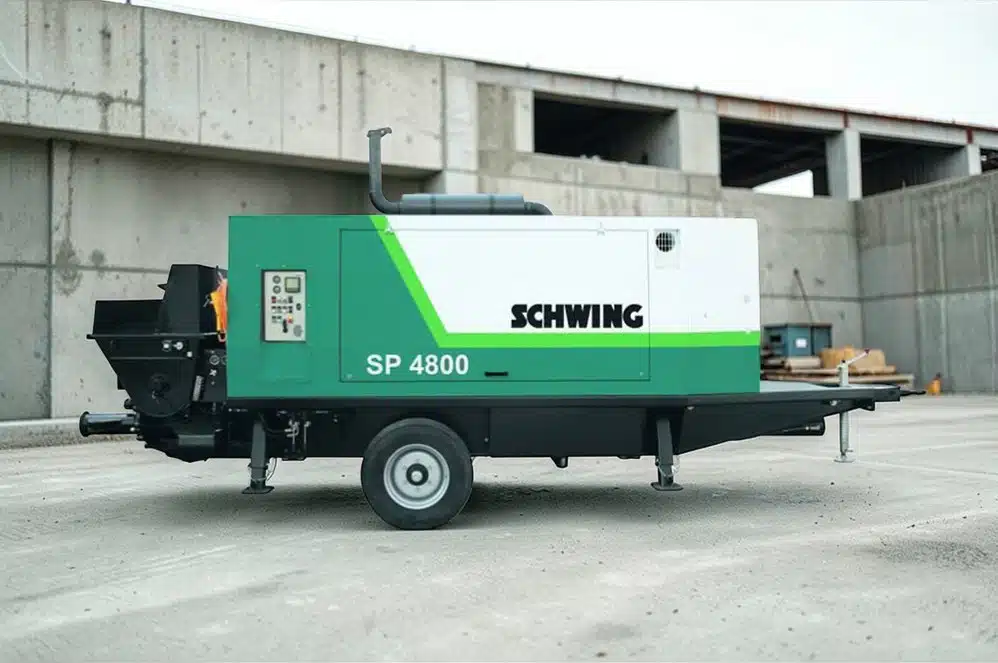
On a concrete pump piston, the cheapest part decides whether the most expensive steel parts survive. The rubber cup on each delivery piston is a wear item, and Sany’s own brochure rates its rubber piston at 25,000 to 30,000 m³ of concrete. Change the cups when slurry first shows in the water box and the hard-chromed delivery cylinders stay in service; keep pumping on torn cups and grit works between rubber and chrome on every stroke. No single price fits every pump, so get a quotation that lists seals, guide rings and labour by part number.
Putzmeister’s parts shop lists the weight of one of its delivery piston seals as 1.6 kg. The hard-chromed delivery cylinders that seal slides through are 1,400 mm long on the Putzmeister BSA 1407 D eSmart and 2,000 mm long on the Schwing Stetter SP 4800. That is the whole trade for a pump owner: change the small part on time, or start pricing the large one. How the pumping unit works is covered in the guide to concrete pump parts and their wear order; this piece is about the money.
How long does a concrete pump piston last?
The only maker figure we found in cubic metres comes from Sany. Its truck-mounted concrete pump brochure says its rubber piston has “a long service life, allowing the piston to pump 25,000 to 30,000 cubic meters concrete without replacement”. The same page rates Sany’s cutting ring at 20,000 to 30,000 m³ and its wear plates at 50,000 to 60,000 m³, so on Sany’s numbers the cups and the cutting ring fall due together.
It is a maker’s claim for its own part, and it says nothing about the mix; the Putzmeister and Schwing Stetter catalogues we read print no piston life figure. Most owners log hours. The table converts Sany’s range at three average site outputs; this is arithmetic, and site output runs well below the spec-sheet figure, as the guide to concrete pump output and pressure explains.
| Average concrete pumped per pumping hour | Hours to reach 25,000 m³ | Hours to reach 30,000 m³ |
|---|---|---|
| 20 m³ per hour | 1,250 | 1,500 |
| 30 m³ per hour | about 830 | 1,000 |
| 40 m³ per hour | about 630 | 750 |
The simplest record is the cubic metres on each ready-mix delivery ticket, added up from the last cup change.
What one cubic metre asks of each piston
Take the Putzmeister BSA 1407 D eSmart, which has 200 mm delivery cylinders with a 1,400 mm stroke. Each full stroke moves about 44 litres. That matches its listed figures: 27 strokes a minute at 44 litres is about 71 m³ an hour, against 72 m³ on the spec sheet.
| Worked example: 200 mm x 1,400 mm cylinders | Figure |
|---|---|
| Concrete per full stroke | about 44 litres |
| Strokes per m³, both cylinders together | about 23 |
| Pushes per m³ for each piston | about 11 |
| Pushes for each piston over 25,000 to 30,000 m³ | about 2.8 to 3.4 lakh |
| Distance each piston slides, out and back | about 800 to 950 km |
A cylinder never fills completely, so real stroke counts are higher. Either way the cup slides hundreds of kilometres against a chrome bore, with only a film of water or oil between them.
When a worn piston starts to cost you a cylinder
Reed’s operation and maintenance manual for its trailer pumps gives four signs that the cups are due: slurry appearing in the water box, a leading edge on the cup that is visibly worn or uneven, a water or oil level in the box that drops fast with no visible leak, and rough, erratic pumping.
The chrome on the cylinder wall is thin. Waitzinger’s operation manual for its trailer pumps calls for a delivery cylinder wear check every 500 operating hours. It says to turn a hardened cylinder at 2 mm of wear, and to turn a chrome-plated cylinder through 180 degrees once its remaining chrome surface is down to 30 µm, which is 0.03 mm. A cup that seals keeps the bore wet and clean. A cup that leaks lets cement paste and sand into the gap between rubber and chrome, and that grit travels with it on every stroke.
The cylinder bill is yours. Schwing America’s standard new-product warranty says pumping cylinders and pumping rams “are subject to normal wear” and that normal wear is not covered. Check the wording of your own warranty in India.
What a concrete pump piston change involves
On most pumps a change means a new piston seal (the cup) and a new guide ring on each side. Putzmeister India’s spare parts catalogue lists a 200 mm delivery piston seal (part 080372004) and a 200 x 180 x 40 mm guide ring (part 080794006) for its BSA 702, 1404 HD, 1405 D, 1407 D, 1407 HD, 2109 HD and 1406 E stationary pumps, and a 180 mm seal and guide ring for the BSA 1404 E eSmart. Schwing Stetter’s truck pump catalogue sells its multi-piece pistons the same way, as a kit of piston sealing, guide ring and bolts. The piston body is reused if sound; Reed’s manual says to check the plate for flatness.
The job is done on site with the pump’s own hydraulics. Waitzinger’s and Reed’s manuals describe the same order. Stop the engine and remove the key whenever hands go into the water box. Drain the box, drive one cylinder to its end position on manual control at low rpm, open the clamp coupling and pull the old piston back into the box. Grease the new piston well, drive it into the cylinder, refit the coupling, repeat on the other side and refill the box. Neither manual gives a time for the job, so ask your dealer for the labour hours in writing.
Why we do not print a piston change price
We list no concrete pump wear parts as products, so we have no price we can stand behind. The bill also changes with the bore (150, 180, 200 or 230 mm), the maker, genuine or aftermarket parts, and whether the piston body is changed. Here is what the bill is made of.
| Cost head | Changed on time | Changed late |
|---|---|---|
| Piston seals and guide rings | Two of each | Two of each |
| Piston body and plate | Usually reused | Replaced if scored or bent |
| Delivery cylinders | Checked at the 500-hour service | Turned 180 degrees or replaced |
| Water box and its water or oil | Refill | Clean out slurry, refill |
| Labour | An on-site job with the pump’s own hydraulics | Cylinder removal, which Waitzinger’s steps show means supporting the water box |
| Idle days | Short, if parts are in stock | Longer, waiting for a cylinder |
The last row is often the biggest, as the piece on what machine downtime really costs sets out. Keep a set of cups and guide rings for your bore in stock, and source genuine spare parts through authorised dealers before the pump is waiting for them.
Rubber, polyurethane, genuine or local
Every maker document we read that names a material describes rubber. Putzmeister’s parts shop lists its delivery piston seal as NBR, a nitrile rubber. Sany credits its piston life to “German rubber piston technology”. CIFA says its pumping pistons “use optimized rubber compounds”. Polyurethane cups are sold in the aftermarket, but no maker document we read gives a life figure for them, so any claim is the seller’s to prove.
Genuine or local is mostly a warranty question. Schwing America’s warranty says “use of non-Schwing OEM products voids any warranties provided by Schwing”, and Waitzinger’s manual excludes wear parts not supplied by the maker or its authorised representative. Inside the warranty period, buy genuine. After it, a cheaper cup is a bet on the part that protects the cylinder. Match the bore and part number, change both sides together, and keep the bill for resale.
Water box and grease habits that stretch piston life
Reed’s daily checklist includes the flush box (water box) level, and says water, if used in place of oil, should be drained daily. Every 100 hours the oil is changed and examined, since heavy contamination “might indicate need to change the Piston Cups”.
Waitzinger’s manual has the operator grease the delivery pistons daily, check their clamping every 100 hours, and refill the water box with fresh water when hydraulic oil runs above 80 °C under heavy load. High pumping pressure also wears rubber pistons faster, so a pump that spends its life on tall buildings should expect shorter cup life than one filling rafts at ground level.
The bottom line
A concrete pump piston cup is a wear part with a life you can measure; Sany rates its rubber piston at 25,000 to 30,000 m³. Change the cups at the first sign of slurry in the water box, keep the box topped up and the pistons greased, and you protect chrome cylinders that warranties treat as your problem.
If a worn pumping unit has you weighing a repair against a newer machine, compare stationary concrete pump models and prices, including the Putzmeister BSA 1407 D eSmart and the Schwing Stetter SP 4800, and check equipment finance before you talk to a dealer.
Piston life figures, intervals and warranty terms quoted here are from the Sany, Putzmeister, Schwing Stetter, Schwing America, CIFA, Reed and Waitzinger documents named, and differ by make and model. Rates, schemes, specifications and prices change — confirm current terms with the OEM, dealer, bank or insurer before deciding.