Excavator
294 models
 Backhoe Loader
51 models
 Crane
68 models
 Concrete Mixer
79 models
 Wheel Loader
54 models
 Compactor / Roller
45 models
 Motor Grader
42 models

 Concrete Pump
66 models
 Skid Steer Loader
11 models


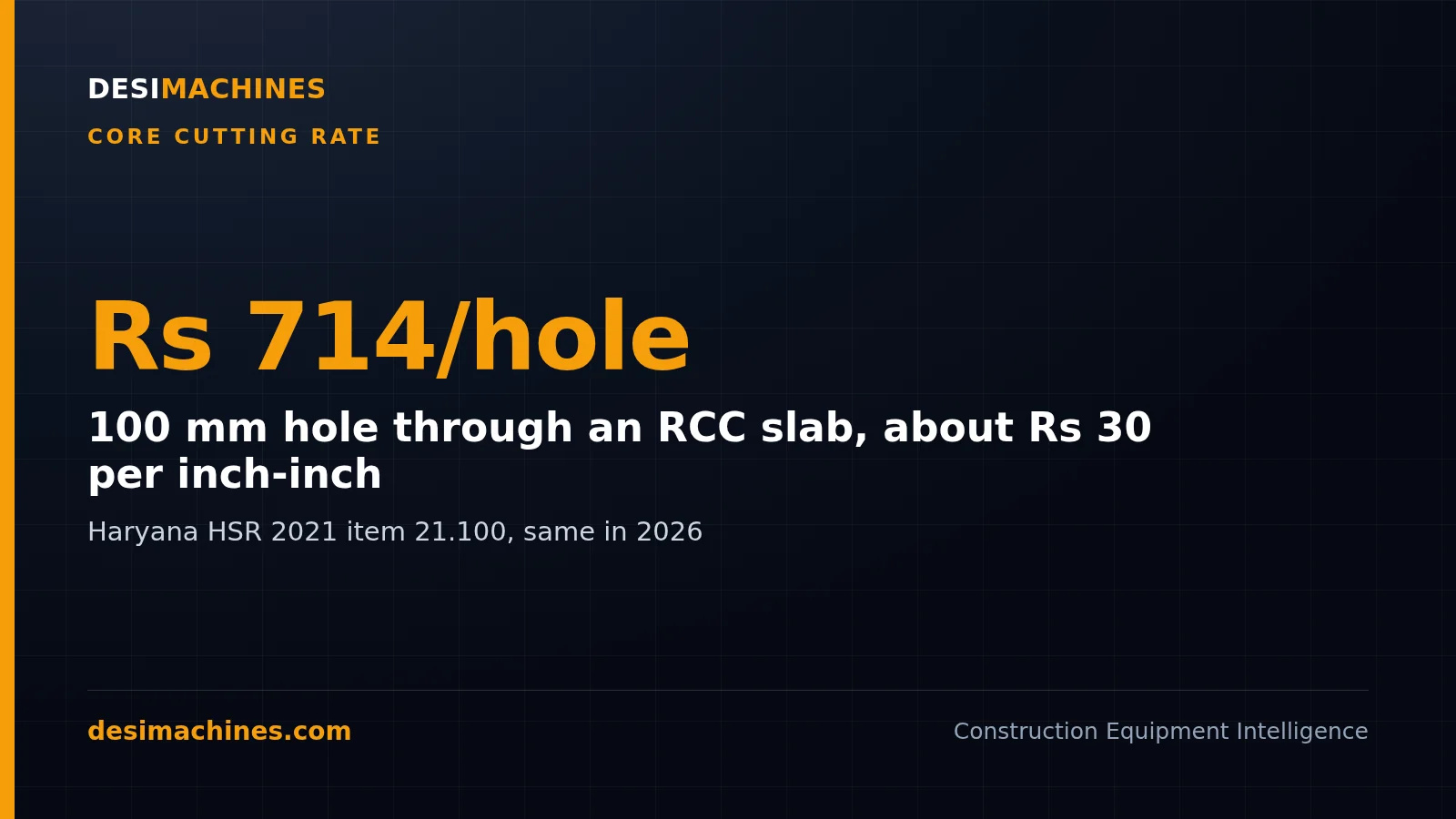
Haryana’s schedule puts the core cutting rate at Rs 714 for a 100 mm (4-inch) hole through an RCC slab up to 200 mm thick, sealed after the pipe goes in, and Rs 260 to Rs 1,234 for holes from 40 to 175 mm (HSR 2021 item 21.100, unchanged in the 2026 web report). On a 150 mm slab that works out to about Rs 30 per inch-inch, the unit most plumbers quote in, and about Rs 22 on a 200 mm slab. Tamil Nadu’s 2025-26 schedule lists diamond core drilling at Rs 324, 432 and 484 for 100, 150 and 200 mm holes. No state schedule we checked publishes a core cutting machine rent per day.
Your plumber quotes core cutting “per inch”, and the site engineer asks what that means for one 4-inch hole through a 150 mm slab. It means diameter in inches times depth in inches: 4 x 6 gives 24 inch-inch, and that number is multiplied by his rate to get the price of the hole.
The rest of the bill is what that rate leaves out, like water, rebar and the slurry on the floor below.
How core cutting is priced per inch
Core cutting uses a hollow, diamond-tipped bit on a motor, usually on a stand bolted to the slab or wall. The bit cuts a ring and the plug of concrete comes out whole, so the hole is clean. Contractors price it in one of three ways:
- Inch-inch: diameter x depth, both in inches, x a rate. This is how most of the trade quotes core cutting price per inch.
- Per hole: a fixed price for a diameter up to a stated thickness, which is how government schedules write it.
- A minimum visit charge: a floor for small jobs, because setting up takes as long for one hole as for five.
Here is the inch-inch arithmetic for a few common holes:
| Hole | Diameter | Through | Inch-inch |
|---|---|---|---|
| Soil or waste pipe through a slab | 4 in (100 mm) | 6 in (150 mm) slab | 24 |
| Same pipe, thicker slab | 4 in (100 mm) | 8 in (200 mm) slab | 32 |
| AC pipe through an outer wall | 3 in (75 mm) | 9 in (230 mm) brick wall | 27 |
| Rainwater pipe through a slab | 6 in (150 mm) | 6 in (150 mm) slab | 36 |
Depth multiplies. Under an inch-inch quote, the same 4-inch hole costs a third more through an 8-inch slab than a 6-inch one, while a per-hole quote often stays flat up to the stated thickness. Put two quotes in the same unit before you compare them.
Core cutting rate in the state schedules
Of the state schedules of rates (SORs) we checked, only Haryana’s and Tamil Nadu’s price core cutting as its own item. Haryana PWD (B&R) carries a core-cut hole for soil and waste pipes in its 2021, 2023 and 2026 editions, all in the Haryana Schedule of Rates online report. Tamil Nadu lists diamond core drilling among its basic rates. All figures are rupees per hole, as printed.
| Schedule and item | 40 mm | 100 mm | 125 mm | 150 mm | 175 or 200 mm |
|---|---|---|---|---|---|
| Haryana HSR 2021, item 21.100 (same in the 2026 report): core cut up to 200 mm slab, sealed with drip-seal sealant | 260 | 714 | 909 | 1,039 | 1,234 (175 mm) |
| Haryana HSR 2023, item 21.100 | 232 | 638 | 812 | 928 | 1,102 (175 mm) |
| Haryana HSR 2021, basic rates PH228 to PH232: core cutting only, up to 200 mm slab | 200 | 550 | 700 | 800 | 950 (175 mm) |
| Tamil Nadu SOR 2025-26, M-0686 to M-0688 (from 22 Jul 2025, excl. GST) | not listed | 324 | not listed | 432 | 484 (200 mm) |
Haryana’s HSR 2021 was approved by its committee of chief engineers on 31 March 2021, and its preface says finished rates include the effect of 12 per cent GST. The chapter notes include water, tools and plant in the rate, so the contractor brings the water. The 2023 edition prints lower figures; the 2026 report shows the 2021 ones again.
To turn the Haryana rate into the trade’s unit, divide by the inch-inch count. Our arithmetic: a 100 mm hole through a 150 mm slab is 24 inch-inch, so Rs 714 is about Rs 30 per inch-inch. Through a 200 mm slab it is 32 inch-inch, or about Rs 22. Every diameter in item 21.100 lands at Rs 29 to 30 per inch-inch on a 6-inch slab.
Tamil Nadu needs care. Its item reads “Making through holes in Plain or Reinforced Cement Concrete with Diamond Core Drilling System by using power tools of following diameter – Depth per cm”, while the unit column says “Each”. Read as a rate per centimetre of depth, one 100 mm hole through a 15 cm slab would cost Rs 4,860, nearly seven times Haryana’s rate. Ask the department’s estimating engineer which reading it applies before you quote against it.
The hand-cut method is still in the books. Haryana’s 2026 sanitary chapter pays Rs 154 to cut a hole up to 15 x 15 cm in an RCC floor and repair it with 1:2:4 concrete (item 22.83), and Chhattisgarh’s Building SOR of 10 June 2026 pays Rs 80 (item 19.44). A chiselled hole is cheaper on paper, but it breaks the edges and has to be patched with that 1:2:4 mix, the concrete priced in our guide to PCC rate per cubic meter.
Read these as government estimating rates for the date shown, as with the schedule figures behind excavation rate per cubic meter and piling rate per metre. If you price plumbing and drainage for public buildings, these items turn up in the bill of quantities; find building works to bid for among live tenders and opportunities.
What pushes the core cutting charge up
A per-inch rate is the start of the bill. These are the extras that change it:
- Rebar hits. A diamond bit cuts steel, but slowly, and steel wears the bit. Many contractors charge extra per bar. On a beam or structural slab, the engineer should approve any cut through main steel first.
- Extra depth. A bit has a fixed working length, so a thick raft or wall needs extensions or drilling from both faces, and the rate goes up.
- Walls and overhead work. A horizontal hole needs the stand anchored to the wall, and shafts or ceilings need scaffolding, common on tower jobs where holes repeat floor after floor (see the equipment used on high-rise buildings).
- Wet or dry. Wet cutting cools the bit and keeps dust down, but the slurry runs to the floor below. Dry cutting with a vacuum suits brick and block.
- Sealing. The Haryana item includes drip-seal sealant around the pipe. A bare per-inch quote may not.
Two other jobs share the name. Drilling cores out of a finished structure to test concrete strength is a separate testing job, and so is the soil core cutter used for the field density test on earthwork.
Core cutting machine rent per day
No official hire rate is published. None of the hire lists in CPWD’s analysis of rates (DAR 2014) or the Puducherry, Tamil Nadu, Chhattisgarh, Maharashtra and Haryana schedules prices a core cutting machine by the day. Rental shops quote daily rent, but those are local quotes, not a benchmark.
If you rent the machine instead of hiring a contractor, cost these heads:
- The machine: motor, stand, anchors and the water feed or vacuum.
- Bit wear: diamond bits wear per inch drilled, faster through rebar, and a rental may charge wear on top of the rent.
- The operator: Chhattisgarh’s water resources SOR (in force from 1 May 2025) lists a core drilling machine operator as skilled labour at Rs 456 a day under the labour commissioner’s order of 25 September 2024, and the helper as semi-skilled at Rs 426.
- Water, a power point and transport to site.
Renting pays when you have dozens of holes on one site and a skilled hand of your own. For a handful, a contractor is simpler, because bit wear and a stuck core become his problem.
What to fix with the core cutting contractor before work starts
- The unit (inch-inch, per hole or per cm) and the rate for each diameter.
- The minimum visit charge and what it covers.
- Wet or dry cutting, and who supplies water and a power point.
- What happens when the bit hits a bar: the extra charge, and who approves the cut.
- Extras for depth beyond the quoted thickness, for walls and for overhead or shaft work.
- Who clears the cores and slurry, and who protects the floor below.
- Whether sealing around the pipe is included.
- Payment for a hole that is abandoned or shifted.
Write these into the work order. Contractors who take whole plumbing packages can track public building works tenders.
Schedule of rates figures are government estimating rates for the states and dates shown and are not market quotes. Rates, schedules and site conditions change — confirm current terms with the contractor, the rental firm or the issuing department before deciding.