Excavator
294 models
 Backhoe Loader
51 models
 Crane
68 models
 Concrete Mixer
79 models
 Wheel Loader
54 models
 Compactor / Roller
45 models
 Motor Grader
42 models

 Concrete Pump
66 models
 Skid Steer Loader
11 models


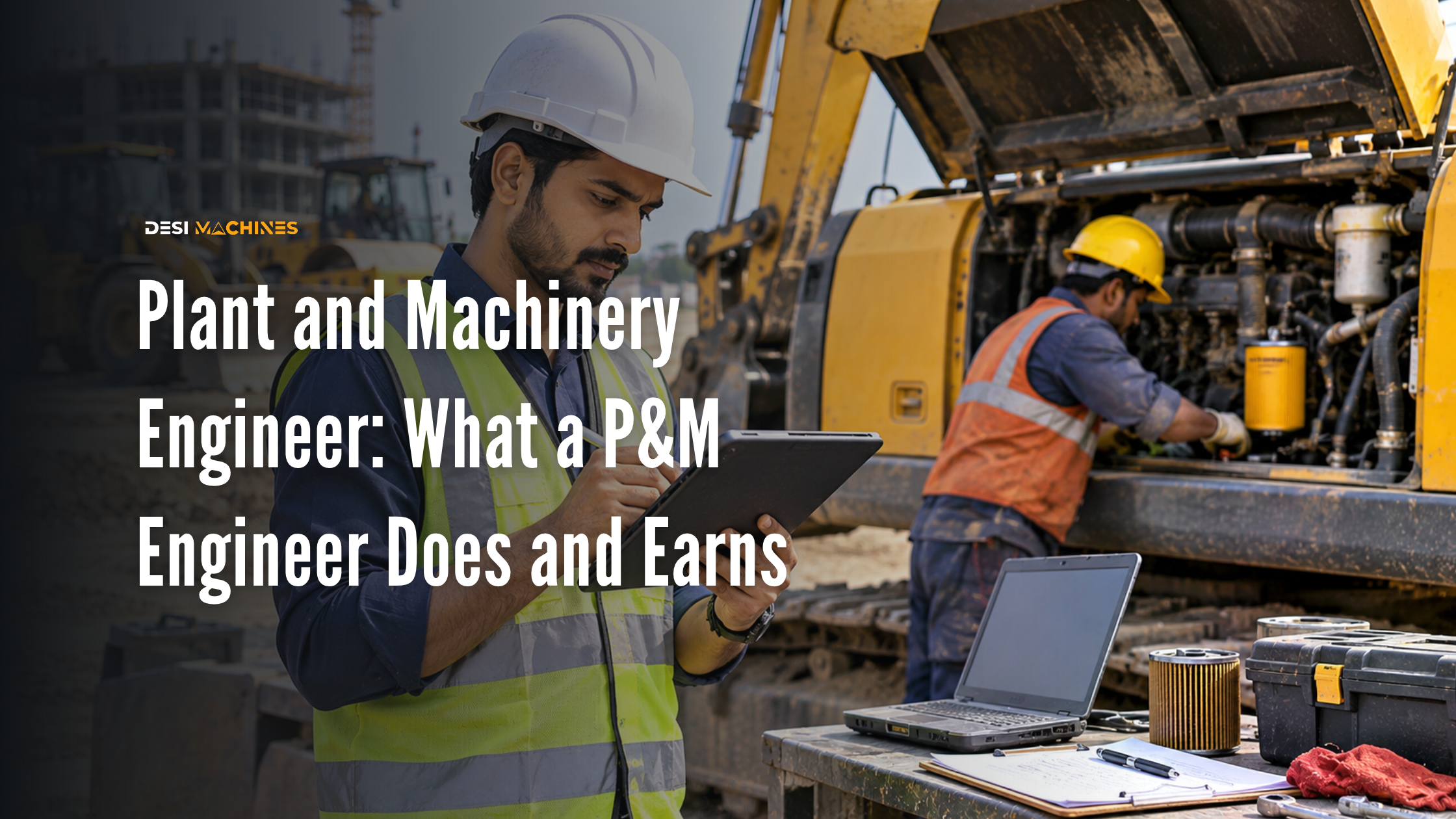
A plant and machinery engineer runs the machine side of a contractor’s project: which machines come to site, whether they are owned or hired, how many hours they work, what diesel they burn, when they are serviced, and who signs the hours a hire owner gets paid for. Private contractors do not publish what this job pays. The nearest published figures are public posts: NBCC hired Junior Engineers (Mechanical) in 2026 at an IDA scale of Rs 27,270 (S-3), and Border Roads Organisation’s 2026 rules put its Assistant Engineer (Electrical and Mechanical) at Level 7, Rs 44,900 to 1,42,400, with dearness allowance on top.
It is the last day of the month at a highway camp. Three hire owners are sitting outside the P&M office with their log sheets. On one excavator’s sheet the P&M engineer has struck out a morning for a hose burst that nobody wrote down on the day. The owner argues, then signs, because the signed sheet is the bill that gets paid.
What does a plant and machinery engineer do?
On an EPC, road or building contract, the civil team builds and the P&M department keeps the machines working for them. The Infrastructure Equipment Skill Council’s qualification Supervisor (Plant & Machinery) (NSQF Level 5, approved 26 May 2022) defines the role as managing “the fleet machines in a safe and secured manner”, and its performance criteria read like a P&M engineer’s working week:
- Plan, schedule and select equipment for each task, and roster operators and “other P&M support personnel”.
- Analyse breakdown and repair data (MTBF and MTTR), productivity and cost, and raise spares requests.
- Check “the details of the hired equipment and actual worked hours of the equipment”.
- Assess sub-contractors by their equipment, and check their documents and work sheets.
- Inspect fire extinguishers and machine equipment for validity, and plan renewals.
Add the daily paperwork: hour-meter readings each shift, diesel issue per machine, the service schedule, and the registration, insurance and test certificates a client’s gate asks for. On large government works the P&M engineer also feeds the monthly report. The Department of Expenditure’s Manual for Procurement of Works (Second Edition, 2025) says that report should contain a “Plant and machinery statement, indicating those deployed in the work, and their working status”.
How the work splits between P&M engineer, in-charge and head
Titles vary by company. The national standard names two rungs, Supervisor and then Assistant Manager (Plant & Machinery). Most departments work on three:
| Level | Where they sit | What they answer for |
|---|---|---|
| P&M engineer | One project or one stretch | Daily log sheets and hour-meter readings, diesel issue, breakdown entries, service due dates, operator rosters, first-line repairs with the mechanics |
| P&M in-charge | Whole project | Fleet plan against the work programme, hiring in and releasing machines, certifying hire bills, spares budget, the machine papers file, the monthly P&M statement |
| P&M head | Head office | Buying and selling machines, moving machines between projects, OEM and dealer service contracts, cost per hour across the fleet, mobilisation for new contracts |
Which contractors run the biggest machine fleets is set out in the list of India’s largest construction equipment fleets.
Own or hire: the rule that shapes the fleet plan
A P&M department usually owns a core fleet and hires in for peaks. Government rules tilt that balance. Under paragraph 5.3.2 of the 2025 Works Manual, a contractor can get an interest-bearing advance of up to 5 per cent of the contract price against new key construction equipment bought for the work, where the bid documents allow it. The machine is hypothecated to the government, and the contractor gives an undertaking that it works only on that job. The manual then adds: “No advance shall be admissible on equipment purchased under a hire purchase scheme/ financing arrangement or on hired equipment.”
So neither a hired machine nor one bought on a loan brings the contractor that money. The P&M head weighs that, with utilisation, before buying. In the 20-tonne excavator class, a common size on road and building jobs, the shortlist usually includes machines such as the JCB NXT 215LC and the Tata Hitachi EX 200 Infra. For a P&M head, the dealer’s service support near the project counts as much as the machine itself.
Dealing with the P&M engineer who hires your machine
If you own machines, the P&M engineer is your real customer on site. That desk certifies your hours, records your breakdowns and decides whether you are called back. The standard’s wording, checking “actual worked hours”, tells you what the P&M engineer is judged on: paying only for hours the contractor got.
Work with that. Get the log sheet signed every day, not at month end. Photograph the hour meter at start and finish. Record a breakdown and the time the machine was ready again on the same day’s sheet. Agree in writing how idle hours are paid and who supplies diesel. The clauses are covered in terms an equipment rental agreement should carry. How owners with several machines win and keep this work is covered in equipment fleet owners in India.
How do you become a P&M engineer?
The usual base is a diploma or degree in mechanical engineering; BRO’s rules also accept electrical or automobile. The national Supervisor (Plant & Machinery) standard accepts a degree, a three-year diploma, or Class 12 with four years of relevant experience, minimum age 20. NCVET’s register shows its validity ending on 26 May 2025, so treat it as a job description, not a licence anyone asks for.
A practical route in is a service engineer’s job with an OEM dealer. A few years of attending breakdowns on customers’ machines teaches hydraulics, engines and warranty claims, which is what a P&M department needs. Others move up from mechanic or operator; the standard notes a large workforce of operators and mechanics trained but not certified. What operators earn is set out in heavy equipment operator salary in India.
Plant and machinery engineer salary: what is published
No private contractor publishes P&M pay, and we found no official survey of it, so job-portal figures are left out here. The published numbers come from public employers with mechanical posts in construction:
| Post | Employer and document | Pay as notified |
|---|---|---|
| Junior Engineer (Mechanical), diploma, no experience | NBCC (India) Ltd, Advt 01/2026 (applications 6 March to 5 April 2026) | IDA S-3, Rs 27,270 (open ended) |
| Junior Engineer (Electrical and Mechanical) | BRO General Reserve Engineer Force, S.R.O. 27 of 22 Sep 2026 | Level 6, Rs 35,400 to 1,12,400 |
| Assistant Engineer (Electrical and Mechanical), 119 posts | Same rules | Level 7, Rs 44,900 to 1,42,400 |
BRO fills Assistant Engineer (E&M) posts from its own Junior Engineers: 90 per cent by promotion after five years in the grade and a four-week course, 10 per cent by a departmental exam after four years. Dearness allowance for central government employees rose to 63 per cent of basic pay from 1 July 2026 (Department of Expenditure order of 29 October 2026). On our arithmetic, a Level 7 entry basic of Rs 44,900 plus 63 per cent DA comes to Rs 73,187 a month, before house rent and other allowances.
Private pay for the same work depends on the contractor, the project and the fleet. Compare an offer with the civil side in site engineer salary, and judge it on the fleet you will run.
Checklist before your machine goes to a P&M department
- Log-sheet format agreed, with columns for start and end hour-meter readings, breakdown time and idle time.
- Daily signature named: which site person signs, and who signs when that person is away.
- Minimum hours, idle-standby hours and the breakdown deduction rule written into the work order.
- Diesel terms fixed: contractor-issued against a slip, or yours and built into the rate.
- Papers in the cab and on file: registration, insurance, and a current test certificate for any crane or lifting machine.
- Billing date and certification time agreed, so the month-end sheet turns into a payment on a known date.
If you are adding a machine to hire out to contractors’ P&M departments, compare equipment finance options before you commit to the purchase.
Pay scales, allowances, procurement rules and qualification standards change. Confirm the current terms with the employer, the recruitment notice, or the contracting department before deciding.