Excavator
316 models
 Backhoe Loader
54 models
 Crane
68 models
 Concrete Mixer
79 models
 Wheel Loader
54 models
 Compactor / Roller
45 models
 Motor Grader
42 models

 Concrete Pump
66 models
 Skid Steer Loader
11 models


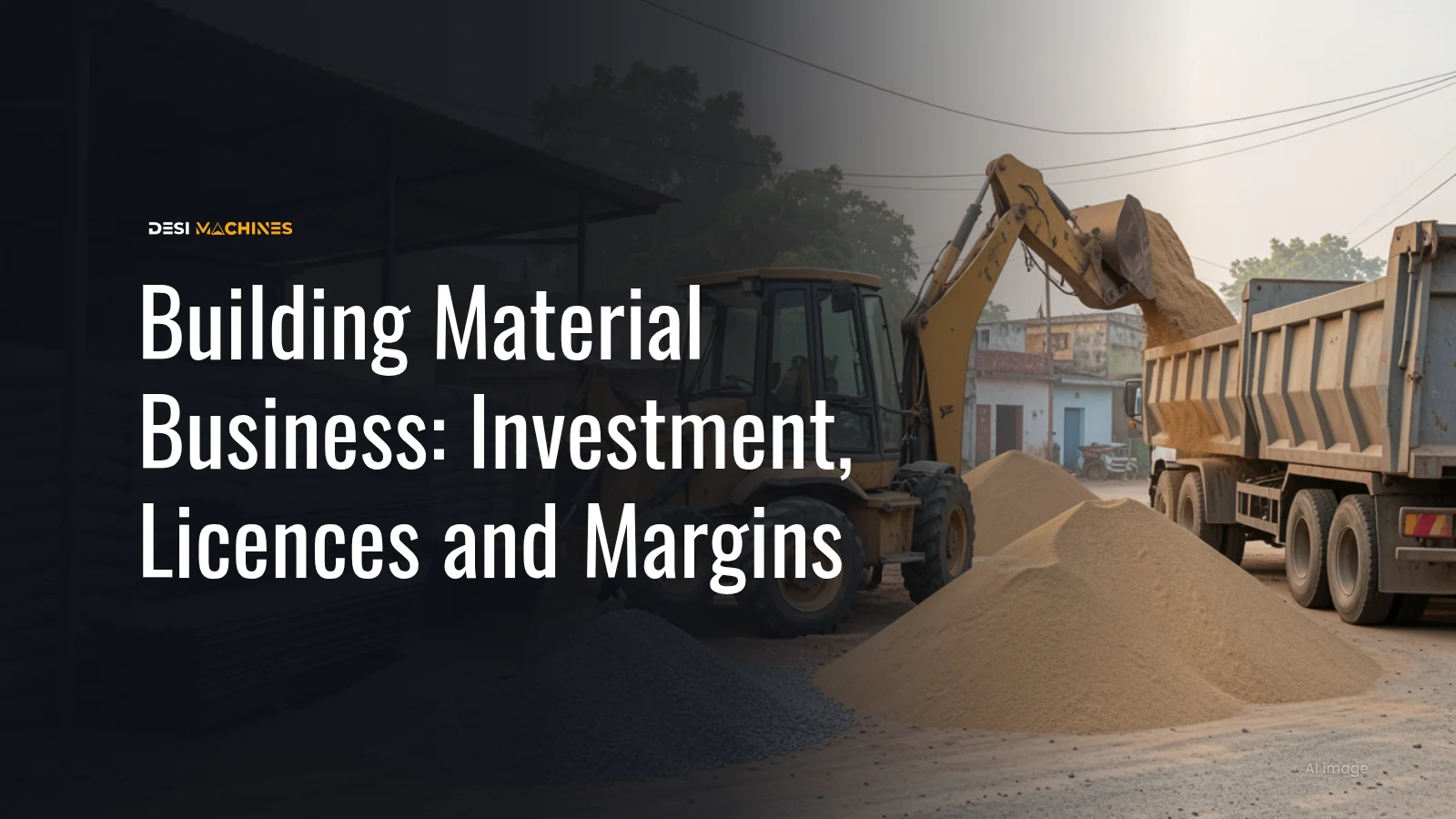
At 7 am on a town’s bypass road, a contractor’s tipper waits outside a yard for 3 cubic metres of M-sand, to be put on the contractor’s account. That one load is the building material business in small: you buy cement, steel, sand and aggregate, sell them on a thin spread and carry the buyer’s unpaid bill. To open one you need a trade licence from your local body, a free Udyam registration and, once goods turnover passes Rs 40 lakh in most states, GST registration; cement and steel bars carry 18 per cent GST and sand and crushed stone 5 per cent since 22 September 2025. No official source publishes a dealer margin, so the money is decided by your buying price, your delivery cost and how fast contractors pay.
What the yard owner cannot see from the gate is how many weeks that load will take to turn into cash.
What a building material business sells, and to whom
The usual stock is bagged cement, TMT bars, M-sand or river sand, aggregate, bricks or blocks, and a counter of binding wire and nails. Buyers are small contractors, masons and house builders who come once.
A shop sells cement and steel off a counter and a small godown. A yard sells loose sand and aggregate by the load, which needs open ground, a loader and trucks. Many owners start with the shop and add the yard once contractors want everything on one bill. If you want to make blocks yourself, see the paver block business and AAC block business posts.
Licences and registrations you need
GST comes first, because contractors who claim input tax credit will ask for a tax invoice. Section 22 of the CGST Act sets the registration line at Rs 20 lakh of aggregate turnover, and Rs 10 lakh in some special category states. Notification No. 10/2019-Central Tax, in force from 1 April 2019, raises it to Rs 40 lakh for a person “engaged in exclusive supply of goods”. That higher line does not apply to intra-state supplies in Arunachal Pradesh, Manipur, Meghalaya, Mizoram, Nagaland, Puducherry, Sikkim, Telangana, Tripura and Uttarakhand, or to anyone Section 24 forces to register, such as a seller crossing a state border. Hire out your tipper or loader on the side and you are supplying a service too, which takes you out of “exclusive”. How the two limits work is explained in GST registration limit for contractors.
The rest is local and quick to list:
- A trade licence from the municipality or panchayat; the fee is set locally.
- Udyam registration, which the Ministry of MSME’s portal says is free, paperless and needs only an Aadhaar number, as read on 14 November 2026.
- A sand stockist or dealer licence where state mineral rules require one; see sand business profit.
- The income tax business code: the ITR-4 schema for assessment year 2026-27 lists 09011, “Wholesale of construction material”.
Where the investment goes
No official source publishes a standard project cost for a building material shop, so list the heads and price each one in your own town.
The shop or yard comes first. Dalmia Bharat Cement says a cement dealership needs at least 250 square feet for storage and operation; a sand and aggregate yard needs open ground with truck access on top of that. A covered godown keeps cement dry, and bags that set in the monsoon are a straight loss.
Opening stock is next, and the rate table below helps you size it. Then delivery: contractors expect material at the site, so most yards run at least one tipper, sized using the tipper guide. Small yards in rural areas often start with a tractor and trolley.
Loading loose material by hand is slow and costs you trucks waiting at the gate. A backhoe loader such as the JCB 3DX, around Rs 28.5-31.5 lakh (indicative, as of Nov 2026), loads tippers and also earns on hire. In a tight yard a skid steer such as the Bobcat S70, around Rs 12.4-13.7 lakh (indicative, as of Nov 2026), turns where a backhoe cannot. Compare backhoe loader models and prices before you commit cash the stock and the credit book will also need.
Last, weighbridge access. Aggregate sold by the tonne needs a weighment slip the contractor trusts, so either sit near a public weighbridge or budget for your own.
How the price of a load builds up
Margins are private, but state works departments publish the material rates they estimate public jobs with. Tamil Nadu’s Schedule of Rates 2025-26 (from 22 July 2025) states its basic rates exclusive of GST and at source, before transport. Kerala PWD’s local market rates for October to December 2026, published between 6 and 12 October 2026, give district rates but do not say whether GST is included. The tax column comes from Notification No. 9/2025-Central Tax (Rate) of 17 September 2025.
| Material (GST heading) | GST from 22 Sep 2025 | Tamil Nadu SOR 2025-26, excl. GST | Same with GST* | Kerala PWD, Oct-Dec 2026, six rate points |
|---|---|---|---|---|
| Cement (2523) | 18% | Rs 5,602.50 a tonne, about Rs 280 a 50 kg bag* | Rs 6,610.95 a tonne, about Rs 331 a bag | OPC-43: Rs 7,000 to 8,000 a tonne, Rs 350 to 400 a bag* |
| Steel bars (7213 to 7215) | 18% | Rs 55,665 a tonne (item “Steel”) | Rs 65,684.70 a tonne | TMT Fe-500D: Rs 6,700 to 7,500 a quintal |
| M-sand, crushed stone sand (2517) | 5% | Rs 1,578.80 a cum | Rs 1,657.74 a cum | Crushed stone 2.36 to 12.5 mm: Rs 1,287 to 2,050 a cum |
| 20 mm aggregate (2517) | 5% | Rs 1,897.40 a cum | Rs 1,992.27 a cum | Rs 2,112 to 2,500 a cum |
*Our arithmetic. Tamil Nadu codes M-0001, M-0002, M-0125 and M-0088; Kerala items 0367, 1005, 1179 and 0295. Kerala also lists modular clay bricks at Rs 7,100 to 12,500 per 1,000. Treating M-sand as heading 2517 follows the GST and HSN codes guide.
Now price one ordinary order at Tamil Nadu’s rates. The quantities are an assumption, a mixed order a small contractor might place in one go: 50 bags of cement, 1 tonne of steel, 3 cum of M-sand and 3 cum of 20 mm aggregate. Before tax that comes to Rs 80,099.85. GST adds Rs 13,062.26, of which Rs 12,540.83 is on the cement and steel, and the bill reaches Rs 93,162.11 (our arithmetic), before any delivery charge.
Cement and steel carry most of the bill and almost all the tax, so they decide your working capital. Sand and aggregate are cheap but heavy, so delivery distance decides whether they pay. Live trade rates per bag, which move every week, are tracked in cement price in India.
Is a building material business profitable?
It can be, but no ministry, state department or cement company publishes a margin you can plan on. The nearest thing to an official statement is Dalmia Bharat Cement’s own dealership page, which says a dealer’s margin “depends on the sales slab achieved by the dealer and achievement of various business objectives”. In plain words, the company sets the terms, and your monthly volume is part of them.
Your real margin is the selling price less landed cost, delivery, set bags and bills never paid. GST is not part of it: you collect it on sales and set off what you paid on purchases, but it passes through your bank account first.
Credit to contractors is the real risk
Under Section 12(2) of the CGST Act, the time of supply of goods is the earlier of the invoice date (or the date it was due) and the date you receive payment. Sell on 60 days’ credit and the GST on that invoice falls due for the period in which you issued it, while the contractor still has your money.
Run the order above through a month. Suppose, as your own assumption, that 12 contractors each take one such order a month and pay at 60 days. You bill about Rs 11.2 lakh a month, carry about Rs 22.4 lakh in unpaid bills at any time, and put through about Rs 1.57 lakh of output tax a month before those contractors pay (our arithmetic). Your input tax credit offsets much of that tax, but the supplier you bought from has usually been paid already.
Now the loss side. If one contractor walks away from a Rs 93,162 bill, divide that figure by your margin per rupee of sales: the answer is how much extra you must sell just to earn that loss back. Do that sum with your own margin before you agree to anyone’s terms. Cap each account, take part payment at delivery and stop loads at the first missed date.
Cement dealership: how to apply
Cement companies take dealer enquiries through their own websites and sales teams. Dalmia Bharat Cement’s dealership page, read on 14 November 2026, asks for your current business (cement, other building materials or others) and your average monthly cement sale in three slabs: under 50 tonnes, 51 to 100 tonnes, and 101 tonnes and above. It names a minimum of 250 square feet, says the dealership cost and investment vary with the location and potential of the market, and gives no security deposit figure. UltraTech’s contact form carries a “Request for Dealership/ Retailership” category.
UltraTech’s home page also carries a fraud warning, read the same day: the company says it does not sell through SMS, WhatsApp, phone calls, emails or social media, and that it “never asks for advance payments in any manner”. Treat any caller who offers a dealership against an upfront fee the same way, and apply only through the company’s own site or branch.
The question to put to the cement company
Before you sign, ask the area sales officer to write down three things for your pin code: your billing price per bag at each monthly slab, how many days of credit the company will give you, and what happens to your slab in a monsoon month when contractors stop buying. If the credit they give you is shorter than the credit your contractors will take, the gap is your working capital, and it is the number to take to your bank, together with the tipper and loader loans you can compare under machine and vehicle finance.
Rates, GST notifications, licence rules and company terms change. Confirm the current position with the cement company or dealer, your local body and an official source before you invest. Machine prices are indicative bands around listed prices as of November 2026. DesiMachines is not liable for decisions taken on information that may have changed after publication.