Excavator
316 models
 Backhoe Loader
54 models
 Crane
68 models
 Concrete Mixer
79 models
 Wheel Loader
65 models
 Compactor / Roller
45 models
 Motor Grader
42 models

 Concrete Pump
66 models
 Skid Steer Loader
11 models


A stone crusher plant loan is sanctioned as an MSME project loan: a term loan for the site work, shed, crushing line and power connection, usually with a working capital limit beside it, all appraised against one project report. The bank reads the site before the numbers. Expect it to want the State Pollution Control Board’s consent to establish before any money goes into civil work, a lawful stone source from a quarry lease, your margin in the account, and the consent to operate and crusher licence before the plant counts as running. Where collateral falls short, the CGTMSE scheme (updated as on 1 April 2026) can cover bank loans of up to Rs 10 crore to a micro or small unit. When your papers are in order, line up the money through equipment finance for your plant and machines.
Picture the file on a credit officer’s desk at a district branch. The supplier’s quotation for the crushing line is clipped to the front. The project report is bound. The promoter has run two excavators on hire for six years and his margin sits in a fixed deposit. Five weeks on, the file has not moved, and the note pinned to it reads: consent to establish awaited, raw material source not shown. Neither line is about the machine.
That is the usual shape of a stalled crusher file. Owners prepare for a machine loan and walk into a project appraisal.
Why a stone crusher plant loan is appraised as a project
When you finance a backhoe or an excavator, the lender’s comfort is the machine: hypothecated, repossessable, saleable in another district. A crushing and screening line sits on foundations, wired to a transformer, on a plot that has to be cleared for crushing. If the plant stops, the lender cannot drive its security away. The profit side of the same point, that three of the four asset classes on an aggregate plant can be redeployed and the crushing line cannot, is worked through in stone crusher business profit.
So the bank appraises the whole project. It asks whether the site can legally run a crusher, whether stone will keep arriving, whether the despatch figures are believable, and how much of your own money is in. Only then does the security question come up.
The project is also classified as an enterprise. The RBI’s Master Direction on lending to the MSME sector (updated as on 9 February 2026), paragraph 2.1, treats a unit as micro where investment in plant and machinery or equipment does not exceed Rs 2.5 crore and turnover does not exceed Rs 10 crore, and as small up to Rs 25 crore and Rs 100 crore. Paragraph 2.2 requires registration on the Udyam portal and tells banks to go by the Udyam Registration Certificate, so get it before you apply; the steps are in Udyam registration for contractors.
The file in the order it stalls
Read this table the way a credit officer reads your file: top to bottom, and each row has to clear before the next one matters. The legal content of the consents and licence sits in the stone crusher licence chain; this is only where each paper bites on the loan.
| Stage | What the lender wants to see | Why files stop here |
|---|---|---|
| 1. Site | Land title or a registered lease for a plot your state allows a crusher on | The plot was bought first and checked against the siting distances later |
| 2. Consent to establish | The State Pollution Control Board’s consent to establish for that plot | Applied for late, or civil work already started without it |
| 3. Stone source | Your own quarry lease, or a supply arrangement with a leaseholder | Despatch is projected with no lawful source of raw stone behind it |
| 4. Project report | Cost of project and means of finance that add to the same total, with debt service cover shown | Rated capacity used as despatch; the two tables do not reconcile |
| 5. Your margin | Your contribution in the account, with its source explained | Margin promised from a sale or a relative that has not happened |
| 6. Security | Hypothecation of the plant, a mortgage if offered, or credit guarantee cover | Collateral short and nobody has asked about CGTMSE or the hybrid model |
| 7. Disbursement | Stage papers: engineer’s progress certificates, supplier invoices, power connection | Funds expected in one cheque; the bank releases against stages |
| 8. Start of operation | Consent to operate and the state crusher licence | Working capital limit waits on papers the owner thought could follow later |
Rows 2 and 3 are where most first crusher files sit for weeks. On row 3, a quarry lease is a state grant under the minor mineral rules, and how a quarry lease is granted sets out the sequence. Put the lease’s remaining term beside your repayment schedule. A lease that ends in year four of a seven-year loan is the first question the officer will ask. If you buy boulder from a leaseholder, a written supply arrangement with quantities and term reads far better than a verbal assurance.
Row 4 is the document the whole appraisal hangs on. How to build it, and the debt service ratio a bank checks first, is covered in the project report for a machinery loan. For a crusher, add two pages that a machine report does not need: the consent status of the site, and the raw material arrangement with its dates.
A worked funding split for an illustrative plant
The figures below are illustrative round numbers to show the mechanics, not a quotation or market price for any plant. The plot is assumed to be your own and is left out of the cost.
| Cost head (illustrative) | Amount | Usually released when |
|---|---|---|
| Site development, foundations, shed | Rs 30 lakh | After consent to establish, in stages against your engineer’s progress certificates |
| Crushing and screening line, with erection | Rs 1.10 crore | Paid to the supplier against invoice and delivery, often with a final part held till erection |
| Electricals, transformer, power connection | Rs 15 lakh | Against the supplier’s invoice and the electricity board’s demand note |
| Pre-operative costs: consent and licence fees, report, insurance during construction | Rs 5 lakh | Generally met from your margin |
| Margin for working capital | Rs 10 lakh | From your margin; the working capital limit opens once operation starts |
| Total cost of project | Rs 1.70 crore |
On the other side of the sheet sit two lines only: your margin, and a term loan equal to Rs 1.70 crore minus your margin. Your lender’s policy fixes the margin it wants, so ask for it in writing at the first meeting; it changes every figure below it.
Now run the regulator’s thresholds against this example. The plant and electrical lines come to Rs 1.25 crore, under the Rs 2.5 crore micro limit in paragraph 2.1, so the unit should be micro if turnover stays within Rs 10 crore. Paragraph 4.2 allows a composite loan of up to Rs 1 crore, term loan and working capital through a single window. This project is larger once the working capital limit is added, so expect two facilities; a smaller plant inside Rs 1 crore can ask for the composite route.
Owners plan least for the staged release. Shed money arrives in parts as the engineer certifies each stage, and plant money goes straight to the supplier, so keep some cash of your own for the gap between finishing a stage and the bank’s release.
Where CGTMSE fits when collateral is short
The RBI’s collateral rule helps less than owners hope on a crusher. Paragraph 4.1 of the MSME Direction, as substituted by circular FIDD.MSME & NFS.BC.No.12/06.02.31/2025-26 of 9 February 2026, mandates banks not to accept collateral on loans up to Rs 20 lakh to micro and small units, for loans sanctioned or renewed on or after 1 April 2026. A bank may raise that to Rs 25 lakh under its own policy for a unit with a good track record. A Rs 1 crore plant loan is well past both.
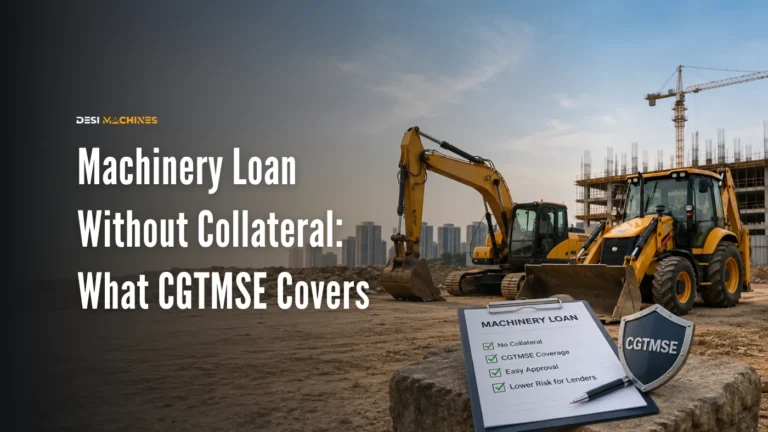
Above those limits, ask about the credit guarantee scheme. The CGTMSE scheme document, updated as on 1 April 2026, covers in section 4 credit facilities of up to Rs 10 crore from public sector, private sector and foreign banks to a micro or small enterprise, given without collateral or third-party guarantees. Section 2(iv) adds a hybrid model, where the bank holds collateral for part of the loan and the guarantee covers the unsecured rest.
Section 9 sets the cover. For a micro enterprise borrowing above Rs 5 lakh, and for all other borrowers, it is 75% of the amount in default; it rises to 85% for SC/ST entrepreneurs and units in aspirational districts, and 90% for women entrepreneurs. Facilities above Rs 50 lakh must carry the bank’s internal rating at investment grade. On the illustrative plant, if the account went bad with Rs 1 crore outstanding, a 75% cover would pay the bank up to Rs 75 lakh. You would still owe the full Rs 1 crore. The fee, and what the guarantee does and does not protect, are set out in a machinery loan without collateral.
One more clause links back to the consents. Section 5(iv) excludes any credit facility that does not conform to the provisions of any law. A banker reading that has another reason to want your consents on file before seeking cover.
Keep the feeding machines in their own loans
The plant needs a wheel loader at the hopper and, if you quarry, an excavator at the face. A loader such as the Hyundai HL930I can go into the project cost, but many owners finance it separately against hypothecation of the machine. If the consent is not renewed or demand dips, the loader can earn on hire elsewhere while the crushing line waits.
What the RBI requires the bank to give you
Paragraph 4.7 of the MSME Direction requires banks to issue an acknowledgement with a unique application serial number, to give MSME borrowers an indicative checklist of documents at the time of applying, and to convey in writing the main reasons for rejecting an application within their sanction time norms. Paragraph 4.4 caps the credit decision at 14 working days for loans up to Rs 25 lakh; a crusher loan above that runs on the bank’s Board-approved norms, which must be displayed on its website. Ask for the checklist on day one and match your file to it.
Before you sign for a plot or a plant, take your consent status, stone source and project report to construction equipment finance and share the requirement.
RBI directions, CGTMSE terms, consent conditions and state crusher rules change, and every lender applies its own policy on margin, security and disbursement. The funding split above is illustrative. Confirm the current position with your bank, your chartered accountant and your State Pollution Control Board before you commit money. DesiMachines is not liable for decisions taken on information that may have changed after publication.