Excavator
294 models
 Backhoe Loader
51 models
 Crane
68 models
 Concrete Mixer
79 models
 Wheel Loader
54 models
 Compactor / Roller
45 models
 Motor Grader
42 models

 Concrete Pump
66 models
 Skid Steer Loader
11 models


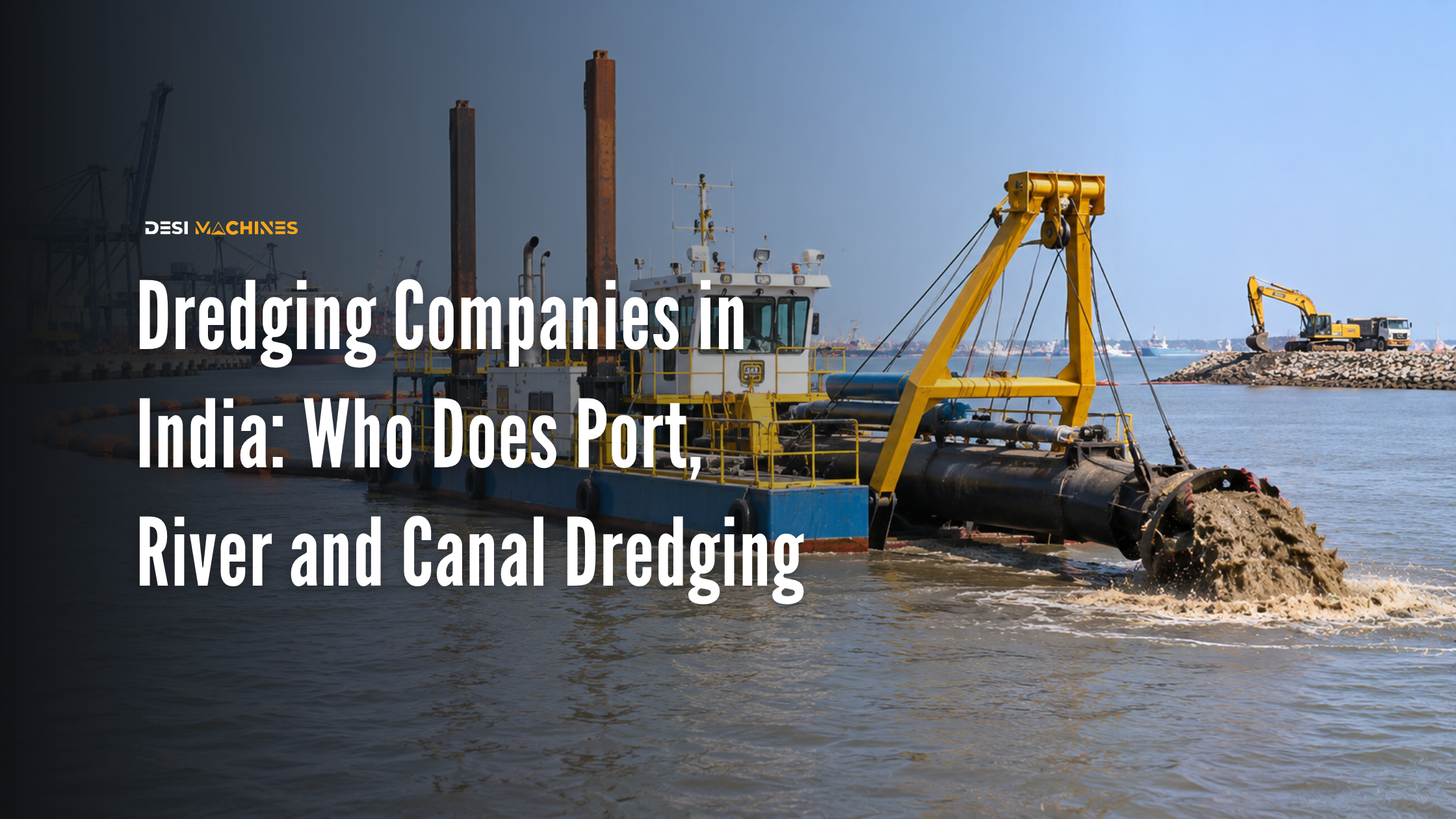
As of Nov 2026, seven dredging companies in India publish their Indian work in their own documents: the public sector Dredging Corporation of India (ten hopper dredgers, two cutter suction dredgers and a backhoe dredger), Adani Ports and SEZ (28 dredgers), the listed Mumbai firm Knowledge Marine & Engineering Works, and four Dutch and Belgian contractors, Boskalis, DEME, Jan De Nul and Van Oord. Ports, the Inland Waterways Authority of India and EPC contractors let the work. A small machine owner gets paid one level down, as a sub-contractor with long-reach or amphibious excavators, pontoon work, tippers and shore-side earthwork.
The Dredging Corporation of India owns twelve suction dredgers, and it is still hiring dredgers. On 4 November 2026 it put out a tender to charter a grab or backhoe dredger with two hopper barges for work at Tuticorin. In December 2025 it gave a Rs 58.39 crore rock dredging job at Jawaharlal Nehru Port to a private firm, Knowledge Marine & Engineering Works, according to that firm’s stock exchange filing.
So the firm that wins a dredging contract is often not the firm that does all the work. That chain of main contractor, sub-contractor and hired plant is what a machine owner needs to understand.
How this list was built
A company is listed only if its own website, annual report or stock exchange filing describes dredging work in India, and every fact below comes from one of those or from a government document, on the date shown. The order is alphabetical. No ranking is implied, because no public body publishes a dated league table of dredging firms. We dropped names we could not confirm from the firm itself. One older private dredger owner is in liquidation, and other names that come up in searches had no live website or filing we could read.
Dredging companies in India as of Nov 2026
| Company | Who it is | Indian work or fleet, as the firm publishes it |
|---|---|---|
| Adani Ports and SEZ (APSEZ) | Port operator, building a dredging fleet since 2005 | 28 dredgers (Annual Report 2024-25); its dredging page lists 17 cutter suction and 4 trailing suction hopper dredgers among them, plus 54 pieces of reclamation spread |
| Boskalis | Dutch dredging contractor | Joint venture with Jan De Nul to deepen the 35.5 km Jawaharlal Nehru Port access channel, about EUR 250 million, more than 40 million m³ (3 Apr 2017) |
| DEME | Belgian dredging contractor | Capital deepening of the harbour basin, turning circle and four berth pockets at Ramayapatnam Port, for Navayuga Engineering (16 Jun 2026) |
| Dredging Corporation of India (DCI) | Visakhapatnam, owned by four major port authorities since 8 Mar 2019 | 10 trailing suction hopper, 2 cutter suction, 1 backhoe and 1 inland dredger (company profile, Nov 2026); turnover Rs 1,214.09 crore in 2025-26 |
| Jan De Nul | Belgian dredging contractor | Over 30 years in India, including Kamarajar Port and the ports of Mumbai and Tuticorin; Vadhavan reclamation with DEME (5 Mar 2025) |
| Knowledge Marine & Engineering Works (KMEW) | Mumbai, incorporated 2015, listed | IWAI fairway maintenance on 145 km of National Waterway 1, Rs 147.44 crore over three years (Oct 2024); work orders from DCI |
| Van Oord | Dutch dredging contractor | About 5 million m³ of maintenance dredging at Krishnapatnam after Cyclone Michaung, with hopper dredger HAM 318, for Adani Ports (1 Mar 2024) |
Two patterns stand out. The Indian fleets are large but not always enough: Adani Ports, which owns one of them, still brought in Van Oord in 2024 for the post-cyclone job at its own Krishnapatnam port. And the foreign firms often work under an Indian EPC company rather than for the port. DEME’s Ramayapatnam contract came from Navayuga Engineering, and Jan De Nul says its Vadhavan joint venture with DEME “will serve as a subcontractor to ITD Cementation”. The EPC side of that chain is covered in the list of top EPC companies in India.
Capital, maintenance, river and canal work: who lets each job
The Ministry of Ports, Shipping and Waterways draws the main line. Capital dredging removes virgin soil or rock to make a channel, berth or basin deeper, and it is a one-time job. Maintenance dredging removes the silt that settles back, so it comes round every year. In 2017-18 and 2018-19 the major ports dredged about 159.36 million m³ between them, and capital work was only about 20 per cent of it, according to the ministry’s guidelines.
| Work type | Who usually lets it | Main plant | Where a small owner fits |
|---|---|---|---|
| Capital dredging (new port, deeper channel) | Port authority or the EPC contractor building the port | Large hopper and cutter suction dredgers | Reclamation earthwork, bunds, shore protection, haulage |
| Maintenance dredging at ports | Port authority, often on multi-year contracts | Hopper dredgers, grab and backhoe dredgers | Berth pockets and drains with long-reach excavators, disposal areas |
| River fairways on national waterways | IWAI, or DCI as its contractor | Cutter suction and small inland dredgers | Pontoon work and bank-side earthwork at terminals |
| Canal and reservoir desilting | State irrigation departments and city bodies | Long-reach and amphibious excavators, tippers | Often the main contractor, bidding directly |
The last row is the one that matters most to a small fleet. Of the seven firms above, DCI and KMEW list inland or river work, and none of the pages we read offers village tank or canal cleaning. That work is tendered by state departments, and it is where a machine owner competes on equal terms.
Where a machine owner fits on a dredging job
The dredger and its crew stay with the dredging firm. What gets hired locally is the plant around it, and the biggest fleet in the table shows how much of it there is: alongside its dredgers, Adani Ports lists 54 pieces of reclamation spread, “dozers, excavators, loaders and other equipment”, and over 50 km of pipeline.
On the bank, the long-reach excavator does most of the work in berth pockets, drain mouths and canal edges. The Tata Hitachi EX 215LC-SLR reaches about 15.6 m on its published spec. Where the ground is too soft to stand on, an amphibious machine such as the Liugong 922E Amphibious floats on sealed pontoons and reaches about 14.8 m; it weighs 29 tonnes. Which of the two suits a job, and when to hire instead of buy, is set out in the guide to excavators for dredging and desilting, so we will not repeat it here.
Behind the excavator sit the tippers and loaders that move dredged material ashore, and the dozers that shape the reclamation. The full set of machines used on port building and harbour yards is on the ports and dredging application guide. Before you quote for this work, compare long-reach and standard excavators on reach and bucket size, because silt is heavy and a long boom carries a small bucket.
How big contractors source plant, and how much they own versus hire, is covered in India’s largest construction equipment fleets.
How dredging jobs are let
Major port and IWAI dredging is tendered on the Central Public Procurement Portal. The bidder lists are short because the rules are strict. Under the ministry’s Dredging Guidelines for Major Ports 2021, a bidder needs similar dredging work completed in the last seven years and an average turnover over the last three years of at least 30 per cent of the estimate. The dredger may be owned, chartered or hired. The same guidelines’ quality plan has a section on control and supervision of subcontractors, which tells you sub-contracting is expected.
Three routes reach a small owner. First, the dredging firm or EPC contractor hires shore plant through its site plant department, on a monthly or per-cubic-metre rate. Second, DCI and the ports sometimes tender plant charters directly, as in the Tuticorin notice, where the contract is paid by quantity dredged. Third, state irrigation and municipal desilting tenders go straight to the market.
When to bid direct and when to sub-contract to a dredging firm
Run the numbers on the ministry’s pre-qualification before you spend on a tender fee. Take a port dredging job estimated at Rs 20 crore. Under the 2021 guidelines you would need, in the last seven years, any one of these:
| Experience route | Rule | On a Rs 20 crore estimate |
|---|---|---|
| One similar completed work | 80% of estimate | Rs 16 crore |
| Two similar completed works | 50% each | Rs 10 crore each |
| Three similar completed works | 40% each | Rs 8 crore each |
| Average annual turnover, last 3 years | 30% of estimate | Rs 6 crore |
Each port defines “similar work” in its own tender, so read that clause first. If you cannot meet it, the port tender is not your bid. Sub-contract to the dredging firm or EPC contractor that wins it, and price your machines by the month or by the cubic metre with a clear standby clause, because dredging stops for weather and tides.
Bid direct where the rules fit your size: canal and drain desilting let by state departments, and plant charters where the machine itself is the contract. Those are the jobs that build a record, and that record is what eventually lets you bid one level up.
Open dredging and desilting tenders are collected on the tenders and opportunities board.
Company fleets, contracts, tender rules and machine specifications change. Confirm current terms with the port authority, IWAI, the dredging firm or EPC contractor, and the OEM or dealer before you bid or buy.