Excavator
294 models
Excavator
294 models  Backhoe Loader
51 models
Backhoe Loader
51 models  Crane
68 models
Crane
68 models  Concrete Mixer
79 models
Concrete Mixer
79 models  Wheel Loader
54 models
Wheel Loader
54 models  Compactor / Roller
45 models
Compactor / Roller
45 models  Motor Grader
42 models
Motor Grader
42 models  Dozer
41 models
Dozer
41 models  Concrete Pump
66 models
Concrete Pump
66 models  Skid Steer Loader
11 models
Skid Steer Loader
11 models  Telehandler
13 models
Telehandler
13 models 


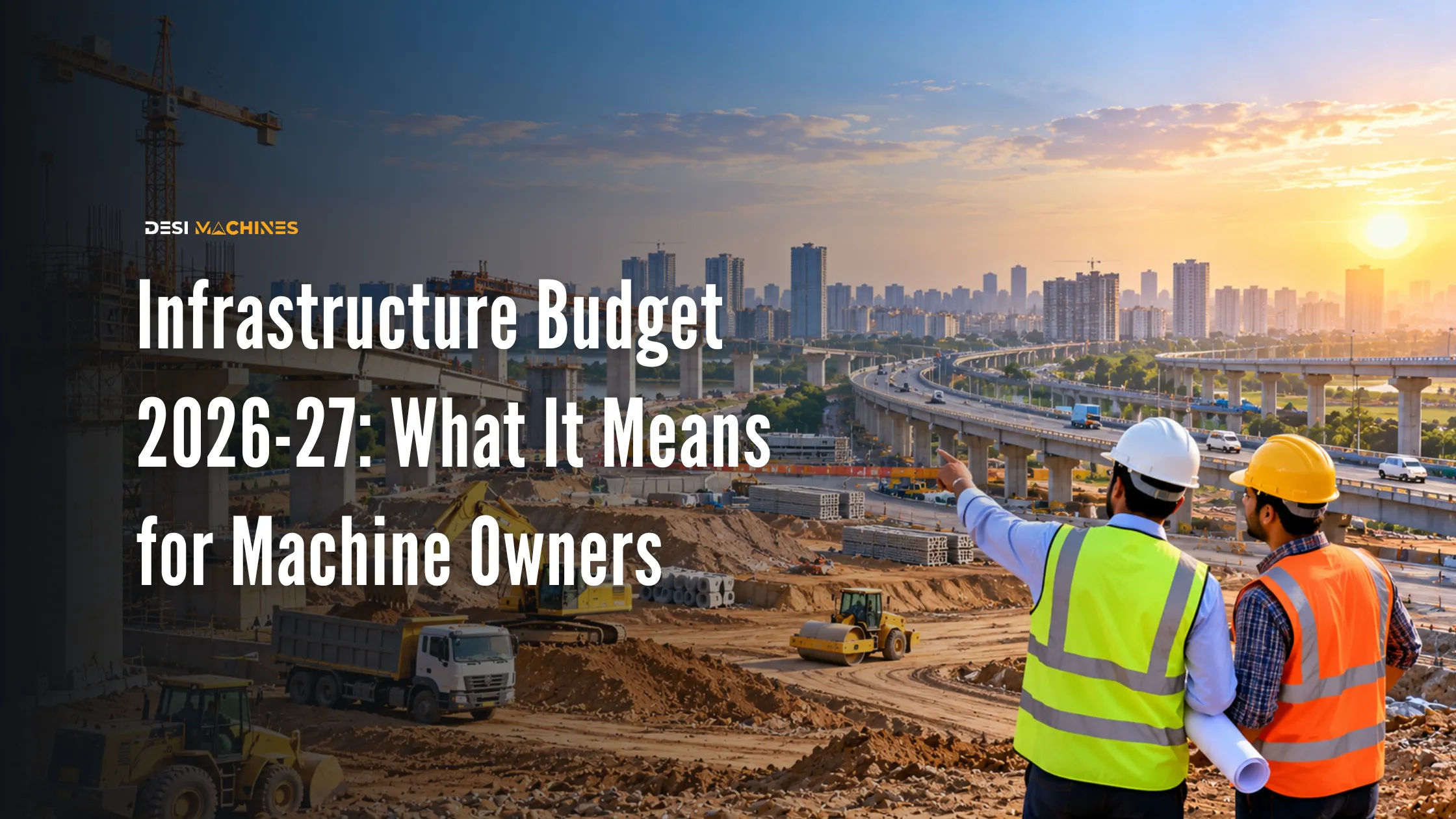
Jal Jeevan Mission was given Rs 67,000 crore for 2025-26 and then revised down to Rs 17,000 crore. Keep that in mind when you read the infrastructure budget 2026-27. On paper the Centre plans Rs 12.22 lakh crore of capital expenditure, up from Rs 10.96 lakh crore actually expected for 2025-26, with NHAI at Rs 1.87 lakh crore, railway new lines and doubling at about Rs 74,500 crore and Rs 1.85 lakh crore of capital loans to states. The lines run by central agencies are the ones that usually get spent.
A budget speech is written for the whole country. A machine owner needs a narrower answer: where will the earthwork, road and pipeline tenders come from this year, and how much of the announced money will actually reach a site. This piece reads the 2026-27 numbers from the government’s own Budget at a Glance and the budget speech of 1 February 2026, and adds the comparison that the headlines leave out: what happened to the same lines last year.
The headline number in the infrastructure budget 2026-27
The Finance Minister told Parliament that public capital expenditure had risen from Rs 2 lakh crore in 2014-15 to an allocation of Rs 11.2 lakh crore in the 2025-26 budget, and proposed Rs 12.2 lakh crore for 2026-27. The detailed table gives the exact figures.
| Rs crore | 2024-25 actual | 2025-26 budget | 2025-26 revised | 2026-27 budget |
|---|---|---|---|---|
| Capital expenditure | 10,51,953 | 11,21,090 | 10,95,755 | 12,21,821 |
| Grants to states for capital assets | 2,72,656 | 4,27,192 | 3,08,151 | 4,92,702 |
| Effective capital expenditure | 13,24,609 | 15,48,282 | 14,03,906 | 17,14,523 |
Two things stand out. Capital expenditure itself came in close to plan last year: Rs 10,95,755 crore revised against Rs 11,21,090 crore budgeted, about 98%. The grants to states did not. They were budgeted at Rs 4.27 lakh crore and revised to Rs 3.08 lakh crore, a shortfall of more than a quarter. Much of the work a small contractor bids for is paid out of exactly those grants.
Where the road and rail money goes
For machine work, five lines in the budget matter more than the total. They are the ones that buy earthwork, formation, paving and structures.
| Line (Rs crore) | 2025-26 revised | 2026-27 budget | Change |
|---|---|---|---|
| National Highways Authority of India | 1,70,266 | 1,87,293 | +10.0% |
| Road works (road ministry, outside NHAI) | 1,16,337 | 1,21,999 | +4.9% |
| Railways: new lines | 30,632 | 36,722 | +19.9% |
| Railways: doubling | 29,026 | 37,750 | +30.1% |
| Railways: track renewals | 25,166 | 22,853 | -9.2% |
| Metro projects | 27,450 | 28,740 | +4.7% |
| Capital loans to states (special assistance) | 1,44,000 | 1,85,000 | +28.5% |
Railway new lines and doubling together rise from about Rs 59,700 crore to Rs 74,500 crore, the biggest jump among the lines that buy earthwork. That is formation and bank work: cutting, filling, compaction and blanketing, which is where excavators, tippers and vibratory rollers earn their hours. Track renewals, which is mostly the railway’s own specialised machinery, falls.
The NHAI line grows by about Rs 17,000 crore. Highway packages are let to large EPC and HAM contractors, and the work reaches owner-operators through subcontracts and equipment hire. On a highway site the steady demand is for motor graders on the sub-base and road rollers on every layer, alongside 20-tonne class excavators such as the Tata Hitachi EX 210 Infra.
The lines that were cut last year
This is the part of the budget that matters most to a small fleet, and it is the part that never makes the speech. Rural and urban schemes run through state governments are budgeted generously and then revised down when states do not draw the money.
| Scheme (Rs crore) | 2025-26 budget | 2025-26 revised | 2026-27 budget |
|---|---|---|---|
| Jal Jeevan Mission | 67,000 | 17,000 | 67,670 |
| PM Awas Yojana (Rural) | 54,832 | 32,500 | 54,917 |
| PM Gram Sadak Yojana | 19,000 | 11,000 | 19,000 |
| Urban Challenge Fund | 10,000 | 1,000 | 10,000 |
| AMRUT | 10,000 | 7,500 | 8,000 |
Every one of these was budgeted high for 2025-26 and revised down, and all but AMRUT are budgeted back at or above last year’s figure for 2026-27. NHAI, by contrast, was revised at exactly its budgeted Rs 1,70,266 crore. If your fleet depends on village roads under PMGSY or on pipeline trenching for water supply, plan on the revised figure, not the budget one. A JCB 3DX bought on the strength of a Rs 67,000 crore water budget had about a quarter of that money behind it last year.
The same caution applies to getting paid. Scheme work routed through states is where payment delays bunch up, and how to protect yourself on that kind of job is set out in our note on contractor payment delay on government work.
What is new for equipment in Budget 2026-27
The speech announced a Scheme for Enhancement of Construction and Infrastructure Equipment (CIE), to “strengthen domestic manufacturing of high-value and technologically-advanced CIE”, with examples running from lifts and fire-fighting equipment to tunnel-boring machines for metros and high-altitude roads. Its first-year allocation is Rs 200 crore. It is a manufacturing scheme. It does not lower the price of a machine you buy this year, and buyer-side support still runs through the schemes listed in our guide to government schemes for buying construction equipment.
The other new items are announcements rather than this year’s money:
- An Infrastructure Risk Guarantee Fund to give partial credit guarantees to lenders on private projects, with Rs 1,000 crore in 2026-27.
- A new Dedicated Freight Corridor from Dankuni in the east to Surat in the west.
- Twenty new National Waterways over five years, starting with NW-5 in Odisha.
- Seven high-speed rail corridors, including Mumbai-Pune, Hyderabad-Bengaluru and Delhi-Varanasi.
- City Economic Regions, with Rs 5,000 crore per region over five years, and a focus on Tier II and Tier III cities above 5 lakh population.
None of the corridor announcements carries a separate 2026-27 line in Budget at a Glance. Treat them as a pipeline of future tenders, years out, and not as work for this season.
How a machine owner should read the budget
Before you add a machine on the back of a budget headline, run three checks.
- Find the line, not the total. A Rs 12 lakh crore capex figure tells you nothing about the district you work in. NHAI, rail, PMGSY and Jal Jeevan Mission each reach different contractors.
- Compare the budget with last year’s revised figure. If a scheme was cut by half in the revised estimate, assume the same can happen again.
- Follow it to tenders. Money becomes machine hours only when packages are let, usually months after 1 February. Watching live road, rail and water tenders in your state tells you more than any allocation.
The revised estimates for 2026-27 will be published with the next budget on 1 February 2027. That is the date to check whether this year’s numbers held.
The bottom line
The infrastructure budget 2026-27 is larger than last year’s, and the growth is concentrated in central lines: NHAI, railway new lines and doubling, and capital loans to states. Those lines have a record of being spent. The state-run schemes are budgeted high again after deep cuts last year, so price that work on the revised figure. If the tenders in your area support it, compare excavator models and prices and check equipment finance options before you commit to an EMI.
Sources: Budget at a Glance 2026-27 and the Budget Speech of 1 February 2026, Ministry of Finance.
Budget figures are the Government of India’s budget and revised estimates as published on 1 February 2026; actual spending can differ. Rates, schemes, specifications and prices change. Confirm current terms with the OEM, dealer, bank or insurer before deciding. DesiMachines is not liable for decisions taken on the basis of information that may have changed after publication.