
 Excavator
294 models
Excavator
294 models  Backhoe Loader
51 models
Backhoe Loader
51 models  Crane
68 models
Crane
68 models  Concrete Mixer
79 models
Concrete Mixer
79 models  Wheel Loader
54 models
Wheel Loader
54 models  Compactor / Roller
45 models
Compactor / Roller
45 models  Motor Grader
42 models
Motor Grader
42 models  Dozer
41 models
Dozer
41 models  Concrete Pump
66 models
Concrete Pump
66 models  Skid Steer Loader
11 models
Skid Steer Loader
11 models  Telehandler
13 models
Telehandler
13 models 


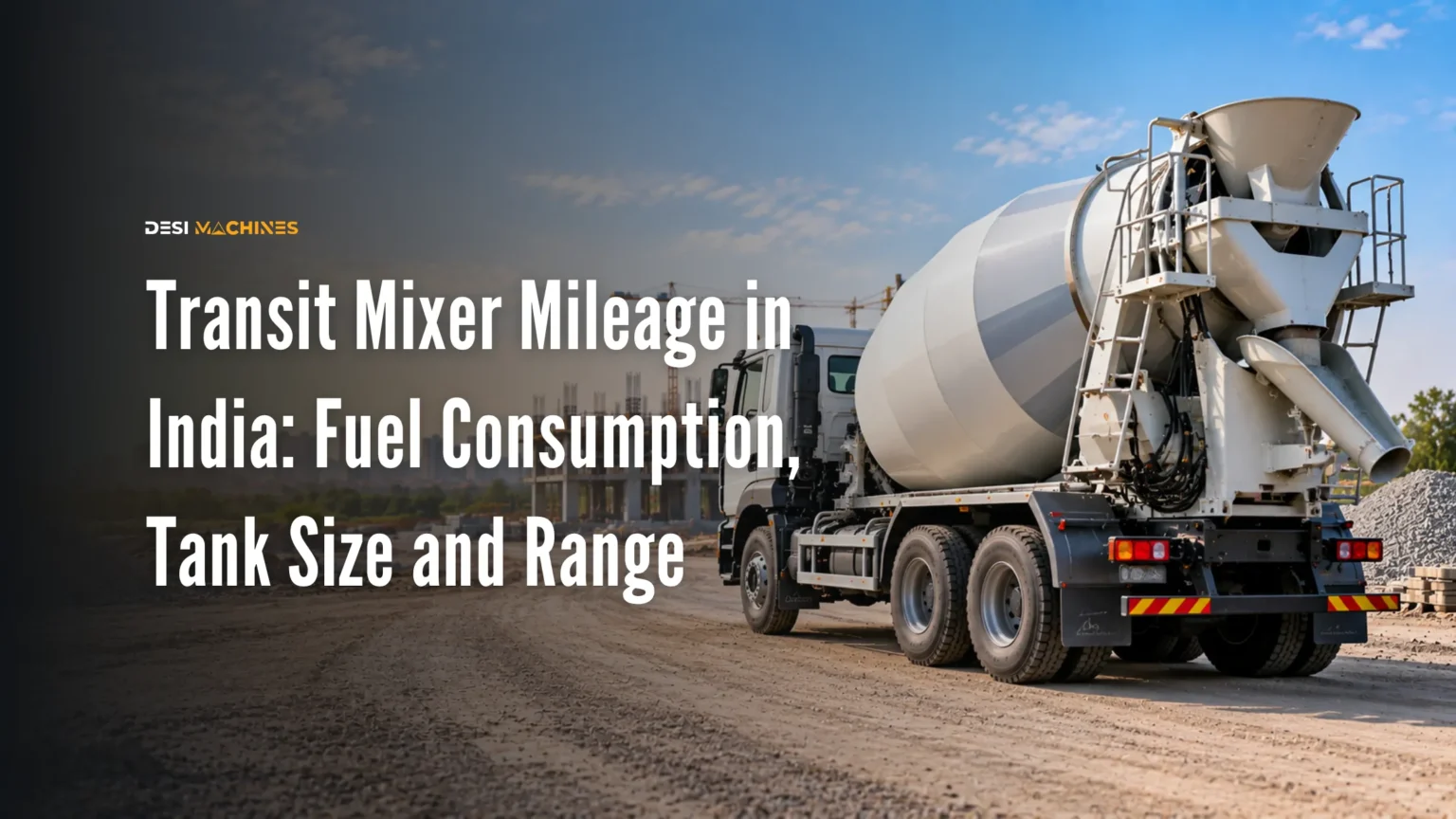
Transit mixer mileage is how far a concrete mixer truck runs on one litre of diesel, written in kilometres per litre (km/l). Across the truck-mounted transit mixers listed in India, the makers state mileage between 2.25 and 5 km/l, on trucks carrying 6 to 11 m³ of concrete at a gross weight of 28,000 kg (28 tonnes) or 35,000 kg (35 tonnes).
A transit mixer is a truck with a slowly turning drum on the back that carries ready-mixed concrete from a batching plant to your pour. Because it is a truck first, its diesel figure is a truck figure: kilometres per litre, not litres per hour. That one point clears up most of the confusion buyers run into, and it is why the mixer drum you see advertised on its own has no mileage number attached to it at all. Who runs the batching plant nearest your site is answered by the ready mix concrete companies in India listed state by state.
What mileage does a transit mixer give in India?
On the truck-mounted machines we list, the stated figure sits between 2.25 and 5 km/l. Most of them cluster lower, in the 2.25 to 3.75 km/l band, and the two heaviest 35-tonne trucks sit at the bottom of that.
Read those figures as a maker’s own number, not as a promise. Every OEM measures mileage its own way and rarely says whether the truck was loaded or empty when it did. A transit mixer runs loaded to the pour and empty on the way back, so a real fleet average usually lands under the brochure figure rather than over it. Use these numbers to compare machines, then measure your own once the truck is working.
Transit mixer mileage by model
Every truck-mounted transit mixer on our books publishes a mileage figure. Here they are, best stated mileage first, with the truck engine and tank alongside so you can see what each figure is being asked to move.
| Model | Truck engine | Gross weight | Fuel tank | Stated mileage |
|---|---|---|---|---|
| Tata LPK 2821.K FE+ RMC | 203 HP (152 kW) | 28,000 kg | 300 L | 4 to 5 km/l |
| Eicher Pro 6028TM | 210 HP (157 kW) | 28,000 kg | 220 L | 4 km/l |
| Mahindra Blazo X 28 | 280 HP (206 kW) | 28,000 kg | 260 L | 4 km/l |
| Ashok Leyland AVTR 2825 6×4 RMC | 250 HP (184 kW) | 28,000 kg | 220 L | 2.75 to 3.75 km/l |
| BharatBenz 2828C RMC | 280 HP (210 kW) | 28,000 kg | 280 L | 2.75 to 3.75 km/l |
| Eicher Pro 6035TM | 260 HP (194 kW) | 35,000 kg | 220 L | 2.5 to 3.5 km/l |
| Ashok Leyland AVTR 3825 8×4 RMC | 250 HP (184 kW) | 35,000 kg | 220 L | 2.25 to 3.25 km/l |
| Tata Prima 2830.K REPTO RMC | 300 HP (224 kW) | 28,000 kg | 300 L | 2.25 to 3.25 km/l |
| Tata Signa 2830.K REPTO RMC | 300 HP (224 kW) | 28,000 kg | 300 L | 2.25 to 3.25 km/l |
Table 1: Truck-mounted transit mixer mileage, India (figures as of September 2026)
One more machine sits outside that table on purpose. The Ashok Leyland AVTR 2820 6×4 RMC publishes 6 km/l, which is well clear of everything else in the class and clear of its own stable-mate the AVTR 2825, a truck of the same gross weight and the same tank stated at 2.75 to 3.75 km/l. We have left it out of the 2.25 to 5 km/l span above rather than let one figure set the ceiling for the whole class, and we have flagged it for checking. If that machine is on your shortlist, ask the dealer to confirm the figure in writing.
Ready to compare the machines themselves? Browse concrete mixer truck models and specifications and talk to our team about what your delivery distances need.
Why does the mixer unit have no mileage figure of its own?
Because a mixer unit is not a vehicle. India’s transit mixer market splits into two products that look similar in a photograph and are bought completely differently.
| What you are buying | What it includes | Does it publish mileage? |
|---|---|---|
| Truck-mounted transit mixer | The complete vehicle: chassis, cab, engine and the mixer body already fitted | Yes, all 10 we list |
| Standard transit mixer unit | The drum, frame and drive only, to be mounted on a chassis you supply | No, none of the 31 we list |
Table 2: Where the mileage figure lives, India (as of September 2026)
The 31 mixer units we list publish drum specifications instead, with nominal capacities from 3 to 12 m³. They carry no mileage figure for a simple reason: the maker does not know what truck you will bolt the drum to. Mileage belongs to the chassis, and the chassis is your choice.
So if you are buying a drum to fit on a truck you already own, your mileage is your truck’s mileage, minus whatever the extra weight and the turning drum cost you. If you are buying a complete machine, the number in Table 1 is the one to work from. The transit mixer capacity and load weight guide explains how much a full drum actually adds.
Does the drum run on the same diesel as the truck?
It depends on how the drum is driven, and this is the part that quietly changes what a mileage figure is telling you.
On most of the machines in Table 1 the drum is turned by a power take-off, an output on the truck’s own engine or gearbox that drives the hydraulic pump. Tata’s REPTO trucks, Ashok Leyland’s EDPTO trucks and the Mahindra PTO machine all work this way. The drum keeps turning while you drive, and every litre it uses comes out of the truck’s tank. That diesel is already inside the km/l figure.
A few machines, including the Eicher Pro 6035TM, drive the drum with a slave engine: a small separate diesel engine bolted to the mixer with its own fuel supply. On those, the drum’s diesel is not inside the truck’s mileage figure at all. Two trucks can show the same km/l and cost you different amounts of diesel a month.
Which drive a machine uses also decides what happens to your load when the truck engine stops. That is a bigger decision than fuel alone, and transit mixer drum drive: PTO, REPTO and slave engine explained sets out all three in full.
How big is the fuel tank, and how far will one tank go?
Fuel tanks on the truck-mounted machines we list run from 220 to 300 litres. Every one of them also carries a separate DEF tank of 24 to 60 litres. DEF, or diesel exhaust fluid, is the urea solution that BS-VI engines inject into the exhaust to clean it; it is not fuel, it is a consumable you top up alongside diesel.
Tank size times mileage gives you range, and the arithmetic is worth doing before you assume a truck can work a full day away from a pump:
- A 220 litre tank at 3 km/l is about 660 km of running.
- A 300 litre tank at 2.5 km/l is about 750 km.
- The same 220 litre tank at 2.25 km/l drops to about 495 km.
For ready-mix work those are comfortable numbers, because a transit mixer does short repeated trips from a plant rather than long hauls. The tank matters more for how often a driver has to break off and queue at a pump than for whether he can finish the run. Capacity figures for the rest of our range are set out in the self-loading mixer fuel and water tank guide and the excavator and backhoe fuel tank guide.
How much diesel does one load of concrete use?
This is the number that actually tells you what a delivery costs, and you can work it out yourself in one line:
Diesel per trip (litres) = round-trip distance (km) ÷ mileage (km/l)
Take a plant 15 km from the site, so a 30 km round trip:
- At 4 km/l, that trip uses 7.5 litres.
- At 3 km/l, it uses 10 litres.
- At 2.25 km/l, it uses about 13.3 litres.
Now divide by the load. Carrying 8 m³, those same trips work out at roughly 0.9, 1.25 and 1.7 litres of diesel per cubic metre delivered. That per-cubic-metre figure is the one to quote against, because it survives a change in distance and a change in diesel price. Multiply it by your own pump rate on the day and you have a real cost per m³ that you can put into a quotation.
Two honest additions to that arithmetic. The drum turning in transit is inside the figure on a PTO or REPTO truck and outside it on a slave-engine machine. And waiting counts: a truck idling in a queue at the plant or at the gate burns diesel while covering no distance at all, which is exactly the burn that km/l cannot see. If you are budgeting a fleet rather than a trip, equipment finance and EMI planning is the place to put those running numbers alongside the monthly instalment.
Why do two trucks with the same engine show different mileage?
Because the figures are not measured to a common standard. Look at two machines in Table 1: the BharatBenz 2828C and the Mahindra Blazo X 28 both run 280 HP engines at the same 28,000 kg gross weight, and one is stated at 2.75 to 3.75 km/l while the other is stated at 4 km/l. That gap is not a gap in the machines so much as a gap in how each maker arrived at its number.
The other surprise in that table is that more power does not mean worse mileage in any straight line. The 203 HP Tata LPK 2821.K is the most economical truck on the list, which fits. But the 280 HP Mahindra matches the 210 HP Eicher, and the 300 HP Tata trucks sit at the bottom alongside a 250 HP Ashok Leyland. Gearing, axle ratio, the drum drive and the duty the truck was tuned for all pull on the figure.
What does hold up is weight. Both 35-tonne 8×4 trucks sit in the bottom half of the table. Carrying more concrete costs more diesel, which is the one relationship you can rely on. The practical conclusion: compare mileage figures within a brand, where the measuring method is at least consistent, and treat comparisons across brands as a rough guide only.
What actually moves your fuel bill on site?
Once the truck is bought, the brochure figure stops mattering and these do:
- Waiting time. A mixer queuing at the batching plant or at the pour is burning diesel and delivering nothing. On a badly sequenced job this is the single biggest loss, and it costs nothing to fix except planning the slots.
- Distance from the plant. Diesel per cubic metre rises in a straight line with the round trip. A plant twice as far away doubles it.
- Carrying part loads. The truck burns nearly the same diesel with 4 m³ in the drum as with 8 m³. Half loads roughly double your cost per cubic metre.
- Tyre pressure and load. Under-inflated tyres on a 28-tonne vehicle are a steady, invisible fuel cost.
- Servicing. A clogged air filter or a tired injector shows up on the fuel bill long before it shows up as a breakdown. The transit mixer parts and components guide covers what wears and when.
None of these appear in a specification sheet, and together they move real-world consumption more than the difference between any two trucks in Table 1.
Transit mixer mileage, in short
Truck-mounted transit mixers in India state 2.25 to 5 km/l, with most in the 2.25 to 3.75 band and the 35-tonne trucks at the bottom. Tanks hold 220 to 300 litres plus 24 to 60 litres of DEF, which is 500 to 750 km of range. The mixer unit on its own publishes no mileage, because the drum has no engine of its own to measure: on a PTO or REPTO machine the drum runs on the truck’s diesel, and on a slave-engine machine it runs on its own. Work in litres per cubic metre delivered rather than km/l and you get a cost you can actually quote: roughly 0.9 to 1.7 litres per m³ on a 30 km round trip.
Compare concrete mixer models and specifications across the full range, or start with the guide to how transit mixers work in India if you are still deciding which machine your work needs. If you are weighing a mixer truck against a machine that batches its own concrete, self-loading mixer versus transit mixer sets the two side by side, and concrete mixer types covers the wider family. Buying second-hand instead? The used transit mixer buying guide lists the checks that matter. The same fuel arithmetic applied to earthmoving is set out in backhoe loader mileage and fuel consumption, and who makes the engine in your machine explains why two trucks with the same badge can carry different engines.
A note on the figures in this guide
Mileage, fuel tank, DEF tank, gross vehicle weight, engine power and drum drive are the published specifications taken from our listings at the time of writing, covering all 10 truck-mounted transit mixers and all 31 standard mixer units we list. The Ashok Leyland AVTR 2820 6×4 RMC publishes a mileage figure of 6 km/l that stands apart from the rest of the class and from its own stable-mate of the same weight and tank size; it is excluded from the 2.25 to 5 km/l span and flagged for checking with the manufacturer.
Fuel per kilometre is only one half of a running-cost figure. The other half is how many trips you actually complete, which our guide to transit mixer productivity sets out.
Diesel per trip and per cubic metre are worked examples for planning, not manufacturer specifications. Real consumption varies with load, distance, traffic, waiting time, terrain, the state of the machine and the driver. Prices, specifications and features are indicative, vary by variant, location and date, and should always be confirmed with the official OEM or authorised dealer before any purchase decision. DesiMachines is not liable for decisions taken on the basis of information that may have changed after publication.