
 Excavator
294 models
Excavator
294 models  Backhoe Loader
51 models
Backhoe Loader
51 models  Crane
68 models
Crane
68 models  Concrete Mixer
79 models
Concrete Mixer
79 models  Wheel Loader
54 models
Wheel Loader
54 models  Compactor / Roller
45 models
Compactor / Roller
45 models  Motor Grader
42 models
Motor Grader
42 models  Dozer
41 models
Dozer
41 models  Concrete Pump
66 models
Concrete Pump
66 models  Skid Steer Loader
11 models
Skid Steer Loader
11 models  Telehandler
13 models
Telehandler
13 models 


Every specification and price band below is taken from our listings at the time of writing, for the standard build of each model.
What is a mini concrete pump?
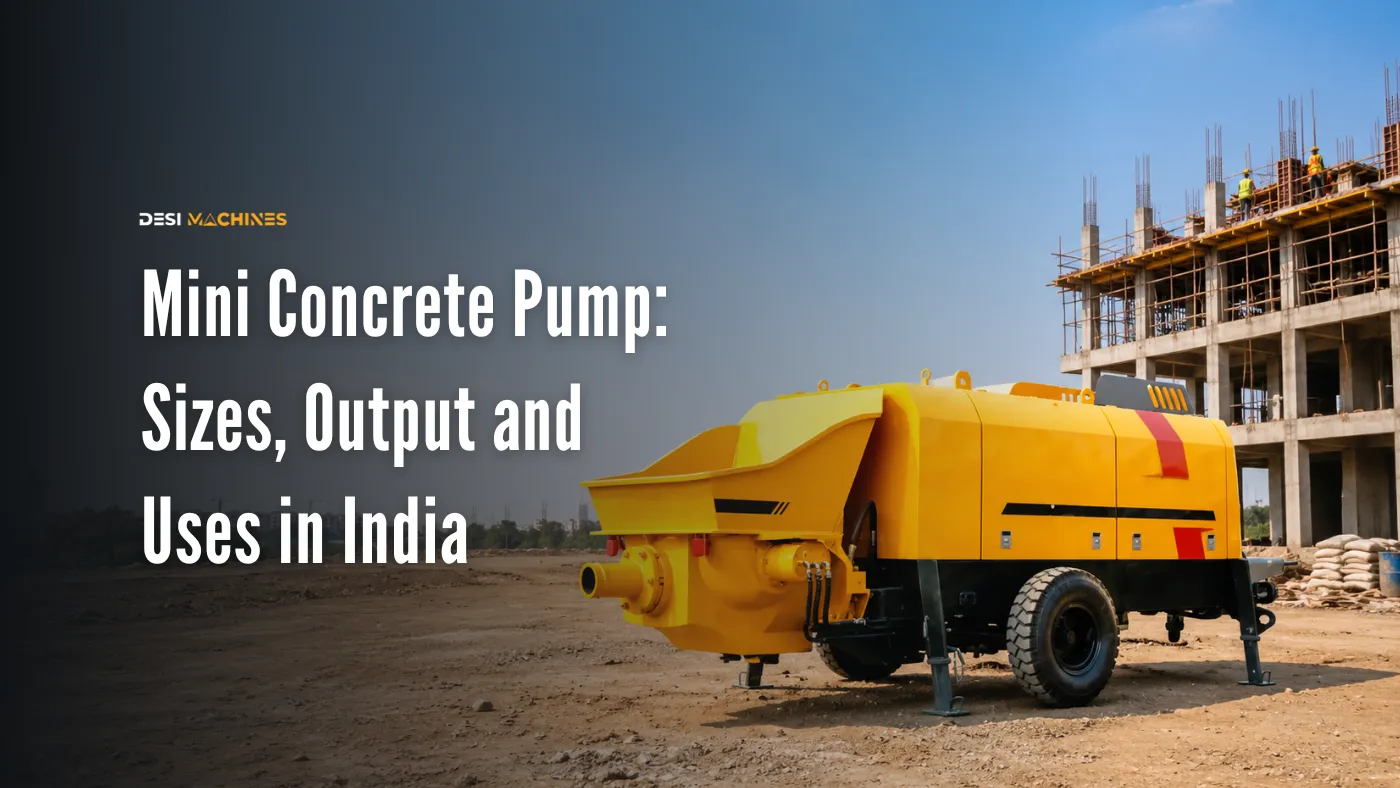
A mini concrete pump is a line pump, which means the concrete leaves the machine through a pipeline laid along the ground and up the building, not through a folding arm. The trade also calls these stationary pumps or trailer pumps, because the pump sits in one place on its own trailer and only the pipeline moves.
The working parts are simple to picture. A transit mixer or a site mixer discharges into the hopper, which is the open steel tray at the back. Under the hopper sit two pumping cylinders. One draws concrete in while the other pushes it out, and a valve between them switches the flow so that the pipeline receives concrete continuously. On the machines listed in India that valve is usually an S-shaped tube, which is why fitters call it the S-valve.
There is no official size class called “mini”. It is a market word, the same way chhota pump is a market word, and it settles on the smallest pumps a manufacturer sells. In India that means machines from 27 m³/hr upward, against 116 m³/hr for the largest stationary pump on sale. A mini pump is therefore about a quarter of the biggest machine in output, but it costs about a fifth as much and needs nothing more than a tractor or a small truck to move it.
How much concrete does a mini concrete pump deliver in an hour?
The smallest pumps sold in India are rated between 27 and 40 m³/hr. The Schwing Stetter BP 250 HDE is rated at 27 m³/hr, the Aquarius 703 D and the AJAX ASP 3009 at 30 m³/hr each, and the AJAX ASP 4011 at 40 m³/hr.
Read that number as a ceiling, not a promise. It is the maximum theoretical output, the volume the pump would move if every stroke filled completely and the machine never stopped. Real sites stop. The pump waits for the next mixer, the pipeline gets washed out at the end of a pour, and someone has to move a bend.
Simple arithmetic makes the point. A typical transit mixer on Indian roads carries 6 m³ of concrete. A 30 m³/hr pump would empty that load in about 12 minutes at full rate. Unless a loaded mixer reaches your gate every 12 minutes, the pump is not the thing setting your pour rate, the concrete supply is.
The hopper capacity is what smooths out the gap between the two. Hoppers on these machines hold 400 to 600 litres, so a full hopper is roughly a tenth of a mixer load. It gives the operator about a minute of buffer at full output while a mixer backs up.
Mini concrete pump sizes and specifications in India
The table lists the smallest stationary pumps currently on the Indian market, in order of rated output. Output is the maximum theoretical figure, pressure is the maximum concrete pressure the machine can develop, and the price band is the listed ex-factory band for the standard build.
Table: small and mini concrete pumps in India, by rated output — as per current September 2026 specifications
| Model | Output (m³/hr) | Max concrete pressure | Engine / drive | Hopper | Weight | Price band (indicative) |
|---|---|---|---|---|---|---|
| Schwing Stetter BP 250 HDE | 27 | 87 bar | 60.3 HP (45 kW) electric | 600 L | 2,800 kg | ₹11–14 Lakh |
| Aquarius 703 D | 30 | 65 bar | 46 HP (34.6 kW) diesel | 500 L | Not specified | Price on request |
| AJAX ASP 3009 | 30 | 57 bar | 66 HP (49.2 kW) diesel | 450 L | 3,000 kg | ₹12–15 Lakh |
| Schwing Stetter BP 250 HDD | 32 | 87 bar | 65.7 HP (49 kW) diesel | 600 L | 3,000 kg | ₹12–16 Lakh |
| Venus 1030E | 33 | 57 bar | 60 HP (45 kW) diesel | 500 L | Not specified | ₹12–15 Lakh |
| Aquarius 1003 E | 33 | 57 bar | 60 HP (45 kW) electric | 500 L | Not specified | Price on request |
| Aquarius 704 D | 35 | 80 bar | 46 HP (34.6 kW) diesel | 500 L | Not specified | Price on request |
| Schwing Stetter SP 1000 | 36 | 65 bar | 46.9 HP (35 kW) diesel | 400 L | 3,560 kg | ₹15–19 Lakh |
| AJAX ASP 4011 | 40 (rod) / 30 (piston) | 75 bar (rod) / 108 bar (piston) | 66 HP (49.2 kW) diesel | 600 L | 4,000 kg | ₹16–20 Lakh |
Three of the machines above are shown as price on request. That is not an oversight: their maker does not publish a list price for them, and of the 66 stationary concrete pumps listed on DesiMachines, 15 carry no published price at all. Where you see price on request, ask for a quote rather than assuming the machine sits near its neighbour in the table — an unpublished price is not a hidden one, and two pumps with the same output can be quoted very differently.
Two habits help when you read a row. First, compare output and pressure together, because a machine that trades output for pressure is built for a different job. Second, look at the weight before the price, since a 4,000 kg machine needs a tractor or truck that can tow it and a gate it can pass through.
Looking for a machine rather than a specification? Compare live concrete pump models and prices and talk to a dealer about the variant that fits your pours.
What does a mini concrete pump cost in India?
The smallest pumps sold in India sit at ₹11–14 Lakh, and the 40 m³/hr machines reach ₹16–20 Lakh (indicative, as of September 2026). Move up to the 70 m³/hr class such as the AJAX ASP 7011 and the band becomes ₹24–30 Lakh, so the jump from a mini pump to a mid-size machine roughly doubles the money.
These bands are ex-factory prices. On-road cost adds transportation, RTO registration, TCS, warranty, insurance and FOC where applicable, and a non-standard configuration changes the figure again.
Budget for the pipeline separately. A pump is sold as a machine, and the delivery pipes, bends, clamps, gaskets and the reducer that steps the line down near the placing point are what actually get the concrete to the slab.
If the machine is going on finance, work out the monthly outgo before you commit, because a five-year loan on a ₹15 Lakh machine is a payment you make in slow months too. Most lenders offering construction equipment finance in India fund pumps of this size.
How far and how high can a mini concrete pump push concrete?
Distance and height come from concrete pressure, measured in bar, and the small machines listed above develop 57 to 87 bar. Pressure is the force the pump can apply to the concrete column standing in the pipeline. More pressure means it can hold up a taller column of concrete, or push through a longer horizontal run.
Manufacturers publish two figures on many pumps, one for the rod side and one for the piston side of the hydraulic cylinder. The AJAX ASP 4011 is a clear example at 40 m³/hr and 75 bar on the rod side, or 30 m³/hr and 108 bar on the piston side. The machine can be set for volume or for pressure, and it cannot give the maximum of both at once. A high-rise column needs the pressure setting, a ground-floor raft needs the volume setting. That same rod-and-piston split runs across the whole range, and output and pressure move independently of each other — a 36 m³/hr pump can out-push a 95 m³/hr one, as the figures for concrete pump output and pressure across all 66 stationary pumps show.
Bar cannot be turned into metres from a catalogue. The reach a pipeline actually delivers depends on the pipe diameter, the number of bends, the vertical rise, the slump of the mix and how coarse the aggregate is. Every bend costs pressure. Give your dealer the real layout, the height, the run along the ground and the number of turns, and ask them to confirm the pump handles it before you sign.
The mix matters as much as the machine. Concrete for pumping needs the right slump and a well-graded sand, and a harsh mix will block a pipeline whatever pump you own. Tell your ready-mix supplier the concrete is being pumped, and tell them the pipe diameter.
Mini concrete pump or boom pump: which one does your job need?
Choose the mini pump when the concrete has to travel a long way at low level, and the boom pump when it has to be placed accurately at height. A concrete pump truck with a folding boom carries its own placing arm, so it can park on the road and drop concrete straight into a column cage without a metre of pipeline being laid by hand.
That convenience has a price and a footprint. A boom pump truck is a registered vehicle costing many times a mini pump, it needs standing room with its outriggers extended, and it needs a road wide enough to reach the site at all. In a lane where a truck cannot turn, the mini pump wins by default.
The daily reality on small sites is that the pipeline is manual work. Someone lays it, clamps it, and washes it out after every pour.
All three families, boom, line and stationary, are set side by side in the guide to concrete pump types in India.
If you are not sure a pump is the answer at all, check which concrete machine suits your job.
Weighing a mini pump against a full-size machine? The engine power figures across all 66 listed pumps show what the bigger engines actually buy, and it is not always more concrete per hour.
Which jobs suit a mini concrete pump in India?
Mini pumps earn their keep where the concrete volume per pour is moderate but access is bad. That describes a great deal of Indian construction.
Individual houses and small apartment blocks are the core work. A G+3 building in a town lane has slabs of a size a 30 m³/hr pump handles comfortably, and the lane itself rules out a pump truck. The same machine handles columns, beams, staircases and the floor slab on the same job, with the pipeline moved between pours.
Basement rafts and water tanks suit these pumps because the concrete has to be placed continuously and a bucket hoist cannot keep up. Canal lining, culverts and small bridge work on rural roads use them for the same reason, with the trailer parked on the bank and the line run to the placing point.
Repair and strengthening work is the third category. Where a slab is being recast in a working factory or a floor is being topped inside a shed, an electric pump such as the Aquarius 1003 E keeps exhaust fumes out of an enclosed space.
If your pours are big and regular instead, the honest answer is that you have outgrown this class. Compare the Schwing Stetter concrete pump range and the AJAX Engg concrete pump range before you settle on a size.
Diesel or electric: which mini concrete pump should you buy?
Diesel machines are self-contained and electric machines are cheaper to run, so the decision is usually made by the site rather than by preference. Most of the small pumps listed in India are diesel, and the electric versions are the same pump with a motor in place of the engine.
An electric pump in this class draws around 45 kW. That is a serious connection, well beyond a domestic supply, so it works where a plant already has three-phase power or where a generator of that size is on site anyway. Where it fits, the running cost is lower, the noise is much lower and there is no exhaust, which matters inside sheds, basements and city sites with restrictions on noise.
A diesel pump goes anywhere. On a village road, a canal bank or a plot with no supply yet, that independence is worth more than the fuel saving. Note that engine sizes in this class are modest, from 46 HP (34.6 kW) on the Aquarius 703 D to 66 HP (49.2 kW) on the AJAX machines, so fuel burn is nothing like a pump truck’s.
What to check before you buy a mini concrete pump
Start with the pour you actually do most often, not the biggest one you can imagine. The size of a routine slab and the height it goes to decide the machine.
Then work through the machine itself:
- Hopper size. A 600 L hopper keeps the pump fed longer than a 400 L hopper when mixers arrive unevenly.
- Weight and dimensions. The AJAX ASP 3009 measures 4,500 mm long, 1,850 mm wide and 1,960 mm high at 3,000 kg. Check that against your gate, your lane and whatever tows it.
- Strokes per minute. These machines run 21 to 24 strokes a minute. Fewer, longer strokes generally mean less wear per cubic metre moved.
- Wear parts and their price. The wear plate, the wear ring, the rubber pistons and the S-valve are consumables on any piston pump. Ask what they cost and how quickly the dealer supplies them, because a pump waiting for a wear plate is a stopped site.
- Pipeline included or extra. Confirm the length of pipe, the bends and the clamps in writing.
- Service reach. A dealer four hours away is a different machine from the same pump with a dealer in your district.
Hydraulic health decides how long the pump lasts, and it is the one system an owner can protect through habit. Hydraulic system maintenance covers oil condition, filters and the warning signs worth acting on, and the spare parts guide sorts parts into wear parts, service parts, major assemblies and electricals.
Mini concrete pump, in short
A mini concrete pump is the smallest line pump a manufacturer sells, rated at 27 to 40 m³/hr, weighing under about 4,000 kg and listed from ₹11–14 Lakh (indicative, as of September 2026). It moves concrete through a pipeline rather than a boom, which is exactly what a site with narrow access needs.
Match the rated output to how fast concrete can reach you, not to the biggest number in the brochure. Read pressure and output as a pair. Budget for the pipeline and the wear parts along with the machine. And when a pour has to be placed accurately at height, price a boom pump before you assume a line pump will do.
Concrete arrives before it can be pumped, so the mixer side of the job deserves the same thought. If you are still deciding how the concrete gets to site, the comparison of a self-loading mixer against a transit mixer and the guide to how transit mixers work in India are the places to start, and the wider concrete equipment guide maps the whole chain from batching to placing.
Ready to shortlist? Compare live concrete pump models and prices in India and send an enquiry to a dealer near you.
If a line does block, the causes, the safe order for clearing it and the mix and pipe rules that prevent it are set out in concrete pump blockage: why lines choke and how to clear them.
Prices, specifications and features are indicative, vary by variant, location and date, and should always be confirmed with the official OEM or authorised dealer before any purchase decision. DesiMachines is not liable for decisions taken on the basis of information that may have changed after publication.
Machines, tenders and news for this industry: Ready-Mix Concrete