
 Excavator
294 models
Excavator
294 models  Backhoe Loader
51 models
Backhoe Loader
51 models  Crane
68 models
Crane
68 models  Concrete Mixer
79 models
Concrete Mixer
79 models  Wheel Loader
54 models
Wheel Loader
54 models  Compactor / Roller
45 models
Compactor / Roller
45 models  Motor Grader
42 models
Motor Grader
42 models  Concrete Pump
66 models
Concrete Pump
66 models  Skid Steer Loader
11 models
Skid Steer Loader
11 models  Telehandler
13 models
Telehandler
13 models  Dozer
Dozer 


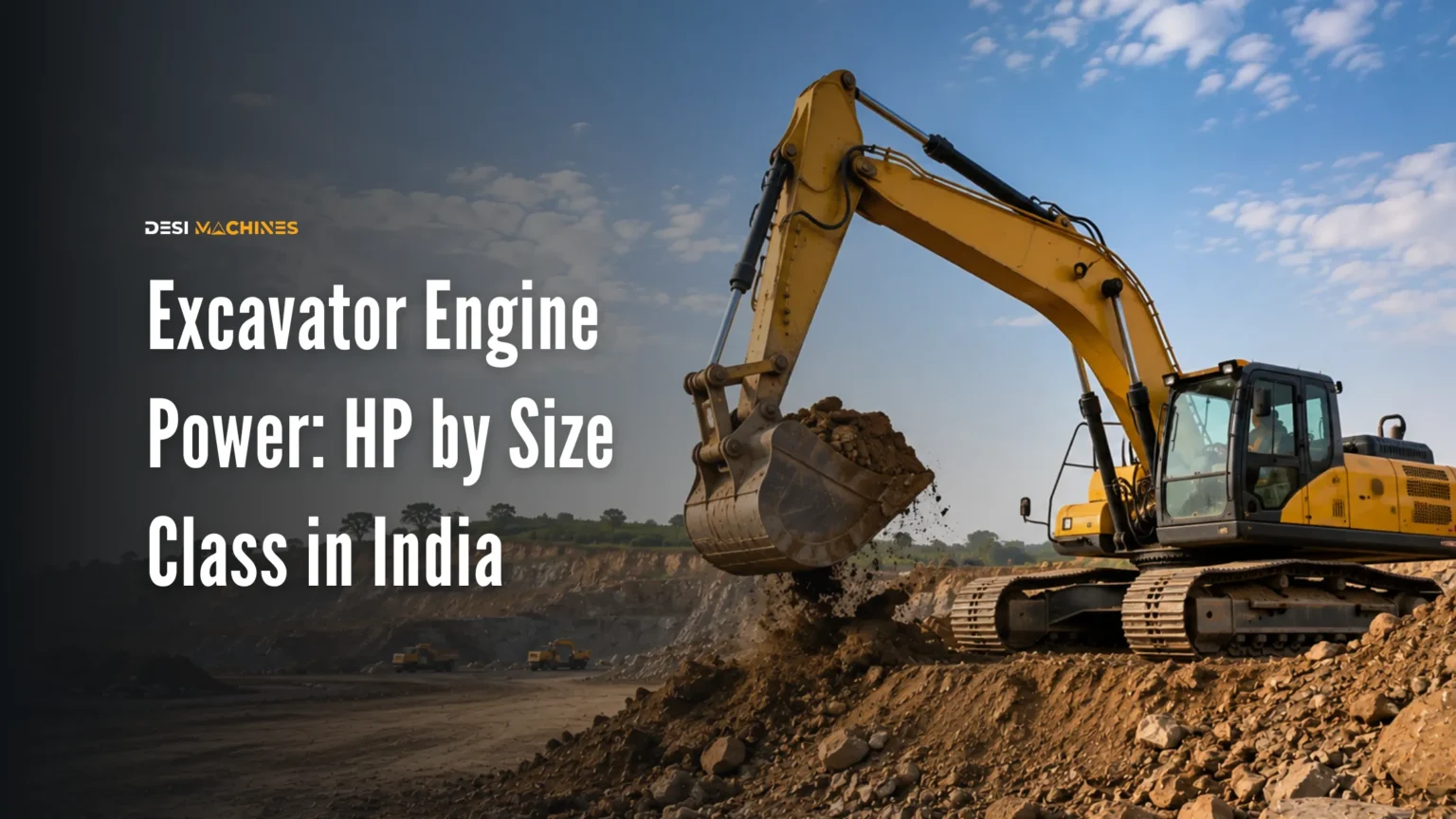
Excavator engine power is the rated output of the machine’s diesel engine, written in horsepower (HP) and usually in kilowatts (kW) beside it. Across the excavators sold in India today it runs from about 13 HP (10 kW) on the smallest mini machine to 2,000 HP (1,491 kW) on the largest mining excavator, and for the 20 tonne machines most contractors actually buy it sits around 140 to 160 HP.
Engine power is one of the three numbers a buyer is given, alongside operating weight and digging depth, and it is the one most often misread. A bigger HP figure does not mean the machine digs harder. It means the engine can supply more energy to the hydraulic pumps, which is a different thing, and understanding that difference will save you from paying for power your work does not use.
This guide sets out the real power range for each excavator size class, what the engine actually drives, and how to decide which figure matters for your site.
What does HP mean on an excavator?
HP, or horsepower, is a measure of how much work the engine can do in a given time. Kilowatts measure the same thing in metric units, so a spec sheet showing “148 HP (110 kW)” is giving you one number twice. To convert roughly, multiply kW by 1.34 to get HP.
On an excavator the engine does not turn wheels or a gearbox in the way a tractor engine does. It turns hydraulic pumps. Those pumps push oil at high pressure to the cylinders that move the boom, the arm and the bucket, and to the motors that swing the machine and drive the tracks. So the engine is a power source, and the hydraulic system is what converts that power into digging force.
The figure you see quoted is normally rated engine power at a stated engine speed, for example “148 HP (110 kW) @ 2,000 rpm”. Take the whole line, not the number alone. Two machines quoting the same HP at different engine speeds are not the same machine, and a few manufacturers quote net power (after the fan and alternator take their share) while others quote gross power. The way the parts fit together is covered in the guide to excavator components.
How much HP does an excavator have?
It depends almost entirely on size class. The table below is built from the rated engine power and operating weight published for 294 excavators, grouped into the same size classes used across these guides.
| Size class | Operating weight | Engine power range | Typical figure | Machines counted |
|---|---|---|---|---|
| Mini | Up to 6 tonne (6,000 kg) | 13–49 HP (10–37 kW) | About 27 HP | 50 |
| Small | 6–15 tonne (6,000–15,000 kg) | 47–160 HP (35–119 kW) | About 99 HP | 48 |
| Medium | 15–25 tonne (15,000–25,000 kg) | 114–201 HP (85–150 kW) | About 148 HP | 85 |
| Large | 25–50 tonne (25,000–50,000 kg) | 148–416 HP (110–310 kW) | About 260 HP | 54 |
| Mining | Above 50 tonne (50,000 kg and up) | 320–2,000 HP (239–1,491 kW) | About 536 HP | 57 |
Rated engine power and operating weight as listed, Aug 2026. The “typical figure” is the middle value in each class, which is more useful than an average because a handful of very large machines pull an average upwards.
Two things in that table are worth pausing on. The classes overlap: the small class reaches 160 HP and the medium class starts at 114 HP, so a heavy small machine can carry more power than a light medium one. And the jump from medium to mining is not gradual. Mining excavators are a different kind of machine, built for a loading face rather than a construction site.
Where each class sits by weight, and what each one is meant for, is set out in the guide to excavator size classes in India. The weight side of the same question is covered in excavator and backhoe weight by class.
What HP is a mini excavator?
A mini excavator runs between about 13 and 49 HP (10–37 kW), with most of them near 27 HP. The smallest machine in the class weighs around 1,800 kg and produces about 13 HP, which is close to what a small tractor makes.
That is enough power for the work these machines are bought for: a cable or pipe trench, a plot foundation, farm and orchard work, a drain line down a lane too narrow for anything bigger, breaking up a floor inside a compound wall. A mini machine gets its usefulness from being small, not from being strong, and its ability to work where a 20 tonne machine cannot reach is the whole point of it.
Note where the class ends. At around 49 HP the mini class runs into the small class, and machines just above it jump to 60 HP and beyond. If your work regularly needs the reach of a bigger machine, an underpowered mini will cost you in hours what it saved you in hire. What a mini can actually reach is set out in how deep a mini excavator can dig, and the class as a whole in the mini excavator guide.
How many HP is a 20 ton excavator?
A 20 tonne (20,000 kg) excavator carries roughly 140 to 160 HP (104–119 kW). This is the workhorse size on Indian sites, and it is where the largest number of machines sits: 85 of the 294 machines counted fall in the 15 to 25 tonne band.
Within that band the spread is wider than people expect, from 114 HP at the bottom to 201 HP at the top. A low figure is not always a weaker machine in the way it sounds. Some manufacturers sell a deliberately lower-powered, lower-cost version of a popular 20 tonne model for buyers who want fuel economy and a simpler machine rather than the fastest cycle times. One 19,800 kg machine in this class is rated at 114 HP for exactly that reason.
So compare a 20 tonne machine on cycle time and hydraulic flow, not on the HP figure alone. Which models are available in this class, and how they compare, is covered in the guide to the best 20 ton excavator in India.
Does more HP mean more digging power?
No, and this is the most expensive misunderstanding in the whole subject. Digging force comes from the hydraulic system: the pressure the pumps generate and the size of the cylinders that pressure acts on. Breakout force, the number that describes how hard the bucket can prise material loose, is measured in kilonewtons and comes from hydraulics, not from horsepower.
What the engine gives you is the ability to sustain that force and to do several things at once. A well-powered machine can swing, boom up and curl the bucket together without any of the three slowing down. An underpowered machine has to share, so movements that should overlap end up happening one after another. You feel it as a slow, hesitant machine rather than a weak one.
That is why engine power shows up in your costs as cycle time rather than as digging capability. Over a shift, a machine that completes a dig-swing-dump-return cycle two seconds faster moves noticeably more earth. The arithmetic that turns cycle time into cubic metres per hour is worked through in the guide to excavator productivity and output per hour.
What engine is inside an excavator?
A diesel engine, almost always turbocharged and water-cooled, and usually built by a specialist engine maker rather than by the excavator manufacturer. Among the excavators sold here with a published engine model, Cummins is by far the most common, followed by Isuzu, Yanmar, Komatsu, Kubota, Liebherr and Volvo.
| Engine make | Machines | Usually found on |
|---|---|---|
| Cummins | 75 | Small to large machines across many brands |
| Isuzu | 33 | Medium and large machines |
| Yanmar | 26 | Mini and small machines |
| Komatsu | 19 | Komatsu’s own range |
| Kubota | 16 | Mini machines |
| Liebherr | 15 | Large and mining machines |
| Volvo | 13 | Volvo’s own range |
Engine makes as listed, Aug 2026, counted across 264 machines that publish an engine model.
The Cummins figure matters more than it looks. Cummins builds engines in India, so parts and service for those machines are easier to arrange in a district town than for an imported engine. When you are comparing two machines of the same size, ask who makes the engine and where the nearest place is that can open it. That question decides your downtime for the next ten years.
On cylinder count, the pattern is straightforward: mini machines mostly run 2 or 3 cylinder engines, small and medium machines run 4, and large and mining machines run 6. Of the machines that state it, 92 are 6 cylinder, 34 are 4 cylinder, 24 are 3 cylinder and 6 are 2 cylinder. More cylinders generally means smoother running and more power, and also a dearer service.
Does a higher HP excavator burn more diesel?
Usually yes, but the link is looser than you would think, because an excavator engine rarely runs at full rated power. It runs at whatever the hydraulics are demanding at that moment, and for a good part of any shift that is idling while a tipper is changed.
So fuel burn follows how hard the machine is worked, and how much of the day it spends idling, more closely than it follows the number on the spec sheet. A 20 tonne machine doing steady trenching can easily burn less diesel in a day than a well-used 14 tonne machine loading continuously. Modern machines also have an auto-idle setting that drops engine speed when the joysticks are still, and using it is one of the few genuinely free savings available on a site.
What the engine power figure does tell you reliably is the size of the fuel tank you will be filling, and how often. Tank capacities by class are listed in the guide to fuel tank capacity of excavators and backhoe loaders.
An engine asked for more than its size allows will say so at the exhaust. If a machine smokes under load, read why an excavator gives black smoke before assuming the answer is more horsepower.
Which HP should you buy?
Start from the work, not from the engine. Pick the size class your job needs, then treat engine power as a way of comparing machines within that class rather than across classes.
- Match the class to the site first. Access, the material you are digging and the depth you need decide the class. Engine power cannot rescue a machine that is the wrong size.
- Inside a class, more power buys speed. If your machine will be loading tippers all day and the site is paid by volume, faster cycles pay for the extra fuel. If it does mixed work with long gaps, they do not.
- Check the engine make and its service reach before the HP figure. An engine nobody nearby can repair is a bad bargain at any rating.
- Be careful with wheeled machines. A wheeled excavator carries more power for its weight than a tracked one, because it also has to drive itself on the road. One 13,500 kg wheeled machine is rated at 160 HP, well above tracked machines of the same weight. The differences are set out in wheeled excavator versus crawler excavator.
Compare live excavator models and specifications and speak to a dealer about the variant that suits your work.
Engine power by size: the short version
Excavator engine power runs from about 13 HP on a 1.8 tonne mini machine to 2,000 HP on the largest mining excavators. A mini machine sits around 27 HP, a small machine around 99 HP, a 20 tonne machine around 148 HP, and a large machine around 260 HP. The engine drives the hydraulic pumps rather than the bucket, so more horsepower buys you faster and smoother cycles, not more digging force. Choose the size class from the job, compare power only within that class, and ask who makes the engine before you ask how big it is.
If you are still deciding which machine to buy, start with the types of excavators and the crawler excavator guide, or read the complete guide to excavators from the start.
Engine power is one of the least useful figures for separating two machines of the same class. Why that is, and what to read instead, is covered in how to read excavator specifications.
Power ratings are one half of the engine picture; the supplier is the other. Construction equipment engine brands in India covers who makes the engines fitted across each machine type.
Specifications on this page are taken from our listings at the time of writing. Prices, specifications and features are indicative, vary by variant, location and date, and should always be confirmed with the official OEM or authorised dealer before any purchase decision. DesiMachines is not liable for decisions taken on the basis of information that may have changed after publication.