
 Excavator
294 models
Excavator
294 models  Backhoe Loader
51 models
Backhoe Loader
51 models  Crane
68 models
Crane
68 models  Concrete Mixer
79 models
Concrete Mixer
79 models  Wheel Loader
54 models
Wheel Loader
54 models  Compactor / Roller
45 models
Compactor / Roller
45 models  Motor Grader
42 models
Motor Grader
42 models  Dozer
41 models
Dozer
41 models  Concrete Pump
66 models
Concrete Pump
66 models  Skid Steer Loader
11 models
Skid Steer Loader
11 models  Telehandler
13 models
Telehandler
13 models 


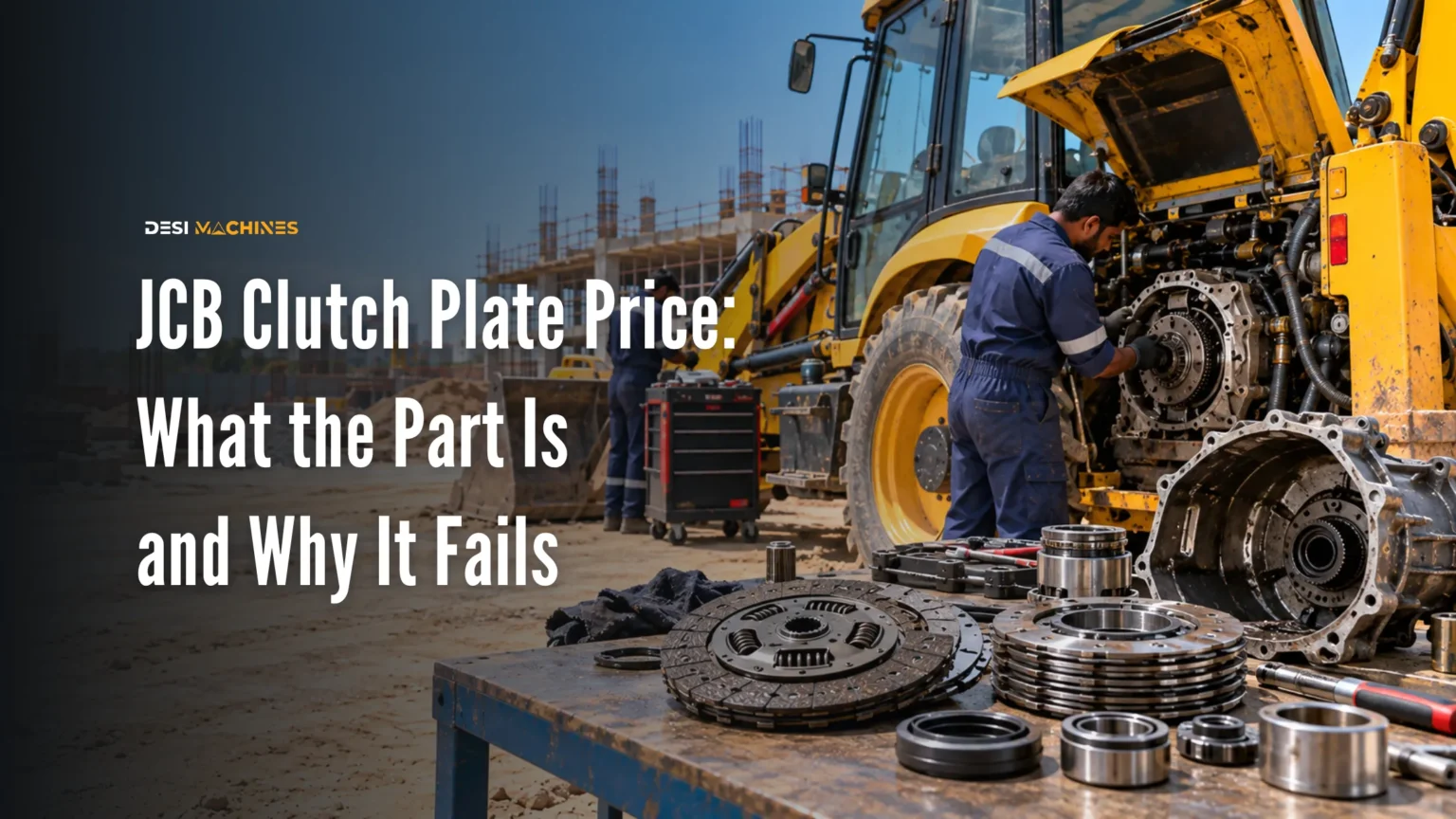
A backhoe loader that revs cleanly but will not pull in forward, or will not pull in reverse, or has gone soft in both, is usually asking for the part Indian fitters call a JCB clutch plate. That part is not the dry plate a tractor has. It is a stack of oil-bathed friction plates and steel plates inside the gearbox, squeezed together by oil pressure to send the drive forward or back, and what the job costs depends on which of the two stacks has gone and whether the gearbox has to come out of the machine.
Ask for a clutch plate price and a seller will quote you plates. Ask the machine, and you find it has no clutch in the tractor sense at all. This page covers what the part actually is, where it sits, what is in a kit, why these plates fail on Indian sites, how a workshop proves the diagnosis before you pay, and what moves the bill up or down.
Does a JCB backhoe loader have a clutch plate?
Not the kind you can see, adjust or burn out with your left foot. A backhoe loader has no clutch pedal and no dry clutch plate between the engine and the gearbox. It has two sets of plates, sealed inside the gearbox and running in oil, and they do the job that a tractor’s single dry plate does.
Our own listings say the same thing by saying nothing. Of the 51 backhoe loaders listed on DesiMachines, 42 publish a full technical specification sheet, and not one of those 42 lists a clutch of any kind. They list the gearbox, the gears, the torque converter and the shuttle. The plates are inside those units, so they never appear as a line item.
A torque converter is the reason there is no dry plate to begin with. It joins the engine to the gearbox through oil flung between two sets of vanes instead of through two surfaces pressed together. Nothing rubs, so nothing wears the way a lining wears. That is what lets an operator drive the front bucket into a packed heap, bring the wheels to a dead stop, and keep the engine running. The backhoe loader transmission guide sets out which transmission each brand fits and what the names on the spec sheet mean.
So when someone says your JCB needs a clutch plate, they mean one of the two oil-pressed stacks inside the gearbox. That is a gearbox job, and it is worth knowing what is in there before you agree to it.
Where do the clutch plates sit, and what presses them together?
They sit in the reverser unit, which is the front section of the gearbox, between the torque converter and the gears. JCB’s own service manual for the Syncro Shuttle gearbox describes it plainly: a torque converter, a hydraulic reverser unit and a four-speed manual gearbox in one housing, with the reverser carrying a pair of hydraulically operated clutches that give forward, neutral and reverse.
Here is the chain, because every link in it is a thing that can fail.
An oil pump turns at engine speed, driven off the lugs of the torque converter. Its oil goes through a strainer and a filter to a pressure maintenance valve, which holds the pressure steady. From there the oil reaches a solenoid valve. A solenoid is an electric coil that moves a small spool when current flows through it. When the operator moves the shuttle lever on the steering column to forward, one solenoid is energised and oil is sent to the forward clutch. Move the lever to reverse and the other solenoid sends oil to the reverse clutch, while the oil in the first one drains back to the sump. In neutral, and when the dump pedal is pressed, the oil is blocked at the valve and neither stack is holding anything.
How oil reaches the forward and reverse clutch packs
Pumpengine speed
Strainerand filter
Maintenancevalve (pressure)
Solenoidvalve
Forward clutch pack
Reverse clutch pack
Torqueconverter
Oil coolercooled by engine coolant
Centre of reverser shaftlubrication feed
Solid blue: pressure that engages a pack. Purple: oil that cools and lubricates both packs.
Only one pack is pressurised at a time. In neutral, neither is.
Two details in that chain explain most of the failures we see. The oil that cools the gearbox goes out to a liquid-to-liquid cooler, part of the cooling pack at the back of the machine, which uses the engine coolant to carry the heat away. It comes back through the centre of the reverser shaft, and that return is what lubricates the plates. And a small restrictor in the feed to the solenoid valve softens the pressure as a pack takes up, which is why a healthy shuttle change feels like a push rather than a bang.
What is in a clutch plate kit, and why is it sold as a set?
Because one plate on its own does nothing. A wet clutch pack is a sandwich: friction plates, which carry a lining and are splined to one shaft, alternating with plain steel plates, which are splined to the drum turning at the other speed. A piston behind the stack takes the oil pressure and squeezes the whole sandwich together until both sides turn as one. Spread the load over six or eight thin plates instead of one thick one and you get a lot of grip in a small space, with oil carrying the heat away.
So a kit for one pack normally holds the set of friction plates, the matching steel plates and the seals for the piston that presses them. The counts differ by transmission unit, not by machine brand, and the only reliable source for yours is the parts list for the unit on your own machine.
| Part in the pack | What it does | Why it is renewed |
|---|---|---|
| Friction plate | Carries the lining that grips | Lining wears thin, glazes, or separates from the plate |
| Steel plate | The plain face the lining grips against | Reused only if flat; discarded if blued or buckled by heat |
| Piston seals | Hold the oil pressure behind the stack | Harden with age and heat, so pressure leaks past |
| Transmission oil and filter | Cools, lubricates and carries the pressure | Always, after any gearbox is opened |
There are two packs in the unit, one for forward and one for reverse, and they do not wear equally. A machine that spends its life loading tippers works the forward pack harder. A workshop that has the gearbox open will usually quote both, and on a machine with hours behind it that is the cheaper decision, because the labour is the same either way.
The oil is part of the job, not an extra. Across the 42 listed machines that publish a specification sheet, 41 give a transmission oil capacity, and it runs from 14 litres on the CAT 424 to 20 litres on the Tata Hitachi Shinrai Pro, with the JCB 3DX family at 17.5 litres. Grades and quantities by make are set out in the guide to backhoe loader transmission oil, and the full set of fluid quantities in the backhoe loader oil and fluid capacities guide.
Why do JCB clutch plates fail in India?
Water in the oil is the failure that JCB’s own manual names first, and it is the one our conditions produce most. The manual’s fault table for the transmission cooling system lists friction lining separating from the clutch plate as a symptom, gives water ingress as the probable cause, and sets the maximum water content in the oil at 0.10 per cent. The remedy it prescribes is not a patch: renew the friction plates, flush the system, refill with the correct fluid. The same table lists a seized clutch piston from the same cause, because the piston material swells when it has taken on water and then gets hot.
Water arrives by three routes, and all three are ordinary.
- Working in water. Trenching in a monsoon cut, canal work, a flooded basement. Water climbs in past a tired seal or the gearbox breather.
- The cooler. The gearbox oil is cooled by engine coolant through a shared cooler. If that cooler fails internally, coolant crosses into the transmission oil. Coolant condition is covered in the guide to coolant for construction machines, and the pack it sits in is in the radiator and cooling pack guide.
- Top-up habits. An open drum in a dusty yard, a funnel that lives in the rain, oil poured from a can that held something else last week.
Heat is the second cause and it rarely acts alone. A pack that slips makes heat, heat thins the oil, thin oil lets the pack slip more. The oil is the only thing carrying that heat out, which is why a gearbox run low, or run on oil two years past its change, fails at the plates and not at the gears.
Then there are habits. Changing direction before the machine has actually stopped makes the incoming pack absorb the whole swing in momentum. Holding the dump pedal down to keep a loaded machine still on a slope, instead of using the brakes, leaves a pack slipping under load for as long as the foot stays there. Neither will kill a gearbox in a week. Both show up at a thousand hours.
Nobody can give you a plate life in hours, because the same machine in a quarry and on a municipal water line will not be close. The narrower answer is more useful anyway: the plates last as long as the oil that cools them, so the service interval in the backhoe loader maintenance schedule is the number that actually governs them.
How does a workshop prove it is the clutch plates before you pay?
With a pressure gauge and a stall test, in under an hour, before anything is opened. Insist on this. A gearbox that comes out and goes back in is one of the larger bills on a backhoe loader, and the symptoms that point at plates are also produced by a blocked strainer, a stuck maintenance valve, a dead solenoid, a damaged sealing ring and a loom fault, all of which are cheaper.
The sequence a competent workshop follows, in order of cost:
- Look at the oil first. Level cold, not hot. Milky or creamy oil is water, and water is the finding, not the plates. Dark oil that smells burnt is heat. Both change what happens next.
- Read the pressures. JCB’s service manual publishes the figures to compare against. For the SS600 Syncro Shuttle unit it gives a clutch pressure of 8.3 to 9.0 bar (120 to 130 lbf/in²) at 50 °C and 1,000 rev/min, rising to 9.0 to 10.0 bar (130 to 145 lbf/in²) at 2,000 rev/min, and a main line pressure in neutral of 9.3 to 11.7 bar depending on speed and temperature. Low pressure across both directions points at the pump, the strainer or the maintenance valve. Correct pressure at a pack that still slips points at the plates.
- Stall the converter. With the brakes hard on and a direction selected, the engine should not fall below the figure in the manual, which for this unit is 1,650 to 1,750 rev/min. A reading well under it means the drive is being held somewhere it should not be. A reading well over it means a pack is slipping instead of holding.
- Separate the two directions. Drive lost in one direction only is almost always that one pack or its feed. Drive lost in both is more often pressure, pump or converter. The manual’s own fault chart splits on exactly this question.
- Check the cheap electrics. A fault that appears only when the machine is hot points at the solenoid. A fault that comes and goes points at the switch, the relay or the loom. Our guide to backhoe loader warning lights covers what the dash tells you first.
Correct pressure at a pack that still slips means the plates, and the gearbox has to come out. Anything else and you have saved yourself a strip. Ask for the gauge readings in writing either way.
On a machine you are thinking of buying, the shuttle test in the transmission guide covers what to do from the seat before any gauge comes out, and current backhoe loader models and prices show what a sound machine costs before you commit to a gearbox repair on a tired one.
What decides the price of a clutch plate job?
Six things, and the plates themselves are rarely the biggest of them. Two quotes on this job are rarely quoting the same work, so check both against the same six before you compare the numbers.
- Which transmission unit your machine has. Not the machine model. The same brand across production years fits more than one unit, and the plate stack differs between them.
- One pack or both. Forward and reverse are separate stacks. Doing one when the other is close behind means paying the labour twice.
- How far the strip goes. Plates and seals only, or plates plus the piston, the drum, the sealing rings and the bearings the strip exposes. A pack that ran hot takes more with it than a pack that wore out quietly.
- Labour, which is usually the largest line. The gearbox has to come out of the machine, be split, rebuilt and set up again. That is days, not hours, and it is the line that varies most between a city workshop and a small-town one.
- Oil, filter and flush. Between 14 and 20 litres of transmission oil on these machines, a filter, and a proper flush of the cooler circuit if water was the cause. Skipping the flush is how a new set of plates fails inside a season.
- Downtime. The machine earns nothing while the gearbox is on the bench, and on a rented-out machine that is the real figure. The backhoe loader parts guide maps what else tends to wear at the same age, which is worth knowing before you plan one shutdown or two.
One quote may be plates and oil, the next plates, piston, seals, bearings, oil, filter and a cooler flush. Get both in writing, itemised, with the transmission unit named.
How do you order the right clutch plates for your machine?
Four details settle it, and you can collect all four yourself before you make a single call.
- Machine model, variant and serial number. The JCB 3DX Super and a machine of the same name from several production years earlier are not guaranteed to take the same stack.
- The transmission unit’s own identification plate. The gearbox carries its own number, separate from the machine’s. Every service manual has a unit identification page for exactly this reason, and this number, not the machine name, is what a parts counter needs.
- Which pack. Forward, reverse or both. Say it, or you will be sent one and need two.
- What the oil looked like. If it was milky, the order is plates, seals, filter, oil and a cooler check, and saying so up front avoids a second visit.
Anything you cannot read off the machine, ask an authorised dealer to confirm in writing against your serial number before the parts are ordered. Fitment information on a page like this is a general guide by machine class. Always confirm the exact part against your own machine’s manual, or with the maker or an authorised dealer, before buying or fitting.
If the gearbox bill is one of several in the queue on an old machine, that is a different conversation from a repair. Owners usually settle it by putting the quote beside the current JCB backhoe loader range and the JCB 4DX if the class has been outgrown, then checking what the monthly outgo would look like through equipment finance. A repair is cash today; a newer machine is a fixed instalment and no gearbox risk for a few seasons.
A note on the figures in this guide
The counts of machines come from the specification sheets published on the backhoe loader listings on this site, read in October 2026: 51 machines listed, 42 with a full specification sheet, 41 of those publishing a transmission oil capacity, and none of the 42 listing a clutch.
The clutch pressures, the main line pressures, the converter stall speed, the 0.10 per cent water limit and the fault sequence are taken from JCB’s own Section F transmission service manual (publication 9803/5100), which covers the Syncro Shuttle gearbox and gives the SS600 unit’s figures in full. Those figures are for that unit. If your machine carries a different transmission, take the numbers from the manual for yours and not from this page.
Nothing here is a substitute for a pressure test on your own machine. The whole point of the sequence above is that two faults with the same symptom have very different bills, and a gauge settles which one you have for the price of an hour.
Prices, specifications and features are indicative, vary by variant, location and date, and should always be confirmed with the official OEM or authorised dealer before any purchase decision. DesiMachines is not liable for decisions taken on the basis of information that may have changed after publication.
Get a clutch plate price from a dealer near you
Tell us your machine and what you need, and we will ask the nearest dealer to reach out to you with a price.