Excavator
294 models
Excavator
294 models  Backhoe Loader
51 models
Backhoe Loader
51 models  Crane
68 models
Crane
68 models  Concrete Mixer
79 models
Concrete Mixer
79 models  Wheel Loader
54 models
Wheel Loader
54 models  Compactor / Roller
45 models
Compactor / Roller
45 models  Motor Grader
42 models
Motor Grader
42 models  Concrete Pump
66 models
Concrete Pump
66 models  Skid Steer Loader
11 models
Skid Steer Loader
11 models  Telehandler
13 models
Telehandler
13 models  Dozer
Dozer 


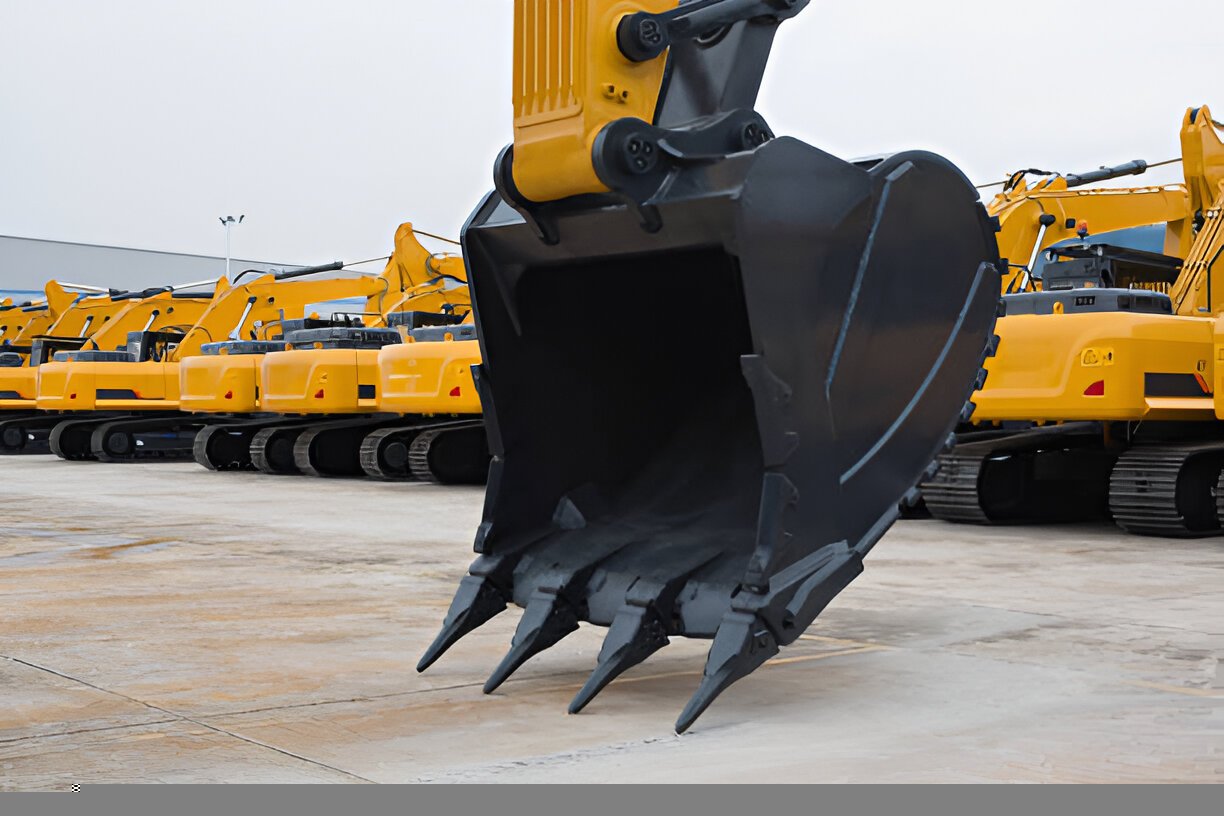
The short answer: the ten excavator bucket types that cover almost every Indian job site are the general-purpose, heavy-duty, rock, trenching, tilting, skeleton, V-ditching, mud, frost/ripper and clamshell bucket. Choose by the material you are moving and the shape of the cut, not by the machine badge: a general-purpose bucket handles ordinary soil, a rock bucket takes blasted stone, a trenching bucket cuts narrow utility runs, and a skeleton bucket sieves rubble out of spoil. Getting the excavator bucket matched to the material is what protects your cycle time, your fuel bill and the bucket’s own wear parts.
This blog explores 10 types of excavator buckets. From general-purpose to tilting and clamshell, designed to improve productivity and reduce wear in excavation machines. Whether you operate a JCB excavator, Tata Hitachi excavator, or CAT excavator, using the right excavator bucket enhances fuel efficiency and reduces costs. Ideal for hydraulic excavator users across mining, utility, and construction sectors in India.
Introduction
Have you ever wondered what makes an excavator so efficient? It’s the excavator attachment that doubles its value by increasing its efficiency and productivity. The attachments of an excavator decide how fast and how cheaply the machine works on excavation, mining and construction jobs. Among these attachments are buckets, which are very useful for an excavator. These excavator buckets are designed to handle various materials, from loose soil and sand to hard rock and heavy debris. The right type of excavator bucket choice significantly improves productivity, reduces wear and tear on the excavator, and minimizes fuel consumption, ultimately reducing operational costs and increasing uptime.
Specialized different types of excavator buckets are designed for different project types, which gives the best results. A general-purpose bucket enables day-to-day excavating, whereas heavy-duty and rock buckets are key for handling tough and abrasive materials. Trenching buckets, for example, allow precise digging in preparation for pipeline installations; tilting buckets improve grading. The proper bucket digs faster, costs less to run and keeps the machine off the workshop ramp.
In this blog, we will explore 10 types of excavator buckets, their unique features, and how they benefit specific construction and excavation tasks. Whether you are in road construction, landscaping, mining, or utility installation, knowing the types of these buckets available will help maximize your machine’s performance and efficiency.
Below are the types of excavator buckets, their uses, and their advantages
General Purpose Bucket
- Description: General-purpose buckets are sometimes referred to as “loading” buckets because they are used for the digging and loading of materials such as soil, sand, and gravel.
- Applications: General-purpose buckets find their major application in construction, landscaping, and roadworks for both digging and loading activities.
- Advantages: The bucket is versatile, offers durability, and comes in a host of sizes.
Heavy-Duty Bucket
- Description: Heavy-duty buckets are those that have been built to work with hard materials, for example, rocks, hard soil, and concrete. Generally, they are experts in any kind of digging job under various ground conditions.
- Applications: Generally used in sectors like mining, quarrying, and demolition of structures.
- Advantages: Heavy-duty buckets are built to withstand heavy wear and tough conditions. They are also designed to resist rough weather conditions.
Rock Bucket
- Description: Rock buckets have reinforced edges and wear-resistant steel to be used to break through extremely tough rock surfaces.
- Applications: Generally, rock buckets are used in quarrying, mining, and foundation excavation for breaking rocks or hard surfaces.
- Advantages: Its stronger construction means that it minimizes bucket wear when handling sharp, hard materials such as rock.
Trenching Bucket
- Description: Trenching buckets are narrow buckets mainly used for digging trenches. For excavating deep trenches with minimal soil displacement, a narrow bucket is suitable.
- Applications: Trenching buckets are used for trenching purposes in the installation of pipelines, drainage systems, and underground utility projects.
- Advantages: It allows for very accurate excavation with minimal backfilling requirements.
Tilting Bucket
- Description: A tilting bucket is hydraulically angled up to about 45 degrees either side of centre, so the operator can cut a slope without repositioning the machine.
- Applications: This type of bucket is mostly used in landscaping, roadwork, and slope grading.
- Advantages: Due to its flexible rotating feature, it is used for contouring and precision work.
Skeleton Bucket
- Description: A skeleton bucket is a bucket with small openings to separate fine particles from large debris.
- Applications: This type of bucket is used for waste segregation, cleaning up of demolition sites, and separation of rocks.
- Advantages: The skeleton bucket improves material handling efficiency by segregating fewer unwanted materials.
V-bucket (Ditching Bucket)
- Description: A V-shaped bucket is specially designed for digging V-shaped trenches.
- Applications: Mostly used to dig ditches in irrigation projects and road works.
- Advantages: It provides cleaner and more efficient trenching with less soil displacement.
Mud Bucket
- Description: This type of bucket has a wide, flat bottom and is used to scoop and move soft, wet materials.
- Applications: Used for dredging, canal and pond desilting, and monsoon site clearance, where the spoil is saturated and a standard bucket would clog
- Advantages: Prevents clogging when moving large amounts of wet material.
Frost Bucket (Ripper Bucket)
- Description: This type of heavy-duty bucket has reinforced teeth to break through frozen ground and hard soil.
- Applications: Widely used during winter excavations, roadwork in cold climates, and digging compacted ground.
- Advantages: Generally, it is equipped to work in harsh weather conditions and reduces strain on the excavator.
Clamshell Bucket
- Description: A clamshell bucket is a hinged bucket with two halves that open and close to provide precision material handling.
- Applications: Used for dredging, bulk material loading, and vertical excavation.
- Advantages: Superior material handling control for very loose or bulk materials.
Matching the bucket to the machine class
Bucket choice is limited by the carrier as much as by the material. A mini excavator in the 1–6 tonne class carries a narrow general-purpose or trenching bucket and will stall on a rock bucket sized for a 20-tonne machine, while a medium 20-tonne excavator has the breakout force to swing a heavy-duty or rock bucket all shift. Check the carrier’s rated bucket capacity before you buy an attachment: an oversized bucket lifts less, burns more diesel and loads the boom pins harder than the machine was designed for. If you are still choosing the carrier itself, our roundup of the best excavators in India and the full excavator price guide set out what each class costs. Buying a machine and its attachment package together is usually the cheaper route — see the equipment finance options before you split the purchase.
What bucket capacity each excavator class actually takes
Bucket type is only half the decision; the other half is capacity, and that is set by the carrier. The table below is read straight off the bucket-capacity figures published for the 246 excavator models listed on our catalogue as of September 2026, grouped by the weight class each machine sits in.
| Machine class | Operating weight | Bucket capacities listed | Models |
|---|---|---|---|
| Mini excavator | 0–6 t | 0.04 – 0.26 m³ | 44 |
| Small excavator | 6–15 t | 0.09 – 1.00 m³ | 42 |
| Medium excavator | 15–25 t | 0.17 – 1.85 m³ | 64 |
| Large excavator | 25–50 t | 0.50 – 3.80 m³ | 46 |
| Extra-large excavator | >50 t | 1.65 – 47.50 m³ | 50 |
Two things in that table are worth reading twice. The first is how wide each band is: these are not one bucket per machine but the range of buckets a class is rated to carry, which is the whole argument for choosing by material rather than by badge. The Liebherr R 922 Litronic, a single 22.5–25.6 tonne machine, is listed at 0.17 to 1.50 m³ — an eight-fold span on one carrier, from a narrow trenching bucket to a wide general-purpose one. The bucket, not the excavator, is what changes when the job changes.
The second is the extra-large row. Its ceiling of 47.50 m³ belongs to an 800-tonne mining shovel, not to anything that turns up on an ordinary Indian site; the median capacity in that class is closer to 6 m³. Treat the top of that band as mining plant and read the large-excavator row instead if you are quoting earthwork. For how capacity is rated and why a heaped figure differs from a struck one, see our excavator bucket capacity guide.
Capacity is a ceiling, not a target. An oversized bucket on an undersized carrier lifts less at reach, burns more diesel and loads the boom pins harder than the machine was built for, which is why the rated figure for your exact variant matters more than the class band. Confirm the rated bucket capacity and the coupler fitment for your machine with the dealer or OEM before you order an attachment.
Conclusion
Choosing the right type of excavator bucket will not only enhance the productivity, it will also affect the performance, cost, and safety of any construction or earthmoving operation. A bucket for excavator is designed specifically for various types of application, whether it is digging soft soil with a general-purpose bucket or getting through frozen ground with a frost bucket. By choosing a bucket appropriate to the material in question and the task involved, productivity can be vastly improved through a reduction in the time and energy taken to complete jobs.
In the end, proper bucket choice results in reduced wear and tear for the heavy construction equipment, enhanced fuel efficiency, and minimized chances of damage or wear and tear. For example, a rock bucket with reinforced edges will perform better in abrasive conditions and will not suffer premature damage, while a tilting bucket will ensure accuracy in grading and, therefore, reduce the need for rework. The various benefits will combine to decrease operating costs.
The right bucket will also ensure job site safety during operation. A bucket that is used for inappropriate materials and conditions is likely to generate mechanical problems, causing equipment failure or resulting in accidents on site. Hence, such factors as material type, the magnitude of the project, and the compatibility of the excavator must be contemplated by operators as well as project managers. A capital investment in specialized buckets and their use will not only lead to the optimum performance of the task but will also enhance the longevity of the machinery, embracing a smarter, safer, and more sustainable operation.