Excavator
294 models
Excavator
294 models  Backhoe Loader
51 models
Backhoe Loader
51 models  Crane
68 models
Crane
68 models  Concrete Mixer
79 models
Concrete Mixer
79 models  Wheel Loader
54 models
Wheel Loader
54 models  Compactor / Roller
45 models
Compactor / Roller
45 models  Motor Grader
42 models
Motor Grader
42 models  Dozer
41 models
Dozer
41 models  Concrete Pump
66 models
Concrete Pump
66 models  Skid Steer Loader
11 models
Skid Steer Loader
11 models  Telehandler
13 models
Telehandler
13 models 


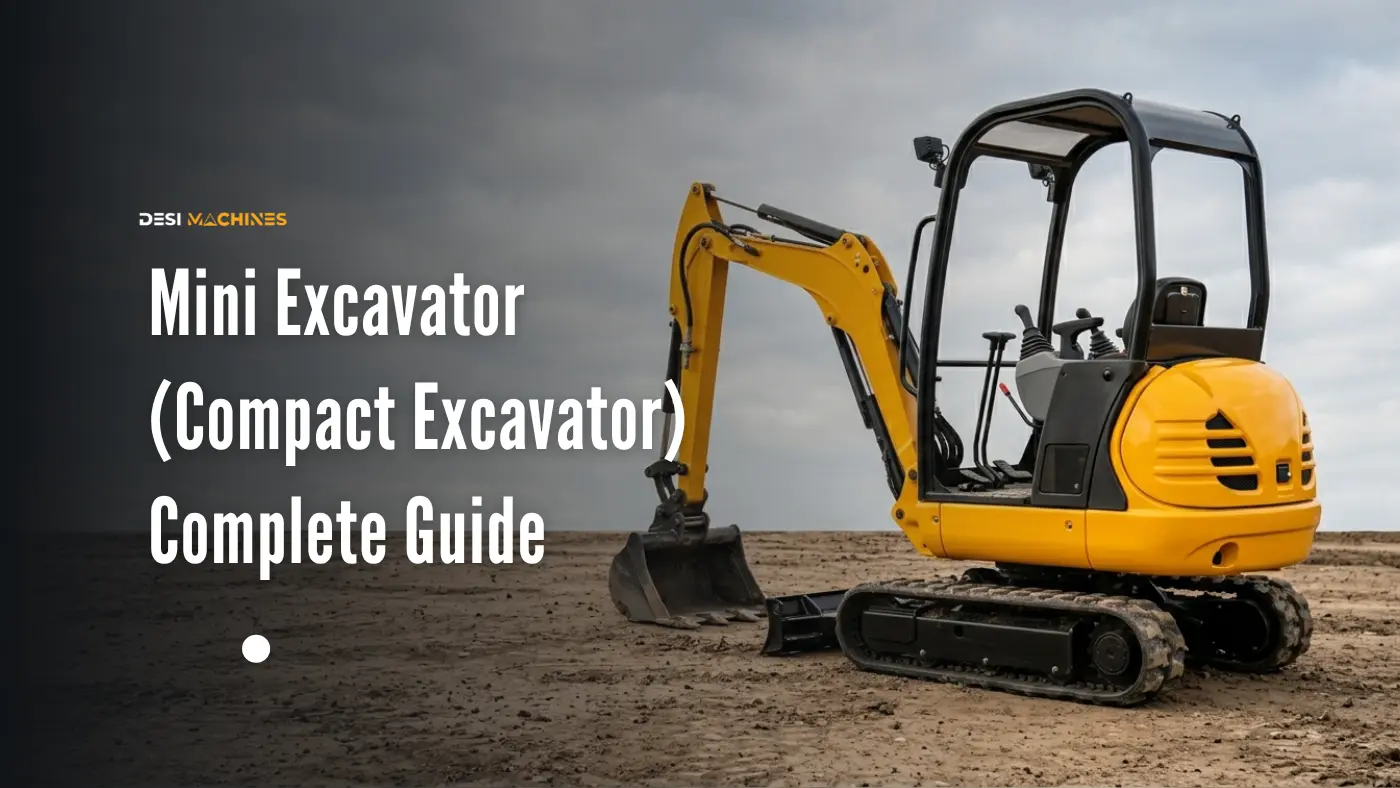
A mini excavator, also called a compact excavator and what most Indians simply call a “Mini Poclain” or “Mini JCB”, is a tracked digging machine in the weight class up to 6 tonne (6,000 kg). The models actually on sale in India sit between 1,800 kg and 5,780 kg (1.8–5.8 Ton), carry 13 to 49 HP, and dig 2.27 to 3.82 metres (7.4–12.5 feet) deep. They suit residential plots, landscaping, utility trenching and tight urban sites where a full-size excavator cannot fit or would chew up the ground. To see where they sit against the bigger classes, read our guide to excavator types, parts and how they work. Across the 49 mini models listed at DesiMachines, prices run from about ₹20 Lakh to ₹36 Lakh (indicative, as of October 2026). Each machine price below is the range published for that model on DesiMachines when this page was last checked.
What is a Mini Excavator (Compact Excavator)?

A mini excavator is compact construction equipment with a rotating upper structure (called the house), a boom-stick-bucket mechanism for digging, and rubber or steel tracks for mobility. Operating weight on the models sold here runs from 1,800 kg to 5,780 kg (1.8–5.8 Ton). The key difference from full-size excavators? Footprint. A 3 Ton mini excavator fits through a standard gate opening. Try that with a 20 Ton machine.
Full-size excavators, the 20 Ton (20,000 kg) workhorses on NHAI highway packages, need flatbed trailers, wide access roads, and solid ground to operate without sinking. Mini excavators transport on a standard pickup trailer, work in backyards, and leave minimal ground damage. That’s not a minor advantage. That’s the reason they exist.
The trade-off is obvious: less digging power, shallower depth, smaller bucket capacity. But for a great deal of residential and light commercial work in India, you don’t need a 20 Ton machine. You need something that fits, finishes fast, and doesn’t destroy the client’s driveway getting in.
How Does a Mini Excavator Work?
The hydraulic system is the heart of every excavator, mini or full-size. Here’s the basic operation:
- Engine and hydraulic pump: The diesel engine (13 to 49 HP across the mini models sold here) powers a hydraulic pump that pressurises oil
- Hydraulic cylinders: Pressurised oil flows to cylinders that move the boom (main arm), stick (secondary arm), and bucket
- Rotating house: The upper structure rotates 360 degrees on a swing bearing, allowing the operator to dig in one direction and dump in another without repositioning
- Track drive: Separate hydraulic motors power each track independently. Push both joysticks forward to go straight, one forward and one back to spin in place
The operator controls everything through two joysticks and foot pedals. Left joystick typically handles swing and stick movement. Right joystick controls boom and bucket. Foot pedals manage track travel. Takes about 2–3 days for a new operator to get comfortable. Mastery? That’s 6 months of daily work.
Types of Mini Excavators
Mini excavators are classified by operating weight. The weight class determines dig depth, bucket capacity, transport requirements and, most importantly, what jobs the machine can actually handle.
1-3 Ton Mini Excavators (Ultra-Compact)
Operating weight: 1,800–2,900 kg (1.8–2.9 Ton)
These are the machines that fit where nothing else will. Basement excavations in Pune’s residential colonies. Garden landscaping in Gurgaon farmhouses. Utility trenching in narrow lanes where a backhoe can’t turn around. Dig depth runs from 2.27 to 2.85 metres (7.4–9.4 feet), enough for foundation footings, drainage lines and septic tank installations.
Transport is dead simple. A 2 Ton mini excavator loads onto a standard pickup trailer. No permits, no pilot vehicles, no headaches. That’s why rental companies love this segment: one Tata 407 can move the machine between three sites in a day.
Popular models in India:
- SANY SY20U: 1,980 kg, 19.8 HP, ₹22–24 Lakh (indicative, as of October 2026)
- Tata Hitachi TMX 20 Neo: 2,300 kg, 27.4 HP, ₹22–24 Lakh (indicative, as of October 2026)
- JCB 30 Plus: 2,870 kg, 24.7 HP, ₹26–28 Lakh (indicative, as of October 2026)
- Kubota U17-3: 1,800 kg, 16.1 HP, ₹24–26 Lakh (indicative, as of October 2026)
3-6 Ton Mini Excavators (Medium-Compact)
Operating weight: 3,069–5,780 kg (3.1–5.8 Ton)
This is the sweet spot for commercial contractors. Enough power for serious digging, from 2.79 to 3.82 metres (9.2–12.5 feet), while still fitting through tight access. Material handling, deeper excavation for commercial foundations, pond digging, and demolition work all fall within this class.
Transport requires a larger trailer. You’re not loading a 5 Ton machine on a pickup. But it’s still single-axle trailer territory — no special permits for most states.
Popular models in India:
- SANY SY60C: 5,780 kg, 48.9 HP, ₹29–31 Lakh (indicative, as of October 2026)
- JCB 55Z: 5,520–5,642 kg, 47.8 HP, ₹29–31 Lakh (indicative, as of October 2026)
- Tata Hitachi NX 50: 5,190 kg, 35 HP, ₹28–32 Lakh (indicative, as of October 2026)
- Bobcat E50z: 5,019 kg, 48.9 HP, ₹33–36 Lakh (indicative, as of October 2026)
Mini excavator classes at a glance
Every figure below is read from the published specification of the 49 mini excavator models listed at DesiMachines (October 2026).
| Weight band | Models on sale | Max dig depth | Engine power | Bucket capacity | Listed price band |
|---|---|---|---|---|---|
| 1.8–3.0 Ton | 17 | 2.27–2.85 m (7.4–9.4 ft) | 13.2–27.4 HP | 0.04–0.08 m³ | ₹20–29 Lakh |
| 3.0–4.0 Ton | 21 | 2.79–3.42 m (9.2–11.2 ft) | 24.2–33.3 HP | 0.04–0.13 m³ | ₹24–32 Lakh |
| 4.0–5.0 Ton | 6 | 3.06–3.56 m (10.0–11.7 ft) | 25.0–47.8 HP | 0.11–0.22 m³ | ₹26–33 Lakh |
| 5.0–6.0 Ton | 5 | 3.45–3.82 m (11.3–12.5 ft) | 35.0–48.9 HP | 0.10–0.26 m³ | ₹28–36 Lakh |
Prices are indicative ranges as of October 2026 and cover the priced models in each band (48 of the 49; one model shows no price yet). Weight bands use each machine’s as-standard operating weight. Bucket capacity runs from the smallest to the largest bucket offered in the band; one 2-tonne model publishes a 0.55 m³ bucket that does not fit its size and is left out.
Key Specifications to Consider
The listed price across this class spans ₹20 Lakh to ₹36 Lakh, so reading the specs properly is what separates a machine that fits your work from one that costs lakhs more and still doesn’t. Here’s what actually matters.
Operating Weight
Weight affects three things: stability when lifting, transport logistics, and ground pressure.
Heavier machines are more stable when swinging loaded buckets. But they also need bigger trailers and can sink in soft ground. A 5 Ton excavator on waterlogged clay in Bengal during monsoon? You’ll spend half your day pulling it out.
Match weight to your typical site conditions. Weight also predicts reach: see how deep a mini excavator can dig for the published depths by class. Residential work on firm ground? Go heavier for stability. Soft soil, tight access, frequent moves? Stay lighter.
Dig Depth & Reach
Dig depth determines what jobs you can take. Residential foundation footings usually need 1.8 to 2.4 m (6–8 feet). Commercial basement excavation needs 3 to 4.3 metres (10–14 feet). Utility trenching for water mains usually needs 2.4 to 3 metres (8–10 feet), depending on the line depth your local authority specifies.
No mini excavator sold here reaches the depths often quoted for the class. The shallowest digs 2.27 m (7.4 feet) and the deepest, the SANY SY60C, reaches 3.82 m (12.5 feet). The class-by-class figures are in the table above, and digging depth by machine size sets them against the larger classes.
Maximum reach at ground level matters for efficiency. Longer reach means fewer repositions per trench. Fewer repositions means faster work. Simple as that.
Engine Power
Measured in horsepower (HP). Mini excavators run from 13.2 HP on the XCMG XE20U to 48.9 HP on the SANY SY60C, depending on size class. More power means faster cycle times, meaning how quickly you can dig, swing, dump, and return for the next scoop.
But here’s what most buyers miss: engine power also determines attachment compatibility. A hydraulic breaker needs consistent flow and pressure. Underpowered engines can’t deliver. If you plan to run breakers, augers, or mulchers, check the hydraulic specs — not just the HP number.
Hydraulic Flow & Pressure
This is where attachment performance lives. Flow is measured in litres per minute (L/min), and pressure in megapascals (MPa). Imported spec sheets sometimes use gallons per minute (GPM) and pounds per square inch (PSI) instead. Both matter.
Take the JCB 30 Plus, a 2,870 kg machine: it delivers a maximum flow of 70.21 L/min (about 18.5 GPM) at an implement-circuit pressure of 23.5 MPa (about 3,400 PSI). Across the class, published maximum flow runs from 41.3 L/min on the Bobcat E20z to 138 L/min on the SANY SY60C. That covers buckets and thumbs on every machine in the class. Breakers, augers and mulchers each carry their own flow and pressure requirement, and that figure comes from the attachment maker, not the excavator. Ask for it in writing and check it against the machine’s published flow before you buy.
High-flow hydraulic packages are optional on most machines. If you’re buying for demolition or land clearing work, spec the high-flow option upfront. Retrofitting later costs more than ordering it with the machine, so ask the dealer to quote both ways before you sign.
Tail Swing Types
Two configurations exist: zero tail swing (ZTS) and conventional.
Zero tail swing means the rear of the house stays within the track width when rotating. Essential for working against walls, near obstacles, or in narrow trenches. The operator can swing freely without checking clearance every rotation.
Conventional tail swing extends past the tracks. More counterweight means better stability for lifting, but you need clearance behind the machine. The published tailswing radius shows the gap plainly: the Kubota U17-3 and XCMG XE20U both turn inside 620 mm, while the conventional-tail JCB 30 Plus needs 1,220 mm.
For urban residential work in India, where you’re often digging half a metre from a boundary wall, a tight tail earns its keep. For open sites with no obstacles, a conventional tail works fine.
Compare mini excavator models side by side on Desi Machines to check specs and prices.
Mini Excavator Attachments
Attachments multiply what one machine can do. A mini excavator with the right attachments handles digging, demolition, drilling, grading and material handling. Five jobs, one EMI.
Essential Attachments
- Buckets: Several widths, typically about 300 mm (12 inch) for trenching, 600 mm (24 inch) for general digging and 900 mm (36 inch) for grading. Most contractors run 2–3 bucket sizes
- Hydraulic thumb: Clamps material against the bucket for handling rocks, debris, logs. Essential for demolition and land clearing
- Auger: Drills holes for fence posts, tree planting, foundation piers. Diameters from about 150 mm (6 inch) to 600 mm (24 inch)
- Quick coupler: Allows fast attachment changes without leaving the cab. Manual couplers take several minutes; hydraulic couplers take seconds. Ask the dealer to quote both, then weigh the difference against how often you actually change attachments
- Breaker/hammer: Breaks concrete, rock and asphalt. Breakers are sized to the carrier, so match one to the machine’s operating weight and published hydraulic flow
Specialized Attachments
Beyond the essentials, specialized attachments open new revenue streams:
- Grapple: For handling brush, debris, scrap metal. Common in demolition and land clearing
- Tilt bucket: Rotates 45 degrees left/right for grading slopes and cleaning ditches without repositioning
- Ripper: Single-tooth attachment for breaking hard soil, frozen ground, or soft rock
- Compaction wheel: Compacts trench backfill in layers, which utility work requires to prevent settling
- Brush cutter: Mulches vegetation for land clearing. Needs high-flow hydraulics
Before buying any attachment, check compatibility. Pin spacing, hydraulic flow requirements and weight ratings all matter. A breaker sized for a 5 Ton machine can damage a 2 Ton excavator’s boom. Check what your own machine is rated to carry before you order.
Ready to find the right machine for your project? Browse every mini excavator listed in India and request a quote.
If you need a mini for one job rather than year-round, hiring may cost less than buying; the excavator rental guide works through sizing and rates.
A mini is the smallest of five weight bands used in India. To see where it sits against the small, medium, large and mining machines, read our guide to excavator size classes.
The front dozer blade that comes with most machines in this class earns its keep on levelling work. The guide to land levelling and grading with an excavator covers blade widths, ground pressure and the finishing pass.
When the tracks wear out, mini excavator rubber track size gives the track width and link count for every mini excavator we list, and explains the three numbers you need before you order a replacement belt.
Prices, specifications and features are indicative, vary by variant, location and date, and should always be confirmed with the official OEM or authorised dealer before any purchase decision. DesiMachines is not liable for decisions taken on the basis of information that may have changed after publication.
Machines, tenders and news for this industry: Demolition · Farm and Land Development · Municipal and Waste