
 Excavator
294 models
Excavator
294 models  Backhoe Loader
51 models
Backhoe Loader
51 models  Crane
68 models
Crane
68 models  Concrete Mixer
79 models
Concrete Mixer
79 models  Wheel Loader
54 models
Wheel Loader
54 models  Compactor / Roller
45 models
Compactor / Roller
45 models  Motor Grader
42 models
Motor Grader
42 models  Dozer
41 models
Dozer
41 models  Concrete Pump
66 models
Concrete Pump
66 models  Skid Steer Loader
11 models
Skid Steer Loader
11 models  Telehandler
13 models
Telehandler
13 models 


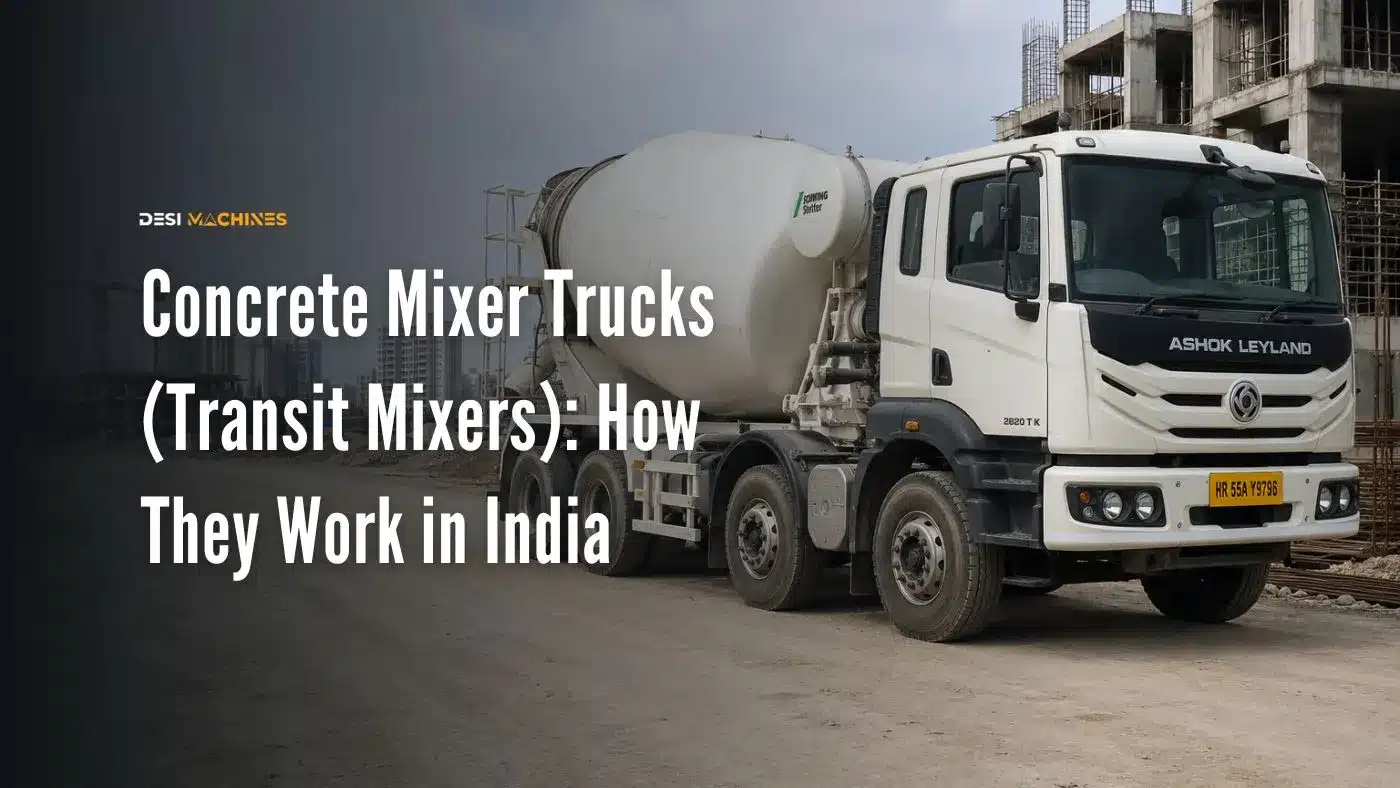
A concrete mixer truck — what most sites in India simply call a transit mixer — is the machine that carries ready-mix concrete from a batching plant to your pour, turning its drum the whole way so the concrete arrives fresh instead of setting hard on the road. It is the link between the plant and the slab, and on any job that buys ready-mix concrete (RMC), it is the machine that decides whether the concrete you paid for is still usable when it reaches the shutter.
This guide explains what a transit mixer actually does, how the rotating drum keeps concrete workable, the capacity classes used on Indian sites, and how a truck-mounted transit mixer differs from a self-loading mixer — so you can match the right machine to the way your project gets its concrete.
What a Transit Mixer Actually Does
Fresh concrete starts setting the moment water meets cement. Left still, it stiffens and, within a couple of hours, becomes a solid lump you have to break out of the drum. A transit mixer solves one narrow but critical problem: it keeps the concrete moving in transit so it stays plastic and pourable from the plant to the site.
The concrete itself is batched and mixed at the ready-mix plant — sand, aggregate, cement and water measured to a design mix. The transit mixer’s job is not to make concrete from scratch; it is to carry and agitate an already-mixed load. The drum turns slowly the entire journey, folding the concrete over on itself so the aggregate doesn’t settle and the mix doesn’t stiffen prematurely. That slow, constant turning is the whole point of the machine.
This is why a transit mixer is a delivery machine, not a batching machine — a distinction that matters when you compare it with a self-loading mixer further down.
How Transit Mixing Works: The Drum, Blades and Three Speeds
Look inside the drum and you’ll find a pair of spiral blades — an Archimedes screw — welded to the inner wall. The direction the drum spins decides what those blades do, and this is the mechanism that makes the whole system work:
- Charging — at the plant, the drum spins fast in the “mixing” direction. The spiral blades pull the incoming concrete up and into the drum and blend it as it loads.
- Agitating — on the road, the drum turns slowly (a few rotations per minute) in the same direction. This gentle folding keeps the mix uniform and stops the heavy aggregate from separating out and sinking.
- Discharging — at the site, the drum reverses. Now the same spiral blades act like a screw conveyor, pushing the concrete out toward the opening and down the discharge chute.
What supplies the power for all three speeds is the transit mixer drum drive — either a PTO from the truck’s engine or a slave engine mounted on the mixer itself.
The drum sits tilted on the truck chassis and is driven either by the truck’s engine through a hydraulic pump (PTO drive) or by a small separate diesel engine mounted on the frame. Water tanks on the machine are for washing down the drum and chute after discharge — not for thinning the concrete. Adding water on site to make a stiff load flow again ruins the water-cement ratio and quietly weakens the concrete you’re about to place. A good operator refuses to do it.
Capacity Classes on Indian Sites
Transit mixer capacity is quoted by the volume of mixed concrete the drum carries, in cubic metres. The 6 m³ machine is the workhorse of Indian RMC delivery — big enough to be economical, small enough to reach most urban sites. The common range runs like this (capacities indicative; confirm against the exact model):
| Drum capacity | Typical use |
|---|---|
| 3–4 m³ | Tight urban sites, small pours, narrow-access lanes |
| 6 m³ | The standard RMC delivery unit — most city and highway work |
| 7–8 m³ | Larger continuous pours, raft foundations, infrastructure |
| 9–12 m³ | High-volume projects with good site access and haul roads |
Bigger is not automatically better. A 10 m³ drum on a heavy chassis needs wide, firm access and a plant close enough to deliver within the workability window — on a congested city site or a bad approach road, two 6 m³ trips often beat one stranded 10 m³ truck. Match the drum to your access and your pour rate, not to a spec-sheet number. You can see the full range of truck-mounted machines on the standard transit mixer listing, including models like the Schwing Stetter AM 6, AJAX AF 7XE, and Putzmeister P10 PTO.
Transit Mixer vs Self-Loading Mixer: The Real India Choice
This is the decision most first-time buyers actually face, and the two machines answer very different problems. For a plain, side-by-side breakdown with live prices, see our dedicated guide on self-loading mixer vs transit mixer.
A transit mixer only carries and agitates concrete that a plant has already batched. It assumes there is an RMC plant within delivery range. In and around cities, where plants are plenty, it is the cheapest way to move concrete — the plant does the batching, the truck just delivers.
A self-loading concrete mixer (SLCM) is a different animal. It loads its own aggregate and sand with a front bucket, weighs the ingredients, adds cement and water, and batches and mixes the concrete itself — then drives to the pour and discharges. It needs no plant. That independence is exactly why it dominates on remote sites: rural roads under PMGSY, canal and bridge work far from any city, projects where trucking in RMC would arrive half-set. Where no plant can reach the site, a self-loading machine is what keeps the pour going.
The trade-off is throughput and cost per cubic metre. For steady, high-volume urban pours, a plant plus transit mixers wins on economics. For scattered, remote, stop-start work, a self-loading mixer earns its keep by removing the plant from the equation entirely. If that batch-as-you-pour idea is new to you, our guide to volumetric, on-site batching mixers explains how a self-loading machine makes fresh concrete right at the site. We break the mixer family down further in our guide to concrete mixer types, and you can compare live self-loading mixer models such as the Ajax and Venus Ultra ranges.
The Workability Clock: Why Timing Decides Quality
Every load of ready-mix concrete carries a hidden timer. From the moment water hits the cement at the plant, you have a limited window — commonly around 90 to 120 minutes in Indian conditions, and shorter in peak summer heat — to place and finish the concrete before it stiffens beyond use. The transit mixer’s constant agitation buys time by keeping the mix moving, but it does not stop the clock.
That timer is why plant-to-site distance is a planning decision, not an afterthought. A pour scheduled too far from the plant, or held up by site delays and traffic, can arrive workable and leave the drum unusable. On big continuous pours, contractors stage trucks so a fresh drum is always waiting — a break in supply shows up later as a cold joint in the slab. The rules for ready-mixed concrete are set out in IS 4926 (BIS); the practical takeaway is simpler — order from a plant close enough that concrete reaches your shutter with time to spare.
Once the concrete is on site, the next machine in the chain is often a pump. If you are placing concrete at height or across a large slab, pair your delivery plan with a concrete pump so the mixer discharges straight into the pump hopper.
What a Transit Mixer Costs in India
A truck-mounted transit mixer is priced as a complete unit — the drum, the drive, and the truck chassis it sits on. As an indicative guide, a new truck-mounted transit mixer — from a 7 m³ unit on a standard 28-tonne chassis at the entry end up to a 9 or 10 m³ machine on a heavier 35-tonne chassis — lands broadly in the ₹33.5–57.5 Lakh (indicative, as of Sep 2026) range, moving with drum capacity, chassis brand and drive type. A bare drum unit without the truck (a standard transit mixer body) is usually quoted on request. Self-loading mixers are priced differently, roughly ₹27–54 Lakh (indicative, as of Sep 2026) depending on batch size, because you are buying a batching machine, not a truck.
These are starting points for budgeting, not quotes. Fuel, drum liner wear, chassis maintenance and — for a rental operator — utilisation decide the real cost per cubic metre far more than the sticker price. If you are financing the purchase, work the EMI into your per-m³ math from day one; our equipment finance options lay out the loan and down-payment side. Buy the machine only when the numbers work on paper first.
Compare current models, capacities and indicative prices across brands on the concrete mixer listing, and read our field notes on choosing the right transit mixer before you commit. For a wider view of what’s driving the market, the leading cement mixer truck manufacturers in India is a useful starting read.
Buying second-hand shifts the question from the price band to the condition of two separate machines, and the used transit mixer buying guide works through the drum checks, the meters and the vehicle paperwork.
How much a drum actually carries, and what that load weighs on the chassis, is worked through in the transit mixer capacity guide.
Ready to buy or rent? Compare transit mixer models, check indicative prices and get the best current offer on DesiMachines.
To put a name to each piece of the machine, the guide to transit mixer parts and components covers the drum, blades, rollers, sub-frame and water system, and the truck chassis below them.
If you would rather hire than buy, the guide to taking a transit mixer on rent covers how hire is billed, how far your site can be from the batching plant, and whether the truck can reach your pour.
For what one of these trucks costs to run, transit mixer mileage and fuel consumption gives the stated figures by model and works out the diesel used per cubic metre delivered.
Most ready-mix loads carry a superplasticiser or a retarder to keep them workable on the road, as the guide to concrete admixtures explains.
Prices, specifications and features are indicative, vary by variant, location and date, and should always be confirmed with the official OEM or authorised dealer before any purchase decision. DesiMachines is not liable for decisions taken on the basis of information that may have changed after publication.
Machines, tenders and news for this industry: Airports · Bridges and Tunnels · Irrigation and Dams