
 Excavator
294 models
Excavator
294 models  Backhoe Loader
51 models
Backhoe Loader
51 models  Crane
68 models
Crane
68 models  Concrete Mixer
79 models
Concrete Mixer
79 models  Wheel Loader
54 models
Wheel Loader
54 models  Compactor / Roller
45 models
Compactor / Roller
45 models  Motor Grader
42 models
Motor Grader
42 models  Concrete Pump
66 models
Concrete Pump
66 models  Skid Steer Loader
11 models
Skid Steer Loader
11 models  Telehandler
13 models
Telehandler
13 models  Dozer
Dozer 


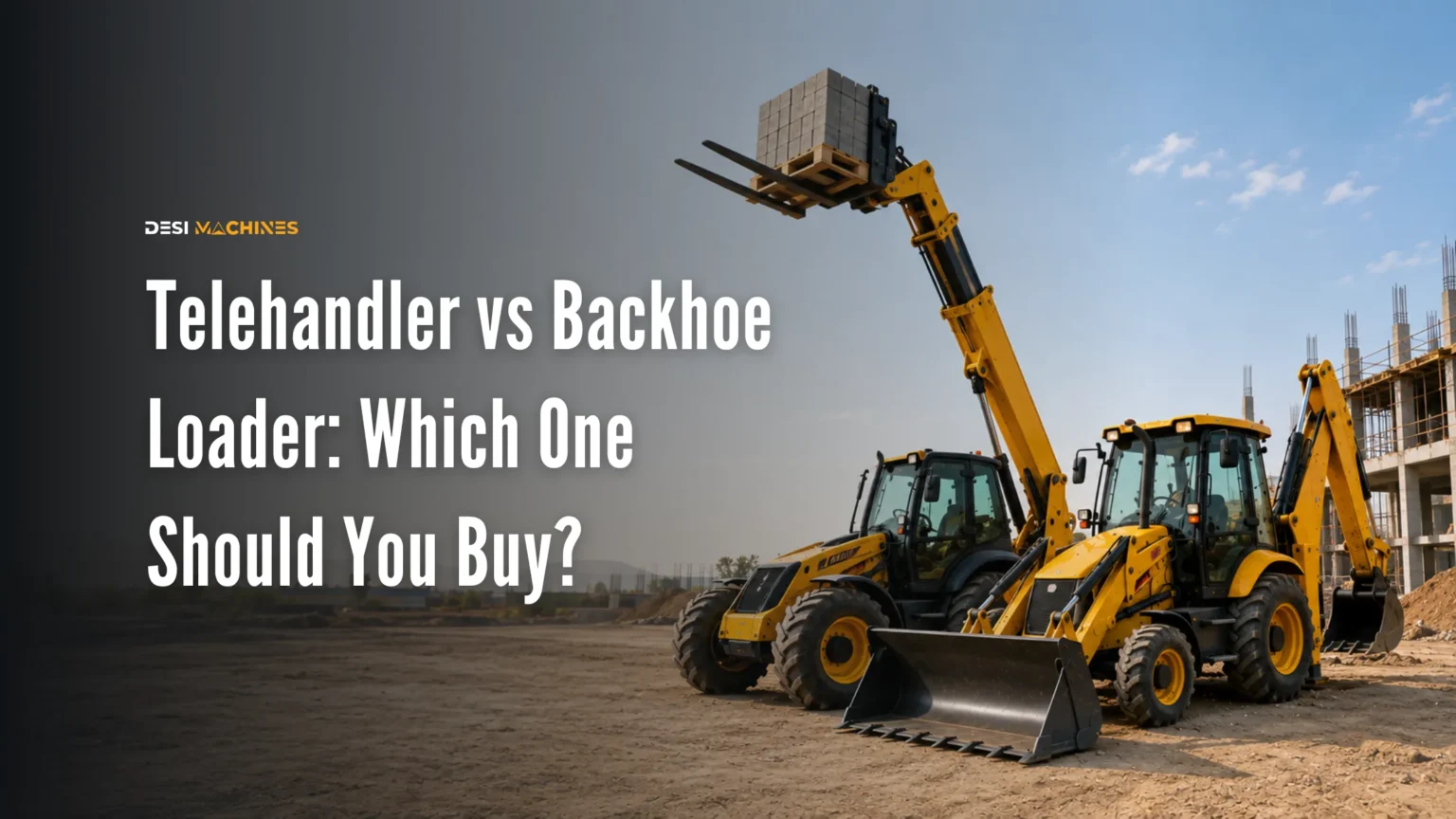
A telehandler is a lifting machine with a single telescopic boom (an arm that slides out longer, like the tube of a telescope) that carries forks or a bucket high up and far forward. A backhoe loader is a digging machine with a loader bucket at the front and a jointed digging arm at the back. The short answer to the choice: a backhoe loader digs into the ground, and a telehandler lifts material up. Neither one does the other’s job well.
That single sentence settles most of the confusion, but it does not settle the purchase. Both machines cost roughly the same money in India, both need one operator, and on a busy site both look equally useful. This guide sets the two side by side using real machine numbers and current listed prices, then works through which one earns its keep on which kind of job.
What is the difference between a telehandler and a backhoe loader?
The difference is in where the work happens. A backhoe loader works at ground level and below it. A telehandler works above ground level.
Look at a backhoe loader and you see two tools on one tractor body. At the front is a loader bucket for scooping loose material and pushing it around. At the back is the backhoe, a folding arm with a small toothed bucket that digs down into the earth. The operator turns his seat around to use it. On Indian sites almost everybody calls the whole machine a JCB, after the brand that sold the first ones here, exactly the way people say Xerox for a photocopy. The backhoe loader guide covers the machine in full, and the TLB explainer unpacks the other name it goes by.
A telehandler has no digging arm at all. It has one boom that lifts and extends, with a coupling at the end that takes forks, a bucket, a jib or a work platform. It looks a little like a forklift that has been stretched, and that is close to the truth: it does a forklift’s job, but on rough ground and much higher. The telescopic handler guide explains the machine from the ground up.
The practical result is that these two machines rarely compete for the same task. They compete for the same budget.
Can a telehandler dig?
Not properly. A telehandler with a bucket on the front can scrape up loose material lying on the surface, load sand from a heap, or push soil around. What it cannot do is dig down into undisturbed ground.
Digging needs a machine that can push a toothed bucket into hard earth and then pull it towards itself with force, using its own weight as an anchor. That is what the jointed rear arm on a backhoe loader is built for. A JCB 3DX reaches 4,770 mm (4.77 m) straight down at full digging depth. A telescopic boom has no elbow and no down-force of that kind, so it simply cannot make a trench.
This matters more than buyers expect, because a very large share of small-contractor work in India is digging: water pipelines, drainage lines, cable trenches, septic tanks, house foundations, farm ponds. If that is your work, the comparison ends here and the backhoe loader wins. If you need a proper trench and nothing else, look at the range of backhoe loaders rather than a telehandler.
What can a backhoe loader do that a telehandler cannot?
Besides digging, a backhoe loader loads a tipper from a heap, backfills a trench it has just dug, levels a rough patch of ground, breaks concrete when fitted with a hydraulic breaker, and drives itself between jobs on the road at a reasonable speed. One machine, one operator, a whole day of mixed work.
That mixed-work ability is the reason the backhoe loader became the default first machine for Indian contractors. A man buying his first machine usually does not have one guaranteed job type for the next five years. He has whatever comes: a bit of digging, a bit of loading, a bit of levelling. The backhoe loader covers all of it at a fair standard rather than any one of them brilliantly. The backhoe attachments guide shows how far that range stretches.
The trade-off shows up the moment you need height. A 3DX lifts its loader bucket to a load-over height of about 3,320 mm (3.3 m) and dumps at roughly 2,740 mm (2.7 m). That is enough to fill a tipper and no more. Ask it to place a bundle of steel on the second floor of a building and it cannot get anywhere near.
How high and how heavy can each machine lift?
This is where the telehandler pulls away. Where a backhoe loader tops out under 3.5 m, telehandlers sold in India lift between 7 m and 13.4 m, while still carrying two to four tonnes.
If height is the whole reason you are looking, put the telehandler next to a pick and carry crane too, because the telehandler versus crane comparison shows where a hydra takes over on both reach and tonnage.
The two numbers that matter on a telehandler are rated capacity (the most weight it can lift, held close in) and maximum lifting height. A third, maximum outreach, tells you how far forward it can place a load without moving the machine, which is what lets it reach over a boundary wall or a stack of material. Capacity always drops as the boom goes out further, which is why every machine carries a load chart.
| Machine | Rated capacity | Max lifting height | Max outreach | Engine power |
|---|---|---|---|---|
| SANY STH634A | 2,721 kg (2.7 tonnes) | 10,400 mm (10.4 m) | 7,000 mm (7.0 m) | 74 HP (55 kW) |
| JCB 530-70 | 3,000 kg (3 tonnes) | 7,000 mm (7.0 m) | 3,800 mm (3.8 m) | 74 HP (54 kW) |
| JCB 530-110 | 3,000 kg (3 tonnes) | 11,000 mm (11.0 m) | 7,400 mm (7.4 m) | 74 HP (54 kW) |
| SANY STH844A | 3,629 kg (3.6 tonnes) | 13,400 mm (13.4 m) | 9,150 mm (9.2 m) | 74 HP (55 kW) |
| JCB 540-70 | 4,000 kg (4 tonnes) | 7,000 mm (7.0 m) | 3,800 mm (3.8 m) | 74 HP (54 kW) |
| MANITOU MXT 840 K | 4,000 kg (4 tonnes) | 7,600 mm (7.6 m) | 4,230 mm (4.2 m) | 74.5 HP (54.8 kW) |
| JCB 3DX (backhoe loader) | Digs to 4,770 mm (4.77 m) deep | 3,320 mm (3.3 m) load-over | 1,520 mm (1.5 m) at ground | 49 HP (37 kW) |
Specifications as per the current August 2026 listings. Read the table by job, not by brand. A machine that lifts 3 tonnes to 7 m suits a warehouse yard and a low building. The 11 m and 13.4 m machines are for putting material onto upper floors and onto scaffolding, which is why they cost more.
Notice also that engine power tells you almost nothing here. Every telehandler in that table runs about 74 HP, the same as a big backhoe loader, yet they reach three times higher. On a lifting machine the boom and the counterweight do the work, not the horsepower. If load charts are new to you, the guide to reading a load chart applies to telehandlers just as it does to cranes.
Telehandler vs backhoe loader price in India
Prices overlap heavily, which is exactly why the decision is hard. A mid-size telehandler and a top-spec backhoe loader sit within a few lakh of each other.
| Machine | Type | Indicative price band |
|---|---|---|
| JCB 3DX | Backhoe loader | ₹28.5–33.6 Lakh |
| Tata Hitachi Shinrai Power | Backhoe loader | ₹34.2–39.9 Lakh |
| ACE AT 30 | Telehandler | ₹28.5–39.9 Lakh |
| SANY STH634A | Telehandler | ₹33.3–44.1 Lakh |
| JCB 530-70 | Telehandler | ₹38.0–50.4 Lakh |
| SANY STH844A | Telehandler | ₹39.9–54.6 Lakh |
| MANITOU MXT 840 K | Telehandler | ₹42.8–57.8 Lakh |
| JCB 540-70 | Telehandler | ₹45.6–60.9 Lakh |
| JCB 530-110 | Telehandler | ₹47.5–63.0 Lakh |
All figures indicative, as of August 2026, taken from our listings at the time of writing. Entry-level telehandlers start close to backhoe loader money. The taller machines run well past it, and the big rotating telehandlers used on large projects go beyond ₹90 Lakh, which puts them in a different conversation altogether.
Compare live telehandler models and prices against the current backhoe loader range before you fix a budget, and if you plan to borrow, work out the monthly outgo on the equipment finance options first. A machine that sits idle three days a week is expensive at any price.
Which machine suits your site?
Match the machine to the work you actually get paid for, not to the work you might get one day.
Buy a backhoe loader if your jobs involve breaking ground: pipeline and cable trenching, drainage, foundations, septic tanks, farm work, village road work, municipal contracts. Also if your work is unpredictable and you need one machine that can attempt most things. This covers the large majority of first-time buyers in India.
Buy a telehandler if your material mostly needs to go up rather than down: building sites where bricks, blocks, steel and shuttering have to reach upper floors; warehouse and factory yards; godown loading; cold storage; agricultural handling such as bales and bagged produce; solar and infrastructure sites where panels and sections must be placed accurately. The telehandler applications guide goes through these job types in detail.
There is a middle case worth naming. On a building site with no crane, a telehandler often replaces three things at once: the hoist, the forklift and a set of labourers carrying material up ramps. That is where it repays the extra money quickly. On a site where a crane is already standing, a telehandler earns much less.
Attachments shift the balance a little in both directions. A telehandler with a bucket does light loading, and one with a jib and hook does light craning. The telehandler attachments guide shows what the coupling will take. Fit a breaker or an auger to a backhoe loader and it covers still more ground work.
If your work sits between the two, pick the machine for your work by choosing the job and how high the load has to go.
Which is cheaper to run and easier to sell?
Backhoe loaders are cheaper to live with in India, and the reason is not the machine. It is the network around it.
Backhoe loaders sell in very large numbers here, so spare parts are on the shelf in most district towns, mechanics who know the machine are easy to find, and an operator who can run one is available in any mandi town. The backhoe fuel guide covers what one actually burns, and the maintenance schedule sets out the service intervals.
Telehandlers sell in far smaller numbers. Parts often come from a regional dealer rather than the local market, a trained operator takes longer to find, and a breakdown can idle the machine longer. None of this is a reason to avoid a telehandler, but it belongs in the sum.
Resale follows the same logic. A used backhoe loader has a deep, liquid second-hand market across the country and moves quickly, as the used backhoe loader guide shows. A used telehandler has a thinner set of buyers, so it can take longer to sell, though a well-kept one in a market with construction activity holds its value respectably.
One more practical point: a backhoe loader drives to the next job on its own wheels. Most telehandlers travel at 23 to 28 km/h and are usually moved by trailer for anything beyond a short hop, which is a real cost if your jobs are scattered.
Which one should you buy first?
For a first machine in India, the backhoe loader is the safer buy for most contractors. It digs, which the telehandler cannot do at all, and digging is where the steady small-contractor work sits. It is cheaper to maintain, easier to staff, and easier to sell when you want out.
The telehandler is the better buy when you already know your work is lifting work. If you are supplying material to multi-storey building sites, running a warehouse or factory yard, or handling farm produce in volume, a telehandler will out-earn a backhoe loader comfortably, because it does in one pass what a backhoe loader cannot do at all.
Contractors running more than one machine often end up with both, and that is the honest end of this comparison: they are partners more than rivals. If you are still weighing it up, compare the current telehandler models and prices and the backhoe loader range side by side, and talk to our team about what the machine will do on your particular site. For a backhoe loader the next decision is drive type, which the 2WD vs 4WD guide settles.
If the telehandler wins that comparison, the next question is which badge to buy: the guide to the best telehandler brands in India compares JCB, SANY, Manitou and ACE on capacity, lift height and listed price.
The other compact alternative to a backhoe is compared the same way in skid steer vs backhoe loader.
Prices, specifications and features are indicative, vary by variant, location and date, and should always be confirmed with the official OEM or authorised dealer before any purchase decision. DesiMachines is not liable for decisions taken on the basis of information that may have changed after publication.

