Excavator
294 models
Excavator
294 models  Backhoe Loader
51 models
Backhoe Loader
51 models  Crane
68 models
Crane
68 models  Concrete Mixer
79 models
Concrete Mixer
79 models  Wheel Loader
54 models
Wheel Loader
54 models  Compactor / Roller
45 models
Compactor / Roller
45 models  Motor Grader
42 models
Motor Grader
42 models  Dozer
41 models
Dozer
41 models  Concrete Pump
66 models
Concrete Pump
66 models  Skid Steer Loader
11 models
Skid Steer Loader
11 models  Telehandler
13 models
Telehandler
13 models 


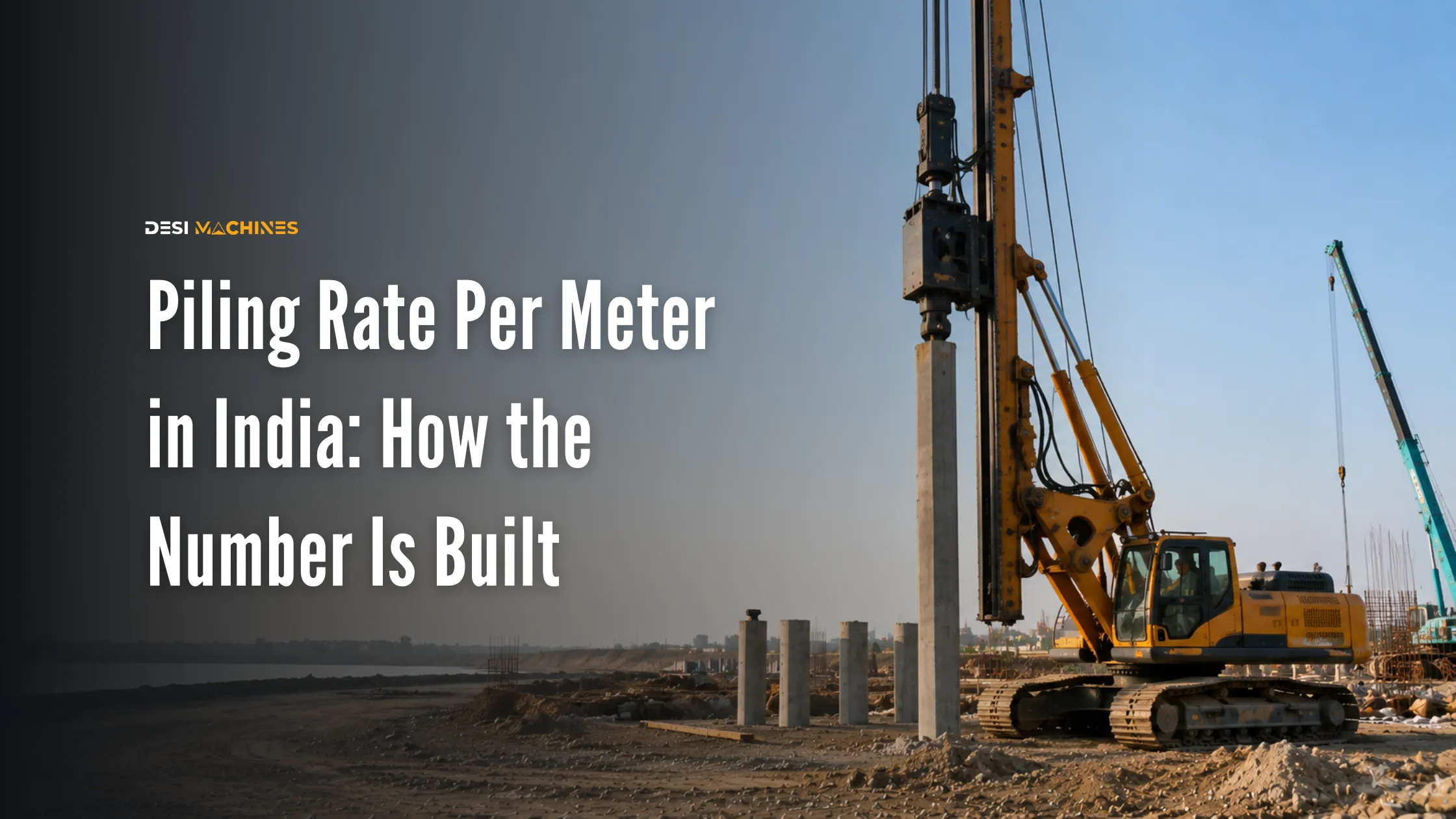
There is no published piling rate per meter in India, and any figure quoted without a diameter, a depth and a strata description is not a rate at all. What you are really buying per running metre is rig time, concrete, steel and risk. This piece breaks the number into its parts so you can build your own quote, compare two contractors on the same scope, and price the chisel hours that quietly decide whether the job made money.
Why nobody publishes a piling rate per meter
Ask five contractors for a piling rate and you will get five numbers with a spread wide enough to make you suspect someone is wrong. Usually nobody is. Piling is one of the few earthwork activities where the same machine, on the same day, legitimately produces very different costs per metre depending on what is under the ground.
Compare that with the work we price elsewhere. Bulk earthwork has a settled basis in the excavation rate per cubic meter, because a cubic metre of soil is a cubic metre of soil. Farm and plot work has the land leveling cost per acre, where the area is known before anyone starts. Piling has neither. The depth is discovered while boring, and the strata decides how long each metre takes.
That is why a state schedule of rates carries piling as a family of items, not one line: separate entries by diameter, by strata class, and with chiselling as its own measured item. Your quote should be built the same way.
What actually sits inside the number
A per-metre rate is a bundle. Break the bundle and the spread between quotes usually explains itself.
| Cost head | What drives it | Basis |
|---|---|---|
| Rig time | Diameter and strata — a bigger auger in stiffer ground means fewer metres per shift | Per hour, converted to per metre |
| Concrete | Volume follows the square of the diameter, plus wastage on an uncased bore | Per cubic metre |
| Reinforcement | Cage length, bar diameter, spirals, cover blocks | Per tonne |
| Bentonite or polymer | Only where the bore will not stand on its own | Per metre bored |
| Casing | Loose top strata, high water table, road-side bores | Per metre of casing |
| Chisel or hammer hours | Rock, boulders, old foundations | Per hour, measured separately |
| Service crane and crew | Cage handling, tremie pipe, general support | Per day on site |
| Mobilisation | Rig transport in and out, first setup | Lump sum per job |
| Spoil disposal | Slurry and cuttings, lead distance to the dump | Per trip |
Two contractors quoting the same site will often differ on only three of these lines. Find the three and you have found the real difference.
The four variables that move the rate most
Diameter. Concrete volume rises with the square of the diameter, so going from 450 mm to 600 mm is not a third more concrete, it is closer to eighty per cent more. Rig time rises too, though not as steeply. This is the single largest step change in the rate.
Depth. The first few metres are the fastest. As the bore goes deeper the rig spends more of each cycle lifting spoil out and less of it cutting, so the metres get slower and the effective cost per metre climbs. A rate quoted off a 12 m assumption will not hold at 25 m.
Strata. Soft alluvium, stiff clay, weathered rock and hard rock are four different jobs. The moment the rig meets rock the basis changes from metres per hour to hours per metre, which is exactly why chiselling is billed separately.
Rig type. A tripod rig, a rotary hydraulic rig and a DTH hammer rig have different day rates, different mobilisation costs and different sensible depth ranges. Matching the rig to the ground is what a good contractor is actually selling you.
Build your own quote, line by line
Rather than hunting for a number to copy, put your own figures into a sum with this shape. Every input is something you can get from a supplier quote or your own records in an afternoon.
| Line | How to fill it |
|---|---|
| A. Rig day rate | Your own hire quote, or your owning cost if the rig is yours |
| B. Metres bored per working day | From your last job in similar strata — measured, not hoped for |
| C. Rig cost per metre | A divided by B |
| D. Concrete per metre | Bore volume for your diameter, plus your usual overbreak allowance, at your supplier’s rate |
| E. Steel per metre | Cage weight per metre from the drawing, at your supplier’s rate |
| F. Consumables and crew per metre | Bentonite, tremie, service crew, divided by B |
| G. Direct cost per metre | C + D + E + F |
| H. Site overhead per metre | Supervision, water, power, site office, divided by total metres in the job |
| I. Your margin | Applied on G + H, not on the concrete bill alone |
Line B is where most quotes go wrong. Owners use the rig’s best-day output and then wonder where the money went. Take the average across a full job, including the days lost to cage delays, concrete that did not arrive and the bore that had to be re-drilled.
Mobilisation, chiselling and casing stay outside this sum as separate items. Folding them into the per-metre figure is how a contractor ends up funding someone else’s rock.
Price the chisel hours before the rig starts
Rock is the item that turns a sound piling rate per meter into a loss, and it is entirely manageable with paperwork rather than luck.
Agree three things in writing before mobilisation. What counts as chiselling, and who calls it. The hourly rate for chisel or hammer time. How the hours are recorded — a log sheet signed at the start and end of each spell by your supervisor and the client’s, on the day, not reconstructed at bill time.
A borehole log from a soil investigation makes all three conversations shorter. It is the cheapest document on the job compared with the argument it prevents.
What comes off before the money reaches you
The rate you agree is not the money that lands. On a running bill the deductions follow the same pattern as any other earthwork item, and owners who have been through a delayed government payment cycle will recognise all of them: retention held against the bill, statutory deductions your client applies at source, and any material issued to you and recovered later.
If you are taking an advance to fund the mobilisation, treat it as what it is — money that will be recovered from your running bills on a fixed schedule. The mechanics are the same as on any other contract, and the clause to check is the same one described in our piece on the mobilisation advance.
Where the piling throws up spoil that has commercial value, or where the client is deducting on quantities you did not agree, the position on deductions in our note on royalty on earthwork is worth reading before you sign the measurement book.
When the rig should be yours
Hiring a rig makes sense while piling is occasional work. It stops making sense at the point where your rig hire bill over a year approaches the cost of owning, and where you are turning down jobs because no rig is free.
The test is the same one that applies to any machine: utilisation. A rig that works 180 days a year is a business. One that works 60 days is a hire decision wearing an ownership badge. The reasoning is set out in full in our piece on what a machine actually earns, and the day-rate benchmarks in the equipment rental rate card will tell you what the hire side of that sum looks like.
If you are running the numbers on buying, look at the support machines first. A piling job needs a service crane and an excavator on site far more days than it needs a rig, and those are usually the machines that earn on the other jobs too.
Build a piling rate from diameter, depth and strata
Treat a piling rate per meter as an output, not an input. Fix the diameter, the depth and the strata first, then price the rig time, the concrete and the steel against them, and keep mobilisation, casing and chisel hours as separate measured items. A quote built that way survives the site; a single number copied from somewhere else does not.
If the sum tells you the work is there but the machine is not, compare current excavator models and prices and the crane range, and work out the funding alongside the quote with our equipment finance options.
Rates, schemes, specifications and prices change — confirm current terms with the OEM, dealer, bank or insurer before deciding. The cost heads and method here are indicative of how piling work is structured and priced, not a quotation for any site. Confirm your own rates with your contractor, supplier or another official source before you budget for a job. DesiMachines is not liable for decisions taken on the basis of information that may have changed after publication.
Machines, tenders and news for this industry: Bridges and Tunnels · Railway and Metro