
 Excavator
294 models
Excavator
294 models  Backhoe Loader
51 models
Backhoe Loader
51 models  Crane
68 models
Crane
68 models  Concrete Mixer
79 models
Concrete Mixer
79 models  Wheel Loader
54 models
Wheel Loader
54 models  Compactor / Roller
45 models
Compactor / Roller
45 models  Motor Grader
42 models
Motor Grader
42 models  Dozer
41 models
Dozer
41 models  Concrete Pump
66 models
Concrete Pump
66 models  Skid Steer Loader
11 models
Skid Steer Loader
11 models  Telehandler
13 models
Telehandler
13 models 


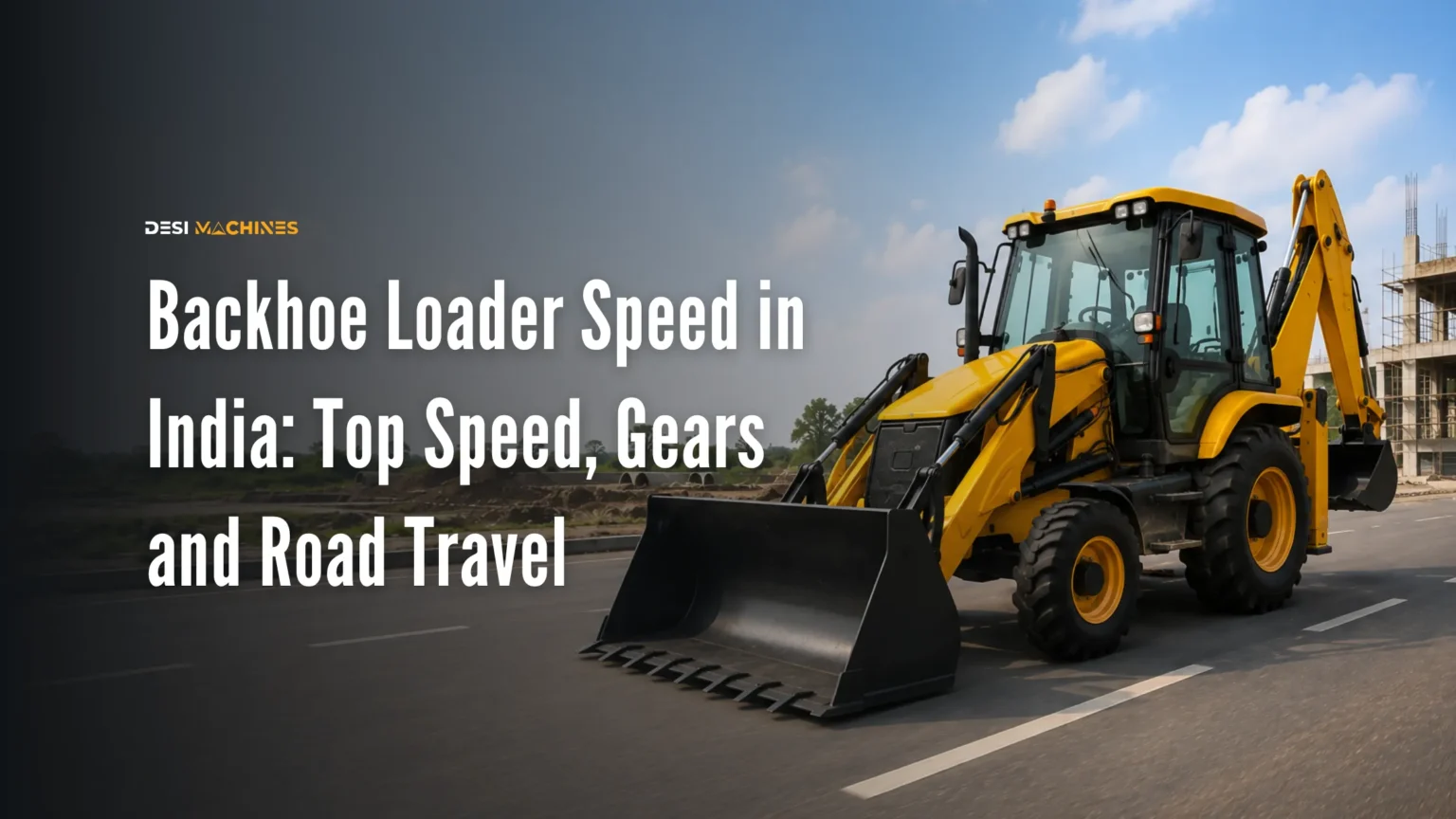
Backhoe loader speed is how fast the machine can travel on its own wheels, measured in kilometres per hour in each gear. Across the 51 backhoe loaders listed on DesiMachines, 49 publish a travel speed, and the top gear runs from 28 km/hr to 41 km/hr. Most machines sit between 32 and 40 km/hr. The 34 machines that publish all four forward gears start at 4.4 to 7.4 km/hr in first gear, which is the digging and loading speed, and finish at 28.8 to 40 km/hr in fourth.
That range is the reason a backhoe loader earns its keep in India. It digs like a small excavator, loads like a small wheel loader, and then drives itself to the next job instead of waiting for a trailer. Nobody hires a low-bed truck to move a backhoe 15 km.
This guide explains what each gear is for, why the reverse gears carry a warning on most spec sheets, and how to work out honestly how long a road move will take. Every figure below comes from the specification sheets published on the machine listings themselves, current as of August 2026.
How fast does a backhoe loader go?
A backhoe loader tops out between 28 km/hr and 41 km/hr in its highest forward gear. Of the 51 machines listed, 49 publish a travel speed; two publish none at all.
The spread is narrower than buyers expect. Three quarters of the machines land between 32 and 40 km/hr, and the single most common figure is exactly 40 km/hr. This is a class where the fastest machine is not quite one and a half times the slowest, so top speed rarely decides a purchase on its own.
| Machine | Top gear speed |
|---|---|
| ACE AX 124 | 28.0 km/hr |
| JCB 2DX | 28.8 km/hr |
| Tata Hitachi Shinrai Pro | 30.0 km/hr |
| JCB 3DX | 32.3 km/hr |
| Mahindra Earthmaster SX | 33.0 km/hr |
| CASE 770 NX | 34.0 km/hr |
| CAT 424 | 37.5 km/hr |
| JCB 3DX Super | 40.0 km/hr |
| Manitou MBL 745 S | 40.0 km/hr |
| Bull HD76 2WD | 41.0 km/hr |
Read the top figure as a ceiling on flat, made road with an empty bucket, not as a speed you will hold. A loaded machine on a broken village approach road travels far slower, and so does one whose tyres are worn.
What is the top speed of a JCB?
Different JCB backhoe loaders top out at different speeds, and the gap inside the brand is almost as wide as the gap across the whole class. The JCB 2DX, the compact machine in the range, reaches 28.8 km/hr. The JCB 3DX reaches 32.3 km/hr. The JCB 3DX Super and the four-wheel-drive JCB 4DX both reach 40 km/hr.
So “what is the top speed of a JCB” has no single answer, and a seller who quotes one number for the brand is quoting one variant. Ask which model and which variant, then check that machine’s own specification sheet. The difference between a 3DX and a 3DX Super is nearly 8 km/hr, and on a 25 km road move that is a real difference in the working day.
JCB is the machine most Indian buyers picture when they hear the word backhoe, to the point where “JCB” is used for the machine type itself. The same speed questions apply to every brand in the class, and several of them travel faster than the JCB most people have in mind. Compare live backhoe loader models and prices before assuming one brand is quicker.
For the same comparison on the other machine, our guide to wheel loader top speed sets out the payloader figures by weight band.
What is each gear for on a backhoe loader?
A backhoe loader normally has four forward gears, and each one has a job. Thirty-four of the 51 machines listed publish a figure for all four, and the pattern across them is consistent enough to plan around.
| Gear | Speed across 34 machines | What it is for |
|---|---|---|
| 1st forward | 4.4 – 7.4 km/hr | Digging, filling the front bucket, working against a heap |
| 2nd forward | 7.1 – 11.9 km/hr | Carrying a full bucket across the site, loading a tractor trolley |
| 3rd forward | 15.2 – 23.0 km/hr | Short hops between work faces, rough approach roads |
| 4th forward | 28.8 – 40.0 km/hr | Road travel to the next site |
First gear is a working gear, not a slow travel gear. Walking pace is roughly 5 km/hr, so a backhoe in first gear moves about as fast as the man standing next to it. That is deliberate. Pushing the front bucket into a heap of soil needs the wheels turning slowly with a lot of force behind them, and low gear is what supplies the force.
Fourth gear is the opposite: plenty of speed, very little pulling power. Try to dig in fourth and the machine will stall or the wheels will spin. Operators who have driven a tractor already know this feeling, because a backhoe gearbox behaves in much the same way.
The remaining 15 machines that publish a speed print only their top gear rather than the full ladder. That does not mean they have one gear. It means the maker published one figure, so treat a single number on a brochure as the top gear unless the sheet says otherwise.
Why does the spec sheet say “not recommended” in reverse?
Because the maker does not want the machine driven backwards at road speed. Of the 51 machines listed, 25 print “not recommended” against a reverse gear instead of a speed figure — 22 against reverse third and 18 against reverse fourth.
This is worth understanding rather than ignoring, because it is unusual for a specification sheet to refuse to answer. Where the reverse gears do carry figures, reverse first runs 4.4 to 7.4 km/hr and reverse second 5.0 to 11.9 km/hr — close to their forward equivalents. The gearbox is capable of the higher reverse speeds. The maker simply advises against using them.
The reasons are practical. The operator sits facing forward, so reversing fast means looking over a shoulder past a rear digging boom that blocks much of the view. Steering is at the front wheels, which makes a reversing machine harder to correct once it starts to swing. And the rear of a backhoe carries the heavy digging equipment, so weight is not sitting where it helps braking.
The safe habit is simple: reverse in first or second, and turn the machine around rather than backing down a long stretch. If an operator is routinely reversing at speed to save time, that is a training issue worth fixing before it becomes an accident. Reversing is the situation in which most yard damage happens on Indian sites.
Does 2WD or 4WD change the top speed?
Barely. Grouping the machines by drive type, the two-wheel-drive machines top out between 28 and 41 km/hr and the four-wheel-drive machines between 32 and 41 km/hr. The machines offered in both configurations run 28 to 40 km/hr. The ranges overlap almost completely, and the fastest machine in the class is a two-wheel-drive one.
Four-wheel drive raises the floor a little, because the machines built with it tend to be the bigger, more powerful ones. But it is not a speed feature. Four-wheel drive buys grip in mud, on loose soil and on a wet slope — traction, meaning the wheels’ ability to hold instead of spin. It does not buy road speed.
If the choice between the two is still open, 2WD vs 4WD backhoe loader works through where the extra cost pays back and where it does not. You can also browse the 2WD backhoe loaders and 4WD backhoe loaders separately.
How long does it take to drive a backhoe to the next site?
Longer than the top speed suggests. Take the arithmetic honestly: a machine rated at 40 km/hr does not average 40 km/hr on an Indian road. Between village lanes, speed breakers, traffic and the simple fact that a backhoe is uncomfortable at full speed, a realistic planning figure is well below the rated one.
Worked through at a steady 30 km/hr, which most machines in this class can hold on decent road, a 10 km move takes about 20 minutes, a 25 km move about 50 minutes, and a 50 km move most of a working morning once you allow for a stop. At 20 km/hr, closer to what a loaded machine manages on a rough approach, those same distances take 30 minutes, 75 minutes and two and a half hours.
The practical cut-off most contractors use is around 40 to 50 km. Beyond that, the diesel burned, the hours added to the meter and the wear on tyres and transmission start to cost more than hiring a trailer. Hours on the meter matter later too, because they are what a buyer looks at when you resell.
Fuel is the part people forget. Road travel burns diesel without doing any billable work, and what a backhoe loader really costs in fuel sets out the hourly burn. Two long moves a week quietly become a running cost.
Can you drive a backhoe loader on the road in India?
Yes, and that ability is a large part of why the machine sells so well here. A backhoe loader is a wheeled machine built to travel on public roads under its own power, which is exactly what separates it from a tracked excavator that must be trailered everywhere.
It does come with obligations. A backhoe loader used on public roads is registered as a construction equipment vehicle, carries a number plate, and must be driven by a person holding the correct licence for it. Insurance should cover road use and not only site use — a claim after a road accident on a site-only policy is an expensive lesson. Registration and licensing rules are set nationally but applied by your state transport office, so confirm the current requirement with your RTO rather than relying on what a dealer says in a showroom.
Practical points that matter more than the paperwork: fit and maintain lights and indicators, keep the front bucket low while travelling so it does not block the view or catch a bank, and swing the rear boom into its transport lock. A backhoe at 40 km/hr with an unlocked boom is a hazard to everyone behind it, because the boom can sit almost 4.9 m past the side of the machine once it swings; the pin and latch types are covered in the guide to the backhoe loader boom lock and transport locks.
Speed also has a limit that is not written on any specification sheet: the tyres. Industrial backhoe tyres are built for load and grip, not for sustained high-speed running, and they heat up on a long tar road in May. Long moves are easier on the machine early in the morning. When a set wears out, find the front and rear tyre for your model and ask a tyre dealer near you for a price.
Backhoe loader speed: the short version
The top gear on a backhoe loader sold in India runs 28 to 41 km/hr, and most machines reach 32 to 40 km/hr. First gear runs 4.4 to 7.4 km/hr and is for digging, not travelling. Reverse is deliberately restricted, and a quarter of the machines listed print “not recommended” rather than a figure against their top reverse gears.
Top speed is a convenience specification, not a performance one. It decides how much of your day a site move eats, and that is worth knowing before you buy. It does not decide how well the machine digs or loads, and no buyer should choose between two backhoes on 3 km/hr. Engine power and torque and bucket capacity, dig depth and dump height are the specifications that decide what the machine does once it arrives.
Ready to shortlist? Browse the full range of backhoe loaders with specifications and connect with a dealer near you.
Where to read next
If the machine has to reach your plot before it can travel anywhere, backhoe loader dimensions and site access covers gate width, height and turning circle. For what the machine is and how the two ends work, start with the backhoe loader guide, then what a TLB is for how the tractor-loader-backhoe layout came about.
The gearbox, axles and transmission that produce these speeds are set out in backhoe loader parts and components, and keeping them healthy is the job of the maintenance schedule. Which transmission each brand actually fits, and what synchro shuttle and power shuttle mean on a spec sheet, is set out in the guide to backhoe loader transmission types. Road travel adds hours faster than site work adds them, so the 250 and 500 hour services arrive sooner on a machine that moves a lot.
Insurance is worth settling before the first road move rather than after; compare construction equipment insurance providers for cover that includes road use.
Prices, specifications and features are indicative, vary by variant, location and date, and should always be confirmed with the official OEM or authorised dealer before any purchase decision. DesiMachines is not liable for decisions taken on the basis of information that may have changed after publication.

