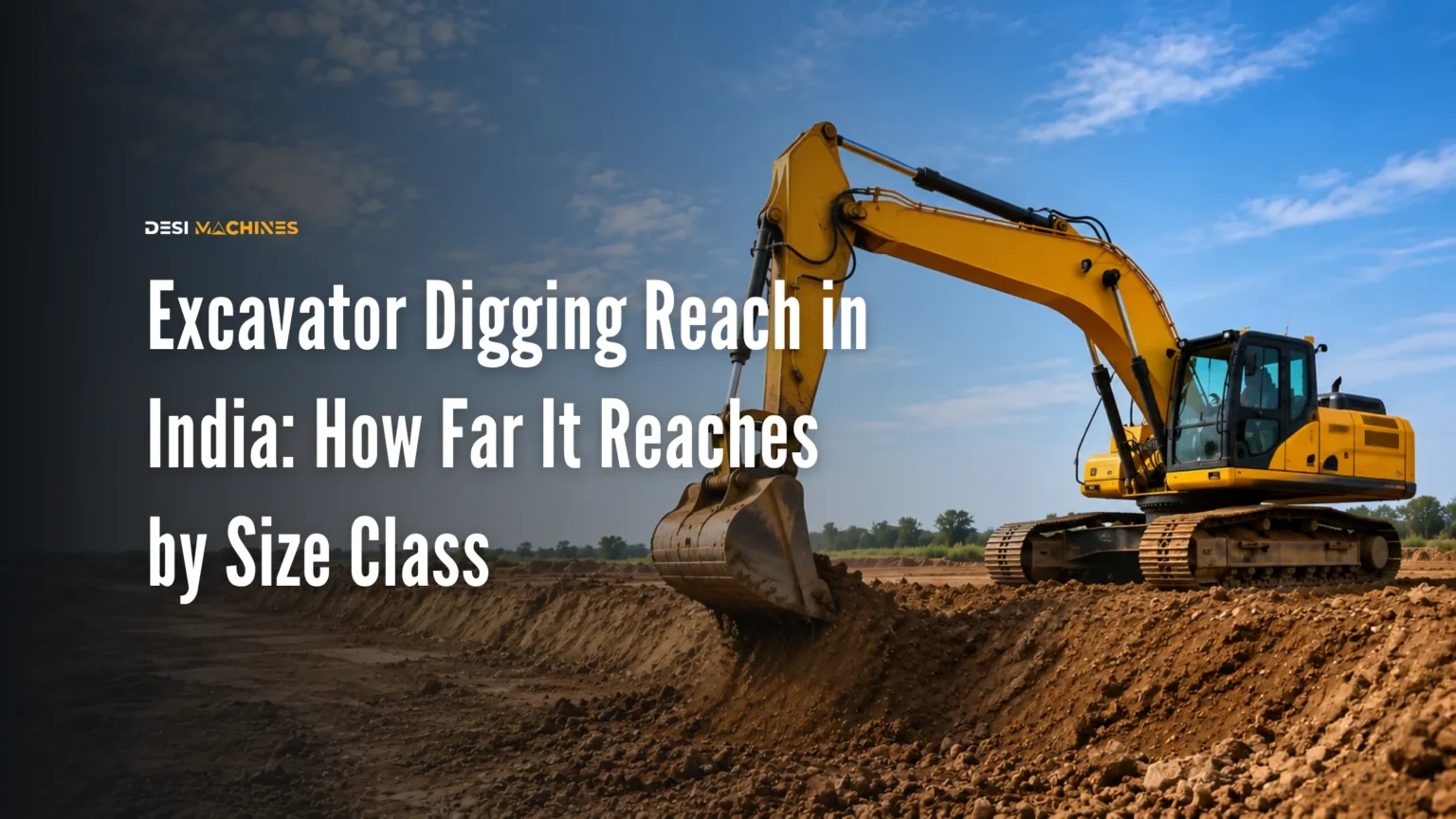
Maximum digging reach is how far an excavator can stretch its bucket out sideways from the machine, measured horizontally from the centre of the turntable to the bucket teeth. It is published in millimetres on every spec sheet, and it is the number that decides whether you can dig the far side of a trench, a canal or a foundation without moving the machine.
Across the 241 excavators listed on DesiMachines that publish the figure, digging reach runs from 3,900 mm (3.9 m) on a 1.8 tonne mini machine to 20,200 mm (20.2 m) on a 544 tonne mining machine, as per the current August 2026 spec sheets. The common 15 to 25 tonne class is the surprise: 68 machines from every brand sold here sit inside a band just one metre wide.
What is digging reach on an excavator?
Digging reach is the greatest horizontal distance the bucket teeth can travel away from the machine. Picture the excavator standing still, boom pushed out and arm straightened: the distance from the middle of the machine to the bucket teeth, measured flat along the ground, is the reach.
Two figures on the spec sheet describe this, and they are not the same thing. Maximum digging reach is the longest stretch the bucket can make at any height, which usually happens with the boom a little above ground level. Maximum digging reach on ground is how far it stretches while the teeth are still touching the ground, which is what matters when you are cutting a trench.
The gap between the two is small and steady. On the 133 machines that publish both cleanly, reach on ground sits between 130 mm and 310 mm short of maximum reach, depending on the class. In plain terms, you lose about a hand’s width to a foot of stretch when the bucket has to stay on the soil. Small enough to ignore on a big job, big enough to matter when you are working to a boundary wall.
A third number sits with them. Minimum swing radius is how tightly the machine can tuck its front in, and it decides how close to a wall you can work. Reach tells you how far out you can go; swing radius tells you how far in you can come. Both are on the same block of the spec sheet, and our guide to reading an excavator spec sheet works through the rest of that page.
How far can an excavator reach? Reach by size class
Reach grows fast through the small classes and then slows down. The table gives the published figures for every excavator size class listed on DesiMachines, counted from each machine’s own spec sheet in August 2026.
One machine in the 25 to 50 tonne class sits outside its band on purpose. The SANY SY365C-9LA is a long-arm build and reaches 13,414 mm, about 1.4 m further than any standard machine in the class. It is listed under Large because it weighs 36.8 tonnes, but it is a different tool. The rest of the class tops out at 12,040 mm on the Volvo EC480D.
Notice how the Mini swing radius range is wider than the whole Small class. That is the zero-tailswing design at work: a few mini machines pull their front in to under a metre so they can dig alongside a compound wall, while others in the same weight class need four metres of room.
What is the digging reach of a 20 ton excavator?
A 20 tonne excavator reaches about 9.5 metres. The 15 to 25 tonne class is the biggest single group sold in India and the most tightly grouped: 68 listed machines span only 9,150 mm to 10,240 mm, and the middle 80 per cent of them fall between 9.3 m and 9.9 m.
That tightness is worth understanding before you shop. These machines are all built around a similar boom and arm, so a buyer choosing between brands in the 20 tonne class is not choosing between reaches. Here is what the common models publish, as per their August 2026 spec sheets.
The whole spread there is 760 mm. If reach is what you are buying on, this class will not separate the brands for you. Digging force, fuel burn and dealer support will.
How far can a mini excavator reach?
A mini excavator reaches between 3.9 and 6.2 metres, and the figure tracks weight closely. A 1.8 tonne machine such as the XCMG XE20U reaches 3,900 mm. A 3 tonne machine reaches around 4.6 to 4.9 m. A 5.5 tonne machine such as the JCB 55Z reaches 6,200 mm, which is the top of the class.
For the work minis actually do in India, that range is the whole decision. A 4 m reach machine parked on a village lane can dig a water line on the far side of the lane without repositioning. A 6 m reach machine can stand on a field bund and clean a channel without putting its tracks in the mud.
Reach and digging depth move together in this class, so a machine chosen for depth will usually have the reach to match. Where they part company is swing radius: if you will work between buildings, check that number before reach.
Why does reach follow digging depth so closely?
Reach and depth are two ends of the same boom and arm, so one predicts the other. Across the 196 standard excavators listed here that publish both figures, maximum digging reach sits at about 1.55 times the maximum digging depth. The median is 1.549, and 90 per cent of machines fall between 1.48 and 1.76.
That ratio is useful in two ways on a dealer’s forecourt.
First, it lets you fill in a missing number. If a sheet gives you a 6.4 m digging depth and no reach figure, the machine will reach close to 9.9 m. Second, and more useful, it lets you check a sheet. A machine printed well outside 1.48 to 1.76 has either a typing error on it or a non-standard boom, and both are worth a question to the dealer before you sign anything.
The ratio holds because the geometry is fixed. The arm swings through an arc; how deep it goes down and how far it goes out are set by the same two lengths. Manufacturers change bucket size, engine power and counterweight far more often than they change boom and arm length, which is why operating weight can vary within a class while reach barely moves.
What is a long reach excavator, and how far does it go?
A long reach excavator is a standard machine fitted with a longer boom and arm so it can work at a distance, usually across water or from the top of a bank. The 12 long reach machines listed here reach from 15,030 mm (15.0 m) on the SANY SY245C-9LR to 22,000 mm (22.0 m) on the SANY SY545C-10LR.
These machines break the 1.55 ratio, and that is the clearest way to see what you are buying. A long reach machine runs at about 1.30 reach to depth, not 1.55. It has bought horizontal distance and given up proportional depth, which is exactly right for canal desilting, pond cleaning and river bank work, where the machine has to stand well back from a soft edge.
The trade is not free. A longer arm carries a smaller bucket and lifts less at full stretch, because the load sits further from the turntable. If your work is dredging and canal desilting, that trade is worth making. For general earthwork it is not, and a standard machine will move more soil per day. There is more on how these booms are built and where they earn their money in our guide to long boom excavators.
Which reach do you actually need on an Indian site?
Start from the widest thing you have to dig across without moving the machine, and add a margin.
For a village water line or a house foundation, a mini machine at 4 to 6 m of reach covers a standard plot boundary from one position. For road and drain work along a highway shoulder, the 15 to 25 tonne class at 9.2 to 10.2 m lets the machine sit on the carriageway and cut the drain without dropping a track off the edge. For canal and pond work, where the bank will not carry the machine, the long reach class from 15 m up is the only honest answer.
Three things shorten the reach you actually get, and none of them are on the spec sheet. A machine standing on a slope loses horizontal stretch on the uphill side. A machine working at full extension is at its weakest, so heavy material forces you to work closer in. And ground that will not take the tracks means you stand further back to begin with, which spends the reach before you start.
How does reach compare with the machine’s other working numbers?
Reach is one of four numbers that together describe the working envelope, which is the shape of everything the machine can touch without moving. The other three are digging depth, digging height and dumping height.
Number
What it measures
Typical relationship
Maximum digging reach
How far out, horizontally
About 1.55 × digging depth
Maximum digging depth
How far down, below track level
The base figure
Maximum vertical wallcut depth
How deep a straight-sided cut it can hold
About 0.84 × digging depth
Maximum dumping height
How high the bucket empties
About 0.70 × digging height
The wallcut figure is the one buyers miss. It is how deep the machine can cut a vertical face, and it comes in at about 84 per cent of digging depth across the 200 machines that publish both. If you are digging a trench with straight sides for a pipe or a footing, that is your real depth number, not the headline digging depth.
Every figure here comes from the machine’s own published specification as listed in August 2026, and machines whose sheets contradict themselves have been left out of the class ranges rather than quietly averaged in.
Five were excluded. The Hyundai R150L SMART Plus publishes a maximum digging reach of 4,920 mm against a reach on ground of 7,770 mm on the same sheet, which cannot be right, because a machine cannot stretch further with the bucket down than with it free. The Volvo EC250D publishes a reach on ground of 1,080 mm against its own 10,260 mm maximum reach. The JCB 520X LC is listed in the 15 to 25 tonne class at an operating weight of 52,000 kg, three classes above where it sits. The Tata Hitachi EX 8000-6 and the L&T LT-300 publish reach figures that do not fit their own weight and depth.
All five have been logged for correction with the supplier. If you are looking at one of these machines, ask the dealer for the working range figures in writing before you buy.
Excavator digging reach, in short
Excavator digging reach is how far the bucket stretches out horizontally from the machine, and it runs at about 1.55 times the machine’s digging depth. Indian excavators reach from 3.9 m on a 1.8 tonne mini to 12.0 m at the top of the 25 to 50 tonne class, with the common 15 to 25 tonne class packed into a one-metre band from 9.2 to 10.2 m whatever the brand.
Because that band is so tight, reach will only decide your purchase in two places: at the mini end, where 3.9 m and 6.2 m are different machines for different jobs, and at the long reach end, where 15 m and above is the entire reason the machine exists. Everywhere in between, buy on digging force, running cost and the dealer who will answer the phone.
Prices, specifications and features are indicative, vary by variant, location and date, and should always be confirmed with the official OEM or authorised dealer before any purchase decision. DesiMachines is not liable for decisions taken on the basis of information that may have changed after publication.
Frequently Asked Questions (FAQ)
Ans.
Maximum digging reach is the greatest horizontal distance the bucket teeth can travel away from the centre of the machine. Across the 241 excavators listed on DesiMachines that publish it, the figure runs from 3,900 mm (3.9 m) on a 1.8 tonne mini machine to 20,200 mm (20.2 m) on a 544 tonne mining machine, as per the current August 2026 spec sheets.
Ans.
About 9.5 metres. The 68 machines listed in the 15 to 25 tonne class span only 9.2 m to 10.2 m, and the middle 80 per cent of them fall between 9.3 m and 9.9 m. Brands barely separate on this number, so a 20 tonne machine is chosen on digging force, running cost and dealer support rather than reach.
Ans.
Between 3.9 m and 6.2 m, and the figure tracks weight closely. A 1.8 tonne machine reaches about 3,900 mm, a 3 tonne machine about 4.6 to 4.9 m, and a 5.5 tonne machine reaches 6,200 mm at the top of the class. If you will work between buildings, check the minimum swing radius before you check reach.
Ans.
Maximum digging reach is the longest stretch the bucket can make at any height. Maximum digging reach on ground is how far it stretches while the teeth stay on the soil, which is the figure that matters for trenching. On the machines that publish both, reach on ground sits 130 mm to 310 mm short of maximum reach, depending on the size class.
Ans.
The 12 long reach machines listed here reach from 15,030 mm (15.0 m) to 22,000 mm (22.0 m). They run at about 1.30 reach to digging depth instead of the usual 1.55, because a long boom and arm buy horizontal distance and give up proportional depth. They also carry a smaller bucket and lift less at full stretch.
Desi Machines is a platform where you can see and compare construction equipment. It showcases images, brochures, features, technical specifications, brand details & dealer information. All these are taken from respective brand websites, brochures, and other public resources. We do not claim ownership of these materials and strive to ensure their accuracy. However, the disparity may happen and we advise users to verify directly with respective brands and dealers. Desi Machines is not liable for any inaccuracies or reliance on the information provided. Use of this website is at your own discretion.

 Excavator
294 models
Excavator
294 models  Backhoe Loader
51 models
Backhoe Loader
51 models  Crane
68 models
Crane
68 models  Concrete Mixer
79 models
Concrete Mixer
79 models  Wheel Loader
54 models
Wheel Loader
54 models  Compactor / Roller
45 models
Compactor / Roller
45 models  Motor Grader
42 models
Motor Grader
42 models  Dozer
41 models
Dozer
41 models  Concrete Pump
66 models
Concrete Pump
66 models  Skid Steer Loader
11 models
Skid Steer Loader
11 models  Telehandler
13 models
Telehandler
13 models