
 Excavator
294 models
Excavator
294 models  Backhoe Loader
51 models
Backhoe Loader
51 models  Crane
68 models
Crane
68 models  Concrete Mixer
79 models
Concrete Mixer
79 models  Wheel Loader
54 models
Wheel Loader
54 models  Compactor / Roller
45 models
Compactor / Roller
45 models  Motor Grader
42 models
Motor Grader
42 models  Dozer
41 models
Dozer
41 models  Concrete Pump
66 models
Concrete Pump
66 models  Skid Steer Loader
11 models
Skid Steer Loader
11 models  Telehandler
13 models
Telehandler
13 models 


What is mining equipment?
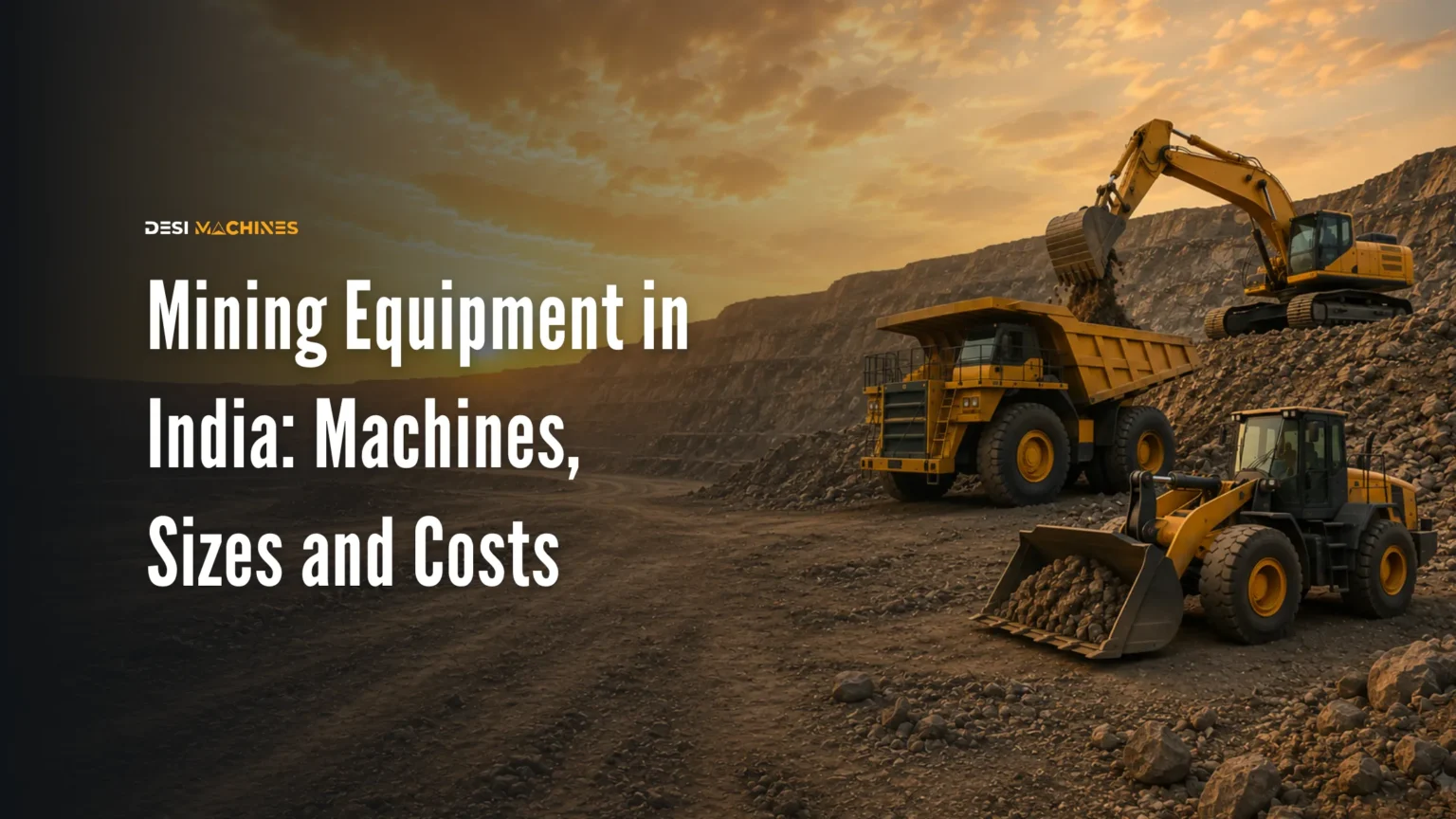
Mining equipment is the set of heavy machines used to strip, dig, load and move rock and mineral out of a mine. In India the core of that set is a large tracked excavator, a heavy dozer, a wheel loader, a motor grader for the haul roads, and haul trucks to carry the material away. Most of these are the same machine families used in construction, built heavier and fitted with thicker steel for a harder life.
The word covers two very different worlds. Surface mining is open-cast work: the ground is opened from the top, in benches, like a giant staircase. Underground mining goes in through a shaft or a tunnel and uses small, specialised machines that will not fit any construction fleet. Almost all Indian coal, iron ore, limestone and bauxite comes from surface mines, so this guide stays on surface work. That is where a contractor with earthmoving machines can actually find business. The guide to mining companies in India names who those buyers are, from Coal India and NMDC to the contract miners that hire most of the machines.
One thing to be clear about from the start. A mining machine is not simply a bigger construction machine. It is a machine chosen so that its bucket fills a truck in a set number of passes, hour after hour, for years. That single idea, matching the digger to the truck, decides most of what follows.
Which machines are used in mining in India?
Surface mining in India runs on five machine types, and each one has a job the others cannot do. The table below lists what each does and how many of that class are listed on DesiMachines as of August 2026.
| Machine | What it does on a mine | Listed on DesiMachines |
|---|---|---|
| Large excavator | Digs the face and loads trucks; the machine that sets the output of the whole pit | 50 machines above 50 ton |
| Dozer | Pushes overburden, builds and repairs benches, cleans up around the loading face | 41 dozers, 12 of them mining class |
| Wheel loader | Loads from stockpiles, feeds crushers, cleans spillage; faster than an excavator but needs firm ground | 54 machines |
| Motor grader | Cuts and maintains haul roads; a bad haul road costs more in truck tyres and fuel than the grader costs | 42 machines |
| Compactor | Compacts haul roads and embankments so they carry loaded trucks through the monsoon | 45 machines |
Two classes matter on a mine and are worth naming honestly: haul trucks (the rigid dumpers that carry material out of the pit) and drilling rigs (which drill the holes for blasting). Both are central to how a mine works, and neither is listed on DesiMachines. The range here covers excavation, loading, dozing, grading and compaction. If you are pricing a full mining fleet, plan the trucks and drills through a specialist supplier and use this guide for the digging and earthmoving side. Where those haul trucks are starting to go electric, our guide to electric dumpers and tippers in India sets out the payloads and battery sizes BEML and SANY have published so far.
Browse the current large mining excavators and the full range of dozers to see what is available right now.
How does work flow on an Indian mine site?
Work on a surface mine runs as a loop, and every machine in the loop has to keep pace with the one in front of it. Break the loop at any point and the whole pit slows down.
First the overburden, the soil and waste rock sitting on top of the mineral, is removed. Where it is soft, a dozer and an excavator strip it directly. Where it is hard rock, holes are drilled and blasted first, which breaks the rock into pieces the excavator can lift. The stripping ratio, the way overburden is measured and the machine chains used for this stage are covered in the guide to overburden removal.
Then the excavator sits at the face and loads. Each bucket goes into a haul truck, and the truck drives out along the haul road to the crusher or the stockpile. What happens inside that crusher, from the first break in a jaw to the finer work of a cone, is covered in our guide to jaw crusher vs cone crusher. While that happens, a dozer keeps the ground around the excavator clean and level so the machine can track and slew without settling into soft muck.
The haul road is the part most new contractors underestimate. A motor grader cuts it to a steady gradient (the slope of the road) and keeps the surface smooth, and a compactor presses it firm. On a rough haul road, loaded trucks slow down, burn more diesel and destroy tyres, and truck tyres on a mining machine are among the most expensive consumables on site. This is why the guide to road construction equipment is worth reading alongside this one: the road-building fleet and the mining support fleet are the same machines doing the same work.
Finally, as areas are worked out, dozers and excavators reshape the ground and put topsoil back. That reclamation work is a legal requirement on Indian mines and it is steady work for earthmoving contractors long after the digging has moved on.
What size excavator does a mine need?
Mining excavators start where construction excavators stop. The 50 machines listed above 50 ton run from an operating weight of about 49,400 kg (49.4 ton) on the Komatsu PC500LC-10R up to 825,000 kg (825 ton) on the Tata Hitachi EX 8000-6. Operating weight is what the machine weighs ready to work, with fuel and operator.
The spread in the other numbers is just as wide, as the current listings show:
| Specification | Smallest in the class | Largest in the class |
|---|---|---|
| Operating weight | 49,400 kg (49.4 ton) | 825,000 kg (825 ton) |
| Rated engine power | 320 HP (238.6 kW) | 4,000 HP (two 2,000 HP engines) |
| Bucket capacity | 1.65 m³ (1,650 litres) | 47.5 m³ (47,500 litres) |
Figures above are taken from the specification sheets published against these machines, current as of August 2026. The very largest of them are not realistic first purchases for an Indian contractor. A 47.5 m³ bucket belongs on a big captive coal or iron ore operation, not a contract job.
For most contractors taking mining work, the useful band sits at the bottom of this class: 50 to 80 ton. A machine of that size fills a normal Indian tipper in three or four passes, can still be moved between sites on a trailer, and has parts and operators available. Go much larger and you are committed to one site for years. If you are working out where your machine sits, the breakdown of excavator size classes from mini to mining sets out the whole ladder.
One number that matters more on a mine than anywhere else is ground bearing pressure, meaning how hard the tracks press on the ground. Overburden dumps and freshly worked ground are soft, and a machine with high ground pressure sinks. The guide to excavator ground pressure in kPa by size class explains how to read it.
What does a mining dozer do that a construction dozer cannot?
A mining dozer is a heavier, higher-powered dozer built to push large volumes of loose rock all day. The difference is not a badge. It shows in the weight and the blade. Of the 41 dozers listed, 12 are mining class, and they run from 35,830 kg (35.8 ton) on the Shantui SD32W to 113,700 kg (113.7 ton) on the Cat D11 in its Carrydozer form. Blade capacity across those 12 runs from 7.9 m³ on the BEML BD155 to 34.4 m³ on the Cat D11.
Compare that with the construction dozers on the same list, which start at about 9,040 kg (9 ton). A mining dozer is roughly four times the weight of a small construction dozer before you even look at the blade.
What that weight buys is traction, the grip between the tracks and the ground. Pushing broken rock uphill needs the machine to hold its footing under load, and a light dozer simply spins. Mining dozers also carry a ripper at the back, a heavy steel tooth that breaks up hard ground so the excavator can dig it without blasting.
If your work is site levelling, road formation and light stripping, a construction dozer is the right machine and far cheaper to run. Step up to mining class only when you are pushing blasted rock or working a face full time.
Ready to compare machines? See what is currently listed across mining dozers and excavators of every size, and talk to a dealer about what suits your site.
How much does mining equipment cost in India?
Prices for this class of machine are mostly quoted on request, and that is worth understanding rather than working around. Of the 50 large excavators listed above 50 ton, only six carry a published price; among the 12 mining dozers, only one does. The rest are configured and quoted per site, because bucket, undercarriage and boom options change the figure substantially.
If the site is your own pit rather than a contract, buy later than feels comfortable: the quarry lease and clearance sequence fixes the annual quantity you may remove, and that quantity is what sets machine size.
A stone quarry is a narrower job than a mine and runs a different machine mix, which quarry equipment in India sets out stage by stage.
Where a price is published, this is what the listings show:
| Machine | Class | Indicative price (as of Aug 2026) |
|---|---|---|
| BEML BD50 | Small dozer | ₹30 – 40 Lakh |
| LiuGong 965E HD | Large excavator | ₹1.25 – 1.35 Crore |
| SANY SY580C-10HD | Large excavator | ₹1.50 – 1.70 Crore |
| Shantui SD32W | Mining dozer | ₹1.80 – 2.20 Crore |
| Volvo EC750D | Large excavator | ₹3.5 – 4.0 Crore |
| Volvo EC950E | Large excavator | ₹4.5 – 5.0 Crore |
All figures are indicative, taken from our listings at the time of writing, and vary by variant, attachment and location. Where a machine shows no price, it is genuinely priced on request — ask for a written quotation against your bucket and undercarriage specification rather than a headline number.
Two cost points catch new buyers out. Large excavators and dozers are tracked machines, so they are not driven on the road and cannot be registered for it; getting one to site means a trailer, and that landed cost is real money on a long move. And the running cost of a mining machine is dominated by diesel, ground engaging tools and undercarriage wear, not by the purchase price. Work those out for your own site before signing anything — equipment finance options are easier to arrange when you can show the running numbers.
What should you check before buying a machine for mine work?
Mine work is harder on a machine than any construction job, and the checks that matter are different.
Parts and service within reach. A mining machine standing idle costs more per day than most contractors earn from it. Before the machine, check where the nearest service engineer and parts store actually are. A cheaper machine two states away from support is not cheaper.
Undercarriage condition and cost. On a tracked machine working rock, the undercarriage (tracks, rollers, idlers and sprockets) is the biggest single wear item. Ask what a full undercarriage replacement costs for the model you are considering, and factor it in.
Matching the truck. Pick the excavator around the trucks you will load. Three to five passes to fill a truck is the target. Fewer passes and the bucket is oversized for the truck; more and the truck waits, which wastes both machines.
Dust and cooling. Indian mines run hot and dusty. Check the air filtration and the cooling package, and ask about the service interval for filters in dusty conditions — it is usually shorter than the standard figure.
Operator availability. A large excavator needs an experienced operator, and a poor one will cost you in fuel, cycle times and machine damage. Budget for training, not just for wages.
Which machines does a new mining contractor actually need?
Most contractors do not start by buying a mining fleet. They start by taking a piece of work at a mine with machines they already own, and grow into it.
A realistic first step is a 20 to 30 ton excavator and a tipper or two, doing overburden removal, haul road work or reclamation on contract. That fleet is affordable, easy to move between jobs, and useful on ordinary construction work when the mining contract ends — which matters, because mining contracts do end.
The second step is usually a motor grader or a compactor, because haul road maintenance is steady, low-competition work that mine operators are usually happy to contract out.
Only when you have a long contract in hand does a 50 ton-plus excavator or a mining dozer make sense. Those machines earn well on a face, and sit idle expensively without one. If you want the wider picture of how machine families map to project types, the earthmoving equipment guide and the overview of excavators and how they are used are the natural next reads.
To check the machine for your mine work, choose quarry or mining in the finder and say whether the work is on contract or full-time.
Mining equipment in India: the short version
Surface mining in India runs on large excavators, heavy dozers, wheel loaders, motor graders and compactors, with haul trucks and drilling rigs completing the picture. The excavator sets the output of the pit, the dozer keeps the ground workable, and the grader and compactor keep the haul road fast. The haul road is where most avoidable cost hides.
Machines above 50 ton run from about 49 ton to 825 ton with buckets from 1.65 m³ to 47.5 m³, but the practical band for an Indian contractor is 50 to 80 ton. Most of this class is priced on request; where prices are published they run from roughly ₹1.25 Crore for a large excavator to ₹5 Crore at the top.
Looking for a machine? Compare current mining excavators, dozers, wheel loaders and motor graders, and get a written quotation against your own site conditions.
The working itself decides which of these machines you need: our guide to the types of mines in India explains how an open cast mine, an underground mine and a quarry differ, and which machine class belongs to each.
The mining application page keeps the machine classes, the models buyers ask about most, open tenders, the main companies and the latest news for this work in one place, rebuilt twice a day.
Prices, specifications and features are indicative, vary by variant, location and date, and should always be confirmed with the official OEM or authorised dealer before any purchase decision. DesiMachines is not liable for decisions taken on the basis of information that may have changed after publication.
Frequently Asked Questions (FAQ)
Surface mining in India runs on five main machine types: a large excavator to dig the face and load, a heavy dozer to push overburden and keep the ground workable, a wheel loader for stockpiles and crusher feed, a motor grader to cut and maintain haul roads, and a compactor to keep those roads firm. Haul trucks and drilling rigs complete the picture; neither is listed on DesiMachines, so plan those through a specialist supplier.
Size and build. Mining excavators start where construction machines stop. The 50 machines listed above 50 ton run from about 49,400 kg (49.4 ton) up to 825,000 kg (825 ton), with buckets from 1.65 m3 (1,650 litres) to 47.5 m3. They also carry heavier undercarriages and thicker structural steel, because working blasted rock all day wears a machine far faster than site work does.
Most are priced on request: only six of the 50 machines listed above 50 ton carry a published price, because bucket, boom and undercarriage options change the figure a lot. Where prices are published they run from around Rs 1.25 – 1.35 Crore for a LiuGong 965E HD up to Rs 4.5 – 5.0 Crore for a Volvo EC950E, indicative as of August 2026. Ask for a written quotation against your own specification.
A mining dozer pushes large volumes of blasted rock and overburden, builds and repairs benches, and keeps the ground around the excavator clean so it can work without settling into soft muck. Of the 41 dozers listed, 12 are mining class, running from 35,830 kg (35.8 ton) to 113,700 kg (113.7 ton), with blade capacity from 7.9 m3 to 34.4 m3. Most also carry a ripper to break hard ground without blasting.
Start with a 20 to 30 ton excavator and a tipper or two, doing overburden removal, haul road work or reclamation on contract. That fleet is affordable, moves easily between jobs and still earns on ordinary construction work when the mining contract ends. A motor grader or compactor is usually the sensible second machine, because haul road maintenance is steady work. Buy a 50 ton-plus machine only against a long contract.
Page Contributors
Compare large mining excavators and dozers, and get a written quotation for your site.
Machines by type
Not sure which machine? Try the machine finder →Disclaimer
Desi Machines is a platform where you can see and compare construction equipment. It showcases images, brochures, features, technical specifications, brand details & dealer information. All these are taken from respective brand websites, brochures, and other public resources. We do not claim ownership of these materials and strive to ensure their accuracy. However, the disparity may happen and we advise users to verify directly with respective brands and dealers. Desi Machines is not liable for any inaccuracies or reliance on the information provided. Use of this website is at your own discretion.
Tell us what you are looking for
Shared only with our team and the dealer or lender you ask for. We call you back; no spam.