Excavator
294 models
Excavator
294 models  Backhoe Loader
51 models
Backhoe Loader
51 models  Crane
68 models
Crane
68 models  Concrete Mixer
79 models
Concrete Mixer
79 models  Wheel Loader
54 models
Wheel Loader
54 models  Compactor / Roller
45 models
Compactor / Roller
45 models  Motor Grader
42 models
Motor Grader
42 models  Dozer
41 models
Dozer
41 models  Concrete Pump
66 models
Concrete Pump
66 models  Skid Steer Loader
11 models
Skid Steer Loader
11 models  Telehandler
13 models
Telehandler
13 models 


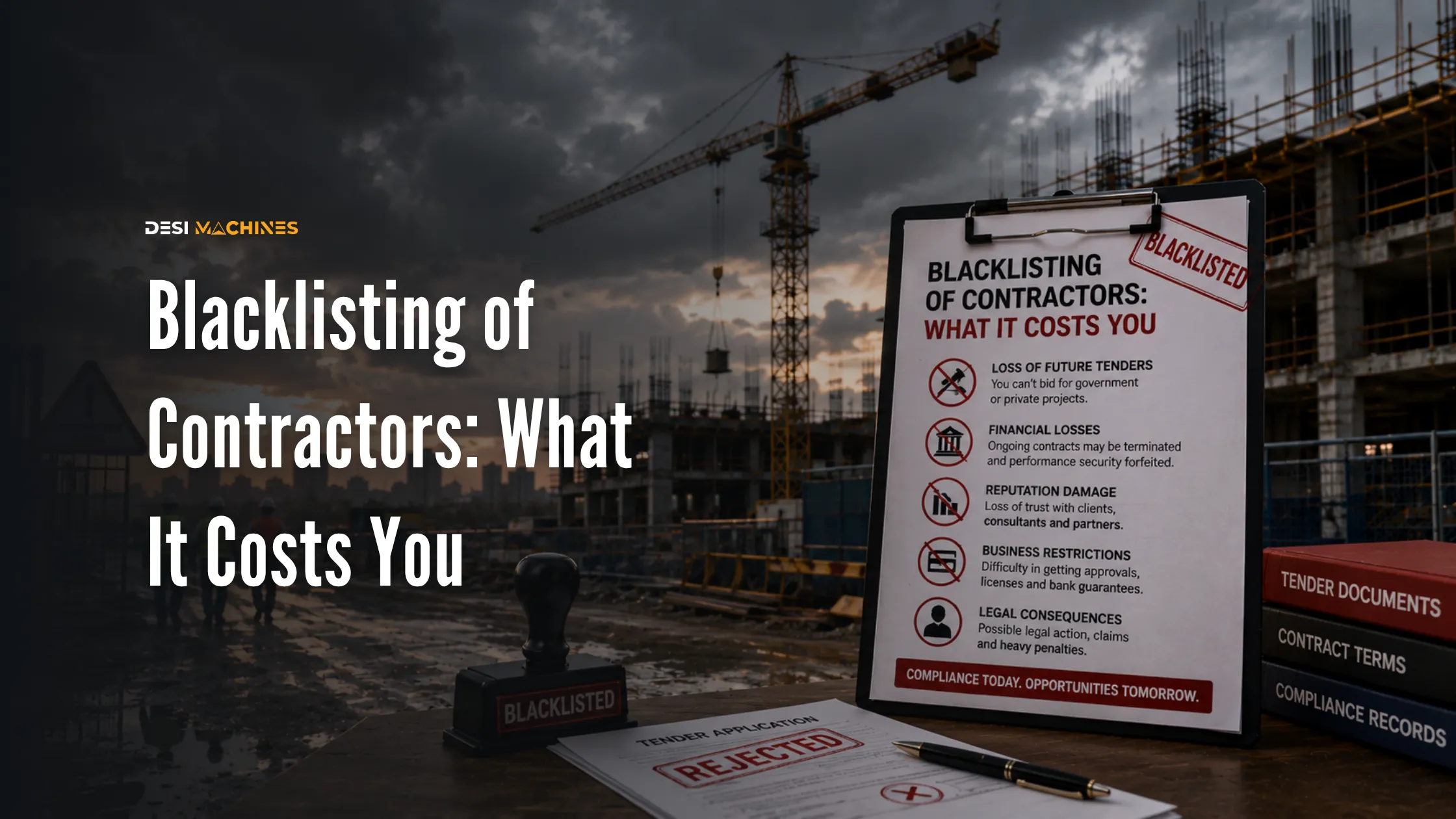
The blacklisting of contractors is a department’s decision to bar a firm from its tenders for a stated period. It is a separate consequence from losing the job: termination takes one contract, debarment takes the next several years of them. The usual triggers are abandonment after award, failure to execute after the acceptance letter, and false documents. The stage that decides the outcome is the show-cause notice — and the wording of the final order decides whether the damage is limited to one buyer or follows you into every tender declaration you sign.
Most owners think about a contract going wrong in terms of the money on that contract. The security gets forfeited, the final bill is short, and the job is written off as a bad year.
Debarment is a different order of problem. It does not touch the money already lost. It removes your ability to earn the money you were counting on next.
What the blacklisting of contractors actually does
A debarment order bars you from participating in tenders of the authority that passed it, for the period the order names. Everything else about your business stays intact — the machines, the staff, the registration — and none of it can be put to work with that buyer.
For a firm whose work comes mainly from one department or one state’s public works, that is close to a shutdown. The fleet still carries EMIs, and the front that was going to feed it is gone.
The second effect is the one owners underestimate. Tender forms almost always require a declaration that the bidder is not blacklisted or debarred by any government department or public sector undertaking. Once an order exists, every future bid needs a truthful answer to that question, and a bid that answers it falsely is in far worse trouble than a bid that discloses and explains.
What triggers it
The grounds are set out in the tender conditions and in each department’s own manual, so the list differs. Four appear almost everywhere.
| Trigger | What it looks like on site | How avoidable |
|---|---|---|
| Abandonment of work | Machines pulled off a live front and not returned; work stops without written notice | High |
| Failure to execute after award | Letter of acceptance issued, agreement not signed or security not furnished | High |
| False or forged documents | Borrowed experience certificates, altered turnover figures, a solvency letter that does not stand up | Entirely |
| Persistent poor performance | Repeated written warnings, quality rejections, deployment far below what was promised | Moderate |
The document cases deserve a separate warning. When a firm cannot clear an eligibility bar it sometimes borrows a completion certificate or dresses up a figure. That is treated as misrepresentation rather than as a site failure, and the response is usually harsher than anything a genuine delay would attract.
The honest route through an eligibility wall is the one built into the rules — the relaxations available to small enterprises, a joint venture where the tender permits it, or simply bidding within the capacity you can prove. Our note on the bid capacity formula covers how that ceiling is worked out, and the solvency certificate piece covers the document most often fudged.
The show-cause stage is the whole case
Departmental practice is to issue a show-cause notice before an order is passed. The notice should state the charge against you, and it gives a period — often short — for your reply. A reasoned order follows.
That reply is the stage where the matter is won or lost, and it is the stage owners most often treat casually. A notice arrives while three sites are running, somebody says the department is only posturing, and the period lapses.
Answer in writing, inside the period, and answer the charge that was actually made. If the charge is abandonment, the reply is the record of what stopped work — the front that was not handed over, the drawing awaited, the payment that stalled, the extension you applied for. If the charge is non-execution after award, the reply is the correspondence showing what you did and when.
This is the same contemporaneous file that decides a delay deduction. If you keep the record described in our piece on liquidated damages and extension of time, the reply mostly writes itself. If you did not keep it, no amount of argument at this stage substitutes for it.
Ask for what you are missing, too. If the notice refers to inspection reports or measurements you have not seen, request copies and record that you have asked.
Risk and cost: the money side of the same default
Debarment deals with your future eligibility. The risk and cost clause deals with the money on the contract that failed, and the two can arrive together.
Under a risk and cost provision the department gets the balance work executed through another agency and recovers the difference in cost from you. If the balance work is retendered in a dearer market, the gap can be larger than anything you saved by walking away, and it is recoverable from your dues, your retention and your performance bank guarantee.
So the decision to abandon a bad job is rarely the clean exit it looks like at the time. Before pulling machines off a front, price the exit properly: forfeited security, the risk and cost exposure, and the possibility that the next three years of tenders with that buyer are gone.
Read the order, not the rumour
If an order is passed, get a certified copy and read three things in it.
Who it covers. The firm alone, or partners and sister concerns as well? Scope is decided by the wording, and it determines whether a related entity can still bid.
How long it runs, and from which date — the date of the order or the date of the default. Diarise the expiry.
What it covers. Tenders of that authority only, or something wider. This is the fact you will be declaring in every bid until it expires, so you need it exactly right rather than approximately right.
An order that is already passed also has a remedy path — a departmental appeal or representation, within whatever period the order or the manual allows. Get advice quickly rather than after the period runs out, because these windows are short.
Answer the blacklisting notice before it becomes an order
Blacklisting is the one contractual consequence that outlives the contract. It is triggered by a small number of predictable defaults, it is preceded by a notice that most firms answer too late or not at all, and its reach is decided by a few lines of wording in the final order.
Keep the site record while the trouble is happening, answer every notice inside its period in writing, and never solve an eligibility problem with a borrowed document. If you are choosing which work to chase, our guide to bidding for government construction tenders covers what to check before committing, and current work is listed on the tender opportunities page.
Rates, schemes, specifications and prices change — confirm current terms with the OEM, dealer, bank or insurer before deciding. Debarment grounds, procedure and appeal routes are set by each department’s own rules and by your tender conditions; confirm them against the documents that apply to you, and take professional advice on any notice you receive.