Excavator
294 models
Excavator
294 models  Backhoe Loader
51 models
Backhoe Loader
51 models  Crane
68 models
Crane
68 models  Concrete Mixer
79 models
Concrete Mixer
79 models  Wheel Loader
54 models
Wheel Loader
54 models  Compactor / Roller
45 models
Compactor / Roller
45 models  Motor Grader
42 models
Motor Grader
42 models  Dozer
41 models
Dozer
41 models  Concrete Pump
66 models
Concrete Pump
66 models  Skid Steer Loader
11 models
Skid Steer Loader
11 models  Telehandler
13 models
Telehandler
13 models 


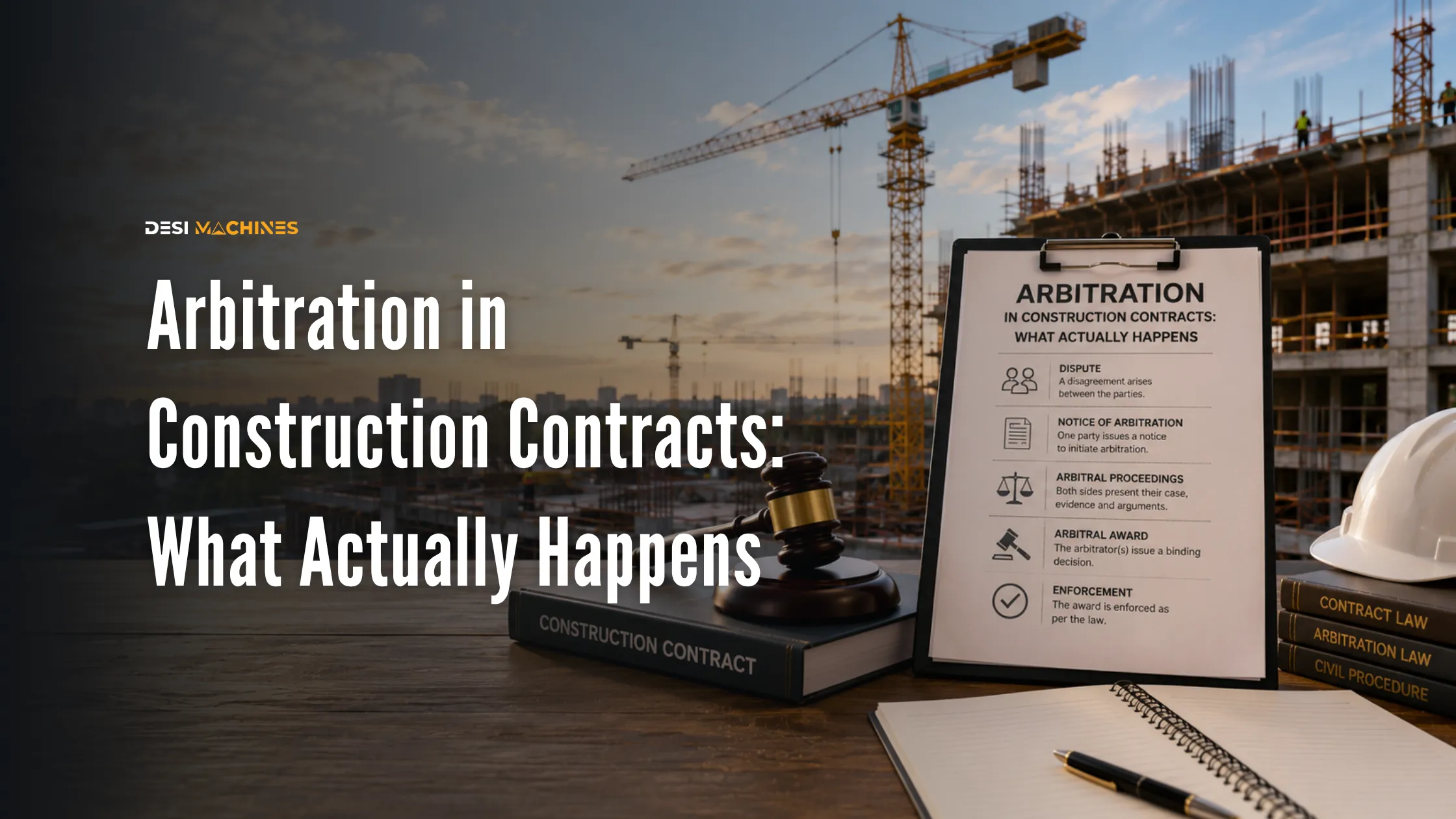
Arbitration in construction contracts is not something you opt into when a dispute starts — the clause is already in the contract you signed. What most contractors do not know is that Section 12(5) of the Arbitration and Conciliation Act, 1996 makes the other side’s own officer ineligible to sit as arbitrator, notwithstanding any prior agreement, and that ineligibility can only be waived by an express written agreement made after the dispute arises. Proceedings start when your request reaches the respondent, and the award is due within twelve months of completed pleadings.
Every substantial works contract in India has a dispute clause, and almost nobody reads it at signing. It becomes interesting only when a final bill has been sitting unpaid for eight months, the department has stopped answering letters, and somebody says the word arbitration as though it were a threat.
It is not a threat. It is a process with its own rules, its own clock, and one provision that has changed the balance of these disputes more than any other.
The clause you already signed
Section 7 of the Act defines an arbitration agreement as an agreement by the parties to submit to arbitration all or certain disputes which have arisen or which may arise between them in respect of a defined legal relationship, whether contractual or not.
Two practical points come out of that definition. It may be a clause in the contract or a separate agreement — you do not need a fresh document once a dispute starts. And it must be in writing, which the section satisfies through a document signed by the parties, or an exchange of letters, telex, telegrams or other means of telecommunication.
So the first thing to do is not to write to anyone. It is to open the contract and read the clause. It will tell you how many arbitrators, who appoints them, where the arbitration sits, and what notice is required — and those terms bind you unless the Act overrides them.
Who is allowed to sit as arbitrator
This is the part worth reading twice, because it is where government and large-employer contracts have historically been most one-sided.
The old pattern is familiar to anyone who has worked for a department: the contract names the Chief Engineer, or a Superintending Engineer, or “an officer nominated by the Employer” as the arbitrator. You are then arguing your claim in front of an employee of the organisation you are claiming against.
Section 12(5) addresses that directly. It provides that notwithstanding any prior agreement to the contrary, any person whose relationship with the parties, or with counsel, or with the subject matter of the dispute falls within any of the categories in the Seventh Schedule is ineligible to be appointed as an arbitrator.
The proviso is as important as the rule. Parties may waive the sub-section — but only subsequent to disputes having arisen between them, and only by an express agreement in writing. A clause signed years earlier, at tender stage, is precisely the prior agreement the section overrides.
What that means in practice: if you are asked to accept the employer’s own officer, you are being asked to waive a statutory protection, and the waiver has to be an express, separate, post-dispute writing. It is not something you concede by attending a meeting.
Section 13 sets the procedure for challenging an arbitrator where you have grounds, with a fifteen-day window from becoming aware of the constitution of the tribunal or of the circumstances giving rise to the challenge. Fifteen days is short. Read the appointment letter the day it arrives.
How many arbitrators, and who picks them
The parties are free to determine the number, with one hard limit: it shall not be an even number. If the contract determines nothing, the tribunal is a sole arbitrator.
Where the contract provides for three, the default mechanism in Section 11 is that each party appoints one arbitrator, and those two appoint the third, who acts as the presiding arbitrator. A person of any nationality may be an arbitrator unless the parties agree otherwise.
Section 11 also gives the Supreme Court and the High Courts the power to designate arbitral institutions from time to time, which is the route through which appointments are increasingly made when a party will not co-operate.
| Situation | What the Act provides |
|---|---|
| Contract is silent on number | Sole arbitrator |
| Contract names an even number | Not permitted — the number shall not be even |
| Three arbitrators | One each, and those two appoint the presiding arbitrator |
| Contract names the employer’s own officer | Ineligible under Section 12(5) unless expressly waived in writing after the dispute arose |
When the clock starts, and how long it runs
Section 21 is a one-line section that decides a surprising number of arguments. Unless the parties agree otherwise, arbitral proceedings in respect of a particular dispute commence on the date on which a request for that dispute to be referred to arbitration is received by the respondent.
Received, not sent. If you are anywhere near a limitation question, the manner in which you serve that request — and your proof of its receipt — is doing real work. Send it in a way that produces a record.
Note also the words that dispute. The commencement date attaches to the disputes you actually referred. A request that gestures vaguely at “all issues under the contract” is a weaker instrument than one that lists the claims.
On duration, Section 29A requires that in matters other than international commercial arbitration, the award shall be made within twelve months from the date of completion of pleadings. The clock runs from completed pleadings, not from your notice, so the months spent constituting the tribunal and exchanging statements sit outside it.
Interest, and why it changes the arithmetic
Contractors often assume arbitration recovers the bill and nothing more. Section 31(7) says otherwise.
Unless the parties have agreed otherwise, where an award is for the payment of money, the tribunal may include interest at such rate as it deems reasonable, on the whole or part of the money, for the whole or part of the period between the date the cause of action arose and the date of the award.
And then there is the part that concentrates minds after the award. A sum directed to be paid by an arbitral award carries interest at two per cent higher than the current rate of interest prevalent on the date of the award, from the date of the award to the date of payment, unless the award directs otherwise.
That post-award rate is what makes sitting on an award expensive for the losing side. Where your claim is an unpaid running bill, this is the same commercial logic that sits behind the statutory interest route in recovering payment delayed on government work — the cost of delay is put on the party causing it.
What you cannot do afterwards
There is no general appeal on the merits. Section 34 provides that recourse to a court against an award may be made only by an application for setting it aside, and only on the grounds listed there — a party under some incapacity, an invalid arbitration agreement, a party not given proper notice of the appointment or the proceedings or otherwise unable to present its case, an award dealing with disputes outside the terms of the submission, and the other limited grounds in the section.
Since the 2019 amendment, the applicant must establish those grounds on the basis of the record of the arbitral tribunal. You cannot build a new case in court out of material the tribunal never saw.
The practical consequence runs backwards through the whole process: the arbitration is your only real opportunity to put the evidence in. Measurement records, the extension of time correspondence, the joint measurement sheets nobody signed — these decide the award, and the award is close to final. It is the same discipline that decides a delay deduction, which we set out in liquidated damages in construction contracts.
Protecting the position while it runs
Arbitration takes time, and in that time a bank guarantee can be invoked or money can move.
Section 9 allows a party to apply to a court for an interim measure of protection — before or during the arbitral proceedings, or after the award is made but before it is enforced. That is the provision to know about if an employer is threatening to encash security while the underlying dispute is precisely what is being arbitrated. What that security is and how it behaves is covered in the performance bank guarantee.
The other exposure to watch is reputational rather than financial. Disputes and debarment travel together on public work, and the consequences of the second are heavier than the first — see blacklisting of contractors.
Is arbitration in construction contracts the right route at all
Not always. If you are a micro or small enterprise and the dispute is simply an unpaid bill from a buyer, the statutory facilitation council route is usually faster and cheaper than a full arbitration under your contract clause, and it has its own timetable. That comparison is worked through in contractor payment delay on government work.
Arbitration earns its cost where the dispute is about more than a number — extension of time, deviation, rejected items, termination — and where the sums justify a proceeding that will take the better part of a year and require you to be represented properly. Check first whether your contract sends the dispute to a dispute resolution board before arbitration; on many NHAI and CPWD-pattern contracts that step comes first and has its own deadlines.
Read the arbitration clause before you sign the contract
Read the clause before you sign, not when you are angry. Check what it says about the number of arbitrators and who appoints them, and remember that a name written into that clause does not survive Section 12(5) if the person is in the Seventh Schedule.
When it does start, treat two dates as fixed points: the day your request is received, and the day pleadings complete. And put every document in, because Section 34 will not let you add them later.
Disputes are also a cash-flow event, and the machines still have EMIs running through them. Keep the next job moving while this one is argued — scan the live government construction and equipment tenders and bid on the ones your capacity supports.
Rates, schemes, specifications and prices change — confirm current terms with the OEM, dealer, bank or insurer before deciding. The position here is summarised from the Arbitration and Conciliation Act, 1996 as it stood at the time of writing and is general information, not legal advice; your own clause governs, and a contractor facing a live dispute should take advice on it.